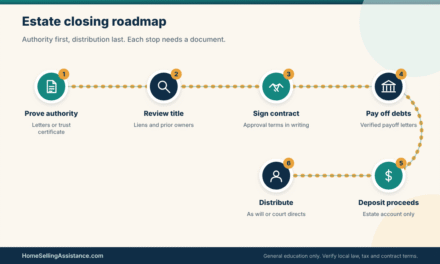
Selling inherited house property is a different job from an ordinary home sale, because before anyone talks about price or staging you have to settle who actually owns the place, who is allowed to sign, and what the estate still owes. Those three questions sit underneath everything else, and when they are skipped the sale tends to stall at the worst possible moment, usually right after a buyer has been found.
Most people come to this task while they are also grieving, juggling work, and sorting through a lifetime of someone else’s belongings. Nobody trained you for it. The house may be three states away, the paperwork may be in a shoebox, and two or three relatives may have strong, different ideas about what should happen next. That is a normal starting point, not a sign that you are doing anything wrong.
This guide is the cornerstone of our inherited-property library. It stays at roadmap level on purpose: you will see how ownership and authority work in general terms, how probate affects timing, why the tax basis of an inherited home matters so much, how condition and cleanout shape the sale, and how a group of heirs can reach a decision without wrecking the relationship. Each section points to a deeper guide when you are ready for the details.
A word about what this article is not. It is general education, and the rules for inherited property change from state to state and sometimes from county to county. Where a point depends on local law, we say so and tell you how to check it. Nothing here replaces a probate attorney, a tax professional or a title company looking at your actual documents. Small records like this make selling inherited house decisions far easier to defend later. That habit pays off again and again when selling inherited house property.
Key takeaways
- Authority comes before price. A buyer and a title company will want proof that the person signing the deed has the legal power to do so, and that proof often comes from a court or from a trust document.
- Probate shapes the calendar, not the whole decision. Whether you can list early, sign a contract early or close only after court steps depends on your state, the will, and how the home was titled.
- Basis can change the tax picture. In general, inherited property receives a new tax basis tied to its value at the date of death, which is why a proper valuation record is worth getting.
- Condition and cleanout are decisions, not chores. Selling as is, repairing lightly, or clearing the house first each trade cash, time and price in a different way.
- Heirs need a process. Agreeing early on who decides, who pays carrying costs and how proceeds are split prevents most of the conflict that derails these sales.
- Verify locally and write it down. Probate rules, disclosure duties and closing steps vary, so confirm with the court, an attorney and a title company before you commit.
Start with the decision you are really making when selling inherited house property
The phrase “I inherited a house” covers a surprising range of situations. You might be the sole heir named in a clear will, one of five children who share equally, the executor who has never seen the property, or a beneficiary of a trust that already owns the home. Each position carries different powers and different duties, so the first step is to name your own role honestly before you call a single agent.
Define your role, your goal and the limits on selling inherited house assets
Start with a plain sentence you can say out loud: “I am the ___ of this estate, and I want to ___ by ___.” Your role might be executor, administrator, trustee, co-heir, sole heir or beneficiary with a life-estate arrangement. Your goal might be a fast, clean exit, the highest realistic price, keeping the home in the family for a while, or simply stopping the monthly bleed of taxes, utilities and insurance on an empty house.
Then list the limits. A limit is anything that restricts what you can do or when you can do it: a court process that has not finished, a mortgage that still has a balance, a co-heir who has not responded to your calls, a house with a leaking roof, or a family member who is still living in it. Writing these down turns a vague sense of overwhelm into a short list of problems that each have an owner and a next step.
Seasoned estate attorneys often say that most inherited-home problems are communication problems wearing legal costumes. A clear goal statement helps because it gives every other person in the process, including agents, attorneys and your own relatives, something specific to react to. Vague goals invite vague advice, and vague advice is how people end up paying for work that does not serve them. Families who write things down tend to find that selling inherited house projects feel less chaotic. None of this is exotic, but it is where selling inherited house plans most often go wrong.
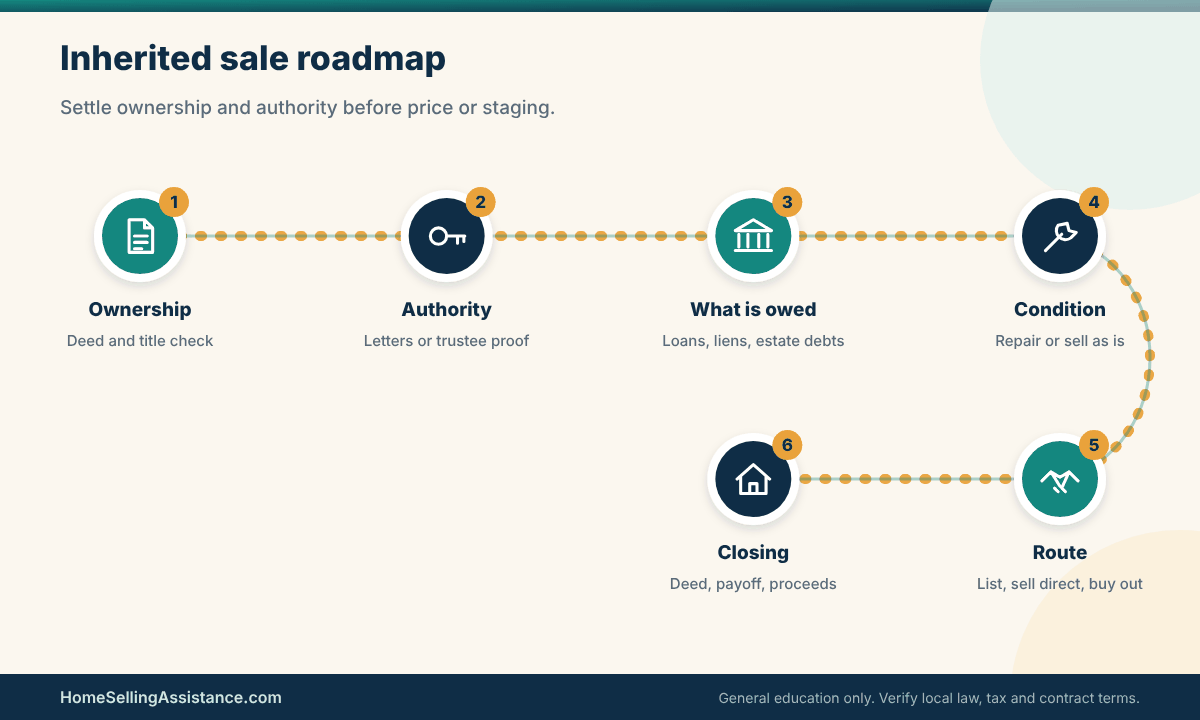
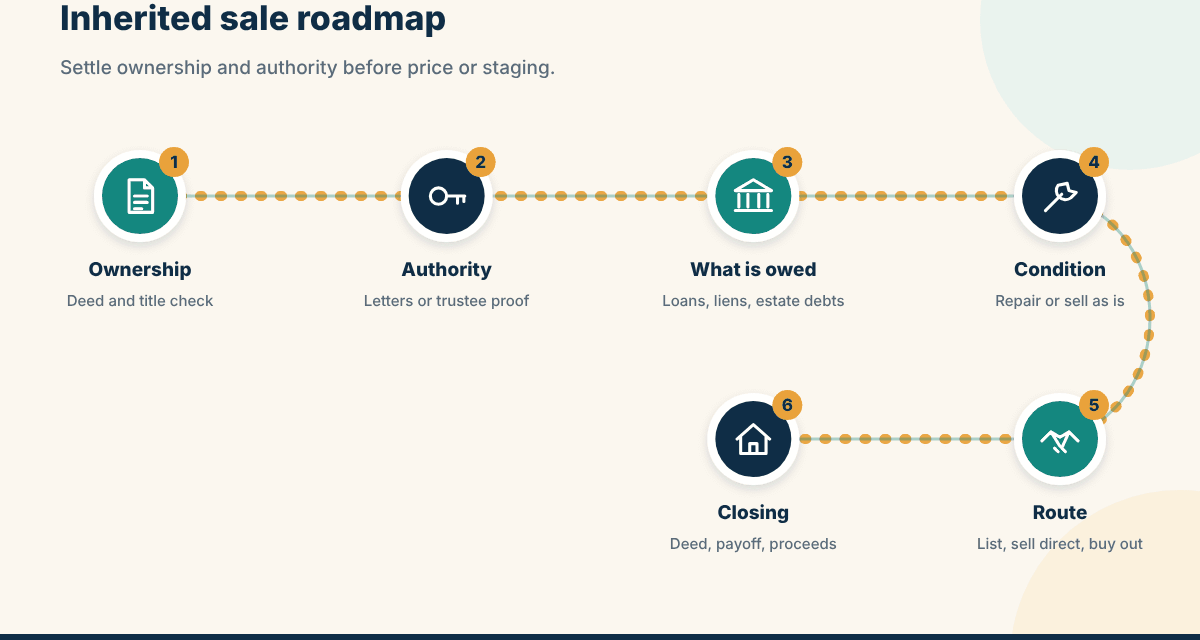
The illustration above shows the usual path in order: confirm who owns the home, confirm who has authority, learn what is owed, decide on condition, choose a selling route, and then close. You will see this order repeated throughout the guide. It matters because each step depends on the one before it, and doing them out of sequence is the most common source of wasted money. If you remember one idea about selling inherited house work, let it be to verify before you promise. Keep the next step small, because selling inherited house tasks are easier to finish in pieces.
Evidence to gather first: proof of who owns what
Before anything else, collect the documents that show how the property was held and how it passed. That usually means the recorded deed, the death certificate, the will if there is one, any trust documents, and any court papers that have already been filed. Ask the county recorder or the title company for a copy of the current deed if the family cannot find one; recorded deeds are generally public records you can obtain for a small fee.
Also look for the quiet details that change the picture. Was the house titled in one name or two? Was there a transfer-on-death or beneficiary deed, where your state allows one? Did the decedent place the home in a living trust years ago? A deed that names two owners with survivorship rights, for example, may mean the house never became part of the probate estate at all. Do not guess; read the deed and, if it is unclear, have an attorney read it.
Finally, gather the money documents: the latest mortgage or home-equity statement, property tax bills, homeowner’s insurance declarations, utility accounts, and any HOA statements. These tell you what is owed and what is accruing every month while the home sits. Put everything in one folder, paper or digital, and keep a running list of what you still need. That folder becomes the backbone of every conversation with professionals. Patience here is not wasted time; it is part of selling inherited house work done carefully. This is also why selling inherited house timelines vary so widely from one family to the next.
A scenario, an exception, and your next step
Picture a daughter named Maria who learns her father’s house is “hers” because he told her so. She calls an agent, who is happy to list it. Then the title company discovers the house was deeded to Maria’s father and his late wife jointly decades ago, and no one ever filed the paperwork that cleared the wife’s name. The listing is not ruined, but the contract cannot close until that gap is repaired.
The exception is a home held in a funded living trust, where the trustee may be able to sell with far less court involvement. Even then, the trustee needs the trust document and often a certification of trust for the title company. Maria’s next step, in this example, would be to order a title search or ask a title company for a preliminary report so that surprises show up before a buyer is involved.
That small habit, finding the surprise first, is worth repeating. A title report is not a legal opinion about your case, but it is a practical map of what is recorded against the property: liens, old mortgages that were paid but never released, judgments, easements and the names on the chain of title. Our deeper article on whether you can sell an inherited house before probate is finished shows how that map affects timing.
A short primer on probate helps here, because it explains so much of the timing. Probate is the court-supervised process of confirming a will if there is one, naming a personal representative, identifying debts and heirs, and passing assets on. Not every home goes through it. Selling inherited house property that sits in a living trust, or that passed by survivorship or a beneficiary deed, may involve little or no court time, while a house held in the decedent’s sole name often does.
Even where probate is needed, it is not one fixed length. Some states offer streamlined procedures for smaller estates, others make the process more formal, and county courts differ in how quickly they schedule hearings. For selling inherited house assets, the practical lesson is to ask the court clerk or an attorney what the local timeline looks like, instead of relying on what a neighbor remembers from a relative’s estate ten years ago.
Probate also has a creditor period in many states, during which people and companies owed money by the decedent can file claims. A personal representative who moves too quickly can end up responsible for unpaid obligations. This is one reason that selling inherited house property is rarely just a real estate question. The estate attorney’s view of claims, taxes and distribution timing can matter as much as the buyer’s offer.
There is a related choice about who handles the work. Some families hire a probate attorney to manage everything, while others handle routine steps themselves and call a lawyer for specific questions. Neither approach is wrong. If the estate is simple, the heirs agree and the title is clean, limited help may be enough. If there is a contested will, a missing heir or a tangled title, full representation is usually money well spent. Browse our inherited homes and probate category for more.
Map the realistic selling paths before you pick one
Once you know your role and your limits, the question becomes how to sell. For an inherited property the realistic paths are fewer than people expect, and each has a different relationship to time, price, effort and risk. Think of them as four lanes on the same road rather than four separate destinations. Ask the question out loud, because selling inherited house surprises are cheaper to find early. Professionals can only help with what they can see, so share the full picture when selling inherited house property.
Lane one is a traditional listing with a licensed agent, usually after any cleanout and light preparation. Lane two is a direct sale to an investor or cash buyer, often as is, which can shorten the timeline and reduce your workload at the cost of a lower price in many cases. Lane three is a sale to one of the heirs or a buyout among them, which can keep the property in the family and avoid agent fees but still needs a fair valuation. Lane four is a hybrid in which you do limited repairs or staging and then list.
There is also a fifth option that people avoid mentioning: keeping the house for a period, whether to rent it, hold it until the market feels better, or let an heir live there. That path has real merit in some families, but it turns you into an owner with ongoing costs and responsibilities, so treat it as a decision with its own budget rather than a way of postponing a choice. For more on comparing buyer types, see our guide to a cash offer for a house.
Evidence to gather first: real comparisons, not general claims
Do not accept a general claim about what any path “usually” nets you. Ask for specifics. From an agent, request a written comparative market analysis with recent sales of similar homes in as-is condition, along with the proposed compensation terms in writing. From a cash buyer, ask for the offer, the proof of funds, the closing timeline, and who pays which closing costs. Lay the numbers side by side, using the same assumptions for both.
A fair comparison includes the costs that are easy to forget: carrying costs while the house sits, cleanout and repair expenses you would pay in one lane but not another, title and recording charges, and any estate administration expenses that run on a clock. Our guide on how to price a house to sell explains how to read comparable sales so you are not relying on a single opinion.
Expect some friction at this point; it is common in selling inherited house situations of every size. That single check can save weeks when you are selling inherited house property with several owners.
If you do receive a quick investor offer, treat it as one data point. The offer may be reasonable for the condition and timeline, or it may be far below what the property would bring on the open market. You cannot know which without a second opinion on value, and that second opinion should come from someone who does not stand to buy the house. This is the kind of detail that separates a calm sale from a stressful one when selling inherited house assets.
Write the answer in your folder, since selling inherited house questions tend to come back later.
A scenario, an exception, and your next step
Consider two brothers, Daniel and Owen, who inherit their mother’s home equally. Daniel lives nearby and wants to keep it as a rental; Owen lives overseas and wants his share in cash. A traditional sale would satisfy Owen but end Daniel’s plan. A buyout, where Daniel pays Owen for his half, could satisfy both if Daniel can finance it and the two agree on a value. Many heirs only learn this after a first offer, which is a late moment for selling inherited house choices. Treat it as a checkpoint rather than a hurdle while selling inherited house property.
The exception is that a buyout needs a trustworthy valuation and, usually, a lender willing to finance a house that is still part of an estate or is held jointly. If those pieces are not in place, the brothers may fall back to a listing. Their next step would be to order an independent appraisal or broker opinion, agree in writing to use it, and only then talk about terms. Our article on multiple heirs selling an inherited house covers that process in detail.
Quick scenario
A sole heir inherits a house in poor repair and receives three offers in the first week: one full-price offer contingent on the buyer selling their own home, one lower cash offer closing in twenty days, and one mid-range offer that wants a repair credit. None of these is automatically right. The decision depends on whether the heir needs speed, how long the court process still has to run, and how much risk the heir can tolerate if a contingent buyer falls through.
Heirs sometimes assume that being related to one another means they will naturally see the sale the same way. Experience says otherwise. One person wants the money for a down payment, another wants to keep the childhood home, and a third is simply exhausted and wants the whole thing finished. Selling inherited house property puts those differences on the table, and a family that talks about them early usually decides faster than one that avoids the subject.
A useful exercise is to have each heir write down, privately, the outcome they want, the outcome they could accept, and the outcome they would fight. Then compare the lists. You will often find that the acceptable zones overlap more than the first conversations suggested. When they do not, you have learned something important before spending money on a listing, and that is a better time to learn it than the week before closing.
Fairness is not always the same as equal, and the family should decide what fairness means before the house is sold. If one sibling provided years of unpaid care, if another paid taxes out of pocket, or if one heir lived in the home rent-free, the group may want to account for it. Whether the law lets them is a question for the attorney. Whether they want to is a question only the family can answer, and it is easier to answer calmly before a check exists.
Put the agreement into writing, even if it is informal. A one-page summary that states who decides, how costs are shared and how proceeds will be divided gives everyone the same reference point. Attorneys can turn it into something more formal if needed. The point is to avoid a situation in which each heir remembers a slightly different verbal promise, which is how loving families end up in court over a house.
What changes price, time, risk and net proceeds in an inherited sale
Every sale moves four dials: how much the house sells for, how long it takes, how much can go wrong, and how much of the money reaches the people entitled to it. Inherited homes add a fifth pressure, which is that the person making the decisions is frequently not the person who lived there, so condition and history are less certain. The next few sections explain what pushes each dial. Once you have this settled, selling inherited house tasks stop feeling like a pile of unknowns.
Market, condition, financing and buyer variables that move the dials
Local market conditions set the frame. In a market where well-prepared homes draw several offers, an as-is estate property may still sell quickly, but the discount buyers apply for condition will be visible. In a slower market, the same property can sit while carrying costs mount. You cannot control the market, but you can read it by looking at how long comparable homes took to sell and how far the final prices landed from the asking prices.
Condition is the variable you can influence the most. Deferred maintenance is common in homes owned by older residents, not because anyone was careless but because repairs get harder to manage with age. Roofs, water heaters, electrical panels, old windows and HVAC systems are typical items that buyers and inspectors flag. Our article on selling an inherited house as is versus repairing it first offers a framework for deciding which repairs earn their cost.
Financing and buyer type change the risk. A buyer with a mortgage needs an appraisal, an inspection and often a loan underwriter’s approval, and each of those can reopen price or timing. A cash buyer removes the financing step but not the title step. An investor may ask for a long inspection period or for the right to assign the contract to someone else, which deserves a careful read before you sign.
Evidence to gather first: numbers and records that anchor the discussion
Gather the facts that let you price the property and judge offers. That includes recent comparable sales within a reasonable distance, the age and condition of the major systems, a list of known defects, any open permits or unpermitted work, and the property tax assessment. If you can, walk the home with a licensed home inspector before listing. A pre-listing inspection costs money, but it replaces guesses with a list, and a list can be priced.
If the home was built before 1978, federal rules require sellers to disclose known lead-based paint hazards and give buyers a pamphlet and an opportunity to test; the EPA explains those duties on its real estate disclosure page. State disclosure rules vary, and some states treat estate sellers differently from ordinary sellers, so check the rules for your state with a real estate attorney or the state real estate commission. Rules differ by state, so confirm locally before selling inherited house property on any assumption.
The goal is a decision you can explain to every heir, because selling inherited house outcomes get reviewed.
Disclosure matters even when you never lived in the house. In many places, a personal representative who has no first-hand knowledge can still be required to share what is known, or to use a modified form that says the seller has no knowledge. The wording and the legal effect differ by state. Our guide to seller disclosure requirements explains the general logic and where to look up your own rules. A little structure goes a long way when selling inherited house property from a distance. Do not let urgency from a buyer rush this step when selling inherited house property.
A scenario, an exception, and your next step
Imagine a three-bedroom house with an original 1970s furnace, a roof near the end of its life, and clean, ordinary interiors. The family expects a normal price. Buyers’ inspectors, however, flag the roof and furnace, and each buyer asks for a credit. In this example, the heirs end up giving credits that exceed what a modest repair before listing would have cost, because buyers tend to price repairs with a cushion for uncertainty.
The exception is a house so far gone that repairs would cost more than the value they add, in which case selling as is to a buyer who plans renovations can be the cleaner path. The next step in either situation is to get two contractor estimates in writing, so that the decision to repair or not repair is based on quotes rather than anxiety. Every heir should hear the same information, which keeps selling inherited house conversations honest. It is a modest step, yet it shapes much of what follows in selling inherited house work.
Timing deserves a closer look, because the best moment to sell is a mix of the market and the estate. Seasonal patterns exist in many places, with spring often busier than winter, but they vary by region and by year, and they rarely matter as much as the readiness of the house and the clarity of the title. Selling inherited house property in a quiet season with a clean file can beat a busy season with an unresolved court issue.
Occupancy changes the picture too. If a relative still lives in the home, you need to know whether that person has a legal right to stay, whether they pay rent and what notice is required to leave. If there is a tenant, the lease generally continues after the owner’s death, and landlord-tenant rules in your state apply. Selling inherited house property that is occupied calls for patience and, often, an attorney’s help with notices and timing.
Be careful with promises made to occupants. A heir who says “you can stay as long as you need” has not changed the legal position, but may have created a problem if the group later disagrees. Put any agreement about occupancy, rent, utilities and move-out date in writing and have every owner or the personal representative sign it. Clear expectations protect both the occupant and the estate. That is the practical heart of selling inherited house planning: facts first, then choices. Think of it as insurance for the rest of the process of selling inherited house property.
Finally, think about the buyer’s point of view. Buyers of estate homes tend to be a mix of families who see potential, investors who see a project, and neighbors who have watched the house for years. Each reads the same listing differently. A short note on the sale that explains the estate context, without drama, can reduce questions about delays and help buyers understand why a seller may need a flexible closing date or a court step.
Costs, tax rules, logistics and what the heirs actually keep when selling inherited house property
People often ask what they will “walk away with,” and the honest answer begins with a list of everything that stands between the sale price and the heirs’ bank accounts. On an inherited sale that list is longer than usual, because it mixes ordinary closing costs with estate costs: court fees, attorney fees, the executor’s expenses, last bills of the decedent, and carrying costs for the months the home remains in the estate.
Start with the ordinary pieces. A sale normally involves a payoff of any mortgage or lien, agent compensation if an agent is used (which is negotiable and must be written down), title and escrow charges, transfer taxes where they apply, prorated property taxes and any HOA balance. Our guide to seller closing costs breaks these into categories so you can ask for a written estimate instead of a single rough number.
Then add the estate pieces. Some of these are paid out of the estate’s funds before proceeds are distributed, which means the amount each heir receives depends on what else the estate owes. If the estate owes more than it holds, state law sets an order in which creditors are paid, and an executor who distributes too early can face personal responsibility. That is one reason attorneys urge executors not to hand out money until the estate’s obligations are understood.
The picture below shows how a sale price shrinks on its way to the heirs. The amounts shown there are structure only, not a forecast. Real figures depend on your contract, the payoff on any loan, the estate’s debts and the local cost of title and recording. People are often surprised by how much this matters in selling inherited house cases. Revisit this point whenever the facts change, since selling inherited house plans are rarely static.
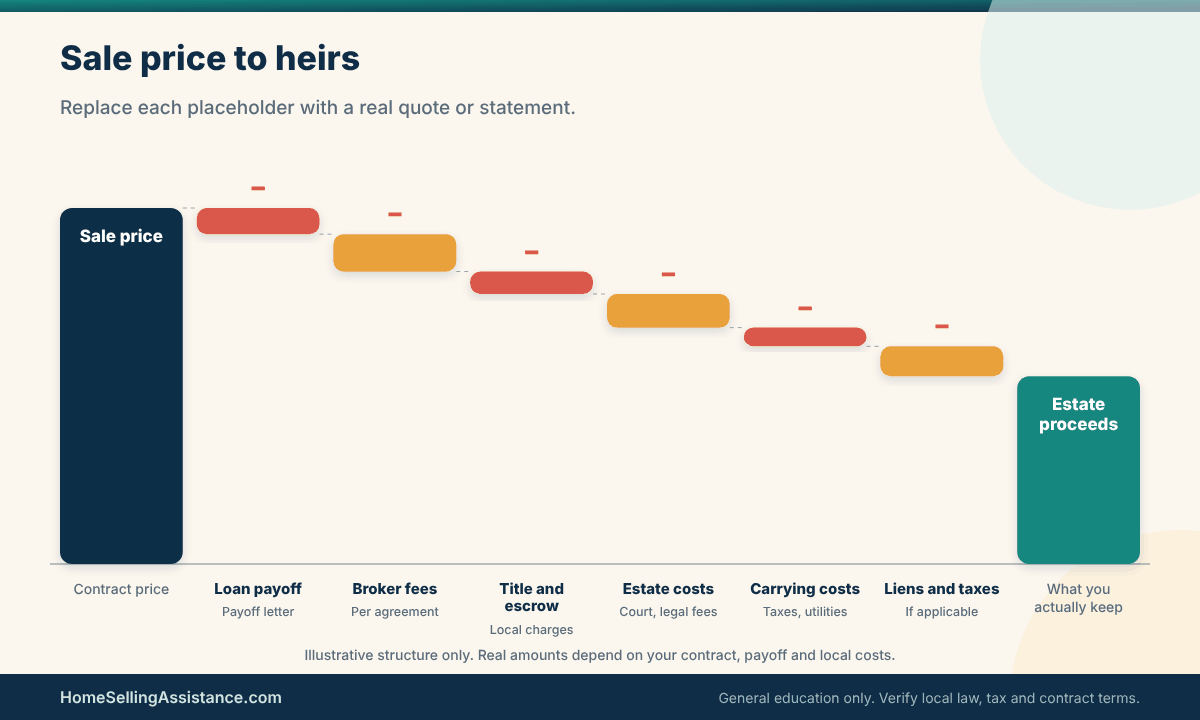
Use the waterfall as a worksheet. Write your estimated sale price at the top, then replace each placeholder with an actual quote or statement: a payoff letter, a title company estimate, a written commission agreement, a tax bill, and an attorney’s fee estimate. Anything you cannot yet quote, mark as unknown rather than guessing. An honest column of unknowns is more useful than a precise-looking number that is wrong. It also gives your attorney and agent a shared starting point for selling inherited house questions. With this in place, the next stage of selling inherited house property gets simpler.
Source, calculation and document evidence: basis, holding period and what the IRS publishes
The most valuable tax concept for heirs is basis. In general terms, property you inherit receives a new basis, often described as a “step-up” or “step-down,” that is tied to its fair market value at the date of the decedent’s death rather than to what the decedent originally paid. Gain or loss on a later sale is measured from that new basis. The IRS explains basis rules in Publication 551, and the rules for executors and survivors appear in Publication 559.
Here is a purely illustrative example with round numbers. Suppose a parent bought a house decades ago for 80,000, and it was worth 400,000 on the date of death. In general, the heir’s basis would be 400,000 rather than 80,000. If the heir later sells for 410,000, the measured gain would be based on the 10,000 difference, before selling costs and adjustments, not on the 330,000 difference from the parent’s purchase price. Your actual result depends on facts only a tax professional can review.
Inherited property is also generally treated as held long term for capital gains purposes, regardless of how soon the heir sells. That is a general federal rule, but it does not tell you what tax, if any, you will owe. Selling costs, improvements, the date-of-death value, and your state’s rules all matter. Because the date-of-death value is the anchor, many families order a retrospective appraisal soon after the death, while market data and the condition of the house are still easy to document.
Some estates may use an alternate valuation date in limited circumstances, and a few states handle inheritance or estate taxes of their own. Federal estate tax applies only to very large estates, but state rules differ and thresholds change, so do not assume either way. Ask the estate attorney or a tax professional whether any estate-level filing affects the basis reporting for your house. Our companion piece on inherited house cost basis goes further into records and valuation.
One more federal concept comes up often: the home-sale exclusion in Section 121. In general, a seller who owned and used a home as a main residence for at least two of the five years before the sale can exclude up to 250,000 of gain, or 500,000 for certain joint filers. Most heirs never lived in the house, so they do not meet the use test, but the rule can matter if an heir did live there. IRS Publication 523 explains the details, and our guide to taxes when selling a home gives a broader overview.
The table below turns the main situations into a quick decision aid. Each row names a situation, the key fact that drives it, a practical action, the trade-off, and the document or source to check. Treat it as a map for questions to ask your professionals, not as an answer. Calm, documented steps are the best protection when selling inherited house property. Skipping it is tempting, but selling inherited house shortcuts usually cost more than they save.
| Situation | Key fact | Practical action | Trade-off | Source or document |
|---|---|---|---|---|
| Sole heir, will in probate | Authority may depend on court appointment | Ask the attorney when letters will issue | Waiting can add carrying costs | Will, court filing, letters |
| Several heirs, no agreement | Sale usually needs every owner or a court order | Hold a written decision meeting | Speed versus fairness and peace | Deed, will, heir list |
| Home still has a mortgage | The loan stays until paid off at closing | Request a payoff statement and servicer contact | Interest keeps accruing monthly | Loan statement, payoff letter |
| House in poor condition | Buyers discount for unknowns | Get two contractor estimates and an inspection | Repair cash versus a lower as-is price | Inspection report, quotes |
| Contents still inside | Heirs may need to agree on items first | Inventory, photograph, then clear in stages | Time and emotion versus a faster listing | Inventory list, will |
| Tax questions on gain | Basis is generally date-of-death value | Order a retrospective valuation | Appraisal fee versus guesswork | IRS Publications 551 and 559 |
Read across the rows and notice how often the trade-off is time against money. That pattern is not an accident. Almost everything that makes an inherited sale slower also makes it more expensive, and almost everything that makes it faster asks someone to accept a discount or a risk. Your job is to decide which side of that trade you can live with, and to make sure every heir agrees to the same side.
A scenario, an exception and your next step
Take Priya, an executor who inherits no share of the estate but must sell the family home on behalf of three heirs. She has an offer that closes quickly, but she is nervous about distributing the money before the creditor deadline in her state has passed. A reasonable approach, in this example, is to close the sale, deposit the proceeds into the estate account, and keep the funds there until the attorney says it is appropriate to distribute.
The exception is a trust-owned home, where the trustee follows the trust’s own distribution terms and a different set of timing rules. Priya’s next step is to ask the estate attorney for a written list of claims deadlines and distribution conditions, so that she can explain to the heirs why the check does not arrive on closing day. For a fuller walk-through, see our guide for an executor selling a house.
Practical logistics deserve their own attention because they are where weeks disappear. Confirm who has keys and who can legally enter. Change the locks if the key history is unknown. Keep utilities on at a minimum level so that inspectors can test systems and pipes do not freeze in cold climates. Notify the insurance company of the death and confirm that the policy still covers a vacant or unoccupied house, because many policies limit coverage after a property has been empty for a set period.
Vacant houses invite trouble. Consider periodic visits, mail forwarding, a lockbox managed by someone you trust, and photographs on each visit so that the condition on a given date is documented. Notify the post office, the utility providers and any HOA. If there is a security system, update the codes and remove access for people who no longer need it. These small steps protect value and prevent the kind of loss that is hard to prove later.
Do not forget the contents. Personal property, vehicles and even digital accounts can have separate ownership and separate rules. Do not remove valuables without a record, and do not let one heir quietly claim items before the group has agreed. Our guide on cleaning out an inherited house before a sale describes how to inventory, divide and clear in a way that keeps family relationships intact. Check it against your own documents, because selling inherited house facts differ from case to case. This is not about perfection; it is about steady progress in selling inherited house tasks.
Loans and liens deserve the same attention. Many inherited homes still carry a mortgage, a home-equity line or a reverse mortgage. The existence of a loan does not stop a sale; it is simply paid from the proceeds at closing. But the loan servicer has its own procedures for communicating with heirs and personal representatives, and the balance keeps growing with interest until it is paid. Ask for a payoff statement as soon as the person with authority can request one.
Federal law gives certain successors in interest some protections when dealing with mortgage servicers, and the Consumer Financial Protection Bureau publishes plain-language material on what heirs can ask for at consumerfinance.gov. Reverse mortgages follow their own timelines after the borrower dies, and servicers typically set deadlines for repaying the loan or selling the home, so contact the servicer early. Our article on an inherited house with a mortgage covers the common cases.
Liens are different from mortgages. A lien might come from unpaid property taxes, an old contractor, an HOA, a judgment or a tax authority. Liens are normally found in the title search, and the title company will require them to be paid or resolved at closing. If a lien surprises the family, ask the attorney whether the estate is responsible and how to document the payoff. Do not assume that a lien disappears because the owner died.
Create a simple monthly carrying-cost sheet. List property taxes divided by twelve, homeowner’s insurance, utilities, lawn or snow service, HOA dues, loan interest if any, and routine upkeep. Add the average cost of a monthly visit, even if it is only gas. The total is the amount the estate loses every month the house stays unsold. Compare it to the discount a faster sale might require, and you have a practical basis for choosing between speed and price.
That arithmetic can reverse people’s first instinct. Suppose, as an illustration, that carrying the house costs 1,800 each month. A buyer offering 10,000 less but closing two months sooner saves 3,600 in carrying cost, which narrows the real gap. Another buyer offering 10,000 more but needing four extra months would cost an additional 7,200 to wait. The numbers will differ in your case, but the habit of converting delay into dollars is universally useful.
Keep records of every expense, because the estate may be able to reimburse the person who paid out of pocket, and some costs of maintaining and selling the property can matter for tax reporting. Ask the attorney or tax professional how to classify them. A shared spreadsheet with dates, amounts and receipts takes minutes per week and prevents arguments months later about who paid for what. Heirs who do this early usually find selling inherited house property less draining.
Imagine Elena inherits a house with a small mortgage and a stack of unpaid utility bills. She is afraid that the loan will “call due” and force a sale. In general, servicers have their own processes for successors, and many will discuss options with an heir who provides the right documents. Elena’s practical next step is to send the servicer a written request that includes the death certificate and proof of her authority, and to ask for a payoff figure and a list of options.
The exception is a loan with an unusual structure, such as a reverse mortgage or a loan owed to a family member, where deadlines or terms can differ. If anything in the loan paperwork looks unfamiliar, bring it to an attorney before you make promises to a buyer. Documenting every call with the servicer, including the date, the name of the person you spoke with and what was said, protects you if a dispute arises.
Taxes beyond the sale itself deserve a brief mention. The estate may have its own income tax filings for income earned after death, such as rent or interest, and some estates must file an estate tax return depending on size and state rules. Heirs may also face property tax reassessment after a transfer in some places, while other states have exemptions for family transfers. Selling inherited house property does not make these issues vanish, so ask your tax professional which ones apply and what the deadlines are.
For deeper reading on the tax side of the sale, visit our home sale taxes category. It collects the guides that explain gain, exclusions and reporting in general terms. Remember that those guides cannot see your records. The honest value of any article, including this one, is to help you ask better questions of the person who can. A short phone call to the right office can settle this before selling inherited house plans go further. Remember that every state has its own flavor of this rule for selling inherited house matters.
Turn the overview into a verification roadmap for selling inherited house property
Everything above is general. To act, you need a roadmap that tells you which facts to verify, which professionals to involve, and in what order. The roadmap below does not replace advice; it keeps you from spending money on the wrong thing first. Think of it as a sequence of gates: you pass a gate when you have a document in hand, not when you feel confident.
It helps to treat this as a project with an owner and a date when selling inherited house property. That is why selling inherited house advice from friends rarely transfers cleanly to your estate.
Documents and professionals to involve at each gate
The document gate comes first. Collect the death certificate in several certified copies, because banks, the court, the servicer and the title company will each ask for one. Collect the will and any codicils, the deed, the trust document if there is one, a list of heirs with current contact details, and every financial statement connected to the property. If the original will is missing, an attorney can explain how your state handles a lost will, and the court may need to be involved.
The professional gate comes second. A probate or estate attorney is usually the central figure: they can tell you whether probate is needed, how long it tends to take in your court, and who has authority. A title company or closing attorney checks the chain of title and prepares for closing. A tax professional addresses basis, filings and the estate’s tax picture. A licensed real estate agent or appraiser addresses value. A home inspector addresses condition. You do not need all of them on day one, but you should know who owns each question.
Vet professionals before you hire them. Ask an attorney how many estates they handle in your county and how they bill. Ask an agent for a written proposal and to explain their experience with estate and as-is sales. Ask a cash buyer for proof of funds and a copy of the contract before you discuss price. Check licenses with the state commission, and ask for references you can actually call. Our article on home sale fraud and seller safety explains warning signs to watch for.
The checklist below organizes the gate by category. Use it as a shopping list for the folder you built earlier. When an item is missing, write down who can supply it and by what date, so that nothing sits unassigned. Keep copies, because selling inherited house paperwork gets requested by more than one party. Notice how often this one point decides the rest of selling inherited house work.
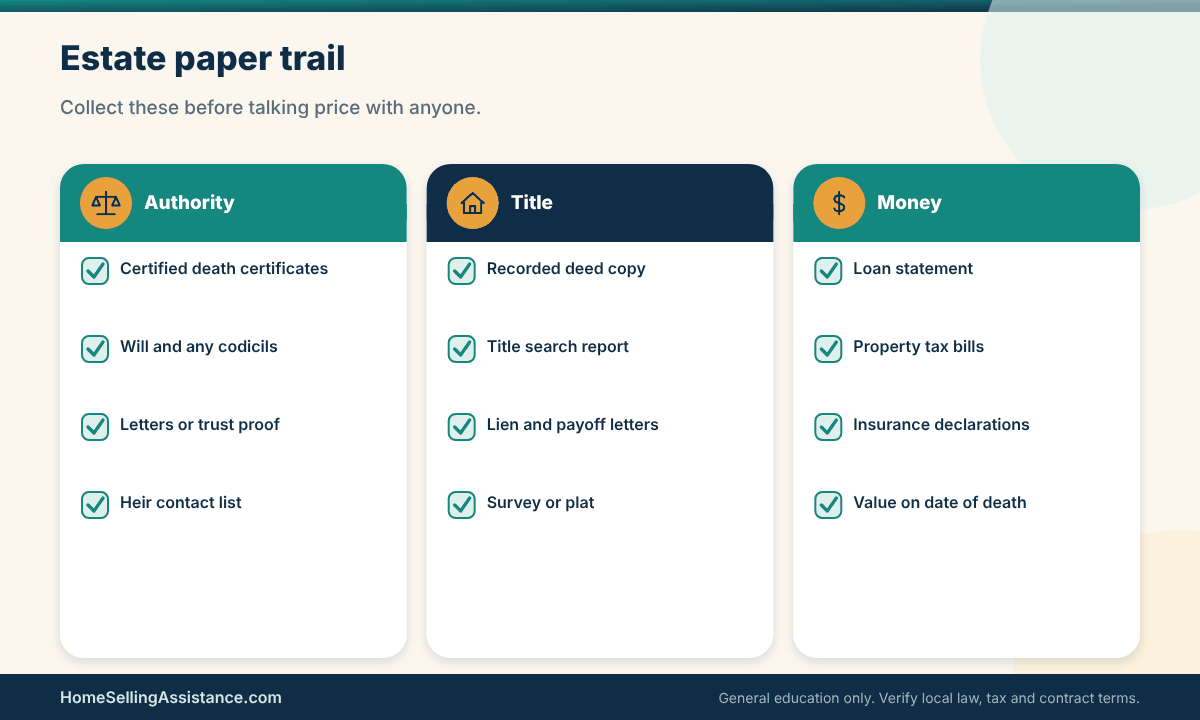
Evidence to gather first: the estate, court and title paper trail
For the estate itself, ask the attorney which of the following apply: an opened probate case with a case number, letters testamentary or letters of administration (court documents showing who has authority), a small-estate procedure that may avoid full probate, or a non-probate transfer such as a trust or a beneficiary deed. The label matters because the title company will ask for the specific document that proves authority, and different documents are accepted in different states.
For the title, ask the title company to run a search and tell you about open liens, gaps in the chain of title, easements and any recorded restrictions. Ask what they will need from the estate to insure the sale, which often includes certified letters, a death certificate, a certification of trust or a court order approving the sale in states that require one. Asking early, before there is a buyer, lets the family fix problems on its own schedule.
For identity and fraud protection, only accept instructions about money from numbers and addresses you have independently verified. Wire fraud targets closings, and estates are attractive targets because of the number of parties involved. The FBI’s Internet Crime Complaint Center and the FTC’s consumer site explain how these scams work and what to do if you suspect one. It rarely feels urgent, yet selling inherited house projects suffer when it is skipped. Stay curious and ask for the reasoning, not just the answer, when selling inherited house property.
A scenario, an exception and your next step
Consider Marcus, a beneficiary who is told by a friendly investor that he can sell “right now” without any court involvement because the house is in his late aunt’s name. The investor hands him a contract. Marcus, wisely, pauses. In this example, he asks an attorney, who explains that in his state nobody has authority to sell until a personal representative is appointed, so the contract cannot be performed as written.
The exception is that some states allow certain estates to transfer property through an affidavit or a simplified process, which could change the timetable. Marcus’s next step is to ask the court clerk or an attorney which procedures exist in his county, and to hold off on any signature until he knows who actually has authority. That one phone call is cheap compared with a broken contract. Give yourself credit for tackling it; selling inherited house responsibilities are not small. This is where selling inherited house guidance becomes specific to your home and your court.
It is worth saying a word about professional fees, because many heirs worry about them and avoid calling anyone. Attorneys, appraisers, inspectors and tax professionals each charge in their own way, whether by hour, by flat fee or by a percentage in some probate matters. Ask for the fee structure in writing before you start. Compare what you will spend with the cost of a mistake, such as a failed closing or an unexpected tax bill, and the fees often look more reasonable.
If you are weighing repairs, our category on repairs and selling as is collects the general guides for that decision. The same logic applies to estates as to any home: spend where the return is likely, skip what is merely cosmetic, and document what you do. Selling inherited house property seldom rewards big renovations, because the person paying for them is often an estate with limited cash.
Finally, think about your own wellbeing. You are not only managing a property but also processing a loss. It is acceptable to take a break, to ask for help and to set a pace you can maintain. Most steps in selling inherited house property can wait a week without harm, and a clear head makes better decisions than a rushed one.
What to decide before listing and what can safely wait until an offer when selling inherited house property
One reason these sales go sideways is that people treat every decision as urgent. In reality, a handful of choices must be made before the house is marketed, and a longer list can wait until you have a real offer and a contract on the table. Sorting decisions into those two piles reduces stress, because it tells you what to do this week and what you are allowed to postpone. Plan around it early and selling inherited house timelines become easier to predict. Use it as a conversation starter with your professionals about selling inherited house options.
The decisions that belong before listing are the ones that change who may sign, what you promise buyers, or how the house is presented. Those are authority, the decision process among heirs, the valuation, the condition plan, the selling route, the compensation terms and the disclosure approach. The decisions that can wait are the specific repair credit you will accept, the exact closing date, the escrow details and the final allocation of personal items. Keep that distinction in mind as you read the rest of this section.
Start with authority. A listing agreement is a contract, and so is a purchase agreement. The person who signs must have the legal power to bind the estate or the owners. In many places, that power begins when a court appoints a personal representative, though trusts and some non-probate transfers work differently. Some agents will take a listing and begin preparing the house while court steps are underway, and some contracts are written to be subject to court approval. The right approach depends on your state, so ask the attorney in writing what may be signed and when.
Next, settle the heirs’ decision process. Who has the final say if the group splits? Does every heir have to sign, or will the personal representative decide? How will heirs be updated? A short written agreement, even a one-page email thread that everyone acknowledges, can prevent the most common blowups. Our article about when one heir wants to sell an inherited house and the others do not explains what options exist when agreement cannot be reached.
Then settle value. Choose how the house will be priced and who will provide that opinion. An appraiser provides a documented value, usually tied to a specific purpose and date. An agent provides a comparative market analysis. An investor provides an offer, which is a price rather than a valuation. Heirs often make better decisions when they have at least two independent sources, and when the date-of-death value for tax purposes is documented separately from the current list price.
Finally, settle compensation and representation. Broker compensation is negotiable and, under current practice, should be agreed in writing before services begin. The National Association of Realtors publishes information about its rules and practice changes at nar.realtor, but the right arrangement for your sale is whatever you negotiate and sign. Compare more than one proposal, read the length of any listing agreement, and ask what happens if the sale does not close.
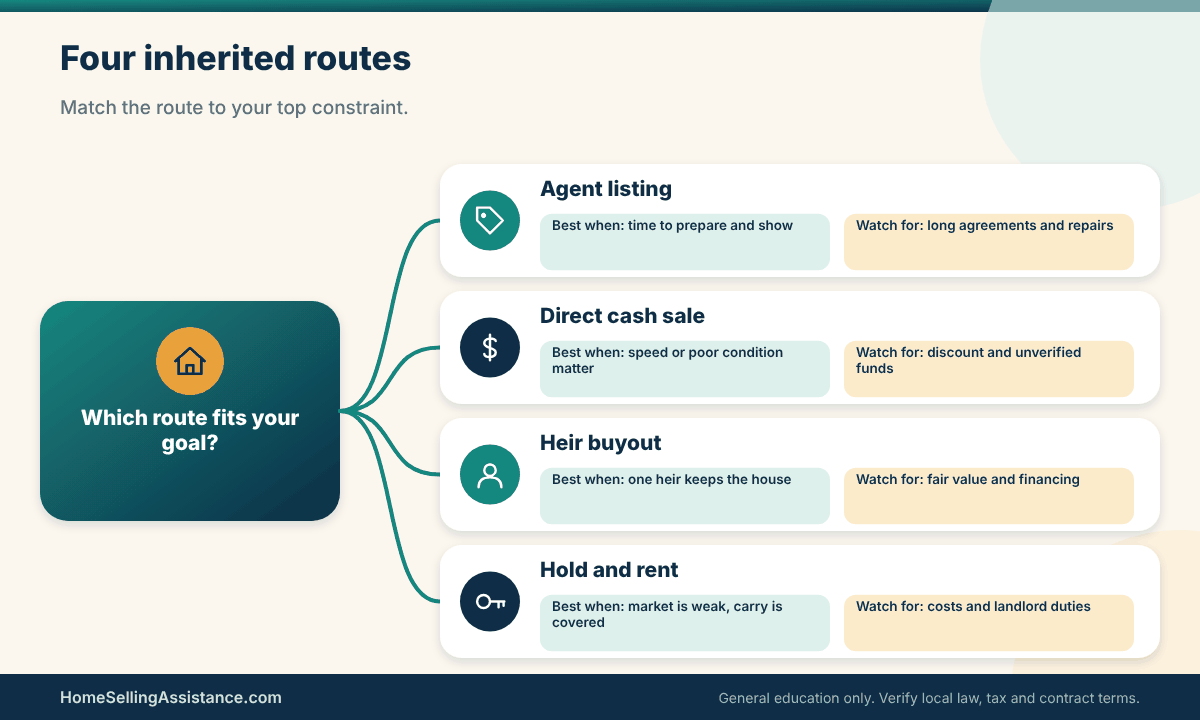
The decision fork above lays out the most common selling routes for an inherited property and, for each, the situation where it fits best and the thing to watch. No route is the best in general. A listing may fit when there is time and the house can be shown. A direct sale may fit when speed or condition is the main problem. A buyout among heirs may fit when someone wants to keep the home. A hold-and-rent plan may fit when the market is weak and the heirs can afford the carry.
A good rule is to choose the route that matches your single most important constraint, and then to protect the next most important one with contract terms. If speed matters most, you might accept a discount but insist on proof of funds and a short, firm closing date. If price matters most, you might accept a longer timeline but plan the repairs and presentation carefully. If peace among heirs matters most, you might choose the route with the most transparent process even if it is not the fastest.
Source, calculation and document evidence: the valuation, the offer file and the contract language
Keep an offer file for every serious proposal. It should include the written offer, the buyer’s proof of funds or pre-approval, the proposed closing date, the contingencies, who pays which costs, and any special terms such as occupancy after closing, assignment rights or a request for personal property. When two offers arrive close together, put them into a single comparison and use the same assumptions. A higher headline price with a long financing contingency may be worth less to you than a lower price that closes.
Read the contract language that matters most for estates. Look for any clause that makes the sale subject to court approval, because that can add weeks. Look at the earnest money terms and who holds the deposit. Look for inspection and repair rights, and whether the buyer can renegotiate after inspection. Look for assignment rights, which let an investor pass the contract to another buyer, sometimes for a fee, and make sure you understand that you are still bound to the original terms. If anything is unclear, have the attorney read the contract before signing.
Use the valuation file to tie together the tax and sale conversations. The date-of-death value anchors basis, the comparable sales anchor the list price, and the contractor estimates anchor the repair decision. When those three live in one folder with dates on them, the tax professional and the agent can do their jobs without asking you to repeat the story. Our overview of repairs before selling a house gives a general framework for judging which repairs are worth making.
Fair housing applies to every sale, including estate sales. Marketing, showing and negotiating must not discriminate or steer on the basis of race, color, religion, sex, disability, familial status or national origin, and some states and cities add more protected classes. HUD explains the federal framework at its Fair Housing and Equal Opportunity pages. In practice that means choosing among offers by price, terms and reliability, not by who the buyer is.
A scenario, an exception and your next step
Think about Samuel, a trustee who receives two offers on a trust-owned house. One is from a family that needs a mortgage and wants an inspection period; the other is from an investor that offers less but will close in two weeks and has already shown proof of funds. Samuel’s trust document says the trustee must act in the interests of the beneficiaries, and the beneficiaries disagree about whether speed or price matters more. In this example, Samuel convenes a short call, shares the comparison, records the decision in writing and then accepts the offer the beneficiaries choose.
The exception is that some trusts and some courts require formal notice or approval before a sale to certain buyers, especially a buyer who has a relationship with the trustee or an heir. When a related party might buy, ask the attorney about conflicts and about whether an independent appraisal is needed. Samuel’s next step is to write down his reasoning, because a clear record is the best protection for a fiduciary if someone questions the decision later.
The last piece of the roadmap is the transaction itself. Once you have a contract, the sale becomes a sequence of stages, each with a responsible party, a dependency on someone else and a deadline. The table below summarizes those stages for an inherited sale. Use it as a reminder of who needs what from whom, and as a prompt to think about the fallback if a stage slips. If anything here feels unclear, bring it to an attorney before selling inherited house steps begin. The same logic applies in almost every case of selling inherited house property.
| Stage | Seller responsibility | Buyer or professional dependency | Deadline to watch | Fallback |
|---|---|---|---|---|
| Authority confirmed | Provide letters or trust certificate | Attorney and title company review | Before signing any contract | Ask the court about interim steps |
| Under contract | Deliver signed contract and disclosures | Buyer deposits earnest money | Deposit date in contract | Return to market if deposit fails |
| Inspection period | Give access, respond to requests | Buyer inspector and any contractors | Inspection window end date | Offer credit, repair or release |
| Appraisal and loan | Provide property records | Appraiser, lender, underwriter | Financing contingency date | Renegotiate or relist |
| Court approval, if required | Supply petition documents | Judge and attorney schedule | Hearing or confirmation date | Extend closing in writing |
| Closing and funds | Sign deed, pay off liens, hand over keys | Title company, buyer funds | Closing date in contract | Short extension agreement |
After you have read the rows, pick the two or three stages that carry the most uncertainty in your case. For many inherited sales, that will be authority and court approval, because those stages depend on someone else’s calendar. Ask your attorney for a realistic range of timing in your county, and then build that range into the closing date you ask for. A closing date that ignores the court calendar is a promise you may not be able to keep.
Contingency planning is part of the same exercise. Ask what you will do if a buyer’s financing falls through, if an heir refuses to sign, if an inspection uncovers a major problem or if the court process runs long. A fallback you have thought about in advance costs nothing, and a fallback you invent under pressure often costs a lot. The tree below shows one way to think through the most common breakdown, which is a disagreement among heirs.
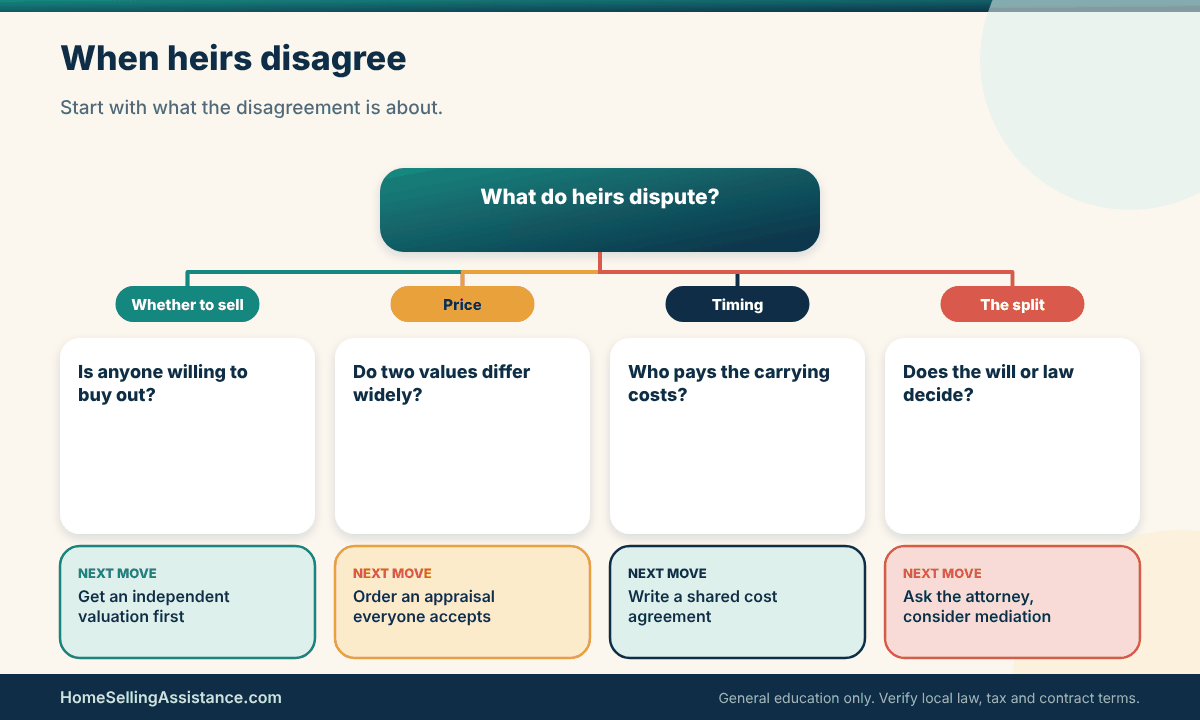
Read the tree from the top: ask whether the disagreement is about the decision to sell, the price, the timing or the split. Each branch points to a different next step, such as mediation, an independent valuation, a buyout or, as a last resort, a court-ordered sale. Courts can order the sale of co-owned property in many states, but it is slow and expensive, so it is generally a last option after the family has tried to reach agreement.
Throughout all of this, keep the family communication separate from the transaction. Someone should send a short update to all heirs on a regular schedule, even when nothing has changed. Silence breeds suspicion, and suspicion makes every later decision harder. A single shared document with the latest status, the next decision and who is responsible for it is more effective than a dozen phone calls. Good notes now will make closing week a lot calmer for anyone selling inherited house property.
If your finances are tight because of the estate or because the home is carrying heavy costs, it is worth knowing that HUD-approved housing counselors can offer free or low-cost guidance. You can find one through HUD’s counselor search. A counselor is not a substitute for an estate attorney, but they can help you understand loan options and budgeting if you plan to keep the house or are worried about foreclosure.
For the closing itself, our guide to an estate home sale closing explains what usually happens on and around the day. Typically the title company prepares a settlement statement, and the personal representative or trustee signs the deed in the capacity stated in the documents, not in a personal capacity. Review the settlement statement a day early if possible, and compare it line by line against the contract and your own cost estimates.
Funds usually go to the estate account or the trust account rather than to individual heirs, and distribution follows the will, the trust or state law. Do not ask the title company to send proceeds to a personal account unless the attorney has confirmed that it is appropriate. And keep the final settlement statement, the deed, and the estate account records for as long as the tax professional recommends, because they support the basis and gain reporting for the sale.
When the sale is done, there is one more task: closing the loop. Notify the insurance company, cancel utilities, update the tax authority with a forwarding address for final bills, and make sure any remaining personal property is handled according to the plan. Send heirs a final accounting of the sale and the estate’s expenses. A clear ending, with numbers everyone can read, is the best way to protect family relationships after the house is gone.
Frequently asked questions about selling inherited house property
Can I start selling inherited house property before probate is finished?
Sometimes, but it depends on your state, how the home was titled and what the court requires. If a personal representative has been appointed, that person may be able to list and sign a contract, and some sales need court approval before closing. If nobody has been appointed yet, a buyer and title company will usually not close. Ask a probate attorney what may be signed at each stage, and read our guide on selling before probate is finished for the general logic.
Who has the authority to sign the deed?
It depends on how the property passed. For a probate asset, authority generally comes from a court appointment, shown through letters testamentary or letters of administration. For a trust, it comes from the trustee under the trust document. For a property that passed by survivorship or a beneficiary deed, the new owner may sign once the proper paperwork is recorded. The title company will tell you exactly which documents it needs.
Do I owe tax when I sell a house I inherited?
It depends on the sale price, your basis, your selling costs and your overall tax situation. In general, inherited property receives a basis tied to its value at the date of death, so many heirs find that the taxable gain is smaller than they expected, and sometimes there is a loss. That is a general rule, not a prediction for your case. Review the IRS publications on basis and sales, and ask a tax professional to look at your numbers.
Why does the date-of-death value matter?
It usually becomes the starting point for measuring gain or loss when the home is sold. If the value was never documented, you may have trouble supporting your basis later. A retrospective appraisal by a licensed appraiser, or other credible evidence of value on or near that date, can help. Ask your tax professional which type of documentation they prefer before you order one.
Should I fix up the house first or sell it as is?
There is no single answer. Selling as is saves cash and time, but buyers tend to discount for uncertainty. Light repairs, cleaning and clearing can improve how the house shows and reduce renegotiation after inspection, but only some repairs repay their cost. Get written estimates, compare them with the likely discount, and consider the estate’s cash position before spending.
What if my siblings and I cannot agree on selling?
Start by finding out what each person actually wants, because the disagreement is often about money, timing or sentiment rather than the sale itself. Try a written decision process, an independent valuation and, if needed, a neutral mediator. A buyout by one heir is another option. A court-ordered sale exists in many states but is usually slow, costly and stressful, so most families treat it as a last resort.
Is a quick cash offer a good idea for an estate property?
It can be, if speed, condition or distance is the main problem and you understand the discount. It can also be a poor deal if it is far below what the open market would pay. Ask for proof of funds, read the contract carefully, and get an independent opinion on value before you accept. Read our article about a cash offer for a house for the questions to ask.
What happens if the house still has a mortgage?
The loan is normally paid from the sale proceeds at closing, and the balance keeps growing with interest until then. Ask the servicer for a payoff statement and explain who you are by providing the documents they require. Servicers have procedures for heirs and personal representatives, and some reverse mortgages have shorter deadlines after a borrower’s death. Our guide on inherited houses with a mortgage covers the typical steps.
Do I have to disclose problems with a house I never lived in?
Rules differ by state, and estate sellers are treated differently in some places. Federal law requires lead-based paint disclosures for homes built before 1978, whatever the seller’s history with the house. In many states, a personal representative must still disclose what is known, or may be allowed to give a limited disclosure. Ask an attorney or the state real estate commission how your state handles it.
How long does selling an inherited house usually take?
There is no reliable universal figure, because probate timing, court calendars, the condition of the house and the local market all vary. Some sales close in a matter of weeks when authority is clear, and others take many months because court steps or heir disagreements slow everything down. Ask your attorney for a realistic range in your county, and then plan carrying costs around that range rather than the best case.
A calm way to move forward
Selling inherited house property goes best when you take the questions in order: who owns it, who can sign, what is owed, what condition it is in, and which route fits your goal. You do not have to solve everything this week. Pick the next document to gather and the next professional to call, and write down the answers as you go. This article is general education, not legal, tax or financial advice, so confirm the details for your state and your situation with a probate attorney, a title company and a tax professional before you commit.