Any counteroffer strategy seller owners can actually use starts with one plain idea: a counteroffer is not a reaction, it is a new proposal that you write on purpose, with every term priced, every deadline dated and every fallback chosen before you sign.
Most sellers feel the pull to answer an offer fast. A buyer sends a number that stings, the phone buzzes, family weighs in, and the instinct is to fire back a higher price and hope. Sometimes that works. Just as often it leaves money, time or certainty on the table, because price is only one of the levers inside a purchase contract.
Credits, closing dates, possession, inspection and financing contingencies, deposits and even which appliances stay are all negotiable. A thoughtful counteroffer strategy seller owners build around those levers, not only around the price line, tends to produce a cleaner contract and fewer ugly surprises in week three.
This article is part of our library on offers, and it sits under our cornerstone on how to evaluate a home offer as a seller. Where that guide asks whether an offer is good, this one asks what you should say back. We will look at what to prepare before you respond, how to move through the exchange in a sensible order, which trades are worth making, and how to lock the final terms down in writing.
One honest limit before we start. This is general education, not advice about your contract. Counteroffer forms, attorney involvement, deposit customs, deadline rules and disclosure duties vary by state and even by county. Every dollar figure here is an illustrative round number that shows the arithmetic, never a prediction about your home or your market.
Key takeaways
- A counteroffer is a new offer. In many states it ends the buyer’s original proposal, so a good counteroffer strategy seller owners rely on treats each response as a document that has to be complete, clear and signed by the right people.
- Price is one lever among many. Credits, dates, deposits, contingencies and personal property can each be traded, and each has a dollar value you can estimate before you reply.
- Know your net before you answer. A short net sheet built from a payoff quote and local closing costs tells you how far you can move without regret.
- Deadlines are part of the strategy. A counter that expires at a clear date and time keeps you in control and avoids the confusion of overlapping offers.
- Ask for proof, not promises. A lender letter, proof of funds and a deposit plan show how likely a buyer is to close, which matters more than a small price gap.
- Write down every agreed change. Verbal understandings fade, so every trade should appear in a signed document before anyone relies on it.
Build the file behind your counteroffer strategy seller decisions
Preparation is the unglamorous part of any counteroffer strategy seller approach, and it is where most of the advantage sits. When the offer lands, you want to be answering from a folder, not from a feeling. The goal of this first stage of your counteroffer strategy seller plan is simple: know your numbers, know your dates, know who can sign, and know what you still need to learn about the buyer.
If you are working with a listing agent, much of this file already exists in some form. If you are selling on your own, you will build it yourself, and you may want an attorney or a flat-fee professional to read the draft counter before it goes out. Either way, the same questions apply.
Papers, numbers, and deadlines to have in hand
Start any counteroffer strategy seller effort with the offer itself, read slowly and in full. Many sellers read the price, glance at the closing date and skip the addenda, which is where buyers often tuck repair requests, appliance conditions, rent-back terms or requests that you pay part of their costs. Highlight every line that asks you to do, pay, fix, leave or wait for something.
Next, gather the figures that tell you what a given price would actually leave you with. That means a current mortgage payoff statement (a payoff quote, not the monthly balance on your app), your property tax and any HOA amounts, an estimate of title, escrow or attorney charges from a local provider, and the compensation terms you agreed to in writing with any broker.
Evidence to gather: the offer, payoff, and net sheet
A simple net sheet is the single most useful tool in a counteroffer strategy seller can prepare. List the offered price at the top, subtract the payoff, subtract estimated closing costs and any compensation you have agreed to pay, then subtract credits the buyer is asking for. What remains is your estimated net. Run it again at two or three alternative prices and credit levels so you can see how the result moves.
Good counteroffer strategy seller work uses quotes, not memory. A title company or closing attorney in your area can usually provide a good-faith estimate of seller charges, and your lender can send a formal payoff figure. Ask your agent, if you have one, for the local custom on who pays which fees, because that custom varies a great deal from one county to the next.
A scenario, an exception, and your next step with the paperwork
Picture a seller who owes an illustrative balance of 240,000 and receives an offer of 400,000 that asks for 6,000 in credits. Subtracting the payoff, a round estimate of closing costs and the credit shows a net that is comfortable but not generous. The seller realizes a 5,000 price increase would matter far less than refusing the credit, and drafts the counter that way.
Now the exception. If the numbers show you would barely clear the payoff, say so to yourself early. That changes the conversation from “how do I get more” to “what do I need to avoid losing,” and it may be a reason to talk with your lender about options before you reply. Your next step is a payoff quote and a net sheet, today, before any counter is drafted.
Information still missing about the buyer and the terms
Even a well-prepared seller rarely has the whole picture when the first offer arrives. You may not know how the buyer is paying, how strong the deposit is, whether the buyer must sell another home first, or whether the buyer’s agent has closed deals in your area. Missing information is not a flaw in a counteroffer strategy seller plan. The skill is knowing which gaps are dangerous and which can wait.
Put the open questions in a short list. Some are answered by a document, such as a lender prequalification or a bank statement. Others are answered by a conversation, such as asking the buyer’s agent how comfortable the buyer is with your timeline. A few are answered only by the contract itself, once the terms are written.
Evidence to gather: proof of funds, lender letter, and agent history
Ask for the documents that a serious buyer can produce quickly. For financed purchases, that is a lender letter that reflects a real review of income, assets and credit rather than a casual chat. For cash purchases, it is recent proof of funds from a bank or brokerage, with the buyer’s name on it. A hesitant response is information in its own right.
Check the earnest money plan too. Who holds the deposit, how much it is, when it is due and what happens to it if the buyer backs out all vary by contract and state. Our guide on earnest money for sellers goes through the mechanics. For now, note whether the deposit is large enough to make the buyer take the contract seriously.
A scenario with a missing piece and what to do next
A buyer sends a strong price but the offer is silent on the appraisal and says only “buyer to obtain financing.” You do not know whether the buyer is prepared for a low valuation. Rather than guess, your counter can ask for a lender letter within a short window and clarify how an appraisal shortfall would be handled.
If the buyer refuses to share any financing evidence, that is useful too. You can keep the counter conservative, shorten the contingency period, or ask your agent whether another buyer deserves more of your attention. The next step is a written request for specific documents with a date, sent through the buyer’s agent or directly if no agent is involved.
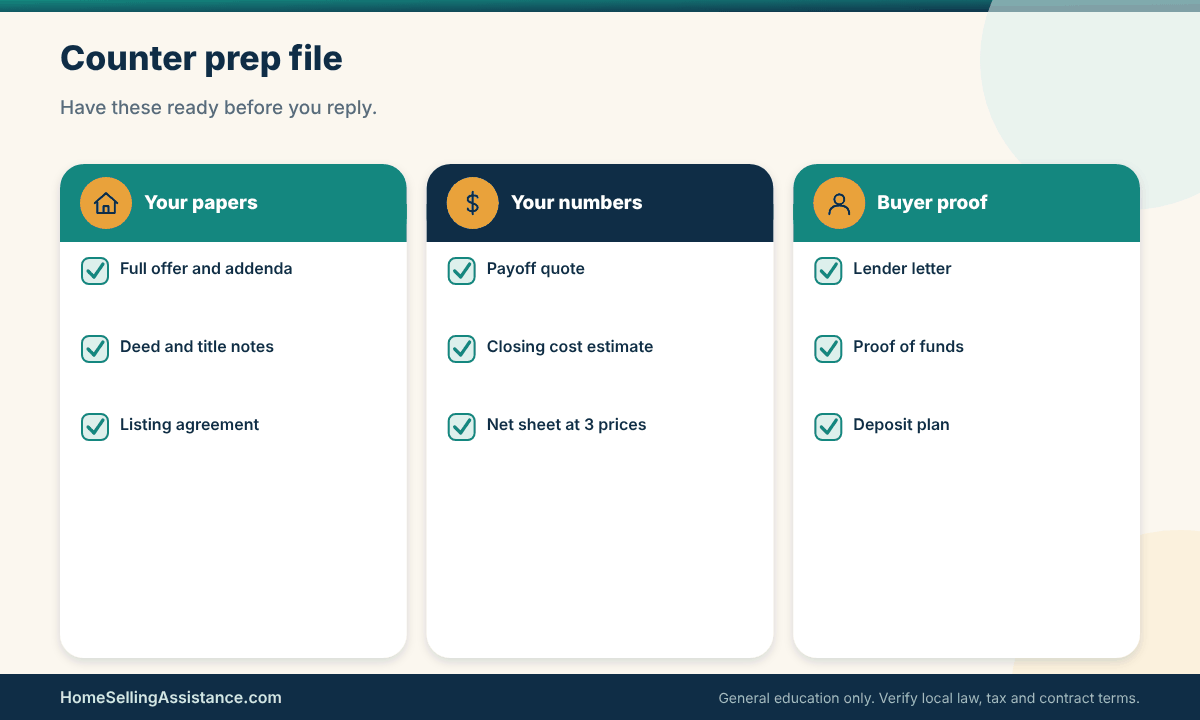
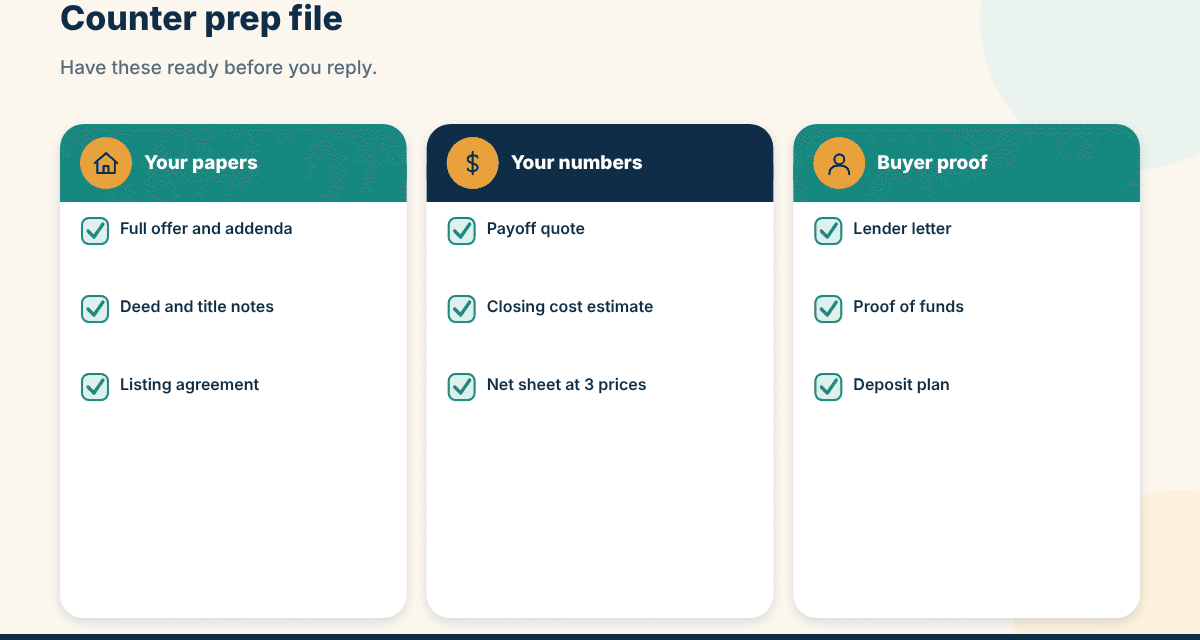
The checklist above groups the paper trail into three piles: what you own, what you owe and what the buyer must prove. Treat it as the packing list before a trip. Most counteroffer problems trace back to something that was not in the bag when the clock started running.
Move through the counteroffer in a deliberate order
With the file ready, your counteroffer strategy seller routine can run in sequence. The order matters because each step narrows the choices for the next one. Sellers who skip steps tend to give away concessions they did not need to give, or to reject offers that were one small trade away from working.
Think of a counteroffer strategy seller sequence as four moves: read, price, choose, and send. You read the offer for everything it asks. You price each ask in dollars and days. You choose which trades to offer and which to refuse. Then you send a clean written counter with a firm expiration.
Early moves and the first decision point
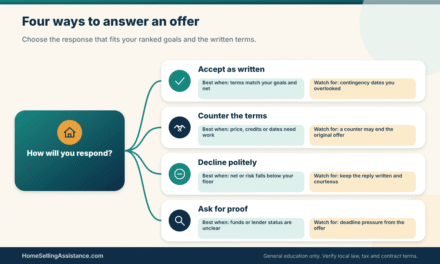
The first decision is not what to counter. It is whether to counter at all. You have three basic options, and each is legitimate: accept the offer as written, reject it, or respond with changes. Many sellers forget that accepting is an option and that rejecting politely is allowed. Which one fits depends on the gap between the offer and your goals.
If you counter, keep your counteroffer strategy seller narrow enough to be answerable. A counter that changes ten things invites a counter that changes ten things back. A counter that changes three things the seller cares about most, and leaves the rest alone, usually gets a faster and friendlier reply. That is not a rule, only a pattern worth testing against your market.
Evidence to gather: reading the offer against your own net
Lay the offer beside your net sheet and mark each term as a gain, a cost or neutral. A closing date two weeks later than you hoped may cost you carrying costs for those two weeks, which you can estimate from your mortgage, taxes and utilities. A request to leave the washer and dryer may cost you the price of a replacement set. Small items are easy to price once you try.
Also compare the offer to any others you hold. If more than one buyer is involved, read our guides on handling multiple offers and on the difference between the highest and the best offer before you decide how to respond to any single one of them.
Scenario: the offer is close but not clean
Imagine an offer that is within a few thousand of your asking price but includes a long inspection window, a request that you pay a share of the buyer’s costs and a closing date a month away. The price is nearly right, so a price-only counter would leave the real friction untouched.
A stronger reply might hold the price, offer a smaller credit, shorten the inspection period to a stated number of days and accept the closing date in exchange. Each piece trades something you care about less for something you care about more. Your next step is to rank your priorities, price, certainty, speed and convenience, so you know which trades are easy.
Trading price, credits, dates, and contingencies in your counteroffer strategy seller plan
This is the heart of any counteroffer strategy seller exchange. Every term the buyer proposed can be accepted, changed or refused, and every change has a cost to one side and a benefit to the other. Good negotiators look for trades where the thing they give is cheap for them and valuable to the buyer, and the thing they get is the reverse.
Take dates as an example. A buyer who needs to move before a school year may value an early closing highly, while a seller who is waiting on a new build may value a late one. Those preferences are not in conflict. A counteroffer strategy seller can test by asking about timing first often finds room that a price fight never would.
The table below turns the counteroffer strategy seller process into a workflow. It follows a typical counter from first read to hand-off, naming what to gather, what to do, when the decision is due and who receives the document next. Use it as a prompt, not a script, since your contract and local custom set the real clock.
| Stage | Information to gather | Action | Decision deadline | Next handoff |
|---|---|---|---|---|
| Offer arrives | Full contract, addenda, expiration time | Read every page; note each ask | Before the stated expiration | Listing agent or attorney |
| Net check | Payoff quote, closing cost estimate, credits asked | Build a net sheet at three prices | Same day if possible | You and your advisor |
| Buyer proof | Lender letter, proof of funds, deposit plan | Request documents in writing | Short, dated window | Buyer’s agent |
| Draft counter | Ranked priorities, trade values | Change only the terms that matter | Before your reply expires | Attorney or agent review |
| Send and wait | Delivery record, expiration of counter | Send with a clear date and time | Counter’s own deadline | Buyer and buyer’s agent |
| Final terms | Signed counter, initialed pages | Confirm all changes appear in writing | Before work begins | Title or escrow office |
To use the table, copy the first column into a notes page and fill in real names, real dates and real figures beside each stage. Seeing the deadline column filled in tends to reveal collisions, such as a counter that expires after another offer does, which is far easier to fix before sending than after.
Evidence to gather: pricing each trade in dollars
A practical counteroffer strategy seller method gives each lever a rough dollar value so you can compare them. A price change is already a dollar figure. A credit is a dollar figure too, though many sellers forget that a credit often costs less than the same reduction in price, depending on how the buyer’s loan and your local taxes or transfer charges are calculated. Ask a lender or title professional how it works for your sale.
Dates have a cost you can estimate from your monthly holding expenses. Contingencies carry a risk cost that is harder to price, but you can think about it as the chance the deal falls apart multiplied by what that would cost you in time and reduced leverage. Our article on seller concessions explains how credits behave, and net proceeds shows how the pieces add up.
Scenario: three counters, three outcomes
For a counteroffer strategy seller example, suppose a buyer offers 395,000 with a request for 8,000 in credits and a 30-day close. You could counter with a higher price and the same credit, with the same price and no credit, or with a middle price, a smaller credit and the date held. These are illustrative, but the point is that each version shifts risk to a different place.
The first counter risks a standoff because it asks for more on both lines. The second is clean but may feel one-sided. The third gives the buyer something and asks for something, which in many markets is the most likely route to agreement. Your next step is to write the three versions side by side and compare the net for each one.
In any counteroffer strategy seller plan, contingencies are the escape hatches in a contract. An inspection contingency lets a buyer renegotiate or leave based on the home’s condition. A financing contingency protects a buyer whose loan falls through. An appraisal contingency addresses a valuation that comes in below the price. Each one gives the buyer options and costs you certainty.
That does not make them evil. In many sales they are reasonable and expected. The strategic question is how long each one lasts and what has to happen for it to end. A shorter, clearer contingency is often worth more to you than a small price difference, and you can read more on inspection contingencies and financing contingencies in their own guides.
Contingency dates and deposit terms. List every contingency in the offer with its length in days and the event that starts the clock. Note who must give written notice to end or waive it, since a missed notice can change rights in ways the parties did not intend. Many sellers discover too late that a contingency period ran from the date of acceptance, not the date of the first inspection.
Look at the deposit as a signal. A larger deposit that becomes non-refundable after a stated date gives you more security than a token amount that is easy to recover. How deposits are handled differs by state, so confirm the local rule with a title company, attorney or your state real estate commission before relying on a general idea.
One buyer waives something and asks for another. A buyer offers to shorten the inspection period and to increase the deposit, but asks that you include the refrigerator and the patio furniture. Those items may be worth a few hundred to a couple of thousand dollars to you, while a shorter inspection window could meaningfully reduce your risk of a late renegotiation.
This is the type of trade that makes a counteroffer strategy seller can feel good about. You accept the personal property in exchange for the tighter contingency and the larger deposit, and you say so in the counter in plain words. The next step is to list personal property you would part with easily and what you would hold back.
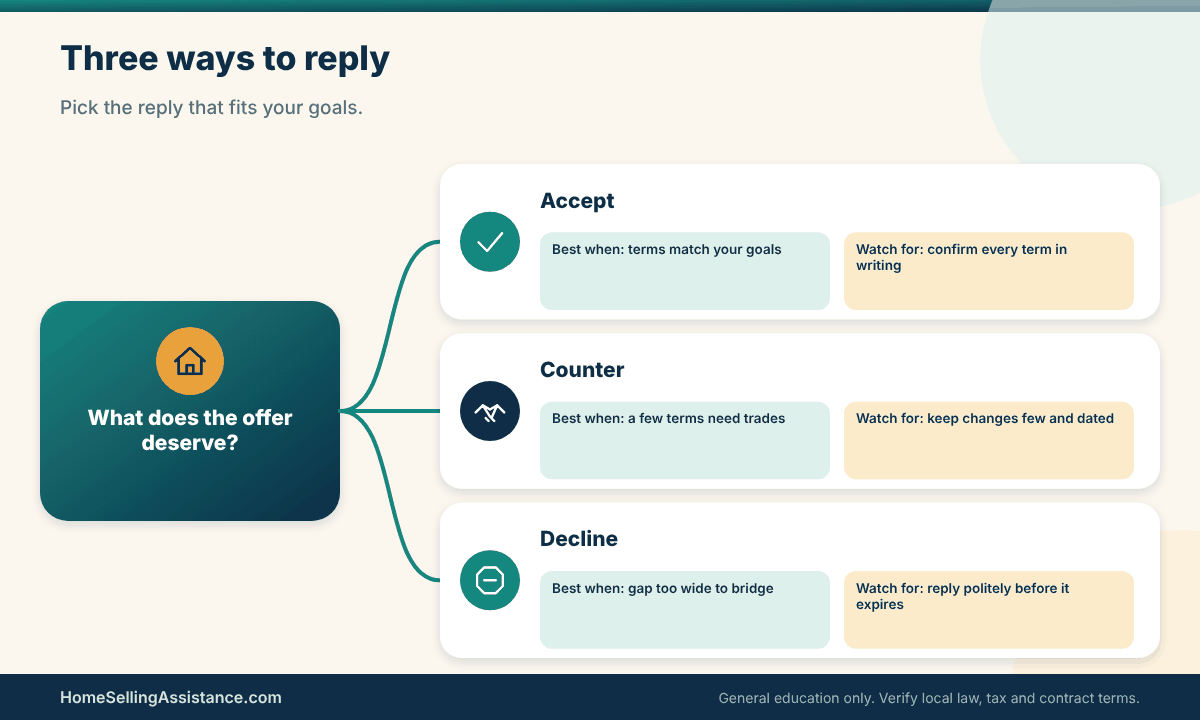
The decision fork above shows the three basic replies and the questions that point you toward each. Notice that countering is the middle path, and that the best version of it keeps the number of changed terms small enough for the buyer to answer without starting over.
A counteroffer strategy seller approach has to account for the fact that negotiation is human. Buyers and agents may try to create urgency, hint at other options or suggest that your counter will end the conversation. Some of that is real and some is posture. Your protection is the same either way: a clear priority list, a net sheet and a deadline you set yourself.
Fair housing law applies throughout. Your decisions about which offer to accept or counter should rest on price, terms and the buyer’s ability to close, never on a buyer’s race, religion, family status, disability or other protected characteristic. The HUD fair housing resources explain the basics, and a consistent written process is a good safeguard.
How agents are compensated in this deal. Buyer agent compensation has changed in recent years, and it is now generally negotiable and required to be written down. If a buyer asks you to contribute toward their agent’s fee, that request belongs in the counter as a clearly labelled line, not as a vague understanding. The National Association of Realtors publishes current information on practice changes.
Our article on paying the buyer’s agent commission covers the options in more detail. For this stage, simply make sure you know what your listing agreement says, because a contribution that conflicts with it could create confusion at the closing table.
The pressure call at 9 p.m. A buyer’s agent calls in the evening to say the buyer needs an answer tonight or will walk. Your offer on the table is not set to expire for another day. This is a moment to slow down. You can thank the agent, say you will respond by the stated deadline, and then use the time to run your numbers and check any other interest.
Pressure is rarely a reason to skip steps in your counteroffer strategy seller routine. If the buyer truly leaves, the deal was weaker than it looked. If the buyer stays, you answered from strength. The next step is to remind yourself that your own deadline, not theirs, governs your reply, unless the contract says otherwise.
Before moving on, it helps to see how the mechanics of a counter work in a counteroffer strategy seller plan, because the legal effect is something many sellers learn only after the fact. In many states, a counteroffer rejects the buyer’s original offer and replaces it with a new one. That means the buyer is free to accept your counter, reject it, or send a counter of their own, and your earlier acceptance of any single term does not bind anyone.
The practical consequences are worth thinking about. If you send a counter and the buyer walks, you generally cannot go back and accept the original offer on the original terms unless the buyer agrees to revive it. Likewise, a buyer who counters your counter is making yet another new offer. Check your state’s forms and customs, since wording and rules differ, and ask your agent or attorney how local forms treat a counter.
Another point is how many counters you may have in play at once. Some sellers send counters to more than one buyer. Whether that is allowed, and how you must handle two acceptances, depends on state law, form language and any listing agreement. Do not improvise here. Ask a licensed professional in your state to explain the rule in writing before you send two live counters.
Then there is the language of your counteroffer strategy seller message itself. A counter should say which terms of the original offer remain unchanged, which are changed, and the exact new wording. “Seller counters at 410,000, with all other terms as written” is clear. “We can probably do something on the price” is not a counter at all, and it can cause real confusion about whether a deal exists. Specific, dated and signed beats friendly and vague.
Every counteroffer strategy seller plan also benefits from a walk-away point decided ahead of time. This is the combination of price, credits and terms below which you would rather keep the home on the market, adjust your plans or wait for another buyer. You do not have to share it. Having it written down for yourself protects you from the heat of the moment, when a lower number can start to sound reasonable simply because the conversation has been long.
Many sellers also find it useful to rehearse the scripts they will use. When a buyer asks for more than you want to give, a calm sentence such as “We can offer this in exchange for that” turns a demand into a trade. When a buyer asks for a deadline extension, “We can extend by one day if the deposit is delivered by noon” turns a favor into a condition. Short, polite and specific works.
A last counteroffer strategy seller tactic is to ask about the buyer’s priorities, which is rarely done enough. A buyer who cares most about the closing date may be willing to give ground on price. A buyer who cares most about price may be flexible on the date. One friendly question through the agents can save two rounds of countering, and the answer is often more candid than people expect.
Mistakes in counteroffer strategy seller work tend to look alike. Sellers counter on price alone and leave a costly credit untouched. They let a counter sit with no expiration, so it floats open while the market moves. They sign without reading an addendum. They forget that a verbal promise from an agent is not part of the contract. Each of these is avoidable with a checklist and a second pair of eyes.
The second table moves your counteroffer strategy seller thinking from workflow to risk. It lists issues that commonly surface during a counteroffer exchange, the evidence you can hold, who can help you check it, what could go wrong and what your fallback might be. Treat each row as a question to ask rather than a conclusion, because the right answer depends on your contract and your local rules.
| Issue | Seller evidence | Buyer, agent or title input | Risk | Fallback |
|---|---|---|---|---|
| Credit request | Net sheet at two credit levels | Lender rules on allowed credits | Net falls below your floor | Offer a smaller credit or a price trade |
| Long closing date | Monthly carrying costs | Buyer’s reason for the date | Extra holding costs, plan delay | Accept with a daily rent-back or deposit increase |
| Open contingencies | Contract days and start dates | Agent’s view of local norms | Late renegotiation or exit | Shorten the window; ask for written waiver |
| Weak proof of funds | Missing or stale statements | Lender letter, bank letter | Buyer cannot close | Request documents with a date; keep showing |
| Appraisal concern | Comparable sales in your area | Lender and appraiser process | Valuation below contract price | Plan a split of any gap or a re-price |
| Personal property ask | Itemised list with values | Title or attorney on what conveys | Confusion at walk-through | List items by name; exclude the rest in writing |
Read across a row from left to right and you have a mini plan. If a buyer asks for a credit, you check the net, ask the lender’s side whether the credit is allowed, understand the risk of eroding your proceeds, and keep a smaller credit or a price trade ready. The same pattern works for every line, and it keeps you out of reactive mode.
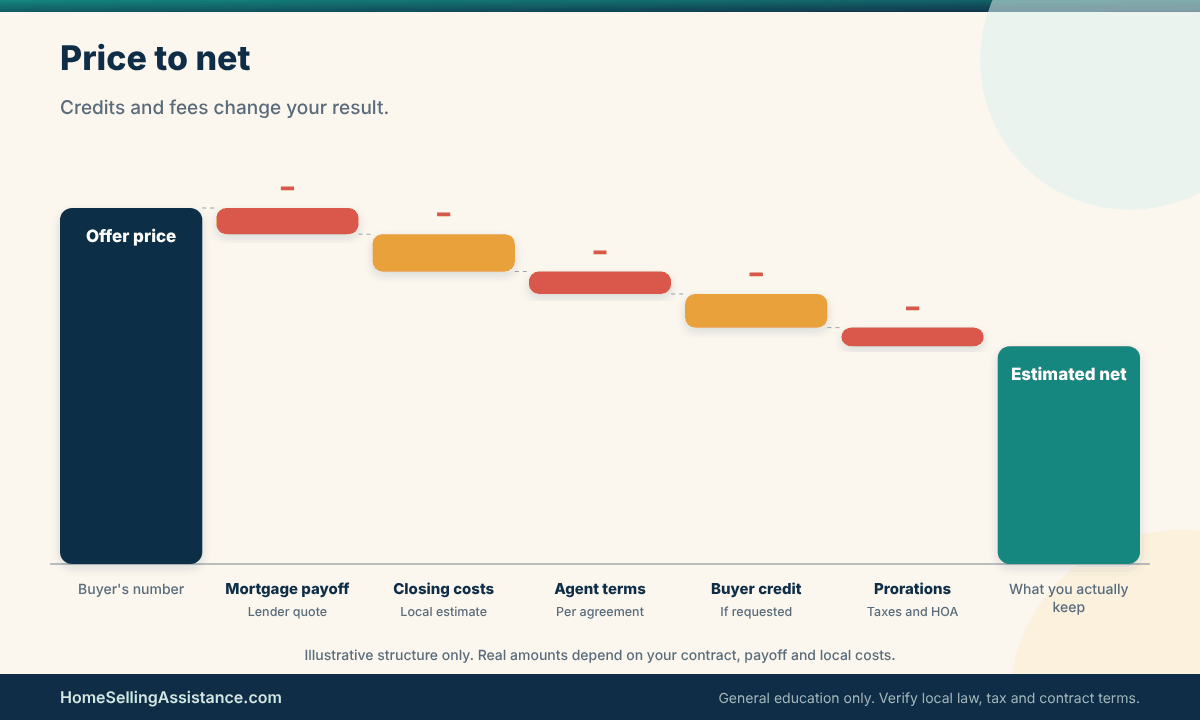
The cost walk-down above makes the same point visually. Each step between the headline price and the money you receive is a place where a counter can add or remove dollars, and a credit that looks small on page two of an offer can be the biggest bar in the picture. Build your own version from real quotes before you reply.
Close the loop on every counteroffer strategy seller step
A counteroffer strategy seller effort is not finished when the last signature goes on the counter. It is finished when every promised term has been captured in the contract, delivered to the people who need it and stored where you can find it later. The final stage is quieter than the negotiation, and it is where many disputes are either prevented or created.
Treat this stage of your counteroffer strategy seller work as a quality check. You are confirming that the document says what you think it says, that dates and amounts match your notes, and that the escrow, title or attorney office has the same version as you do. Small mismatches here become large problems at the closing table.
What to confirm in writing before and after you sign
The counteroffer strategy seller rule is simple: if it matters, it is in writing, and the writing is part of the contract. A hallway promise to fix a gate, a text about leaving the shed or an email agreeing to a later move-out may mean something, but it may also be ignored by the people who prepare the closing documents. Make sure each agreed term appears in the signed counter or in a signed addendum.
Check the details that most often drift: the final price, the credit amount and how it is applied, the closing date, the possession date, the deposit amount and due date, the contingency end dates, the list of items that stay, and who pays which fees. Compare the counter against your notes line by line, preferably with someone who was not in the conversation.
Evidence to gather: the signed counter, initials, and delivery record
Keep a complete copy of the signed counter with every page initialed where your forms require it. Note the date and time each party signed and how each document was delivered, because deadlines often run from delivery or acceptance. An email timestamp, a signing platform record or a delivery receipt can settle a question that memory cannot.
Ask the title company, escrow office or closing attorney to confirm receipt of the final contract and any addenda. Ask them, too, to list any item that looks unusual so you can raise it now. A short confirmation email is better than an assumption, and it creates a record that every party can see.
A scenario, an exception, and what to do next
Imagine you agreed by phone to let the buyers keep a play set in the yard, and the written counter never mentioned it. At the walk-through the buyer expects it, and you had planned to take it. The disagreement is small but irritating, and it could have been solved by one extra line in the counter.
The exception is when the item is fixed to the property. Fixtures often convey with a home unless the contract says otherwise, and local rules about what counts as a fixture can differ. The next step is to ask your agent or attorney how your state treats the question and to name any exclusions explicitly before signing.
Records and follow-up after closing
When the sale closes, your counteroffer strategy seller work is almost done. Keep a folder with the final contract, every counter and addendum, the closing statement, the deed, payoff confirmation and any receipts for repairs or credits. A sensible habit is to store digital copies in two places and a paper copy in a safe spot.
These records matter later for tax reporting, for answering a buyer’s question about what was agreed and for your own memory the next time you sell. They are also useful if a claim arises about a repair or a promise. How long to keep them depends on your situation, and a tax professional can advise on that point.
Evidence to gather: the closing statement and proof of payoff
A last counteroffer strategy seller step is to compare the final closing statement to your net sheet and to the signed counter. Credits should appear where you expect, prorations should look sensible and your mortgage payoff should match the lender’s figure. Our guide to the seller closing statement explains how to read each line.
Ask for written confirmation that your loan was paid off and that any lien release was recorded. Timing and format vary by lender and county. If a number differs from what you expected, ask for an explanation before you sign, because corrections are easier before funding than afterward.
A scenario, an exception, and your next step after closing
Say your final statement shows a credit smaller than the one in the counter. Rather than assume it is correct, you compare it with the signed document and find the closing office had an older draft. A quick call, a copy of the signed counter and a corrected statement fix it in a day.
The exception is a credit tied to a repair that the buyer agreed to complete themselves. In that case the amount may appear differently or be handled by the lender, so ask how it should look. Your next step is to keep all of your documents for the period your tax professional and local rules recommend, and to note the date you plan to review them.

The fallback tree above is worth reading before you ever need it. It shows how a seller can think through a situation where the buyer does not respond, defaults, or returns with new demands late in the process. Your contract language decides which branch applies, so use the picture as a prompt for questions to ask, not as legal guidance.
If you want a deeper look at what happens when a buyer cannot close or something falls through, our article on backup offers explains how to keep a second option alive. Combined with a clear counter and a firm deadline, a backup can reduce the pressure of a single negotiation.
To pull the stages of a counteroffer strategy seller plan together, here is a longer worked example, using illustrative round numbers only. A seller lists a home and receives an offer of 380,000 from a financed buyer. The offer asks for 7,000 in credits, a closing date 45 days out, a 14-day inspection period and the washer, dryer and a wall-mounted television. The seller’s remaining mortgage is 210,000, and a local title quote suggests closing costs in the range of a few percent of the price.
The seller builds a net sheet and sees that the credit and the closing costs together take a meaningful bite. A quick calculation of carrying costs shows each additional week of ownership costs a few hundred dollars. The seller ranks priorities: certainty first, then price, then speed, then convenience. That ranking tells the seller to protect against a failed closing before squeezing the last bit of price.
The seller then requests a lender letter and proof of the deposit, and the buyer’s agent sends both within a day. The documents look solid. With that comfort, the seller drafts a counter at 388,000, a credit reduced to 3,500, an inspection period of 10 days, a closing at 40 days, the appliances included and the television excluded, and an expiration at a stated time the next afternoon.
The buyer replies with 385,000, a credit of 4,000 and 10-day inspection, asking to keep the 45-day closing. The seller checks the net sheet, sees that the difference to the earlier counter is small compared with the benefit of a shorter contingency, and accepts the buyer’s version in writing, confirming each term. Nothing in this story is guaranteed, but notice the pattern: numbers first, documents second, trades third, writing last.
Now consider a harder case. The buyer comes back with an aggressive request for a large credit after the inspection, long after the original counter was signed. This is not a counteroffer in the formal sense. It is a renegotiation under the inspection contingency, and your response depends on the contract wording. Our guides on repair credits versus seller repairs and on low appraisal options look at those later-stage moments.
Pricing strategy before the offer also shapes your counteroffer strategy seller choices. If your home was priced aggressively and drew several viewings, you may have more room to hold firm. If it has sat for weeks, you may value any serious buyer more highly. Those facts are specific to your listing, and our article on price reduction strategy discusses how to read the market’s signals without panic.
Cash buyers and financed buyers also change the shape of a counteroffer strategy seller reply. A cash offer may reduce the risk from financing and appraisal, while a financed offer may bring a higher number with more conditions. Neither is better by default. The article on cash versus financed offers lays out the trade-offs, and a good counter can ask each type of buyer for the proof that suits their route.
Some buyers include an escalation clause, which raises their price automatically in response to a competing bid. That feature changes how you read and answer an offer, and it deserves care. See our guide on escalation clauses before you counter, since you may want proof of the competing offer or a clear cap in the contract.
Finally, a counteroffer strategy seller plan has to respect how time works. An offer or counter that sits open too long is a free option for the other side, and one that expires too fast can feel like pressure. Our guide on offer expiration discusses reasonable windows. Choose an expiration that gives the buyer time to respond properly and gives you a clear moment to move on.
A few counteroffer strategy seller questions are worth putting to anyone helping you. Ask your agent or attorney which terms in the offer are most unusual for your area. Ask what the buyer’s side is likely to prioritize. Ask how similar counters have been received recently, without expecting a promise. Ask what happens under your state’s rules if the buyer does not respond. Their answers do not replace your own judgment, but they sharpen it.
Quick scenario
A seller receives two offers within an hour. One is slightly higher with a long contingency, the other is slightly lower with a short one and a larger deposit. Rather than choosing instantly, the seller asks a professional how local rules handle simultaneous counters, builds a net sheet for each, and counters the one that looks most reliable with a firm expiration. The other buyer is told in writing that the seller is working with another offer and may be contacted if it falls away.
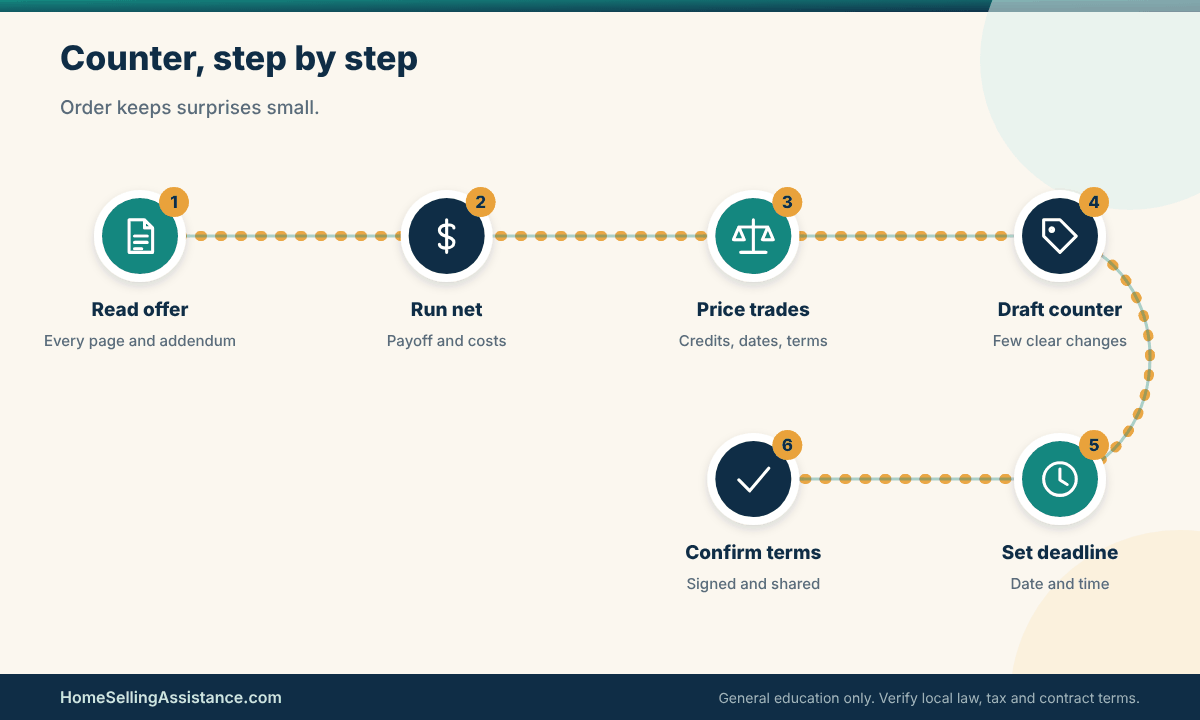
The roadmap above lays the counteroffer strategy seller process end to end, from the first read of the offer to the records you keep after closing. If you only remember one thing, remember the order: prepare, read, price, choose, write, confirm and keep. Each step reduces the number of surprises waiting for you in the next one.
Frequently asked questions about counteroffer strategy seller decisions
What is a sensible first step in a counteroffer strategy seller can follow?
Build a net sheet before you answer. Get a payoff quote, an estimate of closing costs and the details of any credits the buyer requests, then see what each possible price would leave you with. That one page tells you how far you can move and keeps the first reply from being an emotional one.
Does a counteroffer cancel the buyer’s original offer?
In many states it does, because a counter is treated as a rejection of the original and a new proposal in its place. That means the buyer may walk away or send their own counter. Forms and rules differ by state, so ask your agent or attorney how your local forms treat it.
Should I counter on price only?
Not necessarily. Price is one of several levers, and credits, dates, contingencies, deposits and personal property can matter just as much. A narrow counter that trades a few terms you care about less for a few you care about more often works better than a single higher number, though your market and goals decide.
How long should my counter stay open?
Long enough for the buyer to read it and talk with their agent, but short enough that it does not drift while the market moves. Many sellers choose a window measured in hours or a day or two, stated with a clear date and time. Your contract and local custom may suggest a typical length.
Can I send counters to more than one buyer?
Rules vary. Some states and forms allow it with careful wording, while others discourage it or require specific language. Do not guess. Ask a licensed professional in your state to explain in writing what is allowed, and what happens if two buyers accept close together, before you send anything.
What if the buyer refuses to share proof of funds or a lender letter?
That tells you something about how ready the buyer is. You can keep your counter conservative, shorten any contingency, set a firm deadline or give more attention to other interest. Remember that a strong price with weak proof may be worth less than a slightly lower price with solid documents.
Are verbal agreements about repairs or items enforceable?
Do not rely on them. Closing offices and attorneys generally work from the signed contract and addenda, so a promise made on the phone may be ignored. Put every agreed change in the signed counter or a signed addendum, and confirm that the title or escrow office has the final version.
How do I keep the process fair to every buyer?
Decide on price, terms and ability to close, and apply the same standards to everyone. Never base a decision on a protected characteristic such as race, religion, family status or disability. Keep written notes of how you compared offers, and follow the HUD fair housing guidance as a baseline.
When should I involve an attorney?
In some states an attorney is part of nearly every sale, and in others it is less common. If your counter involves unusual terms, a dispute about what was agreed, or any question about your rights, a local real estate attorney can read the documents before you sign. State bar referral services can help you find one.
What should I keep after the sale closes?
Keep the signed contract, every counter and addendum, the closing statement, the deed, proof of payoff and receipts for repairs or credits. Store copies in more than one place. A tax professional can tell you how long to keep records for your situation, and the IRS guidance on selling your home explains what tax records matter.
Before you send the next counter
A good counteroffer strategy seller owners can stand behind is not complicated: know your net, price every term, ask for proof, set a deadline and write down everything you agree. Browse more in our offers and negotiation library and our guides to contingencies, inspections and appraisals. This article is general education, not legal, tax or financial advice, so check your contract and local rules with a licensed professional.