Deciding whether to sell house after job loss is one of the hardest money questions a household can face, because it has to be answered while the paycheck is gone, the mortgage statement keeps arriving, and nobody can tell you for sure how long the gap will last.
Some people lose a job and find another within weeks. Others spend months in a search, burn through savings, and only then start asking whether the house is the thing that has to give. Both stories are common, and neither is a failure. What matters is that you make the decision on purpose, with real numbers on the table, instead of letting missed payments and fear make it for you.
This article is built around a simple idea: the best time to look at how you might sell house after job loss is before it becomes an emergency, even if you end up deciding to stay. We will walk through how to measure your runway, what your mortgage servicer can and cannot do, how equity changes your options, and how to compare a regular listing with the alternatives. Our cornerstone guide on how to sell a house before foreclosure covers the wider picture if you are already behind on payments.
A few honest limits first. This is general education, not legal, tax or financial advice. Foreclosure rules, redemption periods, attorney requirements, disclosure forms and closing customs differ from state to state and sometimes from county to county. Any dollar figure below is a round, illustrative number chosen to show the arithmetic, not a prediction about your home or your market.

Key takeaways
- Count your runway before you decide anything. Months of cash, expected benefits and realistic job-search time tell you how much room you have, and that room is the most valuable thing you own right now.
- Call the servicer early. Forbearance, repayment plans, deferrals and modifications exist for temporary hardship, but availability depends on your loan type and investor, so ask what is open to you and get answers in writing.
- Equity is your leverage. A plan to sell house after job loss with positive equity can usually be done on your timeline, while a sale without equity needs the lender’s consent and has very different steps.
- Compare paths by net result, not by headline price. What reaches your pocket after payoff, fees, repairs and time is the only number that matters.
- Use free, neutral help. A HUD-approved housing counselor costs little or nothing; anyone asking for an upfront fee to save your home, or for your deed, deserves deep suspicion.
- Set trigger points in advance. Decide now which facts, such as a job offer or a missed payment date, will change your plan, so you are not deciding under pressure later.
Before you sell house after job loss, define the real choice
The word “sell” hides several different questions. Are you thinking about whether to sell house after job loss because you cannot afford the house, because you would rather not risk your savings on a long search, or because the job that paid for the house also tied you to a city you may now leave? Each answer points toward a different timetable and a different level of urgency.
Sellers who feel rushed tend to accept the first plan that makes the stress stop. That is understandable, and it can be expensive. A little structure at the start, even a single page of notes, gives you the ability to say yes to the right option and no to the pushy ones.
Goal, runway, cash and condition when income stops
Before comparing routes, pin down five things: what you want from the outcome, how long you can keep paying, how much cash you hold, what shape the house is in, and how much risk you can tolerate. When people decide to sell house after job loss, they often skip the first and last of those, and then feel whipsawed by every piece of advice they hear.
Your goal might be “keep the house if a job turns up within four months, otherwise sell.” That is a perfectly good goal, and it is much more useful than “figure it out.” It gives you a date to work toward and a point at which the plan changes.
Evidence to gather: the numbers behind your runway
Start with a plain list of fixed monthly costs: the mortgage payment (principal, interest, taxes and insurance if escrowed), HOA dues, utilities, insurance not in escrow, health coverage, food, transportation and any other debt payments. Then list what is still coming in, such as unemployment benefits if you qualify, a spouse’s income, severance, part-time work or savings withdrawals. The gap between those two lists is your monthly burn.
Divide your liquid cash by the monthly burn and you have a rough runway. Here is an illustrative example with round numbers: if fixed costs are $4,000 a month, benefits and other income cover $1,800, and you hold $15,000 in accessible savings, the gap is $2,200 a month and the runway is roughly six to seven months. That is a planning estimate, not a guarantee, because benefits can end, costs can rise, and job searches can run long.
It also helps to separate costs you can change from costs you cannot. The mortgage payment is fixed in the short run, but car insurance can be shopped, subscriptions can be cancelled, and some utilities offer hardship programs. Trimming a few hundred dollars a month stretches the runway noticeably, and it can turn a plan to sell house after job loss into a plan to wait two more months and see what the job market brings.
Check how your state’s unemployment benefits work, how long they last and whether they are taxable, using your state workforce agency and the IRS. Also gather your last mortgage statement, your loan servicer’s phone number, your insurance declarations page and your most recent property tax bill. These papers are the raw material for every later step.
A scenario, an exception, and your next step for runway
Picture a couple with a modest mortgage, a six-month runway and a spouse who is still employed. Their burn is small, and the question of whether to sell house after job loss is mostly about how long the household can live on one income. For them, the next step is to set a review date, say day sixty, and agree in advance what they will do if no interviews are scheduled by then.
Now picture a single owner with a runway of eight weeks, a variable-rate loan and a roof that needs work. The exception here is time: waiting for the job market could cost them the ability to list calmly. Their next step is to request a net sheet and a payoff quote this week, not because they must sell, but so that the option exists when they need it.
Neither household has to list tomorrow. Both gain by turning vague dread into dates and numbers. If you have already missed a payment, read about the pre-foreclosure home sale process, which explains how the notices and deadlines tend to unfold.
Risk tolerance is the part people skip because it feels soft, yet it is often the deciding factor. Two households with identical numbers can reasonably choose differently: one sleeps better having chosen to sell house after job loss and keep a cash cushion, the other would rather gamble on a few more months of searching. Neither is wrong. Say your tolerance out loud, ideally to a partner or a trusted friend, because a plan to sell house after job loss only works when everyone in the home can live with it.
Condition matters too. A house with a leaking roof or an outdated system is harder to sell quickly, which complicates any attempt to sell house after job loss on a short clock, and repairs cost cash you may not have. If condition is the obstacle, ask a local agent which fixes buyers in your area actually care about and which can be left alone, and compare an as-is sale with a lightly prepared one. Our library on foreclosure and hardship sales collects related guides.
Facts that could flip the decision
A handful of facts can reverse the sensible answer, and most of them are things you can learn within a week. They include what kind of loan you have, who actually owns it, how far behind you are, what the home is worth compared with the payoff, whether a job offer is close, and whether anyone else holds title with you.
Listing them now matters because they change which conversations you should have first. A homeowner with a government-backed loan may have different relief programs than one with a privately held loan, and an owner with ample equity has more freedom than one whose balance exceeds the likely sale price.
Evidence to gather: loan type, investor and delinquency status
Pull your latest statement and note the loan servicer, the loan number and whether the loan is conventional, FHA, VA, USDA or something else. Servicers are the companies that collect payments, but the investor or guarantor behind the loan sets many of the relief rules. When you call, ask directly: who is the investor, and which hardship options does this loan qualify for?
Next, note exactly how many payments you have missed, if any. Federal servicing rules generally prevent a servicer from starting a foreclosure until a loan is more than 120 days delinquent, with some exceptions, and what happens afterward varies widely by state. Your state attorney general or housing finance agency can tell you whether foreclosure in your state runs through the courts or outside them, which affects how much time you have.
Finally, estimate value. Order a few recent comparable sales from a local agent, or ask for a broker price opinion; both are informal and neither is an appraisal. Compare the realistic range with your payoff quote. That single comparison tells you whether you are in an equity situation, a break-even situation or an underwater one, and our article on selling when you owe more than the home is worth picks up from the last case.
Whether the loan is held by a large investor, a government agency or a local bank can also change who has to approve a sale for less than the balance and how long that approval takes. Ask, and write the answer next to the date of the call. If you hold a VA or FHA loan, the lender or servicer may have extra relief steps, and a counselor will know the names of the programs to ask about.
A scenario with a pending severance or a new offer
Suppose you lose your job but receive a severance package that covers a few months of payments. The facts that could change your decision include how long that severance really lasts, whether it is taxable income, and whether health coverage ends when it does. A plan that looked urgent on day one may look manageable on day ten, and you will only know if you wrote the numbers down.
Or suppose you have a verbal job offer that depends on a background check. The honest answer is that a verbal offer is not income. A sensible next step is to avoid irreversible moves, such as signing a long listing agreement, until the offer is in writing, while still gathering the documents so that a fallback sale can start quickly.
The opposite exception is just as real. If the new job is in another city, the decision to sell house after job loss may become the natural move even though the finances were fine. In that case you are no longer making a hardship decision, and you might find our guide on selling a house for a job relocation more useful for timing and logistics.
Compare the realistic paths for your house
Once the basics are on paper, the question becomes which route fits. There is rarely one correct answer, and anyone who tells you there is probably earns money from one of the routes. We will look at two broad families of ways to sell house after job loss: selling on your own timeline through a regular listing, and the alternatives that bring in the servicer, a lender-approved sale or a different kind of buyer.
The first family of ways to sell house after job loss needs equity and a little time. The second family exists for people who have neither, or who want to avoid a sale entirely. Both are legitimate, and both carry trade-offs that deserve plain language.
Path one: list and sell on your own timeline
A traditional listing is the path with the most room for a good price, because the house is exposed to the widest group of buyers and you control the pace of preparation. It is also the path that asks the most of you: showings, small repairs, negotiation, inspections and an appraisal, all while your finances are under strain. If you have equity and several months, this is often where people begin.
Whether you sell house after job loss with an agent, with a flat-fee service or on your own is a separate choice; the point here is the sequence. Your realistic timeline runs from preparation to listing, to offers, to a contract period, to closing, and each stretch has its own range that depends on local conditions and on the buyer’s financing.

Evidence to gather: payoff quote, comps and net sheet
Ask your servicer for a written payoff quote. It should include principal, accrued interest, any late fees, escrow shortages and a per-day interest figure, because the number changes daily. Our guide to the mortgage payoff when selling a house explains how to read one. If you are behind, the payoff will be higher than the balance on your last statement.
Then build a net sheet, which is a simple estimate of what you would walk away with. Start with a realistic sale price range from recent comparable sales. Subtract the payoff, any agreed broker compensation (which is negotiable and must be written down), title and escrow charges, transfer taxes where they apply, prorated property taxes and HOA dues, and a repair or credit allowance. The article on home sale net proceeds walks through each line.
An illustrative example: a home that could sell in a range around $300,000 with a $230,000 payoff and, say, $30,000 of combined costs and credits leaves roughly $40,000 before taxes. Change the sale price by $10,000 in either direction and the result moves by the same amount, which is why the price range matters so much. Treat every figure as an estimate until a title company or attorney prepares a real settlement statement.
Preparation deserves its own plan, especially if cash is tight. Start with what is free: decluttering, deep cleaning, sorting paperwork, taking out the trash and trimming the yard. Move to what is cheap: touch-up paint, light bulbs, caulk and a few photos taken in good daylight. Only then consider larger repairs, and only after asking a local professional what buyers nearby really notice. If you sell house after job loss, every dollar spent on the house should have a reason you can explain in a sentence.
A scenario where listing early preserves the most choices
Take an owner with comfortable equity who loses a job in the spring. They list in a calm, well-prepared way, accept a reasonable offer, and close before savings run thin. Even if a new job appears in the middle of the effort to sell house after job loss, they have not lost anything they cannot manage, because a buyer’s contract can be negotiated and a listing can sometimes be cancelled under its own terms.
The exception is the owner who lists, finds a job, and then discovers the listing agreement locks them in for months. Before you sign anything, read the cancellation terms and the length of any tail period, and ask a real estate attorney about your state’s rules if the language is unclear.
One more option is worth raising with a buyer: time after closing. A rent-back agreement lets a seller stay in the home for a short, defined period after the sale, usually for a negotiated payment. For a household between jobs, extra weeks to pack and find housing can matter more than a few thousand dollars of price. Our article on the rent-back agreement for sellers covers how these are structured, and your attorney or agent should review any such arrangement.
The next step for a listing-first plan is modest. Choose a decision date, gather your seller file, request a payoff quote, and interview two or three professionals. You do not have to commit to sell house after job loss to do all of that, and it costs very little.
Alternative paths if you sell house after job loss: servicer help and other exits
Alternatives fall into four groups. First are servicer relief options that let you stay: forbearance, repayment plans, payment deferrals and loan modifications. Second is a short sale, where the lender agrees to accept less than is owed. Third is a way to sell house after job loss to a cash buyer or investor, usually faster and usually at a discount. Fourth is renting the house out while you wait, which is not a sale but belongs in the comparison.
None of these is automatically better. Relief options may preserve the house and a credit profile, but they depend on the investor’s rules and on whether your income is likely to return. A short sale can avoid foreclosure, but the lender sets the pace and the terms. A cash offer can be quick, but speed and discount move together. Neutral comparison beats loyalty to any one route.
There is also an emotional layer to these alternatives that spreadsheets miss. Staying in a house you may lose can feel like loyalty, and selling can feel like failure, so people postpone the paperwork that would show them where they stand. If you recognize that pattern, try separating two questions: what do the numbers say, and how do we feel about it? A counselor or a calm friend can hold the first question while you work through the second.
Evidence to gather: what each servicer option actually costs
Ask the servicer to explain each option in writing. For forbearance, ask: how long does it last, what happens to the missed amount afterward, and is it due in a lump sum or spread out? For a repayment plan, ask how much extra is added to each payment. For a deferral or partial claim, ask whether the missed amount is moved to the end of the loan as a non-interest-bearing balance. For a modification, ask how the new rate and term are set and whether a trial period applies.
Do the same for a short sale. Our overview of the short sale process for sellers explains the paperwork, and the comparison in short sale vs foreclosure describes how credit, timing and deficiency exposure can differ. Ask whether the lender will release you from the remaining debt, and make sure the answer appears in a written approval letter rather than a phone call.
For a cash buyer, verify first. Ask for proof of funds, a copy of the purchase agreement, the name of the title company and the closing date, and read our checklist on how to verify a cash home buyer. For renting, gather a rough market rent, an estimate of landlord insurance, and your lender’s position on occupancy, because some loans require that you live in the home.

If you plan to sell house after job loss through any alternative route, keep a written record of every contact: names, dates, what was promised and what you sent. Lenders can lose documents, and a short log is the best defense. Send important papers in a way that provides proof of delivery, and ask for confirmation that each package arrived complete. Missing paperwork is a common reason hardship reviews stall, and it is one of the few delays you can prevent yourself.
A scenario, an exception, and the red flags
Imagine a homeowner with a government-backed loan who qualifies for a temporary payment pause and a later deferral. They keep the house, resume payments when a job starts, and never list it. That is a success, and it is the sort of outcome a quick sale would have prevented.
The exception is the household whose expected income, even after a new job, will not support the payment. For them a pause only delays the same problem, and the sensible next step is to sell house after job loss while equity is still intact.
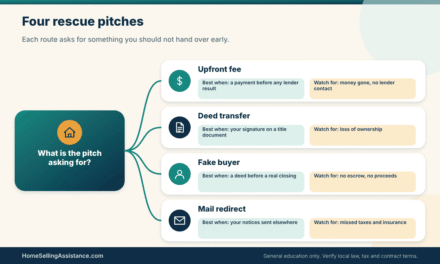
Red flags deserve a sentence of their own. Be wary of anyone who asks for an upfront fee to stop a foreclosure, tells you to stop talking to your servicer, or asks you to sign over the deed or to make payments to them instead. These are classic warning signs, and our guide to foreclosure rescue scams and the Federal Trade Commission’s consumer advice pages explain them in more detail.
The table below lines up common situations with the route that often fits and the reason. Use it as a conversation starter with a counselor, not a prescription. The final column matters most, because a single new fact can reverse the row you are in.
| Situation | Route often favored | Reason | Trade-off | Fact that changes the choice |
|---|---|---|---|---|
| Strong equity, six-plus months of runway | Regular listing or staying put | Time lets you prepare and price well | Showings and carrying costs continue | A written job offer |
| Some equity, runway under three months | Prompt listing, servicer talk in parallel | Shorter clock calls for earlier action | Less time to improve the house | Servicer approves a temporary pause |
| Temporary gap, likely new income soon | Forbearance or payment plan | Keeps the house if income returns | Missed amounts must be repaid somehow | Job search stretching past plan |
| Balance higher than likely sale price | Short sale talks, counselor and attorney review | Lender consent is required to sell | Credit effects and approval delays | Written release of remaining debt |
| Needs speed, house needs heavy repair | Cash buyer or investor, after verification | Fewer contingencies and quicker close | Offer is usually discounted | Proof of funds and contract terms |
| Moving for new work in another city | Relocation-style sale or rental | Timeline is driven by the new job | Two housing costs may overlap | Lease terms and landlord rules |
To use the table, find the row closest to you, read across, and then circle the last column. That column names the single fact worth confirming before you act. If two rows seem to fit, you are probably in a mixed situation, and a HUD-approved counselor or a local attorney can help you weigh them. If you are comparing renting with selling, our piece on whether to sell or rent your house covers the numbers that tend to matter.
Use a net-result decision rule
After you have gathered numbers and looked at the paths, you need a way to choose that does not depend on whoever spoke to you last. A net-result rule for anyone about to sell house after job loss is simply a habit: for every option, estimate what you keep, how long it takes, what it costs, and how likely it is to go wrong, then compare those four things side by side.
The rule is boring on purpose. Distress makes dramatic options look attractive, such as the buyer who promises to close in a week or the plan that promises to erase every problem. Boring arithmetic is a good defense against both.
The price, time, cost and risk framework for sell house after job loss decisions
Price is what the buyer pays. Cost is everything that comes off that price, plus everything you spend while your effort to sell house after job loss is underway. Time is the number of months you carry the house, including the stretch before listing. Risk is the chance that the route fails, delays, or leaves you owing something afterward. Every route has all four, and a route that wins on one usually loses a little on another.
A practical way to apply it is to write each option as a short line: expected net cash, expected months carried, main thing that could go wrong, and what you would do if it did. If you cannot fill in the last two, you do not yet understand the option well enough to pick it. The same discipline works whenever you sell house after job loss, whether you plan to list, negotiate with the servicer or accept an investor’s offer.
The rule also works as a sensitivity test. Change one input at a time and watch what happens: lower the price by a round figure, add a month of carrying cost, increase the repair estimate. If the ranking of your options flips after a small change, the decision is close and the details matter. If one option still wins after you stress it, you can act with more confidence. Running the test takes an evening and costs nothing, and it is a good habit whenever you sell house after job loss.

Evidence to gather: the numbers behind each option
Use the same inputs for every option so the comparison is fair. For a listing, use your net sheet. For a servicer plan, use the written terms and add the total of any repayment amounts. For a cash offer, use the written offer, minus any fees or repair deductions the buyer lists, and add the savings from skipped showings and shorter carrying time. For a short sale, include the time the lender needs to respond, and ask for the written terms on any remaining balance.
The matrix below shows the structure with illustrative notes rather than real figures, because your market and your contract decide the actual numbers. It compares a regular listing with a cash or investor sale, since those two are the most common head-to-head choice. A servicer plan or short sale can be added as extra columns using the same rows.
| Factor | Regular listing | Cash or investor sale | What to ask or check |
|---|---|---|---|
| Price and net proceeds | Often higher headline price, with listing and repair costs | Often lower offer, with fewer deductions | Written net sheet for both routes |
| Time to close | Prep, market time, then a contract period | Can be shorter if funds are real | Proof of funds and a firm closing date |
| Contingencies | Inspection, appraisal and financing may apply | Fewer, but terms vary by buyer | Every contingency written in the contract |
| Workload | Cleaning, showings, repairs, negotiation | One or two visits, less preparation | Who handles title, cleanup and repairs |
| Execution risk | Financing or appraisal can fall through | Buyer may re-trade price or vanish | Buyer track record and earnest money terms |
| Flexibility | Can cancel a contract only on its terms | Closing date and move-out may be negotiable | Rent-back or extended possession options |
Read each row across, then give each cell a rough score: better, similar or worse for your situation. Do not add up scores mechanically, because one row can outweigh the rest. If time is your scarcest resource, the time and workload rows may dominate. If equity is thin, the net proceeds row matters most. Our cornerstone article on a cash offer for a house goes deeper on the second column.
Remember that a number is only as good as its source. A price opinion from a friendly neighbor, a promise from a stranger on the phone and a printed estimate from a title company carry very different weight. Label each figure as a quote, an estimate or a guess, and update the label when better information arrives. This is also how you protect yourself from the quiet pressure of an offer that expires in two days.
A scenario, an exception, and your next step for the framework
Imagine two offers on the same house. One is a regular contract at a higher price with an appraisal and financing contingency, and another is an investor offer at a lower price with a quick closing. On paper the first nets more, so many sellers lean toward it. But if your runway ends in six weeks and financing could slip, the investor offer may leave you in a better place even at a lower net.
The exception is when the cash offer is vague. If the buyer cannot show funds, will not name a title company, or asks you to sign something before you have read it, the lower price comes with a higher risk, and the comparison changes.
Your next step: fill in the four lines for each option on one page, and share that page with a HUD-approved housing counselor or an attorney. They can often spot a missing cost or a flawed assumption in minutes, and the HUD housing counselor locator is a good place to find one.
When new evidence should change the plan
A decision made in week one is based on week-one facts. By week six you may know more about the job market, the servicer’s answers and the likely sale price. A good plan has built-in checkpoints where you ask a simple question: has anything happened that would have changed my choice if I had known it at the start?
Examples of that kind of evidence include a written job offer, a servicer denial or approval, a buyer who withdraws, an appraisal that comes in low, a change in benefits, a family member who can contribute, or a legal notice arriving in the mail. Write your trigger list now and tape it somewhere visible.
Evidence to gather: trigger dates, notices and new offers
Keep a simple log with dates: when you applied for benefits, when you called the servicer and whom you spoke to, what was promised, and when letters arrived. If a notice mentions a sale date, a response deadline or a court filing, put that date at the top of the page. State rules decide how much time follows a notice, so check your state attorney general, state housing finance agency or a local legal aid office for the actual timeline.
Save every written offer, including those you decline. A pattern of offers tells you something about the market, and a stack of letters from unsolicited “buyers” is itself a clue to how visible your situation has become. If you have an offer pending, set a calendar entry for each contract date, including the inspection response, the appraisal and the financing deadline.
For tax questions, remember that sale results depend on your basis, any improvements and the ownership and use tests. The IRS explains the general rules in Publication 523 on selling your home, and a tax professional can apply them to you. Our overview of taxes when selling a home offers a starting vocabulary.
A good counselor meeting is practical. Bring recent pay stubs or benefit letters, your last mortgage statement, a list of other debts, notices you have received and a short list of questions. Ask about options for your loan type, what the counselor sees in your budget, which deadlines worry them and which local resources, such as legal aid or state hardship funds, may apply. Take notes, and ask for a follow-up date. A plan to sell house after job loss works better when someone else has checked the arithmetic.
A scenario: a new job, a failed financing, or a legal notice
Say you list at a sensible price, and three weeks later a job offer arrives in writing, with a start date in a month. Should you pull the listing? The framework says to rerun the numbers: is the new income enough, and does the sale remain attractive for other reasons such as location or the cost of the home? Often the sensible answer is to pause new showings but honor the terms of any contract already signed.
Now say the buyer’s financing falls through. If the contract allows, your next step may be to ask your agent or attorney about the earnest money terms, notify any backup buyer, and decide whether to relist or extend. Our article on the strategies to sell a house before foreclosure describes how that same flexibility can matter when a legal deadline is approaching.
And if a legal notice arrives, do not ignore it. Contact a licensed attorney in your state or a legal aid office quickly, since deadlines to respond may be short. A housing counselor can help you gather documents, but the deadline itself is a legal matter. You can browse more related articles in our foreclosure and financial hardship library.
Finally, think about what happens after you sell house after job loss. If you sell with equity, the proceeds are not a windfall; they may need to cover moving costs, a deposit on a rental, and several months of expenses while the job search continues. Park the money somewhere safe and boring, and resist rushing into a purchase. Selling the house after a job loss can be the step that restores stability, and it works best when the next step is already sketched out.

Quick scenario
Dana, weighing whether to sell house after job loss, loses her job in March with about five months of savings. She calls her servicer, asks for a hardship review, requests a payoff quote and a net sheet, and sets a review date for the end of May. In May she has two interviews but no offer, so she lists the house with a closing target before her savings run out.
A June job offer arrives mid-contract; she keeps the sale because the numbers still favor it. The point is not the ending but the checkpoints: she always knew what would change her mind.
Frequently asked questions about sell house after job loss
Should I sell house after job loss right away?
Not necessarily. Choosing to sell house after job loss is a big step, and many people need a few weeks to measure their runway, talk to the servicer and learn what relief is available. A sensible middle path is to prepare as if you might sell house after job loss, by gathering documents and getting a payoff quote, while deciding on a review date. That keeps the option open without forcing it.
Will my mortgage servicer really work with me if I lose my income?
Before you sell house after job loss, remember that many servicers offer hardship options such as forbearance, repayment plans, deferrals or modifications, but which ones apply depends on your loan type and investor. Call early, ask what you qualify for, and request the answer in writing. If you feel stuck, a HUD-approved housing counselor can often help you prepare and communicate with the servicer.
How many missed payments can I have before foreclosure starts?
Federal servicing rules generally prevent a servicer from beginning the foreclosure process until a loan is more than 120 days delinquent, with some exceptions. After that point the steps and timing depend on your state, your loan documents and whether foreclosure runs through the courts. Do not assume you have a set number of months; check your state rules and any notice you receive.
Can I sell house after job loss if I owe more than the house is worth?
Sometimes, but not in the usual way. If the sale price will not cover the payoff and costs, the lender has to agree to accept less, which is called a short sale. Approval, timing and any remaining balance vary, so get terms in writing and ask an attorney about deficiency rules in your state. Our article on underwater mortgages and selling explains the choices.
Is a cash offer a good idea if I must sell house after job loss quickly?
It can be, if the buyer is real and the discount is one you can accept. Speed and price usually move in opposite directions, so compare the net result of a cash offer with a regular listing rather than looking at the quoted price alone. Verify proof of funds, the title company and the closing date before you sign anything.
What fees should make me walk away from a so-called rescue service?
Be cautious about any company that charges a large upfront fee, guarantees that it will stop foreclosure, tells you to stop contacting your servicer, or asks you to transfer title to it. Legitimate help, such as HUD-approved counseling, is generally low cost or free. The FTC and the CFPB both publish guidance on these warning signs, and the Consumer Financial Protection Bureau is a good starting point.
Do I owe taxes if I sell house after job loss?
It depends on your gain, your ownership and use history, and whether any debt is forgiven in a short sale. Federal rules allow many homeowners to exclude a portion of gain if they meet the ownership and use tests, but details matter. Read the IRS guidance and talk with a qualified tax professional before you rely on any outcome.
Can I rent the house instead of selling it?
Sometimes, though your loan terms, insurance and local landlord rules all matter. Some mortgages require you to live in the home, and rental income can be uncertain. Compare the monthly cost of carrying the house as a rental with the cash you would get if you sell house after job loss, and decide how long you are willing to be a landlord.
How can a housing counselor help me sell house after job loss wisely?
A HUD-approved counselor can review your budget, explain servicer options, help you assemble paperwork and talk through the pros and cons of selling versus staying. They are not a substitute for a lawyer, but they can offer neutral perspective at low or no cost. Use the HUD locator and ask what fees, if any, apply before your first session.
What should I do first this week to sell house after job loss on good terms?
Write down your monthly burn and your runway, call the servicer to ask about hardship options, request a payoff quote, and set a decision date. If you have received any legal notice, contact an attorney or a legal aid office right away. These steps cost little and they keep every option available while you decide.
A calm way to decide
Choosing whether to sell house after job loss does not need to happen in a panic. Measure your runway, talk to the servicer, compare paths by net result, and decide in advance what new facts will change your mind. Reach for free, neutral help rather than quick fixes, and keep your paperwork in order. This article is general education, not legal, tax or financial advice, so confirm state and local rules with a licensed attorney, tax professional or HUD-approved housing counselor before you act.