A divorce capital gains house sale sounds like one tax question, but it is really a chain of smaller ones: who owns the home, who lived in it and for how long, what the house cost you over the years, and whether the sale or the transfer happens before or after the marriage legally ends. Answer those in order and a divorce capital gains house sale usually gets much calmer to think about.
Most people arrive here after hearing something half true from a neighbor, a coworker or an online forum. “You get a free pass on taxes when you divorce.” “The house is only taxed if you make more than a quarter million.” “Whoever keeps the house keeps the tax bill.” Each of those has a grain of truth buried in it, and each can steer you wrong if you apply it to the wrong facts.
This article explains the rules behind a divorce capital gains house sale in plain language: the transfer rule that lets spouses move a home between them without immediate tax, the home-sale exclusion for a main home, the idea of tax basis, and the records that tie them together. It is general education. It will not tell you what you personally owe, because that depends on facts only you, your documents and a qualified tax professional can pin down.
We will use round, clearly labelled example numbers so the mechanics are visible. They are not predictions, benchmarks or averages. Your own cost history, sale price, selling expenses and timeline will differ, and so may your state’s treatment of the sale.
If you are still choosing between selling and keeping the house, think of this article as one piece of that larger decision. The tax side of a divorce capital gains house sale is only one input next to the equity split, the mortgage and the needs of any children. You can browse related topics in our home sale taxes category and our divorce and co-owned homes category.
One more framing point helps. A divorce capital gains house sale rarely involves a single tax event, since the sale, the transfer between spouses and the later filing of returns can each fall in a different year. Reading the rules with those separate moments in mind makes the whole subject less intimidating, and it makes your conversations with professionals shorter and cheaper.
Key takeaways
- A transfer between spouses is not the same as a sale to a stranger. Federal law generally treats a transfer between spouses, or between former spouses when it is tied to the divorce, as non-taxable at the time it happens.
- The tax is often postponed, not erased. The spouse who receives the home usually takes over the original owner’s tax basis, so the built-in gain travels with the house.
- The main-home exclusion is tested person by person. Ownership and use periods, a prior exclusion within two years and your filing status all matter.
- Basis is a paper trail, not a guess. Purchase documents, improvement receipts and selling costs decide how big the gain looks on paper.
- Keep the file even after the decree. A divorce capital gains house sale can be questioned years later, so the divorce paperwork, deeds, closing statements and improvement records may be needed years later.
- Verify with current IRS publications and a professional. Rules, thresholds and state treatment can change, and your facts are specific to you.
Define the tax question before any divorce capital gains house sale math
Before you plug a single number into a calculator, it helps to name the exact event you are dealing with. Three very different things can happen to a marital home in a divorce capital gains house sale discussion, and each carries its own tax logic: the house is sold to an outside buyer, one spouse buys out the other, or the home is transferred under the divorce paperwork and sold much later.
People often blur these together, then wonder why advice from different sources contradicts itself. A divorce capital gains house sale to a third party is a sale, with an amount realized, a basis and a possible gain. A buyout between spouses is governed by a different transfer rule. Naming the event first keeps you from applying the wrong rulebook.
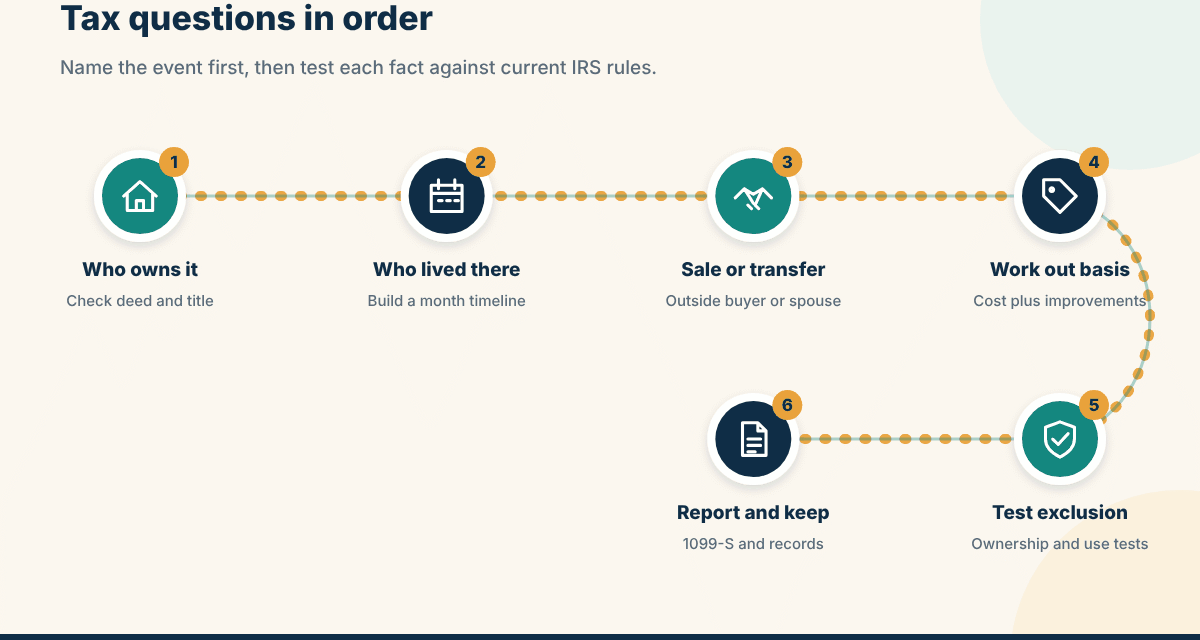
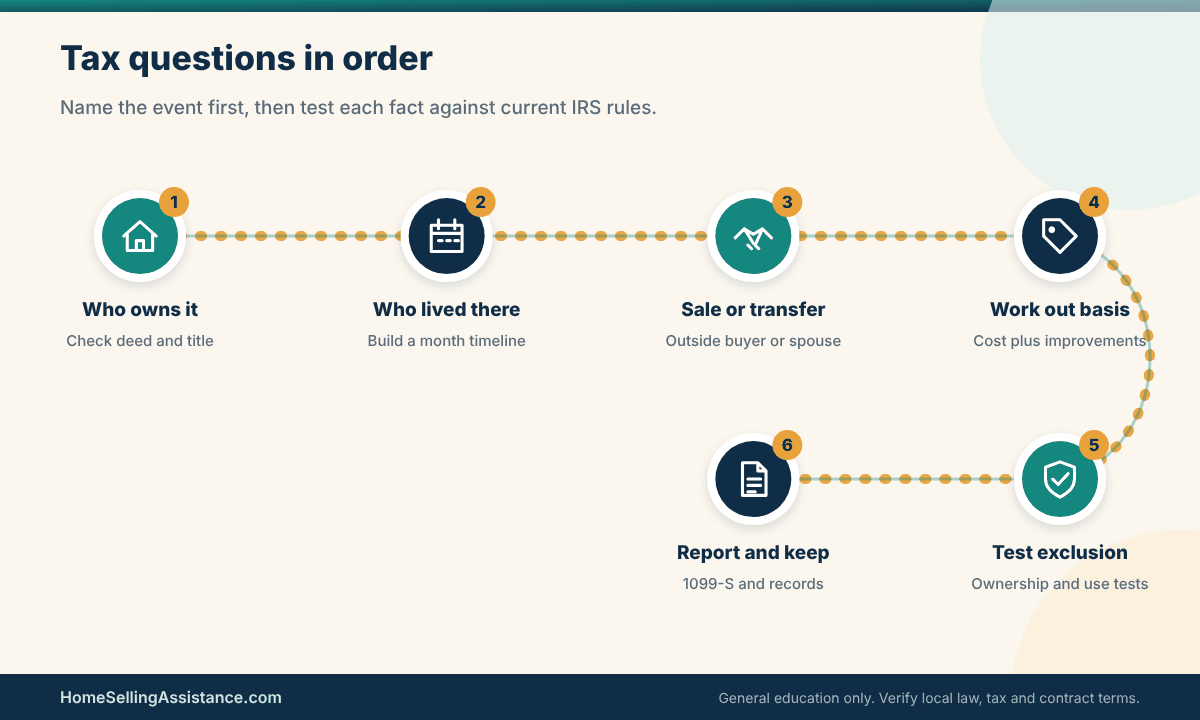
The picture below shows the sequence of questions we will follow, from the facts you hold to the paperwork you keep. Treat it as a map, because we return to each stop in the sections that follow.
The facts behind a divorce capital gains house sale: ownership, use and basis
Three fact groups carry almost all of the weight. The first is ownership: whose names are on the deed, how title is held, and whether anything changed after the wedding, such as adding a spouse through a quitclaim deed. The second is use: who actually lived in the home as a main home, and during which months. The third is basis, which is the tax-world word for what the house cost you in total, including the stuff you added.
These facts rarely line up neatly. One spouse may have owned the house before the marriage. Another may have moved into a rental months before filing. Someone may have paid for a kitchen remodel with an inheritance. Each wrinkle can matter, so write the timeline down in plain sentences before anyone starts quoting rules at you.
It also helps to separate what you know from what you assume. You may know that the house was bought in a certain year, and assume that the improvements were all done early. A divorce capital gains house sale often turns on exactly that kind of detail, and the difference between a documented fact and a good guess can change both the numbers and how comfortable a preparer feels signing a return.
Evidence to gather: deed, purchase file and a month-by-month residence timeline
Start with the deed that shows how title is held and the recorded date. If you cannot find your copy, the county recorder or land records office for the county where the property sits can usually provide one, sometimes for a modest copy fee. Add the closing statement from the purchase, because it shows the price and the settlement charges that may belong in your basis.
Then build a residence timeline. Make a simple calendar from the purchase date to today and mark who slept at the house, who moved out, and when. Back it up with objective records such as utility bills, a driver’s license address, voter registration, tax returns and mail. The IRS looks at facts, not just statements, when it asks where you really lived.
If memory is the only source for a date, flag it as an estimate and look for a record that can confirm it. Dates drift in a stressful year, and a one-month error can sometimes change the answer on the two-year test. A spouse who has moved out can often ask the other spouse for copies, or a lawyer can request them as part of the exchange of financial information in the case.
A scenario, an exception, and your next step on ownership and use
Picture a couple who bought a house together, with both names on the deed, and lived there for six years. One spouse moved out eighteen months ago when the separation began, while the other stayed. Both are still owners, but only one has kept living there. Whether the departing spouse still counts as using the home depends on what the divorce or separation instrument says and on the dates involved.
The exception worth knowing is that federal rules can treat a spouse as still using the home during a period when a divorce or separation instrument gives the other spouse the right to live there. That language is easy to miss in a decree, and it can protect the two-year use test for the spouse who left. IRS Publication 523 explains the details, and the wording of your own agreement controls.
Your next step in any divorce capital gains house sale is small: pull the deed, the purchase closing statement and any draft or signed agreement, then put the residence dates beside them on one page. That single page lets a tax preparer answer in minutes questions that would otherwise take hours of back and forth.
Spotting the exclusion and reporting issues in a divorce capital gains house sale
The federal main-home exclusion lets a seller keep a set amount of gain out of income. For a single filer, the exclusion is up to $250,000 of gain, and for a qualifying married couple filing together, it is up to $500,000. To qualify, you generally must have owned the home and used it as your main home for at least two of the five years before the sale. Those two years do not need to be consecutive.
The word “potential” matters. Nothing is automatic. You must meet the tests, you cannot have used the exclusion on another home within the previous two years, and the numbers above are ceilings on the gain, not payments you receive. A sale with gain below the ceiling may produce no tax on that gain. A sale with gain above it leaves only the excess exposed.
Reporting is a separate question from taxation in a divorce capital gains house sale. Even when no tax is due, a sale can generate paperwork, so it helps to know the difference between owing tax and having to tell the IRS the sale happened. The settlement agent may also file an information return with the IRS, depending on what you certify at the closing table.
Think of it as two separate lanes. In the tax lane, you decide whether any gain remains after the exclusion. In the paperwork lane, you decide what gets reported and by whom. A well-run divorce capital gains house sale keeps both lanes moving at once, because discovering at filing time that a form was never requested is a frustrating way to learn the difference.
Evidence to gather: tax returns, filing status and prior home sales
Look at your last few tax returns first. They show your filing status, and your status on the last day of the tax year is what generally counts. A couple who are still legally married on December 31 can usually file jointly or separately, while a couple whose divorce is final before that date files as single or head of household if qualified. That date can change the exclusion math for the year of the sale.
Next, check for any earlier home sale by either spouse within the last two years. The exclusion generally cannot be claimed again within that window, and each spouse is tested on their own history. A spouse who sold a previous home and claimed the exclusion last year may find that they personally cannot claim it again yet, even if their ex-spouse still can.
Finally, gather any Form 1099-S you or your spouse received or expect to receive. It reports gross proceeds from the sale, and it will not tell you your gain, because it knows nothing about your basis. Compare it with the closing statement, and ask the settlement agent which names and taxpayer identification numbers were reported.
A scenario, an exception, and your next step on the exclusion
Take two spouses planning a divorce capital gains house sale to an outside buyer. If they are still married at year end and both meet the use test, they may be able to claim the larger exclusion on a joint return. If the divorce is final before December 31, each is a single filer, and each can generally claim up to $250,000 on their own share, provided each qualifies on their own.
Here is where the exception bites. Suppose one spouse moved out three and a half years ago with no instrument giving the other spouse the home, and the sale closes this year. That spouse may have used the house for only one and a half of the last five years. Without relief, they may not meet the two-year use test.
There are partial-exclusion rules for certain qualifying reasons for selling early, and divorce can be among the circumstances IRS guidance recognizes. Those rules prorate the exclusion rather than hand it over whole. Your next step is to test the dates against Publication 523 and ask your preparer to run both versions.
Timing is the lever many couples overlook. Closing a few weeks earlier or later can shift the tax year, the filing status and the number of months counted toward the use test. That does not mean you should rush or stall a sale for tax reasons alone. It means a divorce capital gains house sale deserves a calendar, and the calendar deserves a second opinion from someone who knows the rules.
Use current IRS rules and records to check your divorce capital gains house sale
Tax rules for a divorce capital gains house sale are only as useful as the numbers you feed them. Once the facts are straight, the next job is to line up the current IRS guidance with the paper that proves your cost, your selling expenses and your dates. Rules and dollar thresholds can be adjusted by Congress, and guidance is revised from time to time, so treat any article, including this one, as a starting point and confirm against the IRS itself.
The IRS publishes plain-language guides for a divorce capital gains house sale and its neighbors. Publication 523, Selling Your Home, covers the exclusion, the ownership and use tests and the gain calculation. Publication 504, Divorced or Separated Individuals, covers property transfers between spouses, and Publication 551, Basis of Assets, explains how cost is tracked over time.
The records and calculations behind a divorce capital gains house sale
There are two tax ideas you need to hold side by side. The first is the transfer rule often called Section 1041. In general, when property moves between spouses, or between former spouses in a transfer connected to the divorce, no gain or loss is recognized at that moment. The IRS generally treats the transfer like a gift for income tax purposes, even if money changes hands for the other spouse’s share.
The second idea is carryover basis. The spouse who receives the home generally steps into the shoes of the one who transferred it, taking the same adjusted basis rather than a fresh one based on today’s value. That is why people say the tax is postponed, not forgiven. The gain that built up before the transfer can still show up when the receiving spouse eventually sells to someone else.
A divorce capital gains house sale to an outside buyer works differently, because there the house is truly sold. The gain is the amount realized minus the adjusted basis, and the exclusion, if you qualify, reduces the part that is taxed. The table below pulls the main inputs into one place so you can see what each one does and what proves it.
| Input | Assumption or source | Cash-flow or tax effect | Uncertainty | Verification document |
|---|---|---|---|---|
| Purchase price and buying costs | Original closing statement | Starts your basis | Which fees count | Purchase closing statement |
| Capital improvements | Receipts, permits, invoices | Raises basis, may shrink gain | Repair vs. improvement | Receipts and contracts |
| Selling expenses | Sale closing statement | Lowers amount realized | Final figures can shift | Final settlement statement |
| Ownership and use months | Residence timeline | Decides exclusion eligibility | Move-out dates, decree wording | Bills, returns, decree |
| Filing status at year end | Marital status on Dec. 31 | Joint or single exclusion ceiling | Timing of final decree | Decree and prior returns |
| Spousal buyout payment | Agreement and appraisal | Usually no tax at transfer | Carryover basis later | Agreement, deed, basis worksheet |
| Depreciation taken | Past returns if any rental or office use | May be taxed despite exclusion | Partial-use history | Prior-year returns |
Use the matrix as a worksheet. For each row, decide whether you already have the document, and if not, who can supply it. The rows with the biggest uncertainty are usually the ones that deserve a conversation with a tax preparer first, since a small change in an input can change the outcome for the whole sale.
A few of those rows deserve a second look. The “filing status” row is the one people forget, because the divorce date feels like a legal event and not a tax event. Yet your status on the last day of the year can decide which exclusion ceiling applies to a divorce capital gains house sale that closes shortly before or after the decree.
Calculation to run: adjusted basis, amount realized and gain, step by step
Here is the arithmetic in four lines, using made-up round numbers. Suppose the home was bought for $300,000 and the buying closing costs that belong in basis were $6,000. Over the years the owners spent $44,000 on genuine improvements such as a new roof, a finished basement and replacement windows. Their adjusted basis is $350,000.
Now suppose the house sells for $620,000, and selling expenses such as the broker commission, title charges, transfer taxes and legal fees tied to the sale total $40,000. The amount realized is $580,000. Subtract the $350,000 basis and the gain is $230,000. If two qualifying owners each take a $250,000 exclusion, the gain falls inside the combined ceiling in this example.
The next picture follows the same flow from sale price down to a possible taxable gain. It is a structure, not a promise, because the dollar amounts in your own sale will differ at every step.
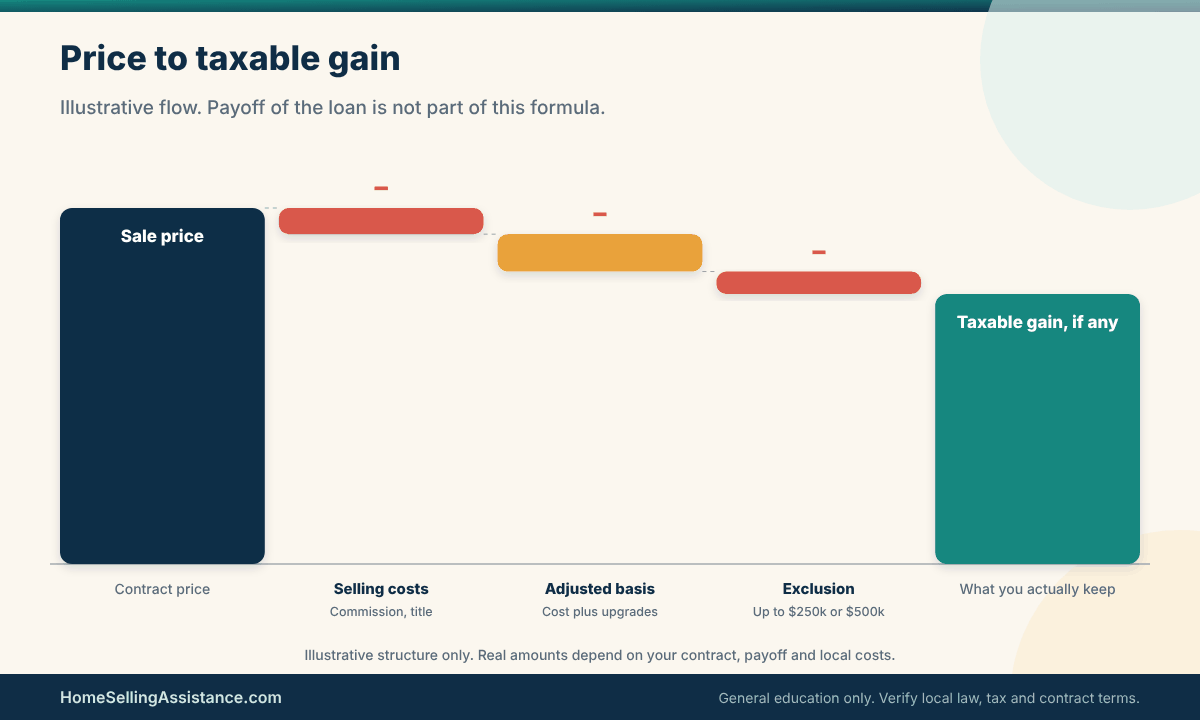
Notice what is not in the formula. The mortgage payoff does not reduce your gain, because paying off a loan returns borrowed money rather than creating a cost of the home. Likewise, routine maintenance like repainting a bedroom or fixing a leaky faucet generally does not raise basis. Pub 551 and Pub 523 draw the line between repairs and improvements, and a preparer can help with the gray cases.
The same discipline applies to any state-level numbers you add. Your state may tax the gain differently, may charge a transfer tax at closing, or may require its own form. Keep those figures in a separate column from the federal ones so you can see each layer clearly. A divorce capital gains house sale in a state with its own income tax can produce a different result than the same sale in a state without one.
Cash and tax are also different things, and mixing them up is a classic mistake. You can owe no tax on a sale and still walk away with little cash because the mortgage and costs consumed the proceeds. You can also receive plenty of cash and owe tax on part of it. Our guide to selling costs and capital gain on a home helps you keep the two straight.
A scenario, an exception, and your next step on a buyout and carryover basis
Imagine one spouse keeps the house and pays the other spouse a share of the equity through a refinance. Under the transfer rule, that payment is generally not a taxable sale to the spouse who transfers out, and the spouse who keeps the home takes the original basis for the half they receive. Say the shared basis was $350,000, so the keeping spouse ends up with that same $350,000 carried over.
Years later, the keeping spouse sells for $780,000 with $45,000 of selling costs. The amount realized is $735,000, and the gain is $385,000 in this example. A single owner who qualifies might exclude up to $250,000, leaving $135,000 exposed to tax. The gain that built up while the couple owned the home together has quietly become one person’s issue.
That is not a reason to avoid a buyout in a divorce capital gains house sale plan, only a reason to price it with open eyes. When you compare a buyout with a sale, ask a preparer to estimate the tax that might be waiting inside the home. Our guides on how a divorce house buyout calculation works and on buying out a spouse versus selling show where that estimate fits next to the equity figures.
Exceptions and uncertainty that can change a divorce capital gains house sale
Even a clean set of facts has edges. Federal rules include several conditions that reduce or complicate the exclusion, and state tax law sits on top of that. A divorce capital gains house sale involves two taxpayers, each with a history, so the odds that at least one of them has an unusual wrinkle are higher than in a simple one-owner sale.
The honest summary of a divorce capital gains house sale is this: for many ordinary couples who lived in a home as their main residence and sold within a normal window, the federal exclusion handles most or all of the gain. For others, a rental period, a home office, a prior sale, a long gap since someone moved out or a very large gain can change that picture. The skill is spotting which group you are in before you sign.
Evidence to gather: depreciation, rental or office use, and state rules
If any part of the home was ever rented, or if a home office was used for business and depreciation was claimed, that depreciation generally has to be accounted for when you sell. The exclusion does not necessarily wipe out depreciation taken after the mid-1990s, and the portion of gain tied to it may be taxed. Publication 527, Residential Rental Property, is the place to start reading.
Pull old returns and look for Form 8829, Schedule E or a depreciation schedule. Look as well for any period when the home sat empty, was rented to a tenant, or was used mostly by one spouse for business. Your tax preparer’s old files may be the fastest source if you used one, and many preparers keep records for several years.
For state taxes, check your state revenue department’s website or ask a local preparer how your state treats home-sale gains and the federal exclusion. Some states follow federal rules closely, some adjust them, and a few have no broad income tax. Local transfer taxes and recording fees, which sometimes land on the seller, are a separate matter and are set by state or county rules.
Also consider whether the sale is a one-time event or part of a bigger change in how you hold property. A divorce capital gains house sale that follows a quitclaim deed, a refinance and a move may involve three or four different dates. Lay them in order, and ask the preparer which of them actually matter for the tax, so you are not paying for review of dates that do not change anything.
A scenario, an exception, and your next step on gray areas
In a divorce capital gains house sale, consider a spouse who rented out the basement apartment of the family home for several years, claimed depreciation on that portion, and then separated. When the home is sold, part of the gain may relate to that depreciation, and the exclusion may not cover it. Neither spouse may have thought about the basement tenants since the lease ended, yet the tax record remembers them.
Another gray area is the spouse who moved out and rented a place for several years while the house stayed in joint names, with no decree granting the other spouse use. The longer that gap runs, the less certain the use test becomes. People in this spot sometimes sell sooner to keep the dates working for them, while others pursue partial relief, and both choices have trade-offs.
The fallback path below shows how to test the dates when someone moved out early, one question at a time.
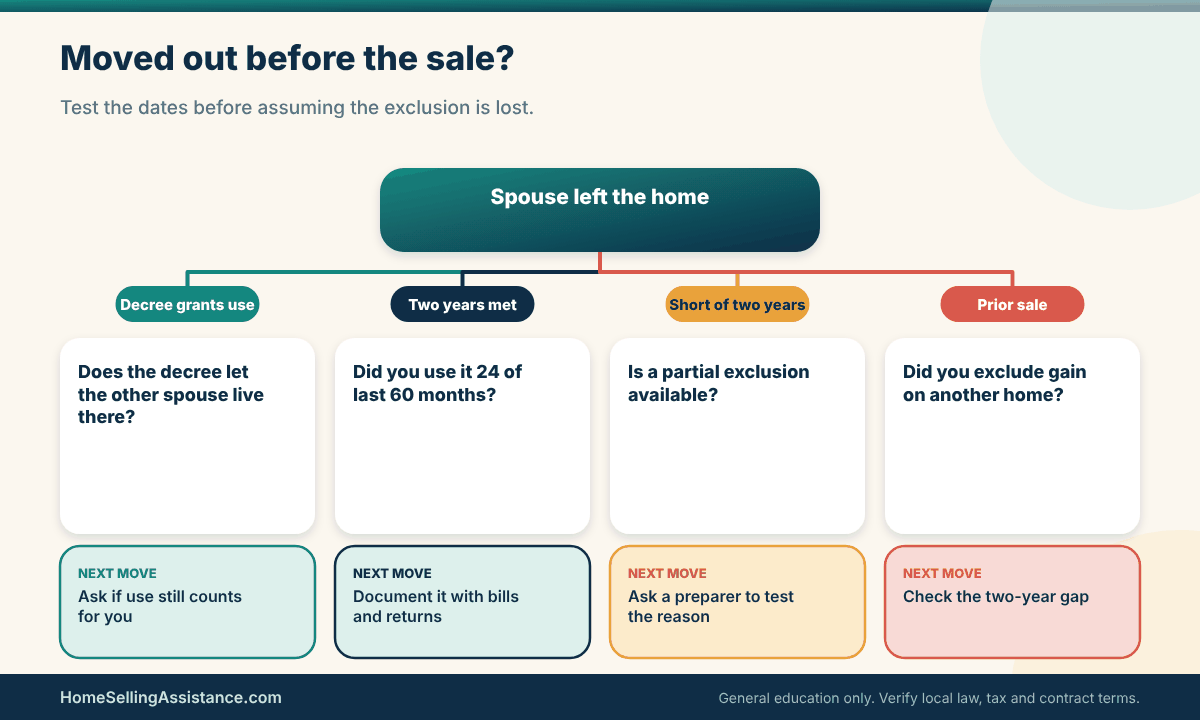
The next step is to write your gray areas down as questions, not conclusions. “Did we ever claim depreciation on any part of the house?” and “Does the decree say who may use the home until it sells?” are the kinds of questions a preparer can answer quickly if you bring documents, and they save you from paying for guesses.
Uncertainty is not a failure of preparation. Even careful people end up with a few open items in a divorce capital gains house sale, such as a lost receipt or an unclear move-out month. The goal is to shrink the open items to a short, honest list, so that a professional can say which ones matter and which can safely be treated as estimates.
Escalate fact-specific tax decisions in a divorce capital gains house sale
General education about a divorce capital gains house sale can take you to the edge of your own situation, but not across it. Somewhere between “I understand the exclusion” and “I know what I will owe,” there is a gap that only a professional with your documents can close. Knowing when to bring one in, and what to ask, is a real skill and one of the cheapest ways to protect a large asset.
Two kinds of professionals tend to matter. A tax preparer, enrolled agent or CPA works out the tax side: basis, exclusion, depreciation and reporting. A family law attorney handles the agreement itself: who gets the home, who pays the tax, and what the decree says about use and sale. The best outcomes usually come when the two talk before the paperwork is signed, not after.
Mediators and collaborative-process professionals can also help, since they often bring the tax questions to the table early. Whether you work with attorneys, a mediator or both, ask who will own the tax questions in your divorce capital gains house sale, so that the task does not fall between professionals who each assume the other is covering it.
Professional questions for a divorce capital gains house sale
Good questions about a divorce capital gains house sale save time and money, since professionals bill by the hour and every minute spent guessing what you are asking is a minute you pay for. Arrive with your timeline, your basis worksheet and your draft agreement, then ask questions that force specific answers rather than general reassurance.
It also helps to ask each professional the same core question and compare. If the attorney says the agreement leaves the tax with one spouse and the preparer says that the tax could be large, you have learned something valuable about the deal before it is final. Our overview of divorce home sale taxes covers the wider tax picture beyond this single asset.
Evidence to gather: a question list and the documents that support each question
Bring your questions in writing, grouped by topic. For the exclusion, ask whether each spouse meets the ownership and use tests on the dates you have, and whether any prior sale in the last two years blocks either of you. For basis, ask which closing costs and improvements belong in the number and how to document the ones you cannot find receipts for.
For the buyout, ask what the carryover basis is, what gain may be embedded in the half being transferred, and how that could affect a fair equity split. For timing, ask whether closing before or after the decree changes filing status, and whether a partial exclusion could apply. For reporting, ask who should receive the Form 1099-S and what should be certified at closing.
Attach one page for each question: the deed for ownership, the closing statement for basis, the timeline for use, and the draft agreement for the buyout language. A preparer who can see everything on a few pages tends to give narrower, more useful answers than one who has to reconstruct your history from conversation.
Use the next table to compare common seller situations side by side. The numbers inside are examples that show direction, not forecasts, and each row ends with a professional question you can lift straight into your meeting notes.
| Seller situation | Sale, loan or tax assumption | Estimated effect | Key risk | Professional question |
|---|---|---|---|---|
| Sell to outside buyer, still married | Joint return, both meet use test | Larger exclusion may apply | Year-end status changes | Which filing status fits us? |
| Sell after decree, both lived there | Each files single, half the gain each | Each may use own exclusion | One spouse fails a test | Does each of us qualify alone? |
| One spouse moved out years ago | No decree granting use to other | Move-out spouse may lose full exclusion | Two-year use test | Is a partial exclusion available? |
| Spouse buys out the other | Refinance funds the payout | No tax at transfer, carryover basis | Gain waits inside the home | How should future tax affect the split? |
| Home partly rented, depreciation claimed | Basement unit rented earlier | Some gain may be taxed anyway | Recapture surprise | How much gain relates to depreciation? |
| Prior home sold last year | One spouse used the exclusion | That spouse may be blocked for now | Two-year rule | Should closing dates move? |
Read the table from left to right as a story: here is who you are, here is the assumption, here is the likely direction, here is what could go wrong, and here is what to ask. If your own situation fits none of the rows, that is a sign to bring the full facts to a professional rather than adapt the nearest row yourself.
A scenario, an exception, and your next step on getting the right help
Suppose a couple planning a divorce capital gains house sale has negotiated a deal in which one spouse keeps the house and the other takes retirement account funds of equal face value. It sounds even, and the spreadsheet says it is. But retirement dollars carry their own future tax, and house equity carries its own embedded gain, so two assets that look equal today may not be equal after the tax bill arrives.
The exception is that some agreements deliberately accept the imbalance for good reasons, such as stability for children or a desire to end the dispute. That is a legitimate choice if both sides understand what they are trading. The risk is the choice made without the numbers.
Your next step is to ask the preparer for a rough range of the embedded tax for each side’s assets, using your actual documents, before the agreement is final. Courts and mediators also tend to prefer agreements that account for known tax costs, though practices vary by state, so ask your attorney how that works where you live. For a wider view of how the money is split, see our guide to dividing home sale proceeds in a divorce.

Quick scenario
Maria and Dev bought their home years ago and agreed in mediation that Maria keeps it. Neither asked about basis. Several years later Maria sells and learns that the gain carried over from the original purchase is larger than she expected, and only one person’s exclusion is available to her. A fifteen-minute question to a preparer before the agreement was signed would have given both of them a chance to adjust the split.
The lesson is not that anyone acted badly. In many couples’ first divorce capital gains house sale, the tax conversation simply never happens until the closing is near, and by then the agreement is fixed. Raising the question while terms are still open keeps options available, including adjusting the split, timing the sale or agreeing on who bears a later tax bill.
Records to preserve after a divorce capital gains house sale
Documents for a divorce capital gains house sale tend to get lost at exactly the wrong time. Files move out with whoever moves out, email accounts change, and the folder of receipts that once sat in a kitchen drawer goes to the person who did not do the remodeling. Yet those records can matter years later, when the person who kept the house sells and the preparer asks how much the new roof cost.
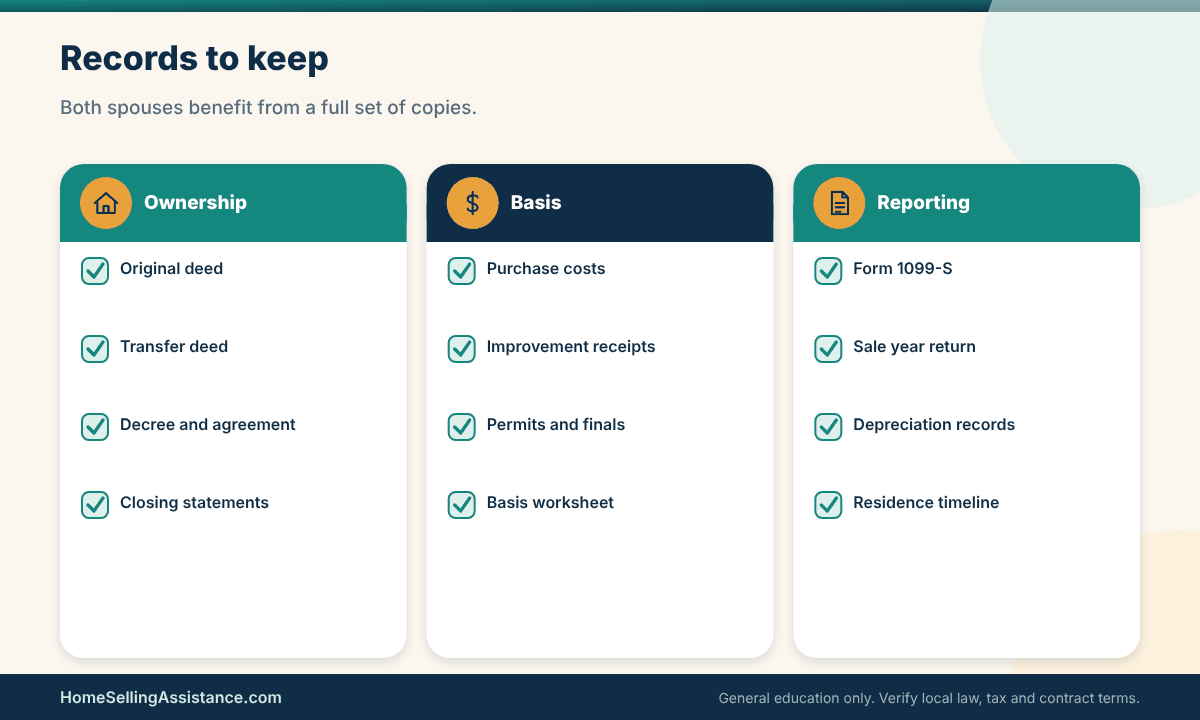
Make records for the divorce capital gains house sale part of the divorce checklist rather than an afterthought. Both spouses benefit from a complete copy of the key records, because one of them may need to prove something the other no longer has. Agreeing on who keeps originals and who receives copies can be written into the agreement or handled as a simple side arrangement.
A shared records plan also lowers conflict. When each side knows the other can reach the documents, there is less to argue about later, and a future divorce capital gains house sale or refinance goes more smoothly. If trust is thin, a neutral third party such as a mediator or an attorney’s office can hold a set of copies for both of you.
Evidence to gather: the core records and how long to keep them
Keep the purchase closing statement, the deed and any later deeds, including the transfer deed made under the divorce. Keep receipts and contracts for improvements, along with permits and final approvals when they exist. Keep the decree, the marital settlement agreement and any court orders about the home, since they explain why a transfer happened and when.
Keep the settlement statement from the sale, the Form 1099-S, and your own worksheet showing how you computed the gain. Keep the tax returns for the sale year and the years in which any depreciation was claimed. IRS guidance in Publication 523 suggests holding home records for as long as you own the home, and then for the period after the sale during which a return could be reviewed. See our guide to home sale tax records for a fuller list.
Digital copies help. Scan paper receipts, store them in a cloud folder both spouses can reach, and name files with dates and descriptions so that a preparer five years from now can understand them without a tour. If you used a bank account or card for a major improvement, note that too, because statements can back up a missing receipt.
A scenario, an exception, and your next step on keeping the file alive
Imagine a divorce capital gains house sale that happens nine years after a spouse kept the house. The prior spouse is long gone, the contractor has closed, and the receipts are in a box in a storage unit that was cleared out when the lease ended. The seller now has to reconstruct improvements from bank statements, permit records and old photographs. It is possible, but slow, and a conservative preparer may count only what can be proven.
The exception is that some improvements leave public traces. County permit offices often keep records of major work, and building departments can sometimes confirm that a permit was issued and closed. These are helpful, though they do not replace a receipt showing what you actually paid.
Your next step toward a clean divorce capital gains house sale is to create a shared records folder now, while the information is fresh and both spouses are still reachable. Even in a tense separation, an exchange of copies handled through attorneys or mediators is usually possible, and it benefits both of you. For the bigger sale picture, our walkthrough of selling a house during a divorce shows where this step sits in the timeline.
Frequently asked questions about divorce capital gains house sale
Is a divorce capital gains house sale taxed differently from any other home sale?
The tax formula is the same: amount realized minus adjusted basis, then the exclusion if you qualify. What changes is that two owners are involved, each with their own history and filing status. A transfer between spouses incident to the divorce follows a separate rule and is generally not taxed when it happens. Check Publications 504 and 523 for the details.
Do we owe tax if one of us signs the house over to the other?
In general, a transfer between spouses, or between former spouses when it is connected to the divorce, is not a taxable event at that moment, even if money is paid for the other spouse’s share. The receiving spouse usually takes the original basis. That means the gain is postponed rather than removed. Your own agreement and dates matter, so ask a preparer to confirm that your transfer fits the rule.
Can both of us still claim the exclusion after we divorce?
Often each spouse can claim up to the single-filer amount on their own share, if each meets the ownership and use tests and has not used the exclusion on another home within the last two years. Each person is tested separately. A spouse who moved out long ago, or who sold another home recently, may fall short even when the other spouse qualifies. Run the dates for each of you.
What if I moved out before the sale?
The two-of-five-year use test looks back from the sale date, so a long gap can erode eligibility. Federal rules can treat a spouse as still using the home while the other spouse has the right to live there under a divorce or separation instrument. The wording of your agreement therefore matters a lot. If the dates are close, ask a professional whether partial relief might apply.
Does the mortgage payoff reduce my taxable gain?
No, not directly. Paying off a mortgage returns money you borrowed, and it is not a cost of the house. Your gain is built from the selling price, selling expenses and adjusted basis. The payoff does matter a great deal for the cash you walk away with, which is a separate question covered in our guide to home sale net proceeds.
Which costs can raise my basis or lower my gain?
Generally, certain purchase closing costs and genuine capital improvements raise basis, and selling expenses such as commissions and some transfer charges reduce the amount realized. Routine repairs usually do not count. The line between a repair and an improvement can be fine, so read Publications 551 and 523 and keep receipts. Our guide to home improvements and cost basis gives examples.
Will the buyer or the title company report my sale to the IRS?
The settlement agent may file Form 1099-S, depending on the facts and on what you certify at closing. Receiving the form does not by itself mean you owe tax, because it shows proceeds and not gain. If you do not receive one, you may still have a reporting duty in some cases. Ask the closing agent what they will file and under which names.
Who pays the tax if the agreement says one spouse keeps the house?
The spouse who sells later generally reports the gain on their own return, using the carried-over basis. The agreement can address who bears that cost, but the IRS looks to the taxpayer who sells. If the future tax is large, it can be fair to account for it when dividing assets. A family law attorney and a preparer can model this before you sign.
Do state taxes apply to a divorce home sale?
They can. States differ on whether and how they tax capital gains, and on local transfer taxes, recording fees and filing rules. Some states largely follow federal treatment of the exclusion and some do not. Check your state revenue department’s website, ask a local tax professional, and confirm any transfer-tax rules with the county recorder or your title company.
When should I talk to a professional about my divorce capital gains house sale?
Ideally before you sign a settlement agreement or a listing contract, since both can lock in tax consequences. A preparer can review dates, basis and filing status, while an attorney can check the language in the decree. If you already signed, still ask, because some issues can be handled in the way you report or time the sale. A short consultation usually costs far less than a surprise.
Where to go from here
A divorce capital gains house sale comes down to a few facts, a few rules and a good paper trail. Write your timeline, gather your basis records, read the IRS publications linked above, and bring a clear list of questions to a qualified preparer and your family law attorney. This article is general education, not legal, tax or financial advice, and your own result depends on your facts, your state and the current rules.