A seller closing statement is the final accounting of your sale: one document, usually a few pages long, that shows every dollar coming in from the buyer, every dollar going out to lenders, agents, title companies and taxing bodies, and the number that is left for you.
Most sellers meet this document late. The contract was signed weeks ago, the inspection is behind you, the movers are booked, and then a set of pages arrives from the title company or closing attorney with columns, abbreviations and line numbers that look nothing like the simple math you did on a napkin when you decided to sell. It is easy to skim it, trust it and sign. It is also the single best moment to catch a mistake while fixing one is still cheap.
This guide teaches you to read a seller closing statement the way a careful closer does. We will talk about what goes in the debit column and what goes in the credit column, how a mortgage payoff differs from the balance on your last statement, why prorations move money between you and the buyer, and how to confirm the net funds you expect before anything is signed. Everything here is general education. Forms, line names and local customs differ between states and even between title offices.
If you want the wider picture of what a sale costs you, our cornerstone article on seller closing costs sets the frame, and this article zooms in on the one document where all of those costs finally become real numbers. Think of it as the receipt for the entire transaction, and a receipt is only useful if you actually check it.
Key takeaways
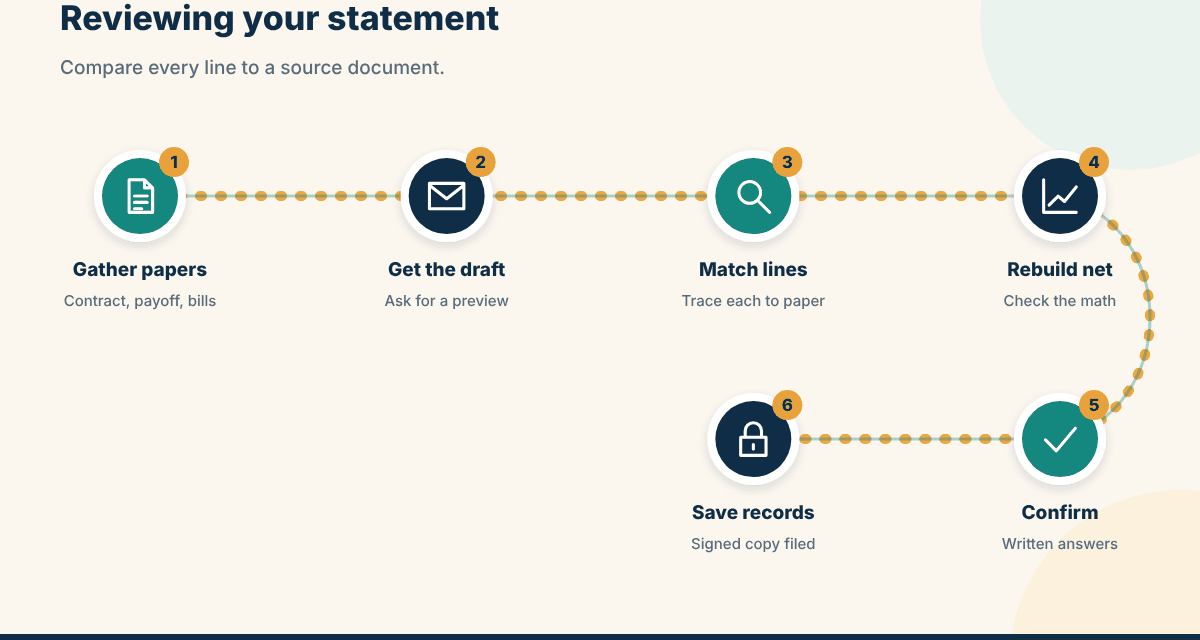
- Ask for the draft early. A seller closing statement can usually be previewed before closing day, and a calm review a few days ahead beats a rushed one at the signing table.
- Compare it to your contract line by line. Price, credits, concessions, deposit handling and who pays for what should all trace back to a signed document.
- The payoff is a quote, not your balance. Interest accrues daily, so the figure on the statement should match a written payoff letter good through the closing date.
- Prorations are a fairness mechanism. Taxes, HOA dues and similar items are split by who owned the home on which days, and the method comes from the contract and local custom.
- Net funds is arithmetic you can check. Total credits minus total debits should equal the cash to you, and you can rebuild that on one sheet of paper.
- Keep the final version. The signed statement is a core tax and legal record, so store it with the deed and contract.
Build your file before the seller closing statement arrives
A closing statement is only as accurate as the information fed into it. The title company or closing attorney pulls numbers from your contract, from your lender, from the county, from your agent’s commission paperwork and from any HOA or management company involved. If any one of those inputs is stale or wrong, the error lands on your page. Your best protection when the seller closing statement lands is a small file of your own, assembled before the draft shows up, so that you can compare rather than simply read.
You do not need a binder or a spreadsheet with forty tabs. You need a handful of source documents, a short list of phone numbers and a calendar with the dates that matter. The next two sections cover what to put in the file and how to spot the gaps early, while there is still time to fill them.

Documents, numbers and contacts that explain every line
Start with the signed purchase contract and every addendum, amendment and counteroffer attached to it. The final agreed price, the earnest money amount, any seller concession toward the buyer’s costs, any repair credit, the closing date, the possession terms and the allocation of title and escrow fees all live there. When a line on the statement looks surprising, the contract is the first place to look, and an honest closer will be happy to point to the clause that supports the number.
Next, gather the loan side. For your seller closing statement, that means your most recent mortgage statement, the lender’s contact for payoff requests, and the account details for any second loan, home equity line or other recorded lien. Add the most recent property tax bill, any special assessment notices, and the latest HOA or condo statement, including the management company’s contact. Finally, note your agent’s listing agreement, because the compensation terms written there feed the commission lines. For a deeper look at how those payoff figures are produced, see our guide to the mortgage payoff when selling a house.
Evidence to gather: payoff, tax bill, HOA and contract
Think of four stacks for your seller closing statement. The first is the contract stack, including all amendments, because a late change to a credit or a closing date is the most common reason a draft disagrees with your memory. The second is the payoff stack: a written payoff letter or demand from each lender, with a per diem interest figure and a good-through date. The third is the tax and assessment stack, showing the billing period, the amount, and whether it has been paid. The fourth is the association stack.
For each stack, write down where the number on your paper should appear on the statement. A payoff of a stated amount should show as a single deduction, usually under a heading about loan payoffs. On the seller closing statement, the tax bill should show up as a proration or a payment, depending on timing. Association dues, transfer fees and any capital contribution should be tied to a statement from the association itself, not to someone’s estimate. This small mapping exercise takes perhaps twenty minutes and makes the draft readable.
Contacts matter as much as paper. Keep the name, direct phone line and email of the closer or escrow officer, the loan servicer’s payoff department, your agent or attorney, and the HOA manager. When a figure needs to change, you will want to reach a human quickly, and the fastest fix is nearly always a short written request to the person who produced the number.
A scenario where the draft figures do not match your records
Here is an illustrative case with round numbers. Suppose your contract price is $400,000, and your own napkin math assumed a loan payoff of about $210,000. The draft shows $214,300 under payoff. Before you worry, remember that your balance on the last statement did not include interest accrued since that statement, and it did not include any payoff or reconveyance fee the lender charges. A difference of a few thousand dollars can be perfectly legitimate.
On any seller closing statement, the question is whether the figure is documented. Ask the closer for the payoff letter used and compare its total and good-through date to the draft. If the letter supports the figure, you are done. If the closer used an old letter, a stale per diem or a figure that does not match the lender’s written demand, ask for a corrected version. The scenario teaches a habit: when a number differs from your records, trace it to a document rather than to your memory or your mood.
Information still missing when the draft arrives
Even a well-prepared seller sometimes receives a draft with blanks or placeholders. Lines marked “TBD”, estimates for a tax bill that has not been issued, a commission figure shown as a rounded placeholder, or a utility final reading that has not occurred are all normal at the preview stage. They are not mistakes. They are reminders that the final seller closing statement is built from facts that finish arriving right up to the closing date.
Your job is to list what is still open, learn who owns each open item, and put a date next to it. A seller who leaves those questions until the signing appointment has very little room to fix anything. A seller who emails a short list two or three days earlier usually gets a clean answer and a revised seller closing statement before the day arrives.
What to request, and from whom, in plain terms
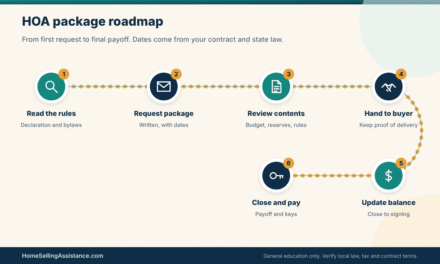
Keep requests about your seller closing statement short and specific. To the closer: “Please send the draft seller closing statement and the payoff letter you relied on, and tell me which lines are estimates.” To your agent or attorney: “Please confirm that the commission and any concession lines match our signed agreements.” To your servicer: “Please send a written payoff good through the scheduled closing date plus five days, with the daily interest amount.” To the association: “Please send the current dues status, any transfer or resale fees, and any special assessment.”
Notice that none of those requests ask for an opinion. They ask for documents. Documents are the currency of a closing, and a request framed around paper is hard to ignore and easy to answer. If a request goes unanswered for a business day or two, follow up by phone and then confirm the conversation in a short email, so that you have a written trail of what you asked and what you were told.
An exception, and what to do if answers come late
Sometimes the missing item cannot be supplied before closing. A county may not have issued a supplemental tax bill, or an association may be slow with a statement. Closers handle this in different ways. Some estimate and hold a small amount back in escrow until the real number arrives, some ask both sides to sign a post-closing adjustment agreement, and in some places the practice is to close on the best available figure with no later true-up.
Do not guess which approach applies to you. Ask the closer how an unresolved item will be handled, ask for that answer in writing, and ask who will contact you afterward and by when. If the amount at stake is large relative to your proceeds, consider whether to talk with a real estate attorney in your state before you sign. That is a judgment call, and you are allowed to make it.
Reading a seller closing statement line by line
Once your file is ready, the seller closing statement becomes much less intimidating. Most seller closing statements, whatever the software or the state, follow the same logic. There is a header with the property, parties, closing date and settlement agent. There is a column for the seller and a column for the buyer. Within the seller side there are entries that increase what you are owed, called credits, and entries that reduce it, called debits or charges. At the bottom there is a balance: cash due to you, or in rarer cases cash due from you.
The language differs. Some closers use a single combined sheet with four money columns. Others produce a separate seller-only statement. Federal rules require a standardized closing disclosure for most buyer-side mortgage loans, but the seller’s document is often a separate form, and cash purchases or other transactions can use different layouts altogether. Because of that variation, learn the logic and not the layout. The logic is the same everywhere.
Before going deeper, here is a workflow table. It shows the stages a seller moves through while a statement takes shape, what to have in hand at each stage, what to do, by when, and who gets the next handoff. Use it as a calendar prompt rather than a rulebook, since your contract dates and local customs will set the real deadlines.
| Stage or symptom | Information to gather | Action | Decision deadline | Next handoff |
|---|---|---|---|---|
| Contract signed, no draft yet | Contract, addenda, listing agreement | Ask closer for timeline and preview date | Within days of acceptance | Closer or escrow officer |
| Payoff figure unclear | Mortgage statement, servicer contact | Request written payoff with daily interest | Before draft is finalized | Loan servicer, then closer |
| Draft arrives with estimates | Tax bill, HOA statement, utility dates | List each estimated line and its owner | Several days before closing | Closer, HOA manager, county |
| A line differs from the contract | Signed amendment or credit agreement | Send clause reference in writing | At least one business day before signing | Agent or attorney, closer |
| Final figures received | Revised statement, wire instructions | Rebuild net funds, verify payment method | Before the signing appointment | Signing officer |
| Signed and funded | Signed statement, recording confirmation | Confirm payoff and file records | Following closing, per local timing | Your records folder |
Read across a row and you will see a single thread: something is unclear, you gather the proof, you ask for a correction in writing, and then someone else carries it forward. The deadline column is deliberately soft. Your purchase contract may fix a date for delivering documents, and some states require specific delivery periods, so check with your agent, attorney or closing office for the real clock on your file.

Credits and debits: how the two columns work
On a seller closing statement, the sale price is the largest credit. Other credits can include a proration refund for taxes you prepaid, a credit for your share of unused prepaid items where local custom allows, and sometimes a return of money you paid in advance to an association. Debits include your loan payoff, the real estate commissions you agreed to pay, title and escrow charges allocated to the seller, recording or transfer charges the contract assigns to you, and any credit you gave the buyer.
A useful way to read any seller closing statement is to ask, for each line, which direction money moves. If the buyer is receiving value from you, such as a repair credit or a concession toward their costs, it is a debit on your side and often also appears as a credit on the buyer’s side. If you are receiving a refund of something you paid ahead, it is a credit on your side. When a line seems to sit in the wrong column, you have probably spotted either a real error or a formatting quirk worth asking about.
Pay special attention to the earnest money deposit on the seller closing statement. It is part of the buyer’s funds, held by the closer or a broker, and it usually appears on the buyer side as a credit toward their purchase. It does not normally appear as an extra payment to you on top of the price. Sellers sometimes believe it is being “left out” of their proceeds, when it is already inside the price. For more on how deposits work, see our guide to earnest money for sellers.
Calculation check: rebuilding the totals yourself
You can verify the bottom line of a seller closing statement with a plain sheet of paper. Write the sale price at the top. Subtract the payoff figure. Subtract the commission lines shown for your side. Subtract the title, escrow, recording and any transfer charges allocated to you. Subtract any buyer credits or concessions. Then add or subtract prorations according to which direction they run. Your result should match the cash to seller within a few cents. If it does not, find the gap before you sign.
Here is an illustrative set of round numbers, not a forecast. Sale price of $400,000. Payoff of $214,000. Commission lines totaling $20,000. Title and escrow charges of $3,000. Transfer and recording charges of $1,500. A buyer concession of $4,000. A tax proration owed to the buyer of $1,200. Subtracting everything leaves $156,300. Every one of those inputs is invented for the exercise. Your own file will have different amounts, different names and probably different line items.
The point of rebuilding a seller closing statement is the method. When your rebuilt number matches the closer’s number, you have confirmed the arithmetic, though not necessarily the inputs. If it does not match, do not assume your sheet is the one that is wrong. Walk down both lists together, line by line, and either they will converge or you will find the entry that explains the difference. Our guide on the seller closing cost calculator method goes deeper on building a reliable estimate before any draft exists.
Scenario: a credit that appears on the wrong side
Imagine your contract says, and your seller closing statement should reflect, you will give the buyer a $4,000 credit toward their closing costs. On the draft, you see $4,000 listed as a credit to the seller. That looks like money coming to you, and a hopeful eye might read it as good news. A careful eye notices that the direction is the opposite of what the contract says, and that the net funds figure is about $8,000 higher than your own rebuilt number.
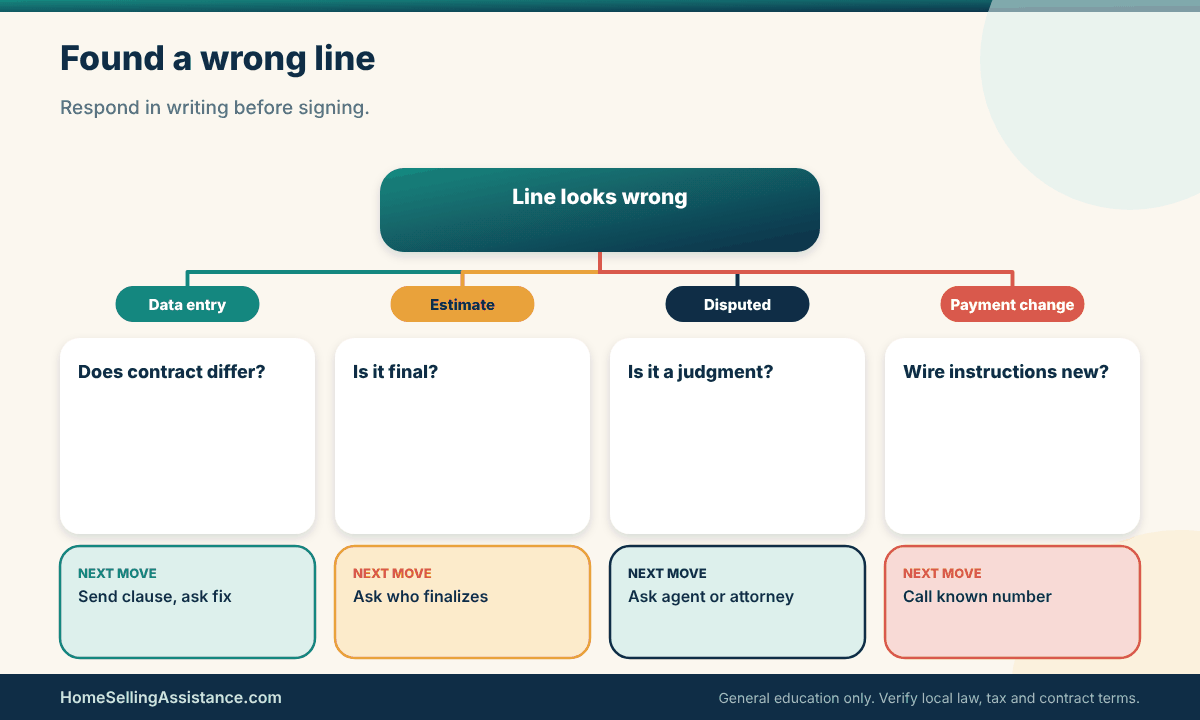
Do not celebrate and do not stay quiet. An error in your favor is still an error, and it will be found, usually before funding, sometimes after. Email the closer with the contract clause, say the line appears to be in the wrong column, and ask for a corrected draft. Quick, written, specific. Corrected paperwork protects everyone, including you, because a post-closing demand to return money is a far worse conversation than a pre-closing correction.
Payoff, prorations and negotiated items
Three kinds of lines cause most confusion on a seller closing statement: the loan payoff, prorations, and items that came out of negotiation. The payoff is confusing because it is not the balance. Prorations are confusing because they involve dates and billing periods that do not line up with the calendar. Negotiated items are confusing because they come from a document you may not have looked at for weeks. Take them one at a time and the page becomes readable.
On the payoff, expect your seller closing statement to show principal, interest to the closing date, and sometimes a recording or release fee, a payoff statement fee, or a small amount for items such as an escrow shortage. If you have an escrow account with your lender, any remaining balance in it is usually refunded to you by the servicer separately, often after closing, and does not appear on the statement. This detail trips up many sellers who expect to see it. Our sibling guide to home sale net proceeds covers how to plan for those refunds.
Prorations allocate recurring costs between buyer and seller based on who owned the property during the period. Property taxes are the classic case, but HOA dues, certain assessments, fuel left in a tank, and rents in a tenant-occupied sale can all be prorated. Whether the proration uses a thirty-day month or the actual days, whether taxes are billed in arrears or in advance, and which date counts as the split are all set by contract and local practice. Our focused article on property tax proration for sellers walks through the typical arrangements.

Evidence for each prorated and negotiated line
For every prorated line on the seller closing statement, ask for the worksheet or at least the inputs: the annual or periodic amount, the billing period, the proration date, and the day-count method. A trustworthy closer will provide these without fuss. Then verify them against the tax bill or association statement in your file. If the statement says taxes are prorated using an estimate, ask whether a true-up is planned once the real bill is issued, and write down the answer.
For negotiated items on a seller closing statement, the evidence is the signed document itself. A concession should trace to a clause or addendum. A repair credit should trace to a signed repair agreement or amendment. A home warranty, if you agreed to provide one, should trace to the contract and an invoice. If a negotiated item appears without any paper behind it, ask who requested it. You are not accusing anyone by asking. The question is routine, and it keeps the file clean.
Be careful with the categories sellers and buyers sometimes mix up. A seller concession toward closing costs and a repair credit are not the same thing, even though both reduce your proceeds. They can be treated differently by the buyer’s lender and in later tax recordkeeping. If you want to understand the difference in practice, read our explainer on seller concessions in a home sale and the comparison of a repair credit versus a seller repair.
Scenario: a repair credit counted twice
Picture this on a seller closing statement. After inspection, you agreed to a $2,500 credit instead of doing a repair. The amendment was signed. On the draft statement, you see a $2,500 debit labeled as a repair credit, and then another $2,500 debit labeled as a closing cost credit to the buyer. Your records show only one agreement. Net funds is $2,500 lower than your napkin figure.
The first step is to ask whether two separate agreements exist, perhaps one in the amendment and another in a lender-required adjustment. If so, the contract trail will show it. If not, the closer or the buyer’s side may have entered the same credit under two names. Send the signed amendment, point to the two lines, and ask for a corrected draft. Keep your tone neutral. Double entries are one of the most common data-entry slips, and they are fixed with a short email and a revised page.
Closing the loop on your seller closing statement
By the time the revised seller closing statement reaches you, the hardest part is behind you. What remains is a final confirmation that the numbers, the payment method and the paperwork all line up, followed by a few habits that protect you after the keys change hands. This last stretch is where sellers either feel calm or feel rushed, and the difference is usually whether they asked for their confirmations in writing a few days earlier.
The table below is a transaction check. It lists the issues that most often surface at the end of a sale, the evidence you can bring, the input you may need from the buyer’s side, the agent or the title office, the risk if the item is ignored, and a sensible fallback. Treat it as a prompt for questions, not as a diagnosis, because your contract and your state’s customs decide which of these actually apply to you.
| Issue | Seller evidence | Buyer, agent or title input | Risk if ignored | Fallback |
|---|---|---|---|---|
| Payoff differs from expectation | Payoff letter, last loan statement | Closer confirms letter used and date | Short payoff leaves lien open | Request updated letter, adjust before funding |
| Proration looks off | Tax bill, HOA statement, contract clause | Closer shares proration worksheet | Over- or under-paying your share | Written true-up agreement after closing |
| Credit or concession mismatch | Signed amendment or addendum | Agent confirms both sides match | Net funds lower than agreed | Corrected draft before signing |
| Commission line unclear | Listing agreement, buyer-agent terms in writing | Agent or broker confirms amounts | Wrong amount paid from proceeds | Hold item until broker signs off |
| Wire instructions changed | Original instructions from closer | Verified call to known number | Funds sent to a fraudster | Stop, call the office directly, report |
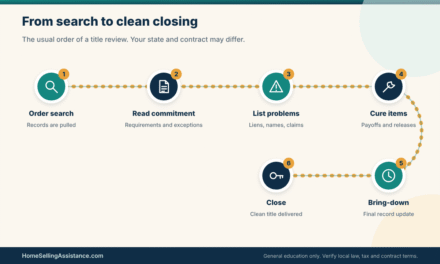
| Missing release or payoff for second lien | Lien records, loan documents | Title shows recorded liens | Closing delayed or title issue | Obtain payoff or release before closing |
Two rows of this seller closing statement check deserve extra emphasis. The wire row matters because proceeds fraud is real and the consequences are severe, which is why we give it its own article. The lien row matters because a statement that omits a recorded lien can quietly set up trouble that shows up months later. If any row in this table describes your file, put the fallback into an email today instead of keeping it in your head.
What to confirm in writing before you sign
A short written confirmation list takes ten minutes and prevents most closing-day surprises. Ask the closer to confirm, in a reply email, that the draft seller closing statement reflects the final signed contract and all amendments, that each lender payoff is supported by a current written payoff letter, that prorations use the stated method and inputs, that commission lines match your signed agreements, and that the net funds figure is what you will receive and by which method.
That last item deserves its own attention. Some closers wire proceeds the same day, some issue a cashier’s check at the table, and some wait for recording or a lender’s funding confirmation. The method and timing are not on the statement itself, so ask. Our article on when the seller gets money after closing explains the usual patterns, and the guide to seller proceeds by wire versus check covers the tradeoffs.
Evidence to gather: signed contract, payoff letters and the final draft
Before the appointment, assemble a short packet for your seller closing statement: the contract with all amendments, each payoff letter, the tax and association statements, the agent’s compensation paperwork, and the final draft. Put them in the order of the statement lines if you can. When you sit down with the signing officer, you can point to the supporting paper for any line you question, and the officer can answer in seconds rather than hunting through emails.
Also bring or have ready the identification and authority documents the closer requested. If title is held in a trust, an estate or an entity, the closer will want proof of who may sign. If someone is signing under a power of attorney, the closer may need the recorded or original document well ahead of time. These are not paperwork games. They are what allows the buyer’s title insurance to be issued and your deed to be accepted for recording.
Finally, confirm the practical logistics in the same email thread. What time and where is signing? Is a notary or remote signing involved? Who needs to be present? If a co-owner cannot attend, how will their signature be handled? A seller closing statement with perfect numbers cannot close if a required signer is on a plane, so use this email to remove avoidable uncertainty.
A scenario, an exception, and your next step
Consider an illustrative situation. Two days before closing, you receive an email that appears to come from the title office, saying the wire instructions on the earlier paperwork have changed and asking you to reply with your account information for the new process. The sender name is close to the closer’s name, but the email domain is slightly different. You were about to answer quickly because you were busy packing.
Stop. Do not reply, do not click links and do not send account details. Find the phone number for the title office from your original paperwork or the company’s own website, call it, and ask whether any change was made. Then forward the suspicious email to the real contact. If you sent anything, contact your bank immediately and report the incident through the FBI’s Internet Crime Complaint Center. The guide to real estate wire fraud for sellers explains the warning signs in more depth.
Records and follow-up after closing
Signing a seller closing statement is not quite the end. After closing, three things typically happen in the background: the buyer’s lender funds, the title company disburses, and the deed and your loan release are recorded. Each step can take a little time. Your job after closing is small but real: confirm that your lender was paid and the lien released, confirm that you received the correct net funds, and file the paperwork where you can find it in years to come.
Many sellers feel the urge to throw out paper the moment a sale is done. Resist it. The final signed seller closing statement, the contract, the deed, the payoff confirmation and records of improvements are exactly what you or an accountant will want if questions arise later about taxes, title or a dispute over a prorated amount. You do not need to understand every tax rule today. You only need to keep the evidence.
On the tax side, the seller closing statement is a primary source for the selling price and for selling expenses. The IRS explains how a home sale is reported in Publication 523, and the exclusion rules, ownership and use tests and basis adjustments are for a tax professional or the IRS itself to apply to your facts. Our library on home sale taxes offers general background, and our article on home sale tax records lists what to save.
Evidence to gather: payoff confirmation, recording and funds received
After closing, ask your servicer for written confirmation that the loan is paid in full and that the lien will be, or has been, released. Timing varies by state and lender, and some release documents are recorded weeks later. Put a reminder in your calendar a month out. If you have not received a payoff confirmation or release notice by then, contact the servicer and the title company and ask for the status in writing.
Next, compare the funds that arrived in your account to the net funds figure on the signed statement. They should match exactly. Small differences can happen when a bank fee is deducted or when a proration true-up is scheduled, but any gap should be explained in writing. Also look for any refund coming from your lender’s escrow account, which is usually a separate payment sent to you by the servicer after the loan is closed.
Last, check for anything left on the statement as “to be adjusted” or “estimated”. Ask the closer who owns the final number, how it will be calculated and by when you should hear. A short follow-up email a few weeks after closing keeps loose ends from becoming forgotten ones. If a final tax bill or utility reading comes in, you want to be the one who asked about it, not the one surprised by it.
Scenario: a tax true-up arrives after closing
Here is an illustrative example. Your seller closing statement used last year’s tax bill as an estimate and the closer noted that a true-up would occur once the current bill was issued. Two months after closing, the closer emails you and the buyer with a revised proration worksheet. The new bill is higher, and your share of the difference is a few hundred dollars. The email asks you to send a check.
Do not pay on reflex and do not ignore it. Compare the worksheet to the post-closing adjustment language you signed, if any. Check the billing period and day count against the actual bill, and confirm the payment instructions by calling a known number, since post-closing adjustment emails are also a favorite disguise for scams. If the math and the paperwork agree, pay it promptly. If they do not, reply in writing with the specific discrepancy and ask for a corrected worksheet.

A final, quieter habit helps. Create one digital folder and one paper folder for the sale. Scan the signed seller closing statement, the deed, the payoff confirmation, the contract and amendments, receipts for significant improvements, and the agent’s final commission paperwork. Name the files plainly. When someone asks for a document years from now, you will find it in a minute, and that minute is worth more than it sounds.
Quick scenario
A seller reviews the draft three days before closing and notices the HOA transfer fee is listed at a different amount than the association’s statement. A short email with the association’s statement attached goes to the closer. The closer confirms the association updated its fee schedule, issues a revised draft that day, and the seller signs a corrected statement. Nothing dramatic happened. The seller simply compared the statement to the source document, and that comparison is the whole skill.
It helps to name the mistakes that show up most often, because once you know their shapes they are easy to catch. The first mistake on a seller closing statement is trusting the title of a line instead of its meaning. A line called “seller credit” might be a credit to you or a credit you are giving the buyer, and only the column and the contract can tell you which. The second is comparing the draft to your memory of the deal instead of to the signed paper. Memory drifts, especially after weeks of negotiation and several amendments.
The third mistake is treating an estimate as a final number. A seller closing statement can contain legitimate estimates, such as a tax proration or a final water bill, and each one deserves a note about who will finalize it and when. The fourth is letting the signing appointment be the first time you look at the document. Even a half hour of seller closing statement review at home, with your contract beside you, changes the experience entirely. You ask better questions, you stay calmer, and you are far more likely to notice a line that does not belong.
The fifth mistake is the subtle one: assuming the closer works for you alone. Title and escrow officers are neutral parties who follow the contract and the instructions of both sides, and many are careful and helpful, but they are not your advocate. If a question calls for judgment, such as whether a credit is fair or whether to accept a post-closing adjustment, your agent or a real estate attorney in your state is the right person to ask. The closer can show you what the document says, and that is a different job from telling you what to decide.
A last practical point about the seller closing statement concerns liens and old paperwork. If you have ever taken out a home equity line, a second loan or a contractor financing agreement secured by the house, make sure each one appears in your payoff stack even if you stopped using it years ago. A dormant line of credit is still a recorded lien until it is paid and released.
Our guide on selling a house with a lien explains how those claims are found and cleared, and our piece on the title search in a home sale shows where they come from.
Finally, remember that your seller closing statement may carry charges that associations and municipalities can bill sellers in ways that surprise people. Resale certificates, capital contributions, transfer fees and statement fees are examples. If your property is in an association, the article on HOA resale fees for sellers will help you understand what typically appears, and you can browse more material in our closing costs and net proceeds category. For a consumer-protection perspective on mortgage closings in general, the Consumer Financial Protection Bureau publishes plain-language resources.
Frequently asked questions about seller closing statement
What is a seller closing statement, in simple terms?
It is the closing-day accounting for the seller’s side of a home sale. It lists the sale price, the payoff of your loans, the commissions and fees you pay, any credits to or from the buyer, prorations, and the net cash you receive. Different offices call it a settlement statement, a seller statement or a closing disclosure for the seller, and the layout varies.
When should I see the draft seller closing statement?
Ask for a preview as early as the closer will allow, ideally several days before closing. Some offices send a draft after the lender’s figures are final, and some states or contracts set delivery timing. Your agent, attorney or closing office can tell you what applies. An early draft gives you time to compare it to your contract and to correct any errors calmly.
Why is my payoff higher than the balance on my last statement?
Interest accrues daily, so the payoff includes interest up to the closing date. It can also include small fees for processing the payoff or releasing the lien. Your lender produces the exact figure in a written payoff letter with a good-through date and a per diem amount, and that letter is what the closer should use.
What are prorations and why do they exist?
Prorations divide recurring costs between you and the buyer based on who owned the home during the billing period. Property taxes and association dues are common examples. The method, including the day-count approach and the proration date, comes from your contract and local custom, so ask the closer to show the inputs.
Where is the earnest money on my statement?
Earnest money is typically held by a broker or the closing office and credited to the buyer toward the purchase price. It does not usually appear as an additional payment to you on top of the price. If a deposit is held by a broker and released in a special way, your contract describes how, so check the deposit clause.
What if I find an error on my seller closing statement?
Tell the closer promptly and in writing, point to the contract clause or document that supports your view, and ask for a corrected draft. Do this even when the error seems to favor you, since a later correction can be more awkward. If the issue is a matter of interpretation rather than data entry, consult your agent or a real estate attorney.
Can the numbers change on closing day?
Yes, within limits. Final figures such as lender payoffs, per diem interest, utility readings or a tax estimate can be updated up to the last moment, and the closer may issue a revised version. That is why you ask for the latest draft, review any changes, and confirm the net funds number again before signing.
How do I know the wire or check for my proceeds is safe?
Confirm payment instructions by calling a phone number you already trust, such as one from your original paperwork or the company’s own website. Be suspicious of last-minute changes sent only by email. If something looks wrong, stop and contact the closing office directly, and consider reporting it to the FTC or the FBI’s Internet Crime Complaint Center.
What should I keep after closing?
Keep the signed seller closing statement, the contract with every amendment, the deed, loan payoff confirmation, records of improvements and any post-closing adjustment correspondence. These documents help with taxes, title questions and disputes. A tax professional can tell you how they apply to your situation, and the IRS explains home-sale reporting in its publications.
Do I need an attorney to review my seller closing statement?
Not always. Some states routinely use attorneys at closing, and others rely on title or escrow companies. If your statement has large unexplained items, a complicated payoff, an estate or trust signer, or a dispute with the buyer, a short consultation with a licensed real estate attorney in your state can be worth considering.
Your next step with the seller closing statement
A seller closing statement rewards the seller who prepared a little, asked in writing and compared every line to a source document. You do not need to be an accountant to read one. You need your contract, your payoff letter, a calm half hour and a willingness to ask the closer a plain question. Everything in this article is general education, not legal, tax or financial advice, so check the details with your agent, a real estate attorney or a tax professional where your facts require it.