An escalation clause seller decision looks simple on the surface: a buyer promises to pay a little more than any competing offer, up to a ceiling, and you get to sit back while the price climbs. In practice, that single sentence in a purchase contract carries a surprising amount of machinery, and the seller who accepts it without reading the mechanics can end up with less certainty than a plain, lower, cleaner offer would have given.
Escalation clauses became familiar in fast, crowded markets, where buyers worried about being outbid by a few thousand dollars and sellers worried about leaving money on the table. They still appear whenever several buyers chase the same listing. The escalation clause seller idea is not shady and it is not magic. It is a pricing formula written into a contract, and like any formula it has inputs, limits, and places where the wording can quietly change who benefits.
This escalation clause seller guide is written for you as the owner of the house. We will look at what an escalation clause actually says, who has to prove what, how the cap interacts with an appraisal, what happens when everything works and when it does not, and which questions are worth asking before you sign. Where we use dollar figures, they are round illustrative numbers, never a forecast of your price. Your contract, your state rules and your own advisers decide the real answers.
One note on perspective. We stay neutral about whether you use an agent, an attorney or sell on your own. What matters is that somebody who has read your actual contract form looks at the exact escalation wording before you accept it. If you are weighing several bids at once, the broader process is covered in our guide to evaluating a home offer as a seller, and this article zooms in on one clause inside that larger decision.
Key takeaways
- It is a formula, not a price. The offer is only as firm as the starting figure, the increment, the cap and the proof requirement written into the contract.
- The cap is the real offer. Treat the maximum price as the number you are negotiating, because the clause only matters if competition pushes the price that far.
- Proof is part of the deal. Decide in advance what evidence of a competing offer you can share, what you must keep confidential, and who will check the math.
- Appraisal still applies. A higher contract price does not make the home appraise higher, so look at how the buyer plans to cover any shortfall.
- Ambiguity favors nobody. Unclear wording about which offers count, how increments stack and what documents are required invites disputes near closing.
- Get a professional read. An agent, real estate attorney or title company that knows your local forms should review the clause before you accept or counter.
Reading an escalation clause seller offer line by line
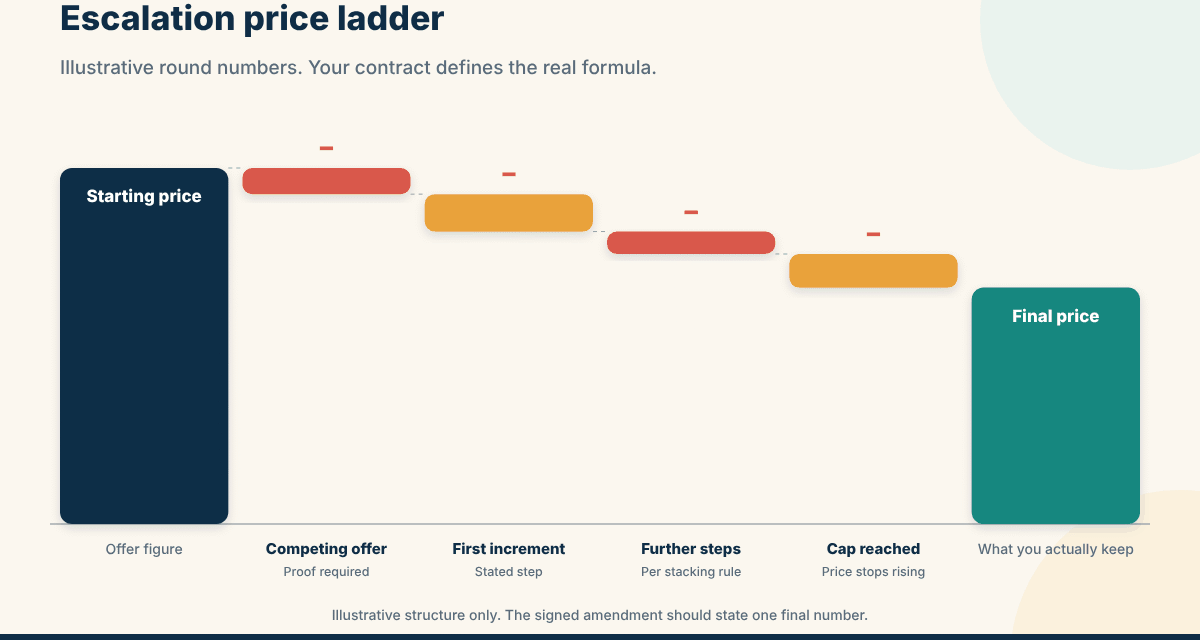
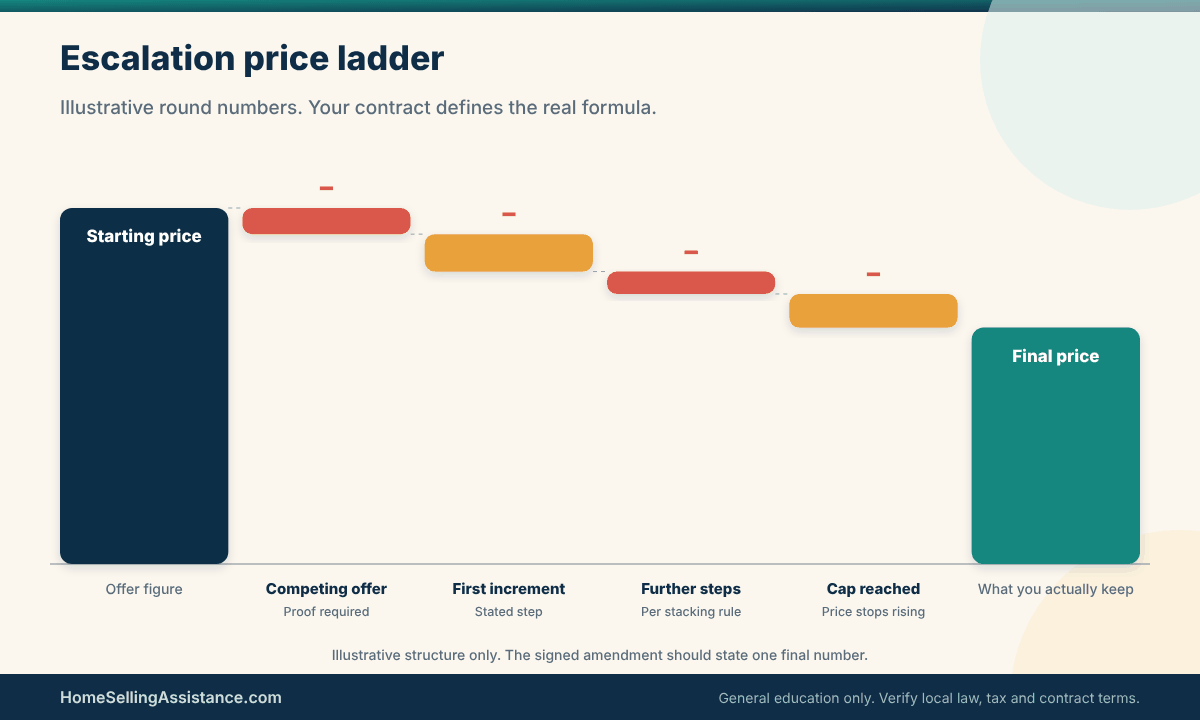
Before comparing escalation offers against anything else, you need to know exactly what each one commits the buyer to. Figure 1 above sketches the usual shape: a starting price, an increment, a cap, and a proof step. This first section takes each of those parts in turn and asks the plain question that matters for you as the owner, which is who holds the rights and duties and what the paper actually says.
Every escalation clause seller review should begin with the document itself, not with a summary from an email or a text message. Agents often describe an offer in one friendly sentence, such as “they will beat the best offer by two thousand up to four hundred and fifty.” The contract language underneath that sentence is what a court, a title company or a mediator would read if there were an argument.
Who holds the right to escalate and who carries the duty to prove it
An escalation clause gives the buyer a conditional right: if the seller receives a qualifying competing offer, the buyer’s price rises automatically. The seller usually takes on the practical burden of showing that a qualifying competing offer exists, because the buyer cannot see your other paperwork. That split, a buyer right and a seller duty, is where most escalation clause seller confusion starts.
Think about what “automatic” really means here. The price changes only when the contract’s trigger is met. If the clause says the buyer will beat any bona fide written offer, then someone must decide what counts as bona fide, what counts as written, and who sees the proof. Some clauses spell those words out. Many borrow them loosely and leave a gap that both sides fill with their own assumptions.
Sellers sometimes ask why anyone would use this structure at all. For the buyer, an escalation clause is a way to stay competitive without guessing the winning number. For the escalation clause seller, it can reveal how far a motivated buyer is willing to go. The tradeoff is that the information flows one way: the buyer learns something about your other offers, and you learn only a cap you may never reach.
The listing side also has a duty to the owner, not to the buyer. In most arrangements, your listing agent owes you loyalty and must follow your lawful instructions about what to share. The buyer’s agent owes the same to the buyer. Neither side’s agent can unilaterally rewrite the clause. That is why a seller acting alone, or a seller working with an agent, should treat the proof step as something you control rather than a formality someone else handles.
What to pull from the paperwork: the exact trigger language
Start any escalation clause seller review by highlighting four phrases in the offer: the starting price, the escalation increment, the maximum price and the definition of a competing offer. Write each one on a separate line in your own words. If you cannot restate a phrase in one clear sentence, the clause is not yet clear enough to accept, and a short call with the other side’s agent usually fixes it faster than a long dispute later.
Next, read how the escalation clause seller offer describes the comparison. Does it beat the highest price only, or the highest net to you, or the highest offer in any form? A buyer who escalates above another buyer’s headline price might still produce a worse result for you if the other buyer was paying cash, waiving contingencies or offering a faster closing. The clause usually compares prices alone. You are comparing everything.
Finally, look for what the clause says about the loser. If the competing offer is withdrawn, countered or expires, does the escalation snap back, stay where it is, or stop being usable? Ask for plain language on that point, in writing, because the answer changes how safe it is to share a competing bid with anyone. The broader tactics around how long bids stay alive are covered in our piece on offer expiration dates.
It also helps to read the clause aloud once, slowly. Awkward phrasing, double negatives and phrases like “or as otherwise agreed” tend to jump out when you hear them. If a sentence needs two readings to understand, flag it. Contracts that feel confusing to the person who owns the house are rarely meant to be that way, but confusion is expensive when closing day approaches and each side remembers the intent differently.
A scenario, an exception, and your next step
Imagine an escalation clause seller opens an offer from a buyer with an illustrative starting price of 400,000 dollars, an increment of 2,000 dollars, and a cap of 430,000 dollars. Another buyer offers 415,000. The first buyer’s clause, if it works as written, lifts the price to 417,000. Now imagine the competing 415,000 offer is actually 415,000 with the buyer covering part of your closing costs. The headline price is the same, but your real comparison has changed.
An exception worth knowing: some clauses only escalate against offers that the seller has actually received in writing from a buyer represented by a licensed agent, or exclude offers that contain a contingency the escalating buyer did not include. Those carve-outs are legal and sometimes sensible, but they narrow the clause. If you read an offer and discover such a carve-out, you are looking at a smaller promise than the cover email suggested.
Your next step in any escalation clause seller scenario like this is the same. Put the clause into a small worked example using numbers from your real offers, and test three cases: no competing offer, a competing offer just below the cap, and a competing offer above the cap. If you can walk each case in two minutes, you understand the clause. If you cannot, ask your adviser to walk it with you, and consider the guidance in our multiple-offers guide for how the surrounding process usually runs.
Deadlines, caps, increments and the cost of getting the wording wrong
The second set of terms is numerical and procedural. An escalation clause has at least three numbers, the start, the step and the ceiling, and at least one deadline, which is when proof must be delivered and when the escalated price becomes the final price. These are the places where small drafting choices move real money, so they deserve a slow read.
The clause also interacts with other deadlines in the contract: earnest money, inspection, appraisal, financing and closing. A price that rises after an inspection period begins or after a financing deadline has been set can create timing knots. The escalation does not change those deadlines unless the contract says so, and you want the paperwork to say clearly whether it does.
Numbers and proof to line up: cap, step, and the evidence window
Write the three numbers on one line and add the deadline for proof. Then ask a simple question: what is the lowest and the highest price this offer could legally produce? The lowest equals the starting price when no one competes. The highest equals the cap. Everything in between depends on the stacking rule, which says whether the buyer beats the other offer by one increment or keeps climbing against other escalation bids.
That stacking rule matters when two buyers both use escalation clauses. Their formulas can chase each other, and the contract usually does not tell you how to resolve the loop. Some sellers treat that situation as a reason to ask both buyers for a best and final offer in plain numbers instead. If you are heading toward that situation, our article on highest and best offers lays out how that request is commonly framed.
Finally, confirm the proof window. If the buyer wants documentation of the competing offer within a set number of hours, can you realistically deliver it? Do you have the other buyer’s written permission to share, or does your listing agreement and your state’s custom allow you to show a redacted copy? These are practical questions with legal edges, and the answer varies by place, so check with your state real estate commission or a local attorney.
Where it goes wrong: a short scenario and a way to respond
Picture an escalation clause seller situation where the clause says the price will increase to beat the highest competing offer, but gives the seller only a day to supply proof. The seller receives two other offers late on a Friday, the buyer’s agent asks for copies, and the listing agent hesitates because one competing buyer asked that their terms stay private. Nobody is acting in bad faith, yet the clock is running on a clause that depended on information the seller was not free to hand over.
A sensible response, in a case like that, is to avoid improvising. Ask the escalating buyer’s side whether the clause can be satisfied with a signed statement from the listing agent or a neutral party, such as the title company, confirming the competing price without the other terms. Many contracts allow some flexibility if both sides agree in writing. If they do not agree, a counteroffer can reset the process.
The lesson for the escalation clause seller is that the proof mechanism is a negotiation point, not boilerplate. When you see a short proof deadline or a vague standard, you can counter with a longer window, a defined form of proof, and a clear statement of who may see what. Our overview of counteroffer strategy walks through how sellers shape those edits without losing a good buyer.
To keep the moving parts in one place, the matrix below lists the issues that most often come up when an escalation clause lands on your desk. It names the document that usually controls each issue, what you are expected or free to do, the timing to watch, and where to confirm the local answer. Treat it as a reading aid for your own contract rather than a statement of what the law requires everywhere.
| Issue | Controlling document | Seller obligation or choice | Deadline to watch | Verify locally with |
|---|---|---|---|---|
| Starting price, step and cap | Purchase offer and any addendum | Accept, reject or counter the numbers | Offer expiration time | Your agent or attorney |
| Proof of competing offer | Escalation addendum | Decide what evidence you may share | Proof window in the addendum | State commission or attorney |
| Which offers count | Definition language in the clause | Confirm what qualifies as competing | Before acceptance | Local contract forms |
| Confidentiality of other bids | Listing agreement and state rules | Choose disclosure, redaction or none | Before sharing anything | State real estate rules |
| Appraisal shortfall | Financing and appraisal terms | Counter, accept a gap plan or reprice | Appraisal deadline | Lender and agent |
| Final price recording | Signed amendment and closing papers | Confirm the figure matches everywhere | Before closing documents print | Title or escrow officer |
Use the matrix as an escalation clause seller checklist while you read each offer. If any row cannot be filled in from the paperwork you are holding, you have found a gap. A gap is not a reason to panic, but it is a reason to ask a question in writing before anyone signs. Most gaps are closed with a short addendum that both sides initial, and a clear amendment is cheaper than a late argument.
A practical habit for any escalation clause seller is to decide your response rules before offers arrive. Write down who may see competing offers, how fast you can produce proof, and who has authority to sign an amendment. Having those answers ready makes a weekend of offers calmer, and it keeps you from agreeing to a proof deadline you could not meet.
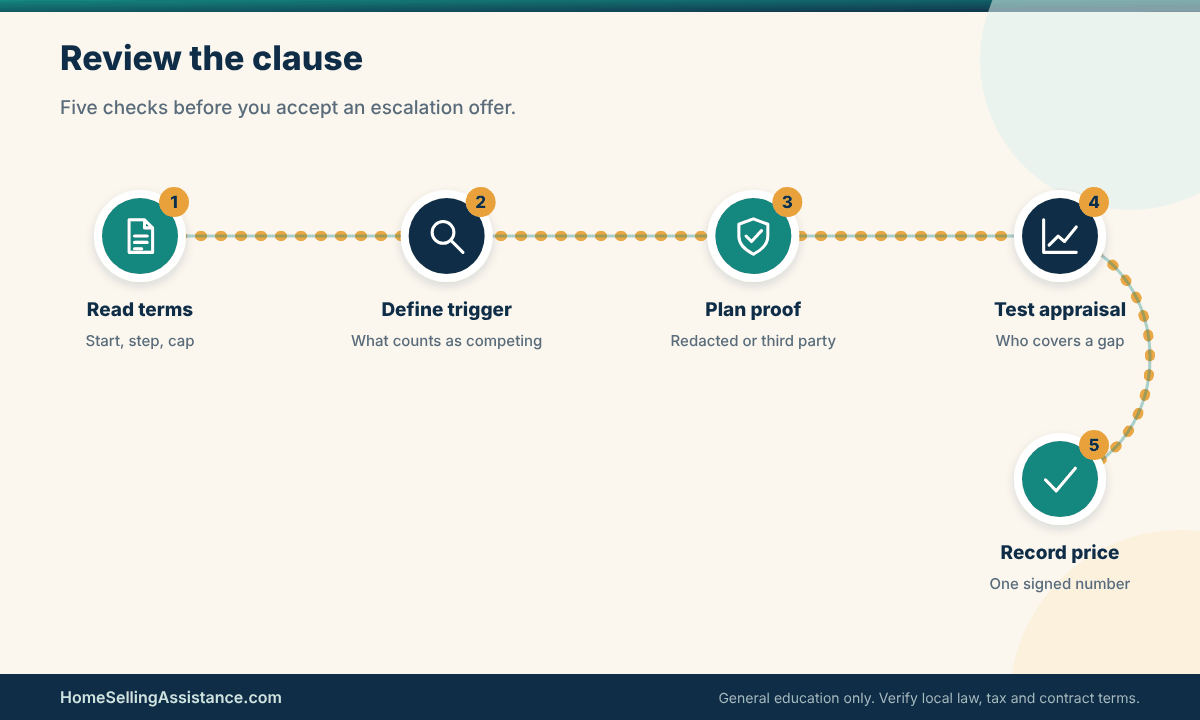
Seen this way, the escalation clause seller decision is really a set of small, checkable questions rather than one big gamble. Each question has an answer in the contract or can be added to it, and each answer you document makes closing less dependent on memory and goodwill.
The picture above puts the same ideas into a flow you can follow with a pen: confirm the numbers, confirm the proof, confirm the appraisal plan, then record the final price. Following it in order keeps you from approving a headline figure before you know how the machinery underneath behaves.
Modeling the outcomes an escalation clause seller can expect
With the wording understood, the next job is to picture the outcomes. Sellers tend to imagine one result, the price goes up, and miss the others. An escalation clause can be satisfied cleanly, satisfied with friction, or disputed. Each path has a different effect on your timeline and your net, and each is easier to handle if you have already walked through it once before it happens.
Modeling an escalation clause seller outcome does not mean predicting. It means asking, for each branch, what documents change hands, who needs to sign something, and what you give up if the branch goes badly. We use illustrative round numbers throughout, so please treat any figure as a teaching example only.
When the clause works as written and the price rises
The best case for any escalation clause seller is straightforward. A qualifying competing offer exists, you show acceptable proof, the price rises by the agreed step, and both sides sign a short amendment that states the new figure. The rest of the contract proceeds as before. Even in this smooth case, a few details deserve attention, because they decide whether the smoothness lasts until closing.
First, the amendment should state the final price as a number, not as a formula. A formula that remains live can be recalculated by someone later, and a title officer or lender will want a single number to build their documents around. Second, any related terms that depended on the old price, such as earnest money as a percentage, should be restated so everyone agrees on the new dollar amounts.
Figures to confirm: the amended price and what it changes
Run a simple escalation clause seller set of figures once the price lands. Take the amended price, subtract the mortgage payoff you expect, subtract the compensation and closing costs your contract describes, and apply any credits you agreed to. Our article on estimating net proceeds from a home sale shows how to build this estimate, and a first pass takes only a few minutes with real quotes in hand.
In an escalation clause seller sale, notice what moves with the price and what does not. Some costs are tied to the sale price, such as certain transfer charges and, in many arrangements, broker compensation, depending on how your agreement is written. Other costs are fixed, such as a payoff or a recording fee. A higher price usually helps your net, but not dollar for dollar, and the difference depends on your contract and your area.
An escalation clause seller also benefits from asking how the final price affects any figures stated in percentages, such as deposits or compensation, because a percentage applied to a new price produces a new dollar amount. Ask for the revised dollar figures in the amendment. It takes a minute, and it prevents the kind of surprise that usually appears on a draft closing statement.
Also confirm that your earnest money amount, if it is tied to the price, was restated. If it was not, ask the buyer’s side to clarify. Our guide to earnest money for sellers explains why the deposit figure and the conditions for releasing it deserve their own careful read, especially after a price change.
A last detail on this branch: keep a clean paper trail. Save the original offer, the proof you were shown, the proof you provided, and the signed amendment in one folder. If the buyer later questions how the price was reached, or the lender asks, you can answer from documents rather than from memory. That small habit costs nothing and removes a whole category of arguments.
A scenario, an exception, and your next step when all goes well
Suppose an escalation clause seller deal worked and the price rose from an illustrative 400,000 to 417,000. The buyer’s lender orders an appraisal. The exception to watch is that the appraiser works from comparable sales, not from the bidding that took place on your listing. If the appraised figure comes in below 417,000, the contract price has risen but the lender’s willingness to lend against it has not.
That is why an escalation clause seller will often see the clause travel with some appraisal language. Some buyers include a gap-coverage promise, in which they agree to pay a stated amount above the appraised value in cash. Others include none. Read what the offer says, and ask how the buyer would cover a shortfall. A buyer with a clear plan and documented funds is a stronger partner than a buyer with a high cap and no plan.
Your next step is to ask the lender or buyer’s agent for evidence that the extra funds exist, in the same way you would ask for proof of down payment. For deeper reading on how appraisal shortfalls are usually handled, see our guides to the appraisal gap and to seller options after a low appraisal. Neither promises an outcome, but both help you prepare questions.
When the clause is disputed, missed or quietly waived
Not every escalation ends neatly. Proof arrives late, a competing bidder drops out, the buyer claims the seller never showed a qualifying offer, or the seller accepts a price without noticing the clause. Each of those is a different kind of problem, and the useful response depends on whether the contract says anything about it. The word “waived” deserves particular care, because it can happen through behavior as well as through paper.
A seller who proceeds as though the clause did not exist, or who accepts a lower figure without comment, may later find the other side arguing the point. Equally, a buyer who knowingly proceeds at a higher price without insisting on proof may find it hard to object later. Courts and mediators look at the documents first, so the safest habit is to write down every change, however small.
Evidence to gather: proof, timestamps and written agreements
If an escalation clause seller dispute is possible, gather evidence before emotions rise. Collect the original offer and addendum with their signature times, the messages in which proof was requested and supplied, and any written agreement to extend or alter a deadline. Keep copies of what you actually showed the buyer’s side. If you redacted a document, keep both the redacted version and a note explaining what was removed and why.
Timestamps matter more than people expect. A clause that requires proof within a set window can turn on whether an email was sent at four in the afternoon or six in the evening. Your listing agent’s records and your own inbox are both useful. If you are selling without an agent, a simple log with dates, times and short notes is enough, and it is worth keeping from the first day.
Be wary of verbal understandings. “We agreed on the phone that we would just use the higher number” may be completely sincere, yet it is hard to prove and easy to remember differently. Ask for a one-line email or a signed amendment that records the agreement, and keep that confirmation with the contract. For an escalation clause seller, a dispute is rarely about bad faith: it is usually two reasonable people reading a loose sentence differently under time pressure, and loose sentences can be tightened. Our overview of seller concessions makes the same point about informal side deals.
A scenario, an exception, and your next step in a dispute
Imagine an escalation clause seller dispute in which the escalating buyer insists the price should have risen to 417,000, while the seller believes the competing offer was withdrawn before the proof deadline and the price should stay at 400,000. The contract is silent on withdrawn offers. This is the kind of gap that a short, calm conversation between agents or attorneys often resolves, sometimes with a split-the-difference amendment that both sides prefer to a long delay.
An exception to keep in mind: where the contract says disputes go to mediation or arbitration, you may be bound to that process before any court. Where it says nothing, local law fills the gap, and that varies. A reasonable next step is to stop negotiating by message, ask a local real estate attorney to read the contract, and pause any irreversible actions, such as a second acceptance, until the position is clear.
Also consider the possibility that you hold a second buyer waiting in the wings. A backup contract can protect your position if the first deal falls apart, and our guide to backup offers describes how those are typically structured. Whether you can use one depends on the language in the first contract, so have it checked before you sign anything new.
The following table collects common situations in one place. It lists what is happening, the choices you generally have, the main risk, the document to review and the point at which professional help is wise. As with the first table, it is a reading aid rather than advice for your particular contract.
| Situation | Seller options | Main risk | Document to review | Escalate to a professional when |
|---|---|---|---|---|
| Two buyers both use escalation clauses | Ask both for best and final in plain numbers | Formulas chase each other, price unclear | Both addenda | Neither clause defines stacking |
| Proof cannot be shared | Offer redacted or third-party confirmation | Buyer claims clause unmet | Listing agreement, proof clause | Other bidder refuses any disclosure |
| Competing offer withdrawn | Hold price, counter or seek written agreement | Dispute over final figure | Escalation addendum | Contract is silent on withdrawal |
| Cap exceeds likely appraisal | Request gap plan or lower cap in counter | Deal stalls at appraisal | Appraisal and financing terms | Gap funds are undocumented |
| Price accepted, amendment missing | Sign a short amendment stating the number | Closing papers show wrong price | Amendment and draft closing statement | Title office flags a mismatch |
| Buyer proves a higher offer existed | Verify the proof, then confirm or contest | Honest mistake or misunderstanding | Proof documents, timestamps | Parties disagree on what counts |
When you use the table, read across a row rather than down a column. Find the row that looks like your problem, write down the document it names, and then check the last column honestly. If your situation matches the trigger in that column, the cost of a short consultation is usually small compared with the cost of fixing a closing built on the wrong price.
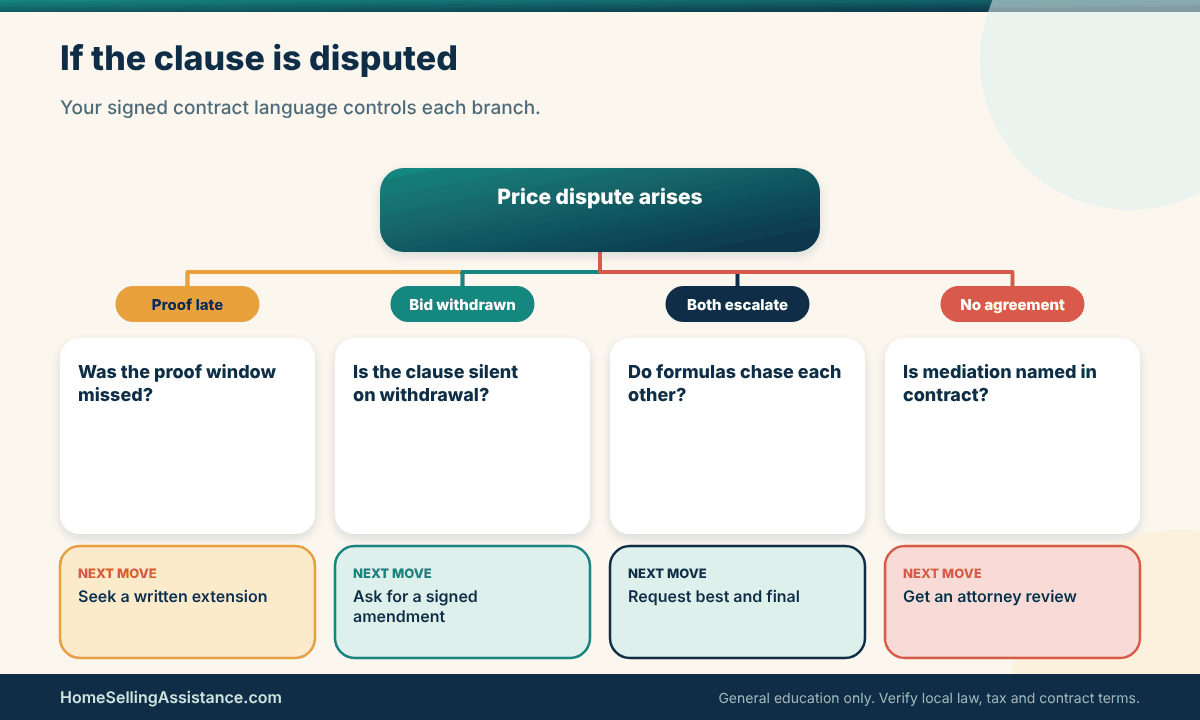
The decision tree above shows the same logic as a set of branches. Each branch begins with a question you can answer from the contract, and each ends with a next move. It is deliberately simple, because under pressure the simplest map is the one you will actually use.
Controlling the risk in writing before you sign
Most escalation clause seller problems are preventable before anyone signs, because the contract is still negotiable and the other side wants the deal. This final main section is about turning your understanding into specific wording and specific questions. It is the part where the escalation clause seller moves from reading to acting, and the actions are mostly small and inexpensive.
The goal of an escalation clause seller is not to beat the buyer. A good clause is one both sides can read the same way a month later. When your counter makes the language clearer, you protect the sale for both of you, and a buyer who resists plain wording is telling you something useful about how the rest of the transaction may go.
Questions an escalation clause seller should ask before signing
Questions are the cheapest protection you have. They cost a few minutes and they surface assumptions while changing them is still easy. We suggest asking them in writing, even if you also discuss them on the phone, so the answers can be attached to the file. Keep the tone friendly and specific, since the other side is more likely to answer fully if the question sounds like clarification rather than challenge.
A useful rule is to ask every question you would want answered if the deal were in trouble. Trouble tends to arrive around the appraisal, the final walk-through or the closing statement. The better your documentation at the start, the less you rely on goodwill when everyone is tired and the dates are close.
Wording to request: definitions, caps and proof standards
Ask for the clause to define a competing offer as a written, signed offer on the same property from a different buyer, with the terms the escalating buyer wants compared stated outright. Ask whether the comparison looks at price only or at net terms. Ask what happens if the competing offer changes after the proof date. Each of these prompts one or two sentences that remove a common ambiguity.
Ask for a stated cap in dollars, a stated step in dollars, and a rule for how the final price is recorded, preferably as a signed amendment with a single figure. If the buyer wants proof, ask what form is acceptable, who may see it, and how long you have to provide it. Offering a neutral confirmation, such as a letter from the title or escrow office, is a common compromise.
Finally, ask how the buyer plans to handle appraisal risk. You are entitled to understand the plan, and a documented answer is a strong sign of a serious buyer. For the financing side of that conversation, our piece on the financing contingency explains how deadlines and release dates typically work, and what to confirm in writing.
Keep a short escalation clause seller question list in one place: definitions, cap and step, proof form, deadlines, appraisal plan and amendment wording. Answering those six items for each offer gives you a fair basis for comparison, and it shows quickly which offers are well prepared and which rely on assumptions that nobody has written down.
If you feel awkward asking this many questions, remember that buyers’ agents write escalation clauses precisely because they expect them to be read. A thoughtful list of clarifying questions rarely scares off a serious buyer. It more often builds trust, because it shows that you intend to perform the contract as written and expect the same in return.
A scenario, an exception, and your next step before you sign
An escalation clause seller might receive three offers on a weekend. One includes an escalation clause with a generous cap, one is a plain full-price offer with a short inspection period, and one is a lower offer with a large down payment and no financing contingency. The escalation offer looks best on paper, but its cap is far above recent comparable sales and it has no appraisal plan. The plain offer looks less exciting and much more certain.
An exception to the usual instinct: the highest possible price is not always the best offer. Certainty, timing, contingencies and the buyer’s funds all count, which is why our cornerstone guide to evaluating a home offer encourages sellers to compare the whole package. Depending on your goals, the plain offer might beat the escalation offer, or a counter to the escalation buyer might improve it.
Your next step in a case like this is to write a short comparison covering price range, deposit, contingencies, closing date, funds, and the clarity of the paperwork. Rank each offer on the factors that matter to you. Then, before answering anyone, ask your adviser to read the top two contracts side by side, and consider whether a clarifying counter would improve the one you prefer.

The checklist above gathers those questions into a form you can print and carry into a conversation. Tick them off as answers arrive, and attach the completed page to your file with the contract. If a box stays empty, that gap is the next question to ask.
When an escalation clause seller should bring in an attorney, agent or title officer
Some escalation questions are ordinary and some are not. The ordinary ones, such as what a cap means or how much time you have, can be answered by reading carefully. The unusual ones involve legal interpretation, confidentiality rules, funds that must be verified, or documents that must match across several parties. For those, the escalation clause seller is better served by a professional who has handled similar contracts in your area.
The three kinds of help overlap but are not identical. An agent knows local forms, customs and the offers on your property. An attorney interprets contract language and advises on legal rights. A title or escrow officer ensures that the final price, the payoff and the recorded documents line up. Knowing which one fits which question saves time and avoids paying for the wrong kind of review.
Triggers worth a second opinion: confidentiality, ambiguity and funds
Three escalation clause seller situations deserve a second opinion almost every time. The first is confidentiality, when you are unsure whether you may show a competing offer to another buyer. Rules and customs vary by state and by listing agreement, and some sellers prefer that all terms stay private unless the other bidder agrees. A local attorney or your state real estate commission can tell you what applies where you live.
The second is ambiguity. If the clause uses terms the contract does not define, if two sections appear to conflict, or if an addendum was edited by hand, pause before signing. Ambiguity is cheap to fix now and costly to litigate later. The third is funds. When the cap is high and the buyer relies on cash to cover an appraisal gap, ask for proof of those funds from a bank or lender before relying on them.
Fair housing is a separate point that sometimes surfaces in multi-offer situations. Decisions about which offer to accept must rest on price, terms and the strength of the buyer’s finances, never on personal characteristics protected by law. If you want a plain-language reference, HUD publishes guidance at its fair housing and equal opportunity pages, and your agent or attorney can explain how those rules apply to the way you compare bids.
One more trigger is a mismatch between what you were told and what you read. If an offer was described as one thing and the paperwork says another, ask for a corrected document before you respond. Never accept a verbal assurance that the paper “means the same thing.” Most misunderstandings are honest, and an honest counterpart will be glad to fix the document. A counterpart who resists a simple correction has given you useful information.
A scenario, an exception, and your next step toward a professional
Say an escalation clause seller is comparing two escalation offers and one buyer’s agent asks the listing agent for a copy of the other offer. The seller is unsure, the listing agent is cautious, and the deadline is tonight. The helpful move is a short call to the attorney or the brokerage’s compliance contact, asking one precise question: what may I share, and in what form, under my agreement and local rules?
An exception to keep in mind is that professional review is not always necessary for a plain, well-drafted clause on a standard local form. Many sellers and agents handle those without legal help, and a heavy response can be wasteful. The judgment call is about risk. The less standard the wording, the larger the cap, and the more parties involved, the stronger the case for review.
Your next step is to write down the one question you need answered, with the clause attached, and send it to the right person. Ask for the answer in writing. If you are weighing the cost of professional help against the stakes, our offers and negotiation category collects related guides, and the consumer protection information at the Consumer Financial Protection Bureau explains general mortgage and closing concepts that sit behind these decisions.

The last figure above shows the same escalation clause seller advice as a quick balance. On one side sit the benefits of a higher possible price, and on the other the added complexity and risk of a formula-based offer. Neither side always wins. The right weighing depends on your market, your timeline, your tolerance for uncertainty and the quality of the specific paperwork in front of you.
If you want to read more about how buyers pay, our comparison of cash and financed offers shows why the financing type matters as much as the headline price. And once an offer is accepted, a careful reading of the seller closing statement confirms that the escalated price landed correctly in the final numbers.
If you remember only one thing, remember that an escalation clause seller controls more than it first appears. You choose whether to accept the formula, how to prove the trigger, whether to counter with a fixed price, and when to ask for help. Each of those choices is made on paper, and the paper is what you will rely on if anything goes wrong later.
Quick scenario
An escalation clause seller holds an offer with a starting price of 400,000 dollars, a 2,000 dollar step and a 430,000 dollar cap, plus a plain offer at 412,000 with a short inspection window. The escalation offer can reach a higher number, but only if proof is accepted and the appraisal supports it. The plain offer is lower but simpler. The numbers are illustrative only, and the right choice depends on your contract, your goals and your adviser’s reading of both documents.
Frequently asked questions about escalation clause seller
What is an escalation clause from the seller’s point of view?
It is a contract term in which a buyer agrees to raise the price automatically if you receive a qualifying competing offer, up to a stated maximum. For an escalation clause seller, the practical meaning is a price that is not fixed until proof is shown. The clause usually names a starting price, a step, a cap and a proof requirement. Always read the exact words in your own contract.
Does an escalation clause guarantee I will get the cap price?
No. The price rises only if the trigger in the contract is met, and it rises only by the amount the clause describes. If no competing offer qualifies, the starting price applies. Any escalation clause seller should also remember that a higher contract price still has to survive an appraisal and the buyer’s financing.
Do I have to show the buyer my other offers?
Not necessarily. Whether you may or must share competing offers depends on your listing agreement, your state’s rules and what the other bidder agreed to. Many sellers offer redacted copies or a neutral confirmation instead. Ask a local attorney or your state real estate commission what applies before you share anything.
What proof of a competing offer is reasonable to give?
Common choices are a redacted copy that shows the price and date, a signed statement from the listing agent, or a letter from a title or escrow officer. The best choice is the one that satisfies the clause while respecting other parties’ privacy. An escalation clause seller can negotiate the form of proof before accepting, so raise it early rather than at the deadline.
What happens if two buyers both use escalation clauses?
The formulas can chase each other, and the contracts often do not say how to settle the loop. Many sellers respond by asking both buyers for a best and final offer stated as a plain number. Some choose to counter one buyer with a fixed price instead. Whichever route you take, put the final figure in a signed document.
How does an appraisal affect an escalation offer?
The appraiser estimates value from comparable sales, not from the competition on your listing. If the contract price rises above the appraised value, the lender may not lend the full amount, and the buyer must find the difference or renegotiate. An escalation clause seller should ask how the buyer plans to cover a shortfall and request documentation of any extra funds.
Is a higher escalation cap always the better offer?
Not always. Price is only one part of an offer, and contingencies, deposit size, closing date and the buyer’s funds can matter just as much. A lower plain offer with fewer conditions may leave you in a stronger position than a high cap with several uncertainties. Compare the whole package against your own goals.
Can I counter an offer that contains an escalation clause?
Yes. You can accept the clause as written, strike it, tighten the proof requirement, change the cap or step, or counter with a fixed price. A clear counteroffer often helps both sides by removing ambiguity. Our guide to counteroffers explains how sellers commonly approach this, and your agent or attorney can draft the wording.
What if the buyer says the price should have risen and I disagree?
Start by gathering the documents: the offer, the addendum, the proof exchanged and the timestamps. Many disputes end with a short written amendment that both sides accept. If the contract names mediation or arbitration, follow that process, and consider asking a real estate attorney to read the paperwork before you reply further.
When should an escalation clause seller get professional help?
Get help whenever the wording is unclear, the cap is large, confidentiality is uncertain, or you are unsure that the buyer can cover an appraisal gap. An agent, a real estate attorney or a title officer can each answer different parts of the question. The cost of a short review is usually small compared with the cost of correcting a closing built on the wrong price.
Before you sign anything
An escalation clause seller does best by treating the clause as a formula to be tested, not a headline to be admired. Read the numbers, define the proof, ask about the appraisal, and write the final price as a single figure in a signed amendment. This article is general education, not legal, tax or financial advice, and your contract, your state rules and your own advisers decide what applies to your sale.