Title deed fraud homeowner stories tend to start the same way: a person who owns a house outright, or a house they are about to sell, discovers that someone else’s name now sits on the public record. No one broke a window. No alarm went off. A single forged page, filed at a county office, did the work.
That sounds frightening, and it should get your attention, but it is also a problem with fairly clear edges. Deeds are public documents. Recording offices have procedures. Title companies, banks, attorneys and police all have a role once something looks wrong. If you understand how the scheme works, you can spot the early signs and put a few inexpensive habits in place.
This title deed fraud homeowner guide is written for people who own or are selling a home in the United States. We will look at what a fraudulent transfer looks like, which pieces of your information thieves lean on, which controls are worth setting up before a sale, and what to do, in what order, if you think your property record has been touched. We stay neutral about agents, attorneys and paid monitoring products, and we keep the legal specifics general because rules differ by state and county.
If you have not read our broader overview yet, the cornerstone article on home sale fraud and seller safety covers the whole transaction, while this page stays focused on the ownership record itself. One honest caveat first: nothing here is legal advice, and no routine makes fraud impossible. The goal of this title deed fraud homeowner guidance is to make you a harder target and a faster responder.
Key takeaways
- The record is the target. Deed and title fraud works by getting a false document accepted and recorded, so the first title deed fraud homeowner defense is knowing what your county record says today.
- Quiet properties are favorite targets. Vacant homes, inherited homes, second homes, and houses with no mortgage give a thief more room because nobody is watching the paperwork.
- Monitoring is cheap, but it varies. Some county recorders offer free alerts, some do not, and paid services differ. Check what your county actually provides before you pay for anything.
- Verify with contacts you already trust. Look up phone numbers yourself. Never confirm a transfer, a notary visit or a payoff using details someone sent to you.
- Act in order. Contact the recorder, your title insurer, local police and an attorney, and keep every document, date and name in one folder.
- A title policy may help, but read it. Coverage terms differ, so ask your insurer or attorney what your specific policy says about forgery and false documents.
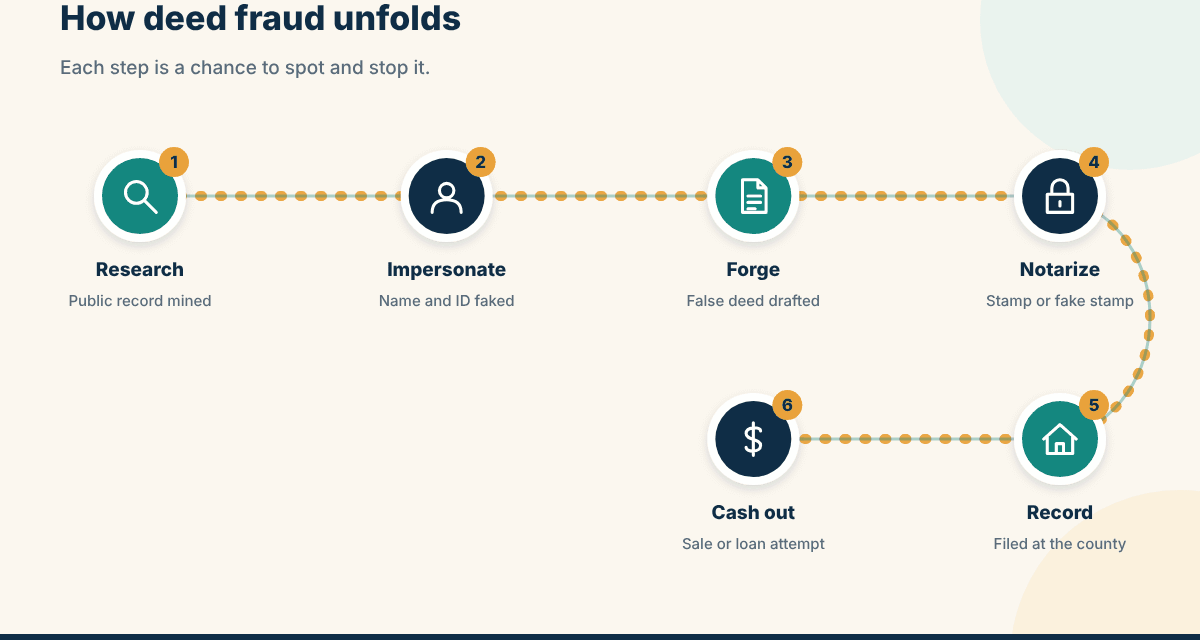
The first image below shows the general pattern, so you can picture where in the process a thief has to succeed and where you can interrupt.
Spot the title deed fraud homeowner risk before a thief does
Most homeowners picture burglary or a mortgage scam when they think about losing a house. Title deed fraud homeowner risk is quieter and more bureaucratic. It rewards patience and paperwork, which is exactly why it often goes unnoticed for months. This section describes the bad outcomes, the exposed information, and the evidence you can check yourself without paying anyone.
What the bad outcome looks like in a real title deed fraud homeowner case
The basic idea is simple. A person with no right to your property creates a deed, signs your name or a made-up name, gets it notarized or appears to, and files it with the county recorder. Once it is recorded, the public record shows a new owner. That false owner may then try to sell the house to a real buyer, borrow against it, list it for rent, or hand it to a shell company to cloud the trail.
Several variations show up in consumer warnings. A forged quitclaim deed moves title from you to someone else with almost no review. A fraudulent deed of trust or home equity line records a loan against your house that you never took. Sometimes the thief impersonates the owner of a vacant lot or a rental and sells it to an unaware buyer, and the real owner learns about it when a surveyor or a neighbor calls.
The damage is not limited to embarrassment. A clouded title can stall a sale you had already planned, tie up a refinance, and take real time and legal effort to clear. Whether you recover quickly depends on how fast the problem is found, what the documents say, and what your state allows. We cannot predict that for you, and anyone who promises a quick fix without seeing your records deserves caution.
Evidence to gather: what your recorded documents show about title deed fraud homeowner risk
Start with the facts you can pull yourself. Your county recorder, register of deeds or clerk, depending on the state, keeps the recorded documents for your parcel. Many offices offer an online search by name or parcel number, and many also let you request copies for a fee or none at all. Search under your name, your spouse’s name, and any prior owner’s name, then read what is attached, not just the index line.
Look for a deed you did not sign, a mortgage or lien you do not recognize, a release of a loan you still owe, or an unusual grantee such as a newly formed company. Write down the document number, recording date and who is named as preparer or notary. Save a copy of the page, with the date you retrieved it. That small folder becomes the backbone of any report you make later.
If you cannot find an online search, call the office using a number from the county website that you typed in yourself. Ask how to search by owner name, whether they offer notification for new filings, and what they charge for certified copies. Offices differ, and you are not imposing by asking.
A scenario, an exception, and your next step
Picture a title deed fraud homeowner example. Dana inherited a small house from her mother and has not yet moved in. She plans to sell next spring. A neighbor mentions that someone was measuring the yard and a sign appeared for a few days. Dana pulls the county record and finds nothing new, so she exhales. Two months later she checks again and sees a recorded deed from “an estate representative” she has never heard of.
The lesson is that one clean search is a snapshot, not a shield. An exception worth knowing: some counties post new filings with a delay, so a document may exist before it appears online. Dana’s next step is to call the recorder to confirm the filing, request a copy, then contact her title insurer if she has a policy, local police to file a report, and a real estate attorney in her state.
The same pattern shows up in the vacant home security checklist for sellers, because an unwatched house is a record problem as much as a physical one.
Which of your details a title thief actually uses
Thieves do not need your keys. They need enough of your identity and property facts to make a forged document look plausible to a notary, a recording clerk or a buyer. Most of that material is available through ordinary channels, which is uncomfortable but useful to understand, because it tells you where to trim the trail.
Public records already reveal a surprising amount. Owner name, mailing address, parcel number, legal description, purchase date and recorded loans are often searchable. Add a leaked email account, a mailbox that nobody checks, or a social media post about a trip, and the picture fills in. Our home seller privacy checklist walks through ways to reduce that spread without hiding from your own buyers.
Evidence to gather: where your details already appear
Search for yourself the way a stranger would. Type your name and address into a search engine, check the county assessor site, and look at any past listing photos or sale pages that remain online. Note what appears: your full legal name, middle initial, mailing address, signature on a recorded document, a notary stamp, and the lender named on your mortgage.
Public signature samples are one of the quieter risks. Recorded deeds often carry a scanned signature, and a determined thief can copy it. You usually cannot remove a recorded document from the public record, so the practical response is not panic but awareness: the more recorded signatures exist, the more important monitoring becomes.
Also check whether your mail still reaches you. A tax bill or lender notice that goes to an old address is a missed warning. Update the mailing address on file with the county assessor and your mortgage servicer, and make sure a trusted person knows to forward anything unusual from a second property.
A scenario, an exception, and your next step
Consider a couple, Marcus and Elena, who own a rental duplex free and clear. Their tax bills go to a post office box they rarely open. A person who has studied the public record forms a company with a similar name, drafts a deed from “Marcus and Elena” to that company, and gets a notary stamp from someone who never checked identification. Nobody on the owners’ side sees anything, because the mail they would normally receive about the transfer goes nowhere.
The exception is that some states require specific formalities, such as witnesses or particular notary procedures, which can make a sloppy forgery easier to challenge. That helps you after the fact, not before. Their next step is a mailing address update, a calendar reminder to search the record monthly, and a conversation with the county about alerts. If you ever receive an unexpected closing request tied to your own property, the guidance in seller identity fraud at closing applies directly.
Reduce risk before the transaction step with a title deed fraud homeowner routine
A routine does not have to be elaborate. The aim of a title deed fraud homeowner routine is to shorten the time between a fraudulent filing and your discovery of it, and to make sure that when someone contacts you about a closing, a payoff or a signature, you have a reliable way to test whether the request is real. This is also the right moment to remember that selling raises your exposure, because more people suddenly know your address, your timeline and your title company.
Figure 2 lays out the checks in the order most sellers can actually do them, from a quick record search to a conversation with your closing professional.

Verification and monitoring controls worth setting up now
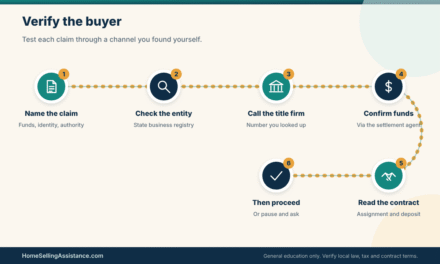
Think of title deed fraud homeowner controls in three layers. The first is watching the record. The second is confirming who is on the other end of any communication. The third is protecting the documents and tools that let someone impersonate you. You do not need all of them on day one, but you should have at least one in each layer before you list the house.
Be skeptical of any sales pitch that makes a title deed fraud homeowner product sound like a total shield. Monitoring tells you something happened. It does not stop a recorder from accepting a document that looks valid on its face. Offices generally have limited authority to judge whether a signature is real, which is exactly why your own attention matters.
Evidence to gather: what your county and insurer offer for title deed fraud homeowner protection
Call or visit the website of your county recorder and ask three plain questions. Do you offer free email or text notification when a document is recorded under my name or parcel? Is there a fraud alert or similar program? What do you require from a person who records a deed, and what do you not check? The answers vary a great deal from place to place, and some offices have no alert program at all.
Next, locate your owner’s title insurance policy if you bought with one. Look at the schedule that names the insured, then read the covered risks and the exclusions. Many policies are written to address certain kinds of forged documents, but terms, endorsements and conditions differ, and coverage generally depends on the policy itself, not on a rule of thumb. If the language is unclear, ask the title company or an attorney to explain it in writing.
If the county offers no alerts, consider a private monitoring service, but compare carefully. Ask what it watches, how often, which counties it covers, who sees the alerts, and what it costs per year. A free calendar reminder to search the record yourself every month can do much of the same work for a vacant or inherited house.
A scenario, an exception, and your next step
Imagine a title deed fraud homeowner such as Priya, who is listing her condo in six weeks. She searches the county record and finds her deed and mortgage as expected. She signs up for the county’s free filing alert, adds a monthly calendar reminder, and asks her title company which items they will verify at closing and how they confirm identity. She also asks them for a direct office number, which she saves in her phone.
An exception worth planning for: a few counties charge for alerts or only notify by postal mail, which can be slow. If that is your county, the monthly search matters more. Priya’s next step is simple. Before listing she will repeat the search and keep both printouts together. If a buyer or agent ever asks her to sign something that does not match what the title company described, she will call the number she saved before she signs.
Tying those habits to the sale itself matters, and the title search for a seller’s home sale explains what the title company is already checking for you.
The first table collects the most common threats in one place. Read each row from left to right: the claim you might meet, the evidence that tests it, the safest response, what to keep to yourself, and who to bring in if the claim holds up.
| Threat or claim | Evidence to check | Safe action | Never share | Escalate to |
|---|---|---|---|---|
| Unknown deed recorded on your parcel | Certified copy from the recorder; grantor, notary, date | Request the full document and compare signatures | Government ID copies to strangers | Recorder, police, title insurer, attorney |
| Loan or lien you never took | Recorded deed of trust; lender named | Call the lender on a number you look up | Account numbers or online banking logins | Lender fraud unit, attorney, FTC |
| Caller says a sale or payoff is “pending” | Your own contract and title company contact | Hang up and phone your closing office directly | Wire details, codes sent by text | Title company, then police |
| Offer on a house you never listed | County record; MLS and online listings | Do not respond to unsolicited buyer paperwork | Signed forms or notarized pages | Attorney, police, title insurer |
| Notary request you did not arrange | Notary commission lookup in your state | Decline until you verify who sent the request | Signature on blank or partial pages | State notary regulator, attorney |
| Vacant property record changed | Monthly record search; tax and utility mail | Pull records and have someone visit the property | Alarm or lockbox codes | Recorder, police, attorney |
Use the title deed fraud homeowner matrix as a prompt, not a script. Your state and county will add or remove steps, and an attorney licensed where the property sits can tell you which apply. The point is to avoid improvising when you are anxious, because the right answer is usually to slow down and use a channel you control.
Information never to share, and assumptions never to make
Some of the worst title deed fraud homeowner outcomes begin with a seller trying to be helpful. A fast reply, a photo of a driver’s license sent by email, or a quick confirmation of a closing date can give a thief the missing piece. The rule that serves you best is almost boring: share what is needed, through a channel you chose, with a person you have independently confirmed.
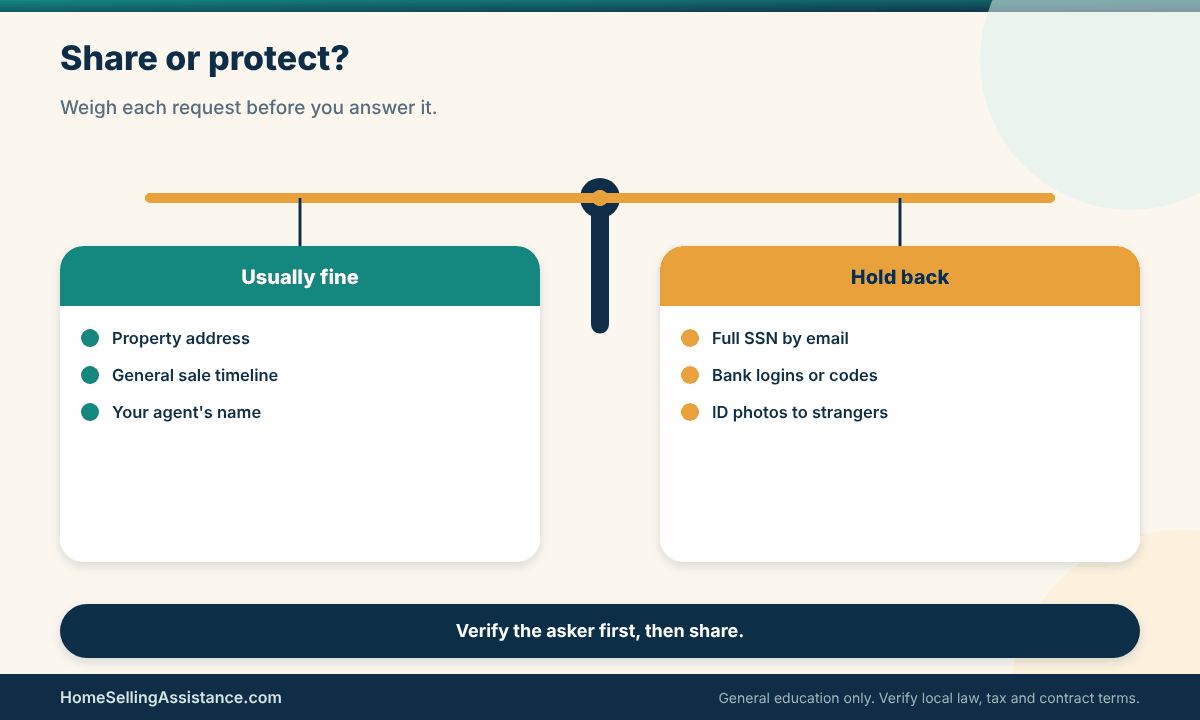
The fourth image sorts details into what is safe to discuss, what to share only after verifying who is asking, and what to hold back until a trusted office requests it in a secure way.
Evidence to gather: details to withhold in any title deed fraud homeowner situation
Do not send full Social Security numbers, bank logins, multi-factor codes or photos of identification through email or text threads unless you have confirmed the recipient and the need. A real title or escrow office will tell you which documents it truly requires and how it wants them delivered, and many use secure portals. If someone insists you must send everything immediately and informally, treat that urgency as a warning sign, not a reason to hurry.
Keep your recorded document numbers, your legal description and the name of your title company out of public social posts. These details are not secrets, but they make impersonation easier. Share your sale timeline in general terms only. The real estate phishing email guide for sellers shows what the usual bait looks like and why replying to it, even to ask a question, can help a scammer.
You should also resist the assumption that a document is genuine because it has a notary stamp or a recorder’s header. Stamps can be copied, and recording usually shows that a document was accepted for filing, not that someone verified the underlying signatures.
A scenario, an exception, and your next step
A homeowner named Tom receives an email that appears to come from his listing agent. It says the title company needs a notarized form and a copy of his driver’s license by the end of the day to avoid a delay. The sender’s address is almost right, but one letter is off. Tom nearly replies, then remembers that he has the title officer’s number from the contract.
He calls. The title officer has sent no such request. An exception to keep in mind is that some legitimate offices do ask for identification, often through a portal or in person. So the question is never simply whether a request is normal; the question is whether you reached the requester through a number you already trust. Tom’s next step is to forward the email to the agent’s real address, save a copy, and report the attempt through the channels described later in this guide.
Our guide to real estate wire fraud for sellers uses the same call-back habit for proceeds.
Never assume a quiet record means everything is fine, never assume a buyer’s representative has checked your identity for you, and never assume that a friendly voice on the phone is who they say. Each assumption feels reasonable in the moment. All three show up in fraud reports.
Finally, be careful about the helpful stranger who offers to “protect” your title for an up-front fee, or a company that claims it can transfer your property into a trust or entity for security in exchange for a payment. Some trust and entity planning is legitimate, and an attorney can advise whether it fits your situation. But aggressive cold outreach about your deed deserves the same scrutiny as any unsolicited offer.
Respond without escalating the damage when something looks wrong
If you think a deed or lien has been recorded against your home without your knowledge, your first minutes matter less than your first day. Calm, ordered action beats a flurry of calls. The aim is to confirm the facts, secure a record of them, and reach the right offices in a sensible sequence, without sharing more of your information with the wrong people than you already have.
The picture below shows a simple fallback path, and the rest of this section explains each branch in plain language.
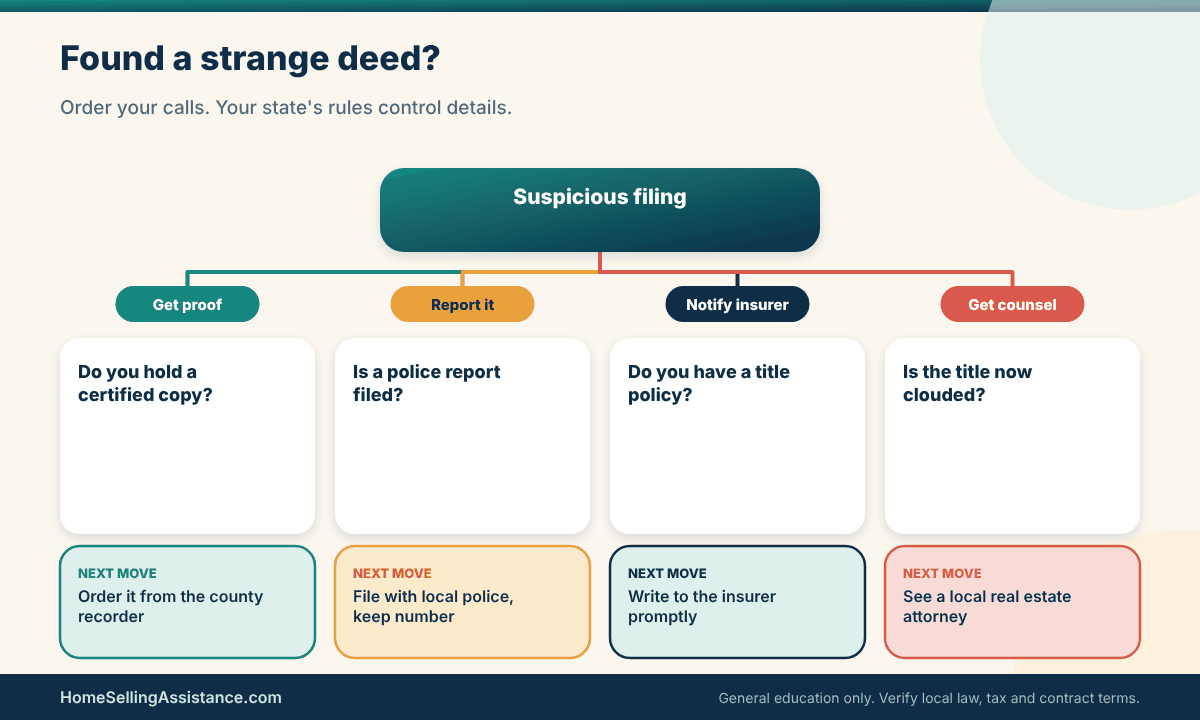
Verify a title deed fraud homeowner scare through contact channels you already trust
When something feels off, the instinct is to answer the message in front of you. Resist it. Whoever sent the message controls the phone number, link and reply address in it, so confirmation through those details proves nothing. Independent verification means you find the number yourself, from a source that existed before the suspicious contact arrived.
That habit is the center of every title deed fraud homeowner response plan, and it costs nothing. Good sources include the county’s official website typed into your browser, the title company’s number printed in your signed contract, the phone number on the back of your bank card, and the lender’s number on your statement.
Evidence to gather: numbers and records that existed before the problem
Build a short contact sheet now, while nothing is wrong. Write down the county recorder’s main line, your title company’s direct number, your listing agent’s mobile number, your mortgage servicer’s fraud line, and your attorney if you have one. Store it on paper and on your phone, away from your email. The sheet is a small thing that saves you from improvising during a stressful call.
Then gather the paperwork that proves your ownership and history: your closing statement from the purchase, the recorded deed, your title policy, tax bills, and any mortgage payoff letters. For a house you inherited, add the estate documents, letters of authority where applicable, and any court filings. Our article on an executor selling a house explains why those papers matter when authority is questioned.
Keep copies of everything you receive from anyone claiming a right to the property. Emails, voicemails, envelopes, text threads and screenshots should be preserved in their original form where possible, with dates. Do not delete a suspicious message just because it frightens you.
A scenario, an exception, and your next step
Consider Walter, a title deed fraud homeowner target, who gets a call from someone saying they represent a buyer and need to confirm that the house at his address is still available. Walter never listed it. The caller knows his full name and the year he bought. He ends the call politely, searches the county record and finds a newly recorded deed naming a company he does not know.
The temptation is to call the number that rang through and demand answers. Walter instead phones the recorder using the county’s published number, asks for a certified copy, and tells them he believes the document is fraudulent. An exception: sometimes a recorded document is real but poorly understood, such as a relative’s deed or an old release. Walter’s next step is to read the copy carefully with an attorney before assuming the worst, but to move quickly if the signature or notary details do not match.
Let us look at a second table, this one organized by situation rather than by threat. It is meant for the moments when the call has already come in and you need to decide what to do next.
| Situation | Warning sign | Verification channel | Seller response | Record to preserve |
|---|---|---|---|---|
| Sale of a vacant house you own | Buyer insists on closing remotely with a new notary | Title company number from your own file | Pause; confirm identity steps in person or by trusted call | Emails, listing history, notary details |
| Inherited home not yet sold | Unknown “representative” records a deed | Probate court clerk and recorder | Request certified copies; contact attorney | Estate papers, certified deed copy |
| Cash buyer pushes for a rushed closing | Refuses to use your chosen title company | Independent buyer and company lookup | Slow down; use your own closing office | Offer, messages, proof-of-funds requests |
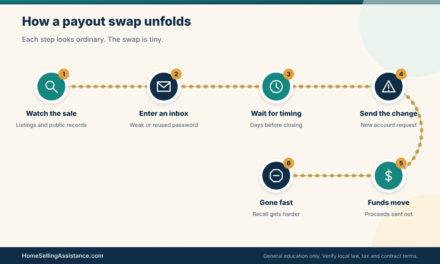
| Payoff or wire instructions change | New account details arrive by email | Known number at lender or title office | Do not send money; confirm by phone | Original and changed instructions |
| Unexpected loan statement arrives | Lender you never used; new lien on record | Lender fraud department via official site | Dispute in writing; report identity theft | Statement, envelope, recorded lien copy |
| Strange visit to the property | Stranger claims to own or rent it | County record; non-emergency police line | Do not argue; file a report | Photos, dates, names, license plates |
To use this title deed fraud homeowner scenario table, find the row closest to what you are facing, then do the verification step before you answer anyone. Then move to the preservation column and gather those items in one place. The rows are examples; your own situation may blend several.
Escalating to the bank, settlement agent, police, insurer or attorney
Once you have confirmed a suspicious filing or a suspicious request tied to a pending sale, escalation becomes about ordering and documentation. Different parties can do different things. The recorder can provide copies and explain how to challenge or flag a document, but it generally does not decide who owns the property. A court does that. Police can take a report, which many institutions want to see. A lender can investigate a loan you never took.
If your sale is already under contract, tell your settlement agent immediately, using the verified number, because a fraudulent filing can freeze a closing. The seller closing statement walkthrough is helpful context if you want to understand which line items the closing office will be reconciling.
Evidence to gather: a title deed fraud homeowner folder an investigator can read in ten minutes
Create one folder, digital or paper, and put these in it: certified copies of the suspect document, your own deed and policy, a timeline of dates and calls, the names and phone numbers of everyone you spoke to, screenshots, and any reference numbers given to you. Keep it factual and neutral. Avoid adding guesses or accusations, because a clear sequence of events is easier for police, insurers and attorneys to use.
Report identity theft where appropriate. The Federal Trade Commission’s consumer protection site explains how to report and recover from identity theft, and the FBI’s Internet Crime Complaint Center accepts online reports of internet-enabled fraud. These reports do not by themselves clear a title, but they create records that banks and insurers may ask about.
If a loan is involved, the Consumer Financial Protection Bureau has plain-language guidance about mortgage complaints and consumer rights. Read it before you call your servicer so you know what to ask.
Contact your title insurer in writing as early as reasonable. Policies often require prompt notice of a claim, and delays can complicate things. Send the notice by a method that gives you a record, and keep a copy. Do not assume a claim will be accepted, and do not assume it will be denied. The result depends on the policy, the facts and the law of your state.
A scenario, an exception, and your next step
In another title deed fraud homeowner example, Maria discovers a recorded deed transferring her rental to an unfamiliar company. She calls the recorder, orders certified copies, and then files a police report with the local department’s non-emergency line, giving the document number and dates. She writes to her title insurer, with the report number and copies attached, and asks an attorney who handles real property in her state to review the deed and the notary details.
An exception worth knowing: if the fraud involves a loan, a lender’s fraud team may move faster than a court, but a recorded lien can remain until it is formally released or set aside. Another is that if a new “owner” has already sold to an innocent buyer, the legal questions become harder, and the attorney matters even more. Maria’s next step is to follow up weekly in writing, keep a log, and avoid public accusations until counsel advises. Our fake cash home buyer warning signs also help if the fraudulent party appears as a buyer.
For any house you plan to sell, the broader fraud and seller safety category collects the related guides in one place, so you can compare the same safeguards across different scams.
Know when professional help is worth paying for
People often wait too long to hire an attorney because they hope the problem will resolve by itself, or because they worry about cost. A title deed fraud homeowner case is one of the situations where early advice can be worth it, since deadlines, notice requirements and court options vary and are sometimes technical. Many bar associations run referral services, and some legal aid organizations help homeowners who qualify.
If you are facing a loss of a home through fraud tied to financial hardship, HUD-approved housing counselors can explain options at no or low cost; see the HUD housing counselor finder. Be wary of any company that charges an up-front fee to “rescue” your home, a pattern covered in our piece on foreclosure rescue scams.
Evidence to gather: questions to bring to a first consultation
Before the appointment, write down what you want answered. Ask what court actions might be available in your state to challenge a forged deed, what deadlines apply, whether a notice or lis pendens can be recorded, how the title insurer’s role fits in, and what the likely cost range and timeline look like in plain terms. Ask what the attorney needs from you and how often you will get updates.
Bring your folder, your deed and policy, and your timeline. A good lawyer will explain what is uncertain, not promise outcomes. If an attorney guarantees a result before reading the documents, that is a reason to keep interviewing.
You should also ask whether the property can be sold or refinanced while the dispute is open. Usually a clouded title blocks both, so a pending sale needs a candid conversation with your agent, your buyer’s side and your title company.
A scenario, an exception, and your next step
Suppose a title deed fraud homeowner family is selling a house they inherited. Midway through the contract, the title company discovers a recorded deed made after the owner’s death. The buyers are nervous, the closing date is close, and everyone wants an answer. The sellers’ attorney explains that probate, the validity of the deed and the title insurer’s review all have to be sorted before the sale can proceed safely.
The exception is that sometimes a document is a clerical mistake, such as a wrong parcel number, and can be corrected through a recorded affidavit or corrective instrument, depending on local practice. The next step for this family is to ask the title company for its written findings, let the attorney lead communications, and keep the buyer informed through the agent. Our guide to estate home sale closings covers how these steps interact with probate timing.
Before we close the loop, it helps to name the mistakes that make a title deed fraud homeowner situation worse than it has to be. They are ordinary human mistakes, and nearly all of them come from stress or politeness.
The first mistake is waiting. Many title deed fraud homeowner cases are discovered late because the owner assumed that no news meant good news. A monthly search takes about ten minutes. Skipping it for a year on a vacant house is how a forged filing ends up being the first thing a buyer’s title company finds.
The second mistake is calling back the wrong number. In a typical title deed fraud homeowner scare, the owner is handed a convenient phone number inside the very message that raised the alarm. Using it feels natural, and it connects you to the person you were trying to check. Always look up your own number first, even when the caller sounds helpful and well informed.
The third mistake is signing under pressure. A deadline invented by a stranger is a sales tactic. Real closings have real deadlines, but they appear in your contract and in messages from the people you already hired. If a new voice adds urgency, slow the process down and ask your title officer to confirm it.
The fourth mistake is deleting evidence. People erase a frightening voicemail or throw out a strange envelope, then discover that the police, the insurer or the lender would have wanted it. Keep everything, label it by date, and put it in your folder. A title deed fraud homeowner report is only as strong as the documents behind it.
The fifth mistake is trying to solve it alone. A recorder can show you the document and an attorney can explain your options, but neither can read your mind. Describe the facts plainly, bring the folder, and ask what happens next. Our overview of seller safety during a home sale shows how these safeguards connect, so a title deed fraud homeowner plan can sit alongside your wire, phishing and identity precautions instead of standing alone.
If you take only one habit from this page, make it the monthly record check, since every title deed fraud homeowner defense in this guide builds on it. If you take two, add the saved contact sheet. Together they cover the two most common failures: not noticing, and trusting the wrong channel. Everything else, from alerts to attorneys, adds a layer on top of those two simple routines.
Finally, remember that you are allowed to ask questions. Recorders, title officers and attorneys field requests from worried owners every week. Asking how a document gets accepted, what they check, and what they do not check is not rude, and the answers will tell you more about your own title deed fraud homeowner exposure than any generic checklist can.
Before the FAQ, one practical point deserves its own space: how a title deed fraud homeowner plan fits around a normal sale. The fifth image below shows the documents most sellers should have in hand before listing, and it doubles as the starting kit for a fraud report if you ever need one.
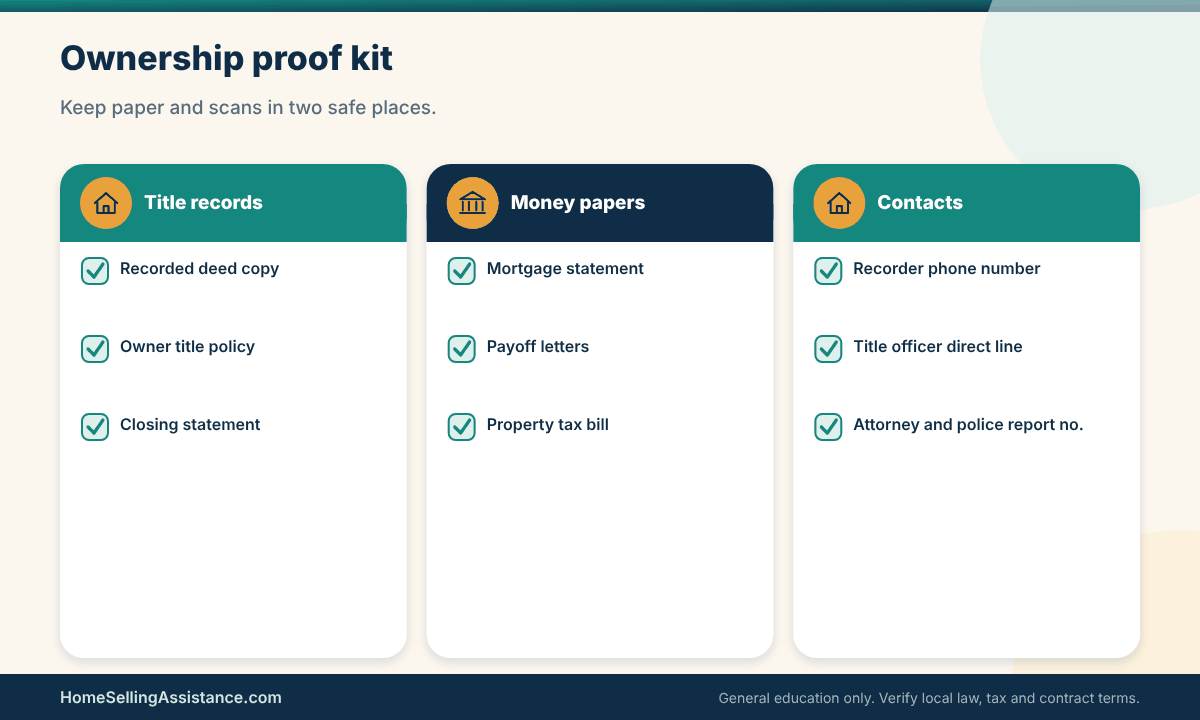
Work through that title deed fraud homeowner list in a quiet hour, not in the middle of an emergency. A homeowner who can produce the deed, the title policy, the mortgage statement and the tax bill within minutes will move faster with every office described above. Add the contact sheet and a note of the last date you searched the county record, and you have the core of a title deed fraud homeowner file.
Keep the file in two places. A fireproof box or a locked drawer holds paper copies. A password-protected folder, not an email draft, holds scans. Tell one person you trust where it is. This matters most for people who travel, own a second property or live far from an inherited house, because the person most likely to notice a problem may not be you.
Sellers sometimes ask whether a trust or a company should hold the house to make forgery harder. That is a legal and tax planning question for an attorney licensed in your state, and it has trade-offs that depend on your mortgage, insurance and goals. Any title deed fraud homeowner strategy that starts with moving the deed should begin with qualified advice, not a cold call.
Quick scenario
A seller lists a house on Monday. By Thursday, three unusual emails arrive, each asking for a signature or a copy of identification “to speed things along.” She does none of it. Instead she calls her title officer on the saved number, learns that only one request is real, and asks that future requests come through the title company’s secure portal. Her whole title deed fraud homeowner routine took about twenty minutes and cost nothing.
Think of title deed fraud homeowner care as maintenance. After a sale closes, search the record once more to confirm that the new deed and the release of your old mortgage were recorded correctly and that nothing else appears under your name. Mistakes happen in recording as well, and a clean closing record is worth having years later when you apply for a loan or sell another property.
Frequently asked questions about title deed fraud homeowner risks
What is title or deed fraud in plain terms?
It is the use of a forged or deceptive document to change who appears to own a property, or to place a loan against it. The false document is recorded at the county office, which can make the public record look as if the transfer were real. Details and names for the schemes differ between states, so it helps to describe what you see rather than rely on one label.
Who is most at risk from title deed fraud homeowner schemes?
Anyone can be targeted, but properties that attract less attention tend to be easier to exploit. Vacant houses, inherited homes, second homes, rentals and houses with no mortgage fit that description. Owners who live far away or rarely check their mail also face more risk. None of that means a lived-in house with a mortgage is immune.
Can I see my county property record for free?
Many counties let you search recorded documents online at no cost, and some charge for copies. Others require a visit or a request in writing. Look for the county recorder, register of deeds or clerk, depending on your state, and use the website you find by typing the county name yourself. Call if you cannot find an online search.
Does my county offer fraud alerts?
Some do, and some do not. Where they exist, the service usually notifies you when a document is recorded under your name or parcel, though the details vary. Ask the recorder directly whether such a service exists, whether it is free, and how quickly it reports. If there is none, a monthly self-search is a reasonable substitute for a title deed fraud homeowner check.
Will title insurance cover a forged deed?
It depends on your policy, the type of coverage you bought and the facts. Owner’s policies commonly address certain defects in title, including some kinds of forgery, but terms, exclusions and conditions differ. Read your policy or ask your title company and an attorney to explain it. Do not assume coverage, and do not assume there is none.
What should I do first if I find a deed I did not sign?
Stay calm and preserve evidence. Order a certified copy from the recorder, save screenshots, and write a timeline. Then contact local police to file a report, notify your title insurer in writing, and speak with a real estate attorney licensed in your state. Use only phone numbers you looked up yourself.
Should I confront the person named on the deed?
Generally no, not before you have advice. Contacting a suspected fraudster can alert them, prompt a rushed sale or loan, or put you at risk. Let the police and your attorney decide how and when anyone is contacted. Keep your own messages factual if contact cannot be avoided.
Can a fraudulent deed be reversed?
Courts in many places can set aside a forged deed, but the process, the timeline and the treatment of good-faith buyers or lenders vary. Some states have special statutes or procedures. An attorney can explain what is available where your property sits, and what a realistic path looks like.
Does a title deed fraud homeowner problem affect a pending sale?
Yes, it can. A clouded title usually blocks closing until it is resolved, and a title company may refuse to insure. Tell your settlement agent and listing agent promptly through verified numbers, and let your attorney guide communication with the buyer’s side. Expect delays you cannot control.
Where can I report related scams?
The Federal Trade Commission and the FBI’s Internet Crime Complaint Center take identity theft and internet fraud reports, and your state attorney general or real estate regulator may also accept complaints. A police report is often the document institutions ask for first. Keep reference numbers from every report you file.
A calm way to close
A sensible title deed fraud homeowner plan is mostly habit: know your record, verify through numbers you trust, keep one folder, and call the right offices in order. You do not need to be an expert, only consistent. This page is general education, not legal, tax or financial advice, and rules differ by state and county. For your own property, ask a licensed attorney, your title company and your county recorder what applies to you.