

Spotting fake cash home buyer signs comes down to one habit: never let a claim about money, identity or authority stand until you have checked it through a channel you found yourself.
A cash offer feels like relief. No appraisal to worry about, no loan underwriter, no financing contingency that can quietly fall apart in week three. That relief is exactly what makes the offer a useful costume. Someone who has no money, no authority to buy, or no intention of closing can borrow the look of a cash buyer for a few days, and in that window they may collect your time, your documents, your trust and occasionally your money.
This article is about the claims a buyer or investor makes and how to test them without turning every conversation into an interrogation. Most cash buyers are exactly who they say they are, and plenty of legitimate investors work through assignments and affiliated companies. Knowing the fake cash home buyer signs simply lets you tell the two groups apart. The goal is not suspicion for its own sake. It is a calm, repeatable way to separate a buyer who can perform from one who only sounds like it.
We will cover what the buyer is really claiming, what paperwork should exist behind each claim, how to verify it independently, what screenshots and polished sales language cannot prove, and how to respond if the warning pattern shows up. For the wider picture of closing-stage scams, our cornerstone guide on home sale fraud and seller safety is the best companion to this page.
Key takeaways
- Treat every cash claim as a claim, not a fact. Funds, identity, authority and timeline each need their own evidence, and one polished document does not cover the others.
- Verify through channels you found yourself. Look up the bank, title company and business registration independently, and never rely on a phone number, link or email supplied by the buyer.
- Screenshots and letters prove very little. Balances can be edited or borrowed, and a letter proves only that someone wrote a letter, so the strongest evidence comes straight from the institution.
- Assignment is not automatically a scam. Many investors legitimately assign contracts, but you should know who the actual buyer is, what the contract allows and what happens to your deposit and timeline.
- Pressure is the pattern to watch. Fake cash home buyer signs often cluster around urgency, secrecy and requests to skip the usual steps, and those requests are your cue to slow down.
- Document politely and escalate to professionals. Keep records, never share sensitive account details, and bring in a real estate attorney or the title company when something does not add up.
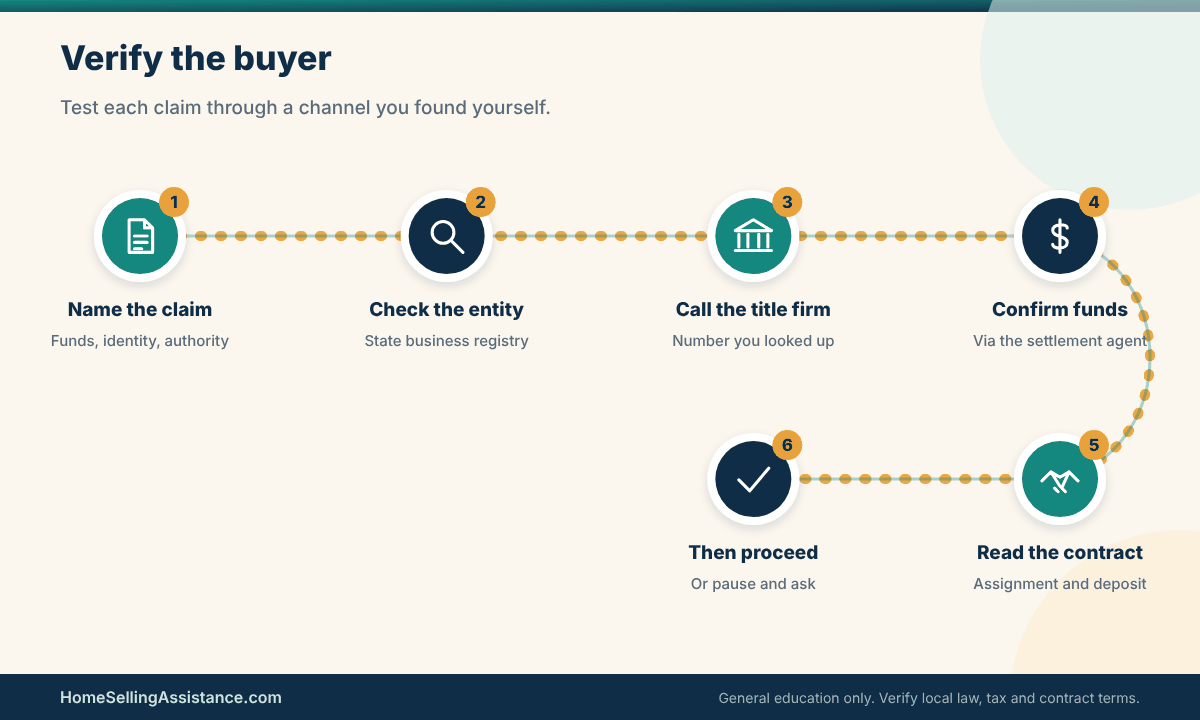
The picture above lays out the order we recommend: define the claim, ask for the evidence that should exist, check it independently, and only then decide how much trust to extend. The rest of the article works through each step with examples you can adapt to your own sale, and it keeps coming back to one question: what do the fake cash home buyer signs look like in practice, and what is the calmest response?
Start by defining the claim: what a cash buyer is promising, and where fake cash home buyer signs hide
Before you can test an offer, you need to know exactly what is being offered. That sounds obvious, but sellers often accept a vague impression, something like “they’re paying cash and can close fast,” and then discover later that the buyer never actually promised any of it in writing. A cash offer is a bundle of separate promises, and each one can be true or false on its own.
Think of the offer as a short list of statements. The buyer says they have the money. They say they are who they claim to be. They say they have the authority to sign. They say they can close by a certain date, and they say what they will pay and what fees they will charge. Fake cash home buyer signs usually show up as a mismatch between two of those statements, or as a refusal to put one of them on paper.
Funds, identity, service, timeline, fee, or authority: the six claims inside one offer
Most cash offers rest on six claims, and it helps to name them. The first is funds: the buyer has cleared, available money, not a line of credit and not a promise to raise it from partners. The second is identity: the person writing to you is a real individual or a registered entity, and is who the paperwork says. The third is authority: the signer may legally bind the buyer, and the buyer may legally purchase.
The fourth claim is service. Some companies pitch themselves as a convenient way to sell, handling repairs, cleanouts and paperwork. The fifth is timeline: a stated closing date that depends on title work, payoff letters and, often, your own preparation as much as the buyer. The sixth is fee: what you pay, what the buyer keeps, and what is quietly built into a lowered price or a separate assignment or administrative charge.
Write those six words on a sheet of paper and, next to each, note what the buyer has actually said and whether it appears in a signed document. A claim made only in a phone call or text is a hope. A claim that sits in the purchase agreement, backed by a document from an independent institution, is much closer to a fact. Most fake cash home buyer signs are really claims that never made it that far. Notice which claims are missing as well as which are present, because a missing claim is where trouble tends to start.
Evidence to gather: what each of the six claims should be backed by
For funds, the strongest backing is a statement or letter that comes from the holding institution, lists the buyer’s legal name, and can be confirmed with that institution through a number you looked up. For identity, you want a full legal name, a business entity name that matches the state registry, and a signer whose name matches the contract. For authority, look for an operating agreement, a resolution or a title company’s confirmation of who may sign.
For service claims, the evidence is a written scope: what the company will do, what it will not do and who pays. For timeline, ask for the closing date in the contract and the name of the title or escrow company that will handle it. For fees, ask for a line-by-line list of everything that reduces your proceeds, including any assignment-related charge, so you can compare it with the seller closing statement later.
You do not need every item on the first call. Ask in stages, starting with the cheapest to provide and the hardest to fake, which is usually the title company contact and the entity name. A real buyer can answer those in minutes. If a buyer answers each polite request with a new reason why it cannot be shared, that pattern is information in itself, and one of the more reliable fake cash home buyer signs. You can note it without accusing anyone.
A scenario, an exception, and your next step: the “seven days, no inspection” offer
Picture an illustrative offer that arrives by text on a Friday: all cash, seven-day close, no inspection, no agent fees, and the buyer needs an answer by Sunday. Each element has an innocent version. Some investors really do close quickly, and some do skip inspections because they plan to renovate. Taken together with a short deadline, though, the offer asks you to decide before you can check anything, and that combination is among the classic fake cash home buyer signs.
The exception is a buyer who has bought from neighbors, can show closed purchases, and gives you the title company’s name without being asked. In that case speed is simply a feature of how they operate. Your next step in both situations is the same, whether or not you suspect fake cash home buyer signs: reply that you are glad to consider it and that your answer will follow once the title company confirms the contract and the funds. A legitimate buyer will wait a day for that confirmation, and a stalling one will often push harder.
The evidence that should exist before you rely on a cash offer
Every real cash purchase leaves a trail of documents, and most of them exist long before closing day. A signed purchase agreement names the buyer, the property and the price. An earnest money receipt shows a deposit placed with a neutral party. A title or escrow company opens an order and assigns someone to your file. Evidence of funds, in some form, goes to the settlement agent. None of that is exotic, and none of it is hard for a real buyer to produce. Its absence is one of the quieter fake cash home buyer signs.
When some of these pieces are absent, ask yourself whether there is a reasonable explanation. A buyer who is early in the process may not have opened an escrow yet, and that is fine if the contract is not yet signed. What matters is that the trail grows as the sale advances. If days pass, the closing date draws near, and the trail has not moved, the offer is behaving less like a transaction and more like a conversation.
One more point about order. Documents that arrive before you have signed anything are marketing, and documents that arrive after signing are obligations. Ask for the useful ones before you commit your timeline, and treat anything that arrives only after you have taken the house off the market with extra care, because by then you have already paid the cost of waiting.
Evidence to gather: the paper trail that belongs to a real cash purchase
Start with the contract itself. It should list the full legal name of the buyer, the property address or legal description, the price, the deposit amount and holder, the closing date, who pays which costs and what happens if either side defaults. If the contract has blanks, a vague “and/or assigns” line or an unnamed escrow holder, ask for those blanks to be filled before you sign, not after.
Next comes the deposit. A real earnest money deposit goes to a title company, an attorney’s trust account or a licensed broker’s trust account, depending on local custom, and you can ask for written confirmation from that holder. A deposit “to be wired later” or a promise that the buyer will “hold it until closing” is not a deposit. Our article on earnest money for sellers explains how deposits are normally handled and what can go wrong.
Finally, ask who the settlement agent will be and call that office using a number from its own website. Confirm that they have the contract, that the buyer’s name matches and that an order has been opened. That single call checks more than any letter, because the title company has its own reputation and compliance rules to protect, and it will only tell you what it has actually received.
A scenario, an exception, and your next step: the deposit that never arrives
Imagine a buyer who signs your contract, promises an illustrative deposit within two business days, and then sends a screenshot of a pending transfer. A day later they say the bank flagged the transfer and ask whether you could “just release the keys early” so their contractor can begin measuring. The screenshot proves nothing about the title company’s account, and early access would hand them a position in your home with nothing at risk. That request alone counts among the fake cash home buyer signs worth writing down.
The exception is a genuine bank delay, which does happen with larger transfers. The fix is simple and fair: you wait for the title company to confirm in writing that the deposit has landed, and you decline access until it does. Your next step is to send a short, friendly note stating that the contract timeline continues and that you will schedule access once the escrow holder confirms receipt. Keep that message and the screenshot in your file in case the deal ends.
The matrix below pulls the main claims, the evidence that backs each one, the safest response and the things you should never hand over into one view. Use it as a quick reference when a message arrives and you are unsure how to answer. It is general education, so local practice and your own contract can change the details. Think of it as a map of fake cash home buyer signs and the safest reply to each.
| Threat or claim | Evidence to check | Safe action | Never share | Escalation |
|---|---|---|---|---|
| “I have the cash ready” | Statement or letter confirmed with the institution directly | Ask the title company what it has received | Your bank login or account details | Real estate attorney if documents conflict |
| “I represent a company” | State business registry entry and signer authority | Match the entity name across every document | Personal ID images before a contract | Attorney or title company review |
| “Close in a week, skip steps” | Open title order and a dated contract | Keep the contract timeline and decline shortcuts | Keys, codes or access instructions | Title company or local police if threats appear |
| “This contract can be assigned” | Assignment wording and disclosure of the end buyer | Ask who the ultimate buyer is and in writing | Your signature on unread addenda | Attorney before signing any assignment terms |
| “Send the deposit or fee first” | Written request from a licensed escrow holder | Pay nothing outside the contract process | Wire details, card numbers, MFA codes | Bank fraud team, then FTC or IC3 reports |
| “Use my closing company” | Company license, office address, reviews you found yourself | Call the office using an independently found number | Payoff figures sent through unverified links | Your own attorney or agent, if you have one |
To use the table, find the row that matches the sentence you just heard, then read across. The third column is your default reply, and the fourth is the boundary you hold even if the buyer is friendly and the story sounds reasonable. If you reach the fifth column, you are no longer verifying; you are getting help, and that is exactly what that column is for.
Verify independently: how to test a cash buyer without insulting a real one
Verification works best when it is routine. If you tell every serious buyer, in a friendly voice, that you confirm funds and entity details through the title company before you take the house off the market, you are not accusing anyone. Real buyers meet this step all the time and generally respect it. A loud objection is one of the fake cash home buyer signs worth noting.
The principle is simple: information you find yourself is more reliable than information handed to you. A phone number printed on a letter was chosen by the person who printed it. A phone number on the bank’s own website was not. That difference is the whole reason independent verification works, and it is the same principle fraud investigators recommend for wire and closing scams, which we cover in our guide to real estate wire fraud for sellers.
Official records, known contact channels and bank or title documentation
Three kinds of sources deserve your trust more than anything a buyer sends. Official records are public or regulated: the state business registry for entities, the county recorder or assessor for ownership and recorded documents, and the licensing board for any broker, attorney or escrow officer. Known contact channels are phone numbers and addresses you found through a search you ran or a relationship you already had. Institution documents come from the bank or title company, and ideally reach you through them.
Compare what the buyer told you with what these sources show. Does the company exist, and is it active? Is the person who signed listed as an officer, manager or member? Does the title company have a licensed office at the address on the contract? None of these checks is a guarantee of good behavior, but together they remove the cheapest fakes, and spotting fake cash home buyer signs early costs far less than discovering them at closing.
Evidence to gather: records you can pull yourself in an afternoon
Begin with the entity. Search the secretary of state or equivalent business registry in the state where the buyer says the company was formed, and note the exact legal name, status, formation date and registered agent. A company formed last month is not automatically suspicious, since investors often create a fresh entity per deal, but it means you should rely more on the title company and funds confirmation and less on reputation.
Then look at the property side. Your county recorder or assessor can show who owns what, and you can search the buyer’s name for other recorded purchases in the area if public records are searchable. Check the title or escrow company’s license status with your state’s regulator, and read recent independent reviews, understanding that reviews can be manipulated and are only one signal among several.
If a real estate agent is involved on either side, you can usually confirm their license through your state real estate commission. Our guide to verifying a cash home buyer walks through these checks in more detail, and our fraud and seller safety library collects related articles on protecting yourself during a sale.
A scenario, an exception, and your next step: the phone number that only rings one way
Suppose a buyer’s contract names a title company and includes a phone number and email for the “closing officer.” You search for the company, find a website, and notice that its listed number differs from the one on the contract. The buyer says the contract number is a direct line and that the main number “goes to a call center that will just slow us down.”
The exception is real: some officers do have direct lines, and some offices list only a general number online. You do not need to decide who is right. Call the main number you found yourself, ask for the officer by name, and ask whether an order has been opened for your address. If the officer exists and confirms the order, you have lost five minutes and found no fake cash home buyer signs at all. If no one there has heard of the deal, you have learned something valuable, and you can pause without ever accusing the buyer of anything.
What screenshots, letters and sales language cannot prove
Digital documents are easy to alter, and persuasive words are even easier to produce. A bank screenshot can be edited, cropped to hide the account type, taken from a real account that belongs to someone else, or captured during a short-lived balance that was moved out the next hour. A letter on letterhead proves that someone typed a letter. A video call with a stack of bills in frame proves nothing about funds in a bank.
Sales language has the same limits. Phrases such as “we buy dozens of houses a month,” “we’ve never had a deal fall through” and “ask anyone in the area” are claims about reputation, not evidence. They may be true, and a real investor will happily back them with closed purchases you can look up. What matters is whether the buyer replaces claims with checkable facts when you ask. Vague boasting that never turns into documents is one of the fake cash home buyer signs people overlook.
For a closer look at funds documentation in particular, our article on proof of funds from a cash buyer explains what these documents typically show and where their limits lie, so you can read them with realistic expectations and recognize fake cash home buyer signs in the paperwork itself.
Why a bank screenshot is weaker than it looks
Consider what a screenshot actually contains. It shows a number, a name and a date, but it lacks any of the things that make a record trustworthy: an official source, a way to confirm it independently and a link between the money and your specific transaction. Even a genuine screenshot says nothing about whether the funds are available for this purchase, are owned outright, or will still be there at closing.
A somewhat stronger form is a statement or letter issued by the institution that holds the money, addressed to the settlement agent, and confirmed by that agent. This approach still has limits, since balances change, but it moves the verification from you to a regulated party. Sellers can reasonably ask that funds evidence go to the title or escrow company directly instead of coming through the buyer’s hands.
Be careful with any request to share your own account details so that the buyer can “show good faith” with a test deposit. A genuine buyer has no need for your banking login, your online credentials or a code sent to your phone. Account details should reach the settlement agent only through the secure process that agent describes, and you should confirm that process by calling the office yourself.
A scenario, an exception, and your next step: the buyer who is really a middleman
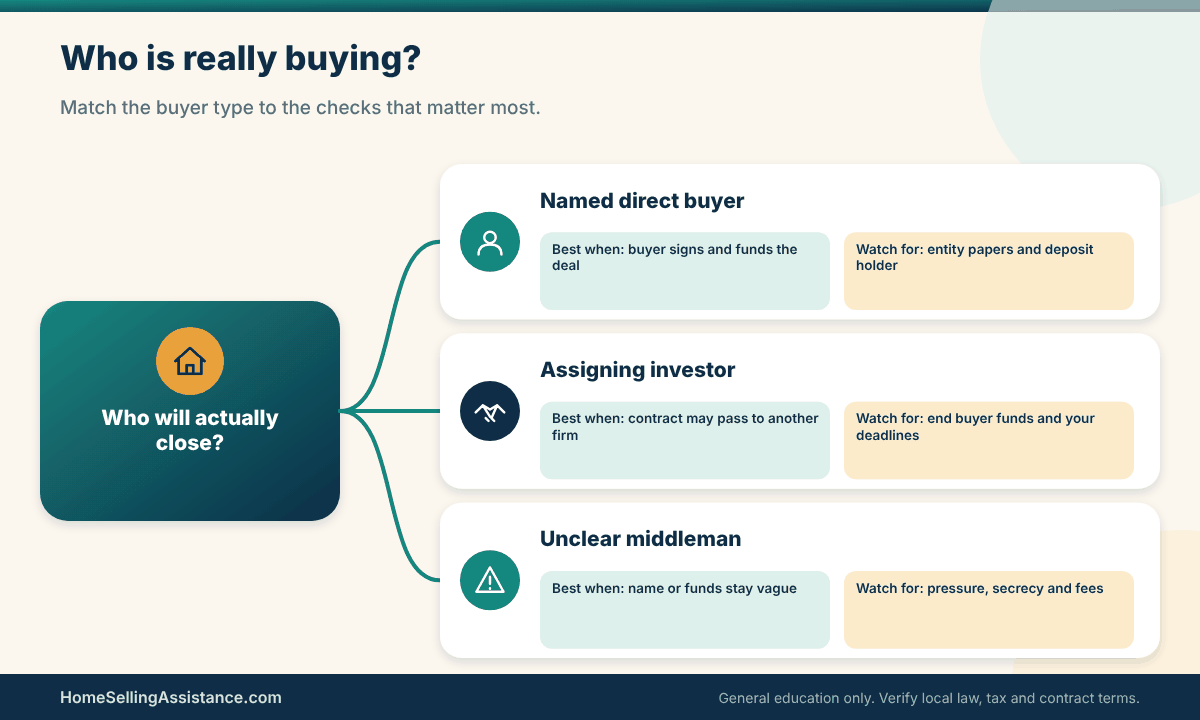
Imagine a buyer who signs your contract with the words “and/or assigns” after their name, and a week later you learn that a different company will close. This pattern, often called wholesaling, is legal in many places and common among investors, but rules about disclosure, licensing and advertising of other people’s property vary by state. Some states regulate it closely, and others do not.
The exception is the investor who tells you up front that they may assign the contract, explains how it works and shows you the language. In that case there is nothing hidden, though you may still want to talk to a real estate attorney before signing.
Your next step, if you were surprised, is to ask in writing who the ultimate buyer is, whether the funds belong to that buyer, how your deposit and closing date are protected, and what happens if the new buyer cannot close. Surprise assignments are not always among the fake cash home buyer signs, but secrecy about them often is. Compare that situation with our guide on how an investor offer compares with listing a house if you are weighing options.
Not every gap in the paperwork means fraud. Sometimes a buyer is simply disorganized, a title office is slow, or a new investor does not yet know what a seller expects. The next section is about reading fake cash home buyer signs fairly, so you can protect yourself and your timeline without accusing anyone of something you cannot prove.
Use red flags without unsupported accusations: reading fake cash home buyer signs fairly
A red flag is a reason to look closer, not a verdict. The difference matters in practice because you may still need to do business with this person, and because a false accusation can create its own problems, from a ruined deal to a legal dispute. A better frame is to describe what you observe, ask a neutral question and let the answer guide your next step.
For example, “the buyer refused to name the title company” is an observation. “The buyer is a scammer” is a conclusion you cannot support. Keep your notes and your messages in the first style, and describe each of the fake cash home buyer signs you notice without labeling the person. If something does go wrong later, a calm, factual record is far more useful to an attorney, a title company or a law enforcement agency than a record full of guesses about someone’s motives.
Warning patterns that tend to repeat in cash buyer and investor deals
Across many stories about fraudulent or unreliable buyers, the same few fake cash home buyer signs reappear. The first is pressure: an artificial deadline, a claim that another buyer is waiting, or a suggestion that you will “lose the deal” if you ask questions. The second is secrecy, such as requests not to talk to your agent, attorney or the title company, or not to tell family members about the offer.
The third is a shortcut around the normal structure: a deposit that goes somewhere other than a neutral holder, a request to sign over keys or access before closing, or a request for your personal financial credentials. The fourth is a mismatch, where names, addresses, signatures or entity details differ between documents. The fifth is a fee that appears late, sometimes labeled as an assignment, administrative, processing or release charge, and often presented as the last small step before funds arrive.
None of these signs alone proves anything, and a legitimate buyer can display one of them by accident. Several fake cash home buyer signs together, especially when the buyer reacts badly to routine questions, move an offer from “worth checking” to “worth pausing.” The table below sets out common situations with a verification channel and a recommended seller response.
| Situation | Warning sign | Verification channel | Seller response | Record to preserve |
|---|---|---|---|---|
| Cash offer arrives with a one-day deadline | Pressure to decide before checks | Title company found independently | Reply that you will answer after confirmation | Original message and your reply |
| Contract names an unfamiliar escrow holder | No license or address you can confirm | State regulator and company website | Ask for a recognized neutral holder | Contract copy and search notes |
| Buyer sends a bank screenshot as proof | Image only, no institution contact | Settlement agent confirming funds | Request funds evidence go to the agent | Screenshot and date received |
| Late request for a fee before closing | Fee not in the contract | Contract text and your attorney | Decline until reviewed in writing | Fee request and written reply |
| Contract assigned to another company | New buyer you never vetted | Business registry and new buyer’s funds proof | Ask for written assignment terms | Assignment document and emails |
| Buyer asks for keys before closing | Access with no money at risk | Escrow holder deposit confirmation | Decline access until funds are confirmed | Request and written refusal |
| Instructions change at the last minute | New wire or payment instructions by email | Known phone number for the settlement agent | Call and confirm before acting | Original and changed instructions |
Use this table of fake cash home buyer signs before replying to a message that makes you uneasy. Match the situation, check the warning sign, choose a verification channel that does not depend on the buyer and write your response in plain, polite language. The final column matters more than people expect, because the records you keep are the part an attorney, bank or agency can actually work with.
Evidence to gather: documents that turn a hunch into a record
Good records are boring, which is why they work. Save the original offer and every later message, in the app where it was sent, and consider exporting emails as files. Note dates and times of phone calls and the names of the people you spoke with. Keep a copy of the contract in every version, including drafts, and save the screenshot or document the buyer sent as proof of funds exactly as received.
Add your own verification notes: what registry you searched, what you found, which number you called and what the person said. If you are working with an agent or an attorney, forward them the same file, since they can read patterns you might miss and they may know local practice that matters here.
If a message contains a link, an attachment you did not expect or an instruction to wire money, do not click or act on it. Preserve it and call the sender through a verified number. Our guide on email phishing aimed at home sellers explains how look-alike addresses and hijacked threads can make a fraudulent message appear to come from someone you trust. If a buyer pushes for copies of your ID early, read how seller identity fraud at closing works first.
A scenario, an exception, and your next step: the fee that appears at the finish line
An illustrative case: a buyer under contract tells you, three days before the scheduled closing, that a small “release fee” is due from you so that the buyer’s lender-of-last-resort will fund. They add that your title company will refund it at closing and that you can send it through a payment app to speed things along. You never agreed to any such fee in the contract.
The exception would be a fee your own contract already lists, such as a seller-paid cost that the settlement agent shows on a closing statement. Real costs are paid through the settlement process, not to the buyer by app. Your next step is to decline politely, in writing, and ask the title company whether any such charge exists. A late fee request is one of the fake cash home buyer signs people report most. Keep the request, because it may become relevant if you decide to report it to the FTC or ic3.gov, a topic we return to below.
Safer next steps when fake cash home buyer signs appear
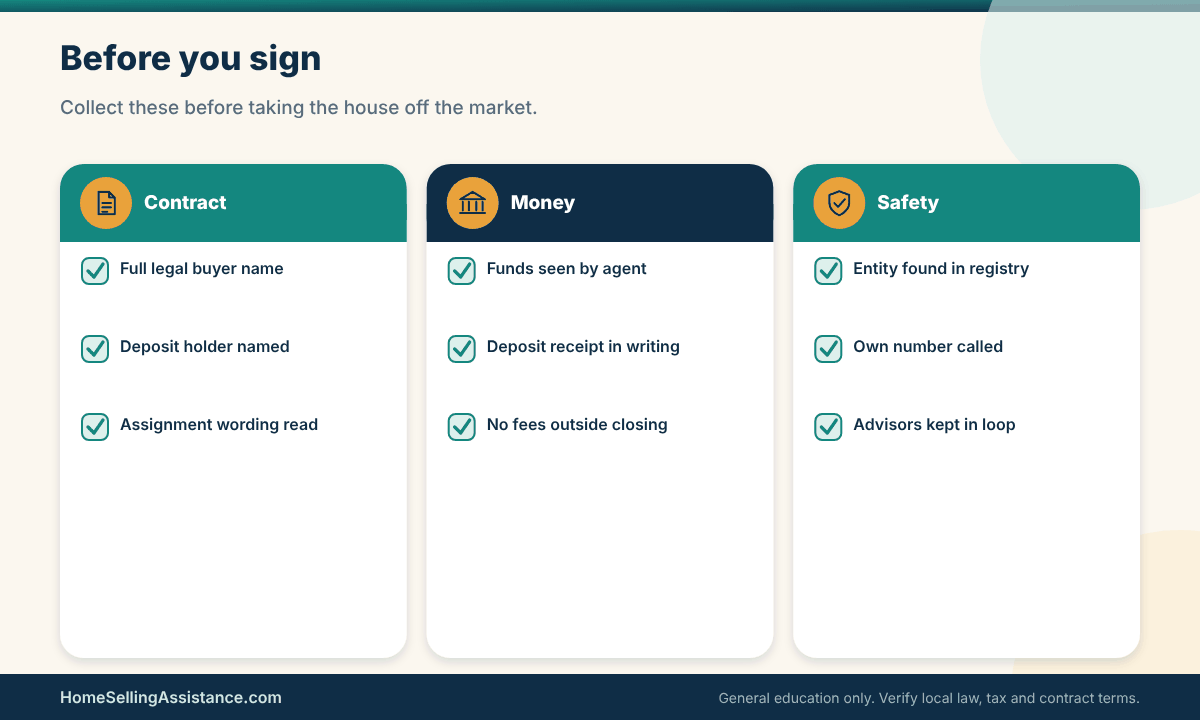
When several fake cash home buyer signs line up, the useful question is not “how do I catch them?” but “how do I protect my house, my money and my time while I find out?” The answer tends to be a slow, quiet pause. You do not need to confront anyone. You need to stop moving forward on the buyer’s schedule and start moving on yours, with a short list of checks and a clear person to ask if the answers do not satisfy you.
That person might be your listing agent, and sharing the fake cash home buyer signs you noted gives them something concrete to work with. They might also be a real estate attorney, your title or escrow officer, or all three. If you are selling without an agent, the title company and an attorney are your best allies, and you can ask them to review the contract before you sign anything further. Our cornerstone guide on seller fraud and safety includes a broader checklist that fits alongside these steps.
Two protective habits are worth setting early. First, decide in advance what you will never do: you will not send money to a buyer, share account credentials or one-time codes, hand over keys before closing, or sign documents you have not read. Second, decide who will review changes and how you will react to fake cash home buyer signs. A short pre-commitment like this is harder to break under pressure than a rule you invent in the moment.
Evidence to gather: confirmations that justify moving forward or stopping
Moving forward is reasonable when the independent checks line up and no fake cash home buyer signs remain unexplained: the title company confirms the contract and an open order, the entity exists and the signer appears connected to it, the deposit is confirmed by a neutral holder and the funds evidence has been reviewed by the settlement agent. At that point the buyer’s claims have been tested by parties with no stake in your trust, and you can proceed with more confidence.
Stopping, or at least pausing, is reasonable when the checks conflict or cannot be completed, or when fake cash home buyer signs keep multiplying. You might hear that no order exists, discover that the entity name differs from the contract, or learn that the deposit holder is unlicensed. You do not have to explain every reason to the buyer. A short message saying that you cannot proceed until the title company confirms the details is usually enough, and it keeps the record clean.
Keep in mind that pausing has costs of its own, including time on the market and the chance that a real buyer loses interest. Weigh that cost against the risk of tying up your house. If your contract has a deadline and you are unsure whether the buyer is in default, talk to an attorney before sending any notice, since the rules on default and deposit release depend on your contract and your state.
The decision path pictured next shows how these checks fit together when you are not sure what to do. It is deliberately simple, because under stress a short path is easier to follow than a long list of rules, and it applies whenever fake cash home buyer signs begin to stack up.
A scenario, an exception, and your next step: the buyer who wants you to stay quiet
Imagine an investor who tells you, in a friendly way, that you should not mention the offer to your agent because it could “complicate the commission.” They suggest keeping everything between the two of you and signing a short document they will send over. The investor adds that the title company they use is their cousin’s and that you do not need to call it.
The exception is a buyer who simply prefers a streamlined process and is happy to loop in your agent or attorney once you ask. Many are. Secrecy requests are still among the fake cash home buyer signs you should record. What matters is how they respond when you say that you always include your advisors. A real buyer says fine. A buyer who needs secrecy tends to repeat the pressure in new words. Your next step is to include your advisors anyway, keep the exchange in writing and let the response tell you what to do.
Be especially cautious if the secrecy is paired with an unusual document, such as something described as a “short agreement,” a “memorandum,” or a “right of first refusal.” Documents like these can affect your ability to sell to someone else. Do not sign anything that you cannot explain in your own words, and ask an attorney to review anything that touches ownership, a recorded interest or a limit on who you can sell to. Our guide to the real estate sales contract from the seller’s side explains which clauses deserve a careful read.
If a deal has already gone wrong, the steps change. If you have already sent money, shared credentials or signed something you now doubt, act quickly and calmly. Contact your bank’s fraud department using the number on your card or on the bank’s own website, and ask what options exist for the specific type of payment you used.
Speed matters with transfers, and the fake cash home buyer signs you saved help your bank and the title company understand what happened, though outcomes vary and nobody can promise that money will be recovered. Then contact the title company and your attorney, if you have one.
You can also report suspected fraud to the Federal Trade Commission through consumer.ftc.gov and, for internet-enabled crime, to the FBI’s Internet Crime Complaint Center. Reports help investigators see patterns, though they do not guarantee a particular result for you. The Consumer Financial Protection Bureau also publishes plain-language material on closing-related scams at consumerfinance.gov.
Local police may take a report too, particularly if someone has entered your property or threatened you. Give them your organized records. If you feel embarrassed, remember that these schemes are built by people who do this repeatedly and who count on polite, trusting sellers. Telling someone early is a sign of good judgment, and it often helps the next seller as well.
Saying no politely is a skill worth practicing. Plenty of sellers freeze because they worry about offending a buyer who might be genuine. A few short scripts can help. To slow an urgent offer: “Thanks for the offer. I review every contract with the title company before I respond, so you will hear from me tomorrow.” To request verification: “Could you tell me which title company you are using? I will call them directly to confirm they have the contract.”
To decline a request outside the contract: “I’m not able to send anything outside the closing process. If there is a cost, please have the title company list it and I will review it with them.” To decline early access: “I can schedule access once the escrow holder confirms the deposit. That is how I handle every sale.” Each reply is friendly, specific and difficult to argue with, and each works whether or not the fake cash home buyer signs turn out to mean anything.
Real buyers usually accept these answers. Some even tell you that it reassures them to deal with a careful seller. When someone responds with anger, a threat or a new deadline instead, you have gathered the clearest evidence you will get without spending a dollar. Our article on weighing a cash offer for your house covers the legitimate side of cash buying so you can compare.
Quick scenario
A seller receives a strong cash offer on Thursday with an illustrative deposit “wired to escrow Friday.” By Monday, with fake cash home buyer signs piling up, no title company has an order, the buyer’s company was formed last week and the buyer now asks for a small fee to “unlock” funds. The seller writes back that the offer is on hold until the title company confirms a contract and deposit, keeps every message and calls the title company directly. No money moved, and the house stayed available for the next serious buyer.
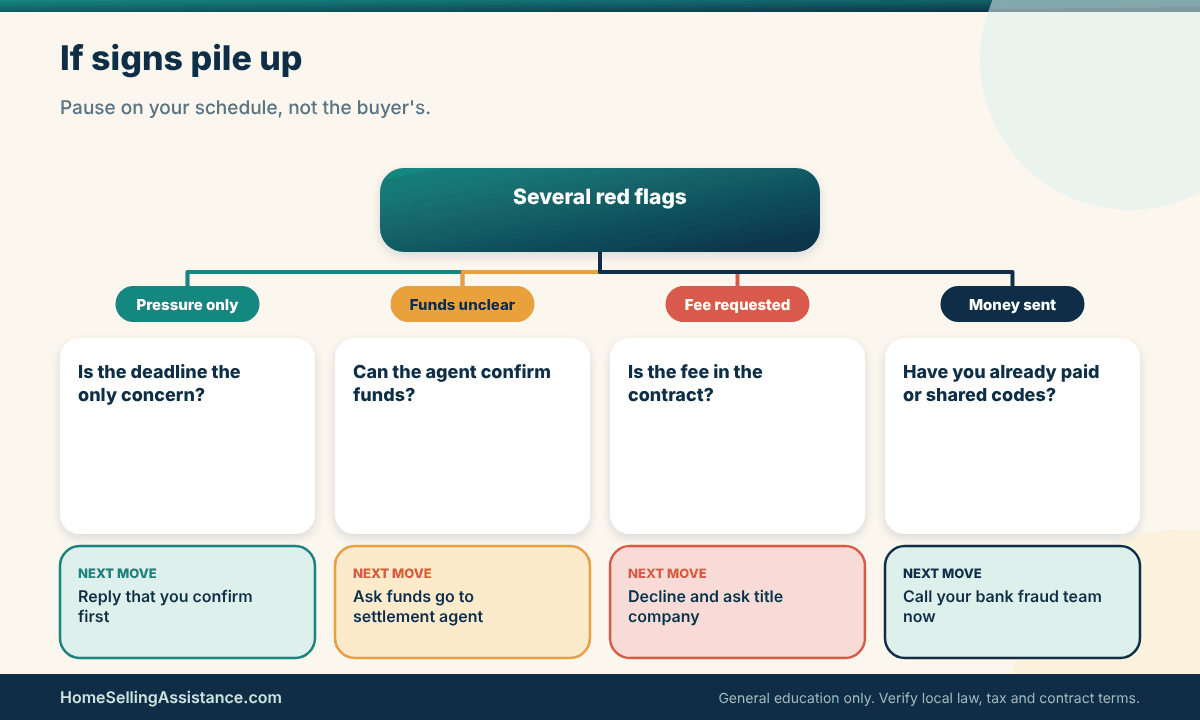
Think of the checklist above as a pre-flight routine for spotting fake cash home buyer signs. You do not need to complete every item before you reply to a first message, but you should be able to complete the whole list before you sign a contract, release access or take a listing off the market. The earlier you start, the less awkward each request feels, since it simply becomes part of how you sell.
One last thought about fairness. Learning fake cash home buyer signs is not the same as treating buyers as enemies. Most cash buyers are real, and a seller who is organized, polite and consistent is a pleasure to deal with. The point of verification is to let genuine buyers prove themselves quickly, and to give you a basis for confidence that does not depend on how smooth the pitch sounds. For Fair Housing considerations, apply the same checks to every buyer, whatever their background, and see HUD’s fair housing resources for context.
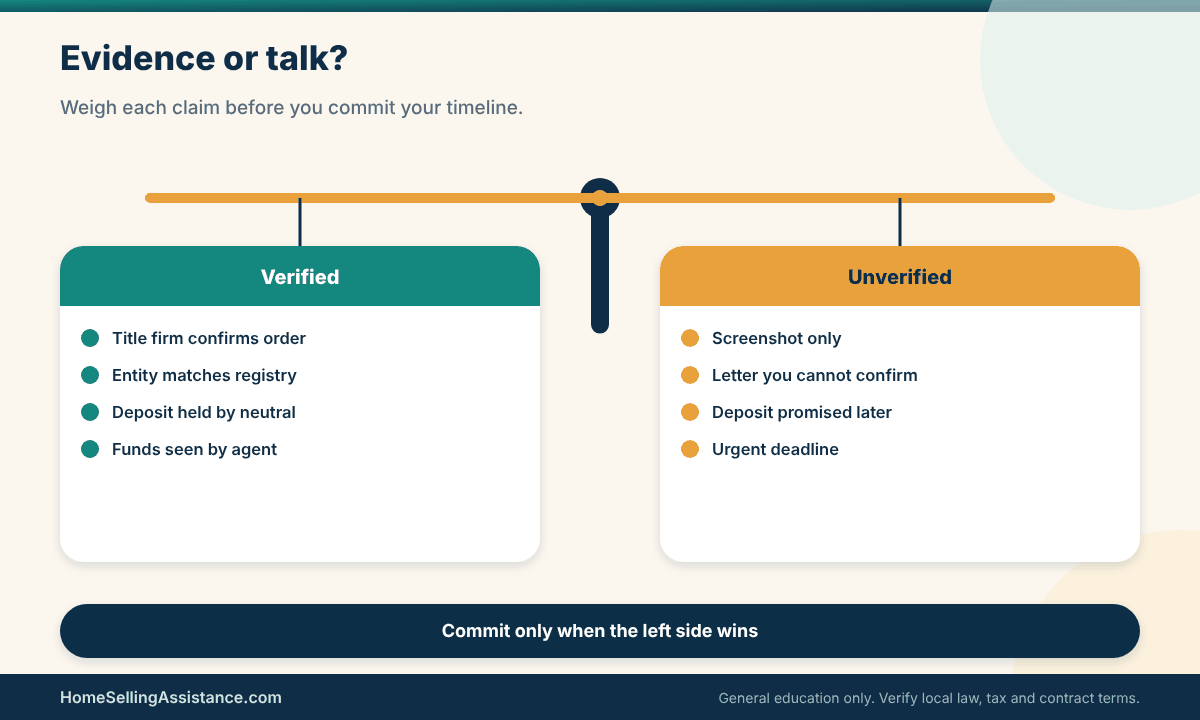
The final graphic compares what a verified claim looks like with what an unverified one looks like. If you can place every important claim from your buyer on the left side, no fake cash home buyer signs are left to worry about and you are in a strong position. If most of them sit on the right, your next move is to ask for more, not to commit.
Frequently asked questions about fake cash home buyer signs
What are the most common fake cash home buyer signs?
Fake cash home buyer signs are best read as a cluster, not a single item. Pressure to decide quickly, secrecy, reluctance to name a title company, a deposit that does not go to a neutral holder, mismatched names across documents and late fees all appear often in problem deals. Any one of them can have an innocent explanation, so look for several together and verify each through channels you found yourself.
Is it rude to ask a cash buyer for proof of funds?
No. Experienced buyers expect it and many offer it first. Frame the request as routine: you confirm funds with the settlement agent before taking the house off the market. A polite request is reasonable, and how the buyer responds tells you a lot, since pushback is among the fake cash home buyer signs. If the proof goes to the title or escrow company instead of passing through the buyer, that is usually cleaner for everyone.
Can a proof of funds letter be faked?
Yes, letters and screenshots can be altered, borrowed or out of date, so on their own they prove little. The stronger approach is confirmation from the institution or the settlement agent, using contact information you found independently. Even then, balances can change, so ask about timing and keep checking as the closing date approaches. Funds evidence that cannot be confirmed is one of the clearer fake cash home buyer signs. Our guide on proof of funds goes deeper on what these documents show.
Is an assignment clause a sign of a fake buyer?
Not by itself. Assigning a contract is legal in many places and widely used by investors, though state rules on disclosure and licensing vary, and some contracts restrict assignment. What matters is transparency: who the actual buyer will be, whether that buyer has verified funds, and how your deposit and deadlines are protected. If you are unsure, an attorney can explain what the wording means for you.
Where should an earnest money deposit be held?
Local custom varies, but deposits are commonly held by a title or escrow company, an attorney’s trust account or a licensed broker’s trust account. Ask the holder to confirm receipt in writing, using a number you found yourself. A deposit that stays with the buyer, goes to an unfamiliar account or arrives “later” is a reason to pause.
What should I never share with a prospective buyer?
Never share online banking logins, passwords, one-time codes, full account numbers outside a secure settlement process, or images of identification before there is a signed contract and a verified recipient. You should also avoid sharing keys, lockbox codes or alarm details until closing is complete. A real buyer does not need these to make an offer or to schedule an inspection.
How can I check whether a buyer’s company is real?
Search your state’s business registry for the exact entity name and look at its status, formation date and registered agent. Compare the signer’s name with the contract. A new company is not necessarily suspect, but it should lead you to rely more heavily on title company confirmation and verified funds. An attorney or title officer can help interpret what you find.
What if a buyer asks me to pay a fee before closing?
Treat it with caution. Legitimate seller costs appear on the settlement statement and are paid through the closing process, not sent to the buyer or through a payment app. Ask for the request in writing, check the contract and call the title company. If the fee is not in the contract, you can decline until a professional reviews it.
Should I report a suspected fake buyer?
If you lost money, shared sensitive information or were threatened after seeing fake cash home buyer signs, yes, and quickly. Contact your bank first, then the title company, then consider reports to the FTC and the FBI’s IC3, and to local police if appropriate. Even when nothing was lost, a report can help others. Keep records organized, including notes on every one of the fake cash home buyer signs, since they make any report more useful.
Can I back out of a contract if I suspect fraud?
Whether you can, and how, depends on your contract and state law, including any default and deposit provisions. Do not send a termination or demand notice without advice, since an incorrect move can create problems of its own. A real estate attorney can review the wording and your options, and the title company can confirm what has been received.
Selling with your eyes open
Knowing the fake cash home buyer signs does not mean treating every offer as a trap. It means giving each claim a quiet, routine check: who is the buyer, where is the money, who may sign and who holds the deposit. Real buyers pass those checks easily, and you keep control of your home and your timeline. This article is general education, not legal, tax or financial advice, so talk to a real estate attorney, your title company or a licensed professional about your own sale.


