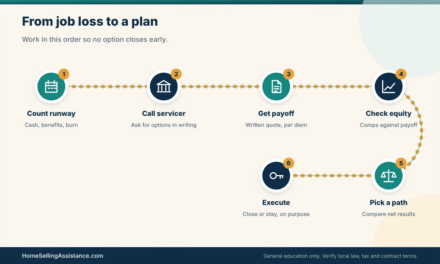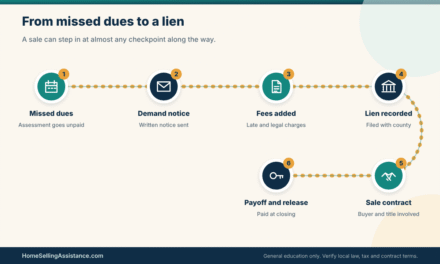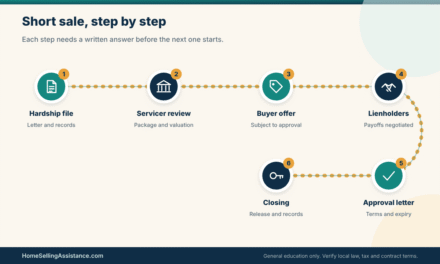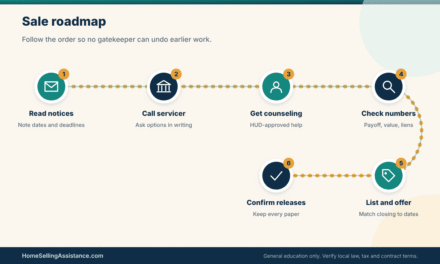
Figuring out an underwater mortgage sell house plan starts with one uncomfortable fact: your loan balance is higher than what buyers are likely to pay, so a normal sale will not produce enough money to clear every lien. That does not mean you are stuck, and it does not mean you must lose the home. It means the sale has to be built around a gap, and the gap has several possible ways to close.
If you are reading about an underwater mortgage sell house situation, you may have opened your mortgage statement, then a home value estimate, and felt your stomach drop. Maybe you bought near a market peak, borrowed against the house later, or watched local prices soften while your balance barely moved. Maybe a job change or a family event makes staying put impossible. Whatever brought you here, the first job is simple: replace worry with a few real numbers.
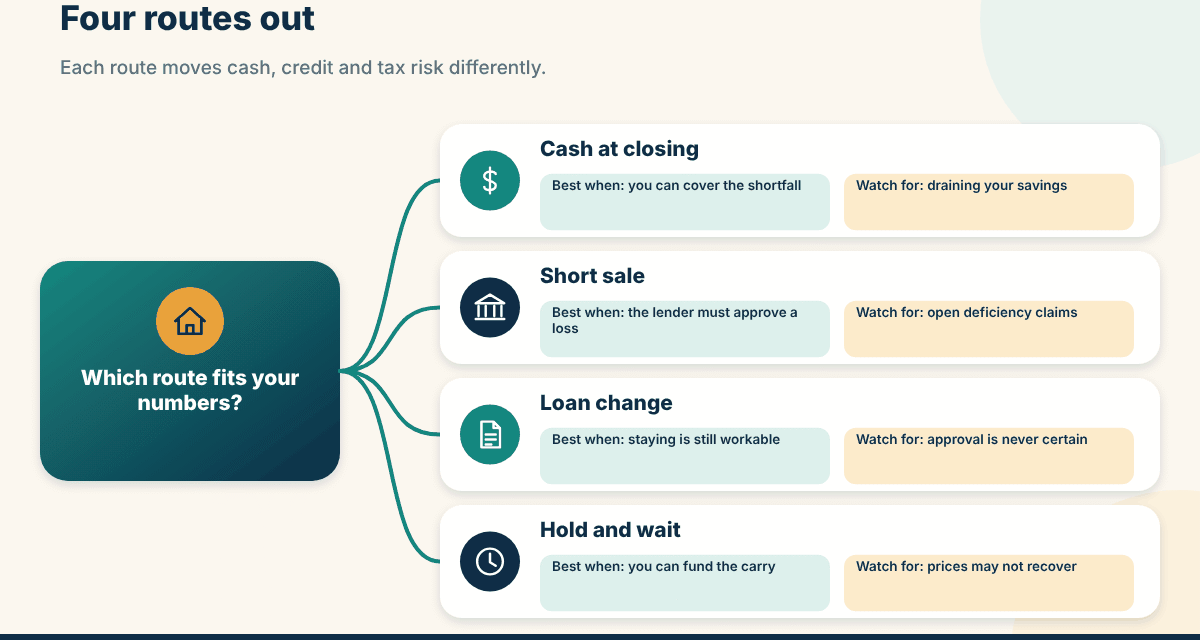
An underwater mortgage sell house decision usually comes down to four routes. You can bring cash to closing and pay the shortfall yourself. You can ask your lender to approve a short sale, where the lender accepts less than it is owed. You can try to change the loan so that staying, or selling later, becomes workable. Or you can wait and hold, if the payments are manageable and the market might recover. Each route moves money, credit, taxes and stress around differently.
This guide stays general on purpose. Lender programs, state deficiency rules, tax treatment of forgiven debt and local custom all vary, and none of us can see your loan file. What we can do is show you how to gather inputs, compare the total risk of each path, test your plan with round-number scenarios, and decide which questions to put to your servicer, a HUD-approved housing counselor, a tax professional and a real estate attorney. If foreclosure is already on the calendar, read this alongside our guide to selling a house before foreclosure.
Key takeaways
- Underwater means a gap, not a dead end. Compare what you owe, including second liens and selling costs, against a realistic sale price before you pick a route.
- Get written payoff figures first. A mortgage statement balance is not a payoff quote, and any junior lien, HELOC or lien on title changes the math.
- Four routes, different risks. Cash at closing, a lender-approved short sale, a loan change, or holding all trade credit, tax and cash-flow risk in different ways.
- Ask about deficiency and taxes in writing. Whether a lender can pursue the leftover balance, and whether forgiven debt counts as income, depends on state law and your facts.
- Use free, neutral help. HUD-approved housing counselors cost little or nothing, and you should never pay an upfront fee to a stranger who promises to rescue your home.
Before we get into the details, a quick note on how to read this page. The first section of this underwater mortgage sell house guide is about your inputs and your clock, because every other decision depends on them. The second compares the full financial risk of each route. The third gives you a worked example with illustrative numbers and a break-even check you can rebuild with your own figures. The tables are designed to be copied into a notebook.

Start your underwater mortgage sell house plan with cash flow and net proceeds
Every underwater mortgage sell house plan is, at heart, a subtraction problem with an uncertain first number. You take a realistic sale price, subtract what a sale would cost, subtract everything secured against the property, and look at what is left. A positive number means you walk away with money. A negative number is the shortfall, and it is the number all the other decisions revolve around.
The trouble is that sellers weighing an underwater mortgage sell house choice often compute this with soft numbers: an online estimate for the price, a rough memory of the loan balance, and a guess at costs. A soft shortfall number leads to soft decisions. Spending a week to firm up each input is the most valuable thing you can do before you speak to a buyer, an agent or your lender about a short sale.
The numbers behind an underwater mortgage sell house decision
For an underwater mortgage sell house plan, think of five inputs: the likely sale price, the payoff on the first mortgage, any other liens, the costs of selling, and the money you have available. The first four define the shortfall. The fifth tells you which routes are even open. If you owe more than the home is worth but have savings, a cash-to-close sale may be possible. If you have little cash and a pending payment problem, a lender-approved route is more realistic.
Be careful with the word “worth.” An automated estimate, an agent’s opinion, an appraisal and an actual contract price are four different things. If you want a refresher on how those differ, our articles on how much your house is worth and comparative market analyses versus appraisals explain who produces each number and why they disagree. For an underwater sale, plan with the lower end of a reasonable range, not the hopeful end.
Evidence to gather: payoff quote, lien search, and a price range you can defend
Start your underwater mortgage sell house paperwork with the payoff. Your monthly statement shows a principal balance, but a payoff quote adds interest accrued to the closing date, any fees the servicer charges, and sometimes unpaid escrow items. Request a written payoff statement from your servicer for a specific future date, and ask what the per-day interest amount is so you can adjust if closing slips. Our guide to the mortgage payoff when selling a house explains what the line items mean.
Next, find out what else is attached to the property. A second mortgage, a home equity line, a tax lien, an unpaid contractor claim or a judgment can all sit on the title, and every one of them must be paid or released for a buyer to receive clean title. A title company can run a search, often for a modest fee or as part of opening an escrow, and your county recorder’s records are usually searchable too. If a lien turns up, read about how to sell a house with a lien.
For price, ask two or three local agents for a comparative market analysis and ask to see the closed sales behind it, with dates and condition notes, not just active listings. Pending and expired listings in your price band tell you what buyers refused. Write down a low, middle and high figure, and mark which comparable sales you would trust least. Defendable beats optimistic here, because a short sale lender will check your price against its own valuation anyway.
Finally, build a cost list for the underwater mortgage sell house worksheet. Gather quotes or written estimates for broker compensation (which is negotiable and must be written down), title and escrow charges, transfer taxes where they apply, prorated property tax, HOA payoff or transfer fees, and any repairs a buyer is likely to request. Rules on who pays which transfer tax differ by state and sometimes by county, so ask a title company or local attorney rather than copying a number from a blog. Our overview of seller closing costs is a good checklist.
A scenario, an exception, and your next step with the inputs
Picture an underwater mortgage sell house seller we will call Dana, with round, made-up numbers for illustration only. Her first mortgage payoff is higher than the middle of her price range, and she also has a small home equity line she barely remembers opening. When she asks for payoff figures, the second lender’s number turns out to be larger than she expected because the line was drawn on for a roof repair. Nothing about the house changed. Only her inputs did, and her shortfall grew.
An exception worth knowing: some sellers discover that a lien they assumed was attached to the home is actually in someone else’s name, or that a lien they expected has already been released but never recorded. A title search can sort this out. In the other direction, a surprising lien from an old contractor dispute can show up late and delay a closing by weeks. That is why we ask you to search early rather than after you are under contract.
Your next step in an underwater mortgage sell house plan is small and concrete. Write your five inputs on one page: low, middle and high price, first-lien payoff, other liens, estimated selling costs, and available cash. Mark each as “confirmed in writing,” “estimated,” or “unknown.” Anything marked unknown becomes this week’s phone call. Once the page has no unknowns, you can compare routes honestly, and you will be better prepared if a short sale lender asks the same questions.
Timing and liquidity: how long you can carry this loan
In an underwater mortgage sell house situation, the second question after “what is the gap” is “how long can I afford to wait.” Time cuts both ways. Waiting may let the market recover or let you rebuild savings. It also means more months of payments, taxes, insurance and upkeep, plus interest still accruing on the balance. A seller who can comfortably cover payments has options. A seller who is already behind has a clock set by the servicer’s own process, which varies by loan type, investor and state.
Liquidity matters in an underwater mortgage sell house plan because most routes cost cash at some point, even a short sale. You might need money for a move, for an agent’s expenses before closing, for repairs the lender expects, or for a contribution the lender asks you to make. Knowing roughly how much cash you could raise without hurting your family’s other needs, and how quickly, narrows the realistic list of routes before you waste weeks on one that needs money you do not have.
Evidence to gather: payment history, lender letters, and your reserves
Pull together your last twelve months of mortgage statements, any letters from the servicer about missed payments, forbearance, modification offers or default notices, and a plain list of dates. If you have received a notice of default or a foreclosure filing, note the exact dates on it, because those dates drive deadlines that vary by state. A foreclosure attorney or legal aid office can tell you what those notices mean where you live. Do not ignore a letter because it looks like junk.
Then document your reserves, since an underwater mortgage sell house route often needs cash. List savings, retirement accounts you could access (with the taxes and penalties that might apply, which a tax professional should help you estimate), help family might offer, and expected income for the next six months. Include known costs: moving, deposits on a rental, storage, and the carrying costs of the home while it is listed. Being honest about liquidity does not commit you to anything. It simply stops you from planning around money that is not there.
If your main problem is a sudden drop in income, our article on selling a house after job loss covers how to build a short runway budget. If you are already behind on payments, our overview of a pre-foreclosure home sale explains the stages from the first missed payment to a scheduled auction, in general terms.
A scenario with a deadline, and what to do on Monday
Take a second made-up seller facing an underwater mortgage sell house choice, Marcus, who has two missed payments and a servicer letter offering to discuss options. He has some savings but not enough to cover a shortfall. His clock is not infinite, yet he is not at the auction stage either. His best Monday is a set of three calls: one to the servicer to ask what loss-mitigation options exist and what deadlines apply, one to a HUD-approved counselor, and one to a local attorney for an initial consultation about deficiency risk.
The exception for Marcus is a seller who is current on payments but underwater and simply wants to move for work. That seller has a different clock. They can list, wait for a strong offer, or ask the servicer whether a pre-approved short sale is available for hardship reasons, which some servicers allow even before a missed payment. The deadline might be a job start date rather than a lender letter. Either way, write the date down and plan backward from it.
One more piece of advice from people who have seen many of these: do not stop paying the mortgage as a negotiating tactic without advice. Some lenders consider a sale only after hardship is documented, but stopping payments can damage credit, trigger fees and speed up legal steps, and in some states it changes what a lender may later pursue. Whether that trade-off makes sense for you is a question for an attorney and a counselor, not for a blog.
Before we compare routes, here is a way to keep your inputs organized. The table below lists the main money items in an underwater sale, where each number should come from, how it affects cash flow or taxes, how uncertain it tends to be, and the document that proves it. Treat it as a worksheet, not as a set of facts about your loan.
| Input | Assumption or source | Cash-flow or tax effect | Uncertainty | Verification document |
|---|---|---|---|---|
| Sale price | Low-to-middle of agent comps | Sets gross proceeds | High until under contract | CMA with closed sales |
| First mortgage payoff | Servicer quote for closing date | Largest deduction | Low once dated | Written payoff statement |
| Second lien or HELOC | Lender payoff or release terms | Adds to shortfall | Medium, often overlooked | Title search, lender letter |
| Selling costs | Written estimates, local custom | Reduces proceeds | Medium, varies by state | Title estimate, listing agreement |
| Cash available | Savings and family help | Determines open routes | Medium, can change | Account statements |
| Forgiven debt, if any | Lender terms, state law | May be taxable income | High, needs professional | Lender letter, Form 1099-C if issued |
To use the matrix for an underwater mortgage sell house plan, copy it and add a column for your own numbers and dates. Highlight every cell where the uncertainty is medium or high, and decide who will close that gap. If two documents disagree, such as a title search and a lender letter, trust neither until you understand why. The goal is a page that a counselor, attorney or tax professional could read in five minutes and immediately see where to help.
The picture above sketches the main routes out of an underwater position, so you can see how the underwater mortgage sell house choices branch before we price each one. Notice that one branch involves your own cash, one involves lender approval, and one involves changing the loan. Those are the three levers that actually exist, and the rest of this guide is about the trade-offs between them.
Compare the total financial risk of each way out
Once your inputs are firm, you can compare routes by total risk instead of by the first number that catches your eye. A route that looks cheapest on closing day can be costly later, through a deficiency claim, a tax bill or a credit hit that raises borrowing costs for years. A route that costs more cash today can leave you cleaner afterward. No route wins on every measure, so the point is to see all the measures side by side.
Four kinds of cost matter most: money you pay at or before closing, money you may owe afterward, money you lose by waiting, and costs that are hard to measure, such as credit effects and stress. We will go through them in order, then look at the risks that attach to the home itself as collateral.
Fees, credits, carrying costs, financing, and taxes on forgiven debt
The cost side of an underwater mortgage sell house plan has more moving pieces than most sellers expect. There are the ordinary selling costs, the carrying cost of the months it takes to sell, any money you bring to closing, and, in a short sale or deed-in-lieu, possible effects on debt that is forgiven. Some of these are certain, some depend on negotiation, and some depend on rules you cannot guess from the outside.
Credits matter too. A buyer may ask you to pay part of their closing costs or to fix items from an inspection. In an underwater sale you rarely have room to give those credits unless the lender agrees to absorb them, and a short sale lender often limits what it will approve. Knowing that early keeps you from agreeing to a buyer’s wish list that the lender then rejects.
Evidence to gather: estimates, lender fee rules, and tax documents
For selling costs, ask your agent or attorney for a written estimate on the same worksheet your title company will use. For carrying costs, total your monthly mortgage payment, property tax and insurance escrow, utilities, HOA dues, basic maintenance, and lawn or snow service for a vacant house, then multiply by the number of months you realistically expect between listing and closing. Add one extra month for slippage. It is crude, but it is far better than leaving the line blank.
For any short sale or lender-assisted underwater mortgage sell house route, ask the servicer in writing whether it allows broker compensation and closing costs from the proceeds, whether it requires a contribution from you, whether it will release you from the remaining balance, and whether it reports the outcome to credit bureaus in a particular way. Ask for answers by email or letter. Phone promises are easy to forget, and a later dispute is much simpler when you hold a dated document. Our guide to the short sale process for sellers goes through each request.
For taxes, gather the dates you bought and moved in, your purchase documents, and records of major improvements. If a lender forgives part of the debt, it may send a Form 1099-C, and whether the forgiven amount counts as income depends on federal rules that have changed over time, on exclusions such as insolvency, and on how the loan was used. The IRS explains the basics in Publication 523 on selling your home, and a tax professional should confirm how they apply to you. Our overview of taxes when selling a home adds background.
A scenario, an exception, and your next step on costs and credits
Imagine Priya, an underwater mortgage sell house seller, using made-up round numbers, who lists her house and gets an offer slightly below her hoped-for price. The buyer’s agent also asks for a modest closing-cost credit. Priya’s agent explains that because her lender must approve any short sale, the credit must appear in the contract and the lender may or may not allow it. If the lender refuses, Priya may need to renegotiate or pay out of pocket. That exchange is normal, and it is why we say to write the lender’s rules before you accept anything.
An exception: a buyer might be paying cash and willing to buy as-is, which can reduce repair credits and shorten the timeline. That helps carrying costs but does not change the payoff. And a faster closing does not always mean a better one. If the quick buyer’s price is meaningfully lower, the shortfall grows. The right comparison is the total outcome, including carrying cost, not the speed alone.
Next step for your underwater mortgage sell house worksheet: extend your one-page worksheet with a “monthly carry” line and a “months to close” line, and calculate a carrying cost for three, six and nine months. Seeing that number may change how you think about a modest price cut versus patience. Then ask a tax professional one specific question about forgiven debt on your loan type, written down so you get a specific answer.
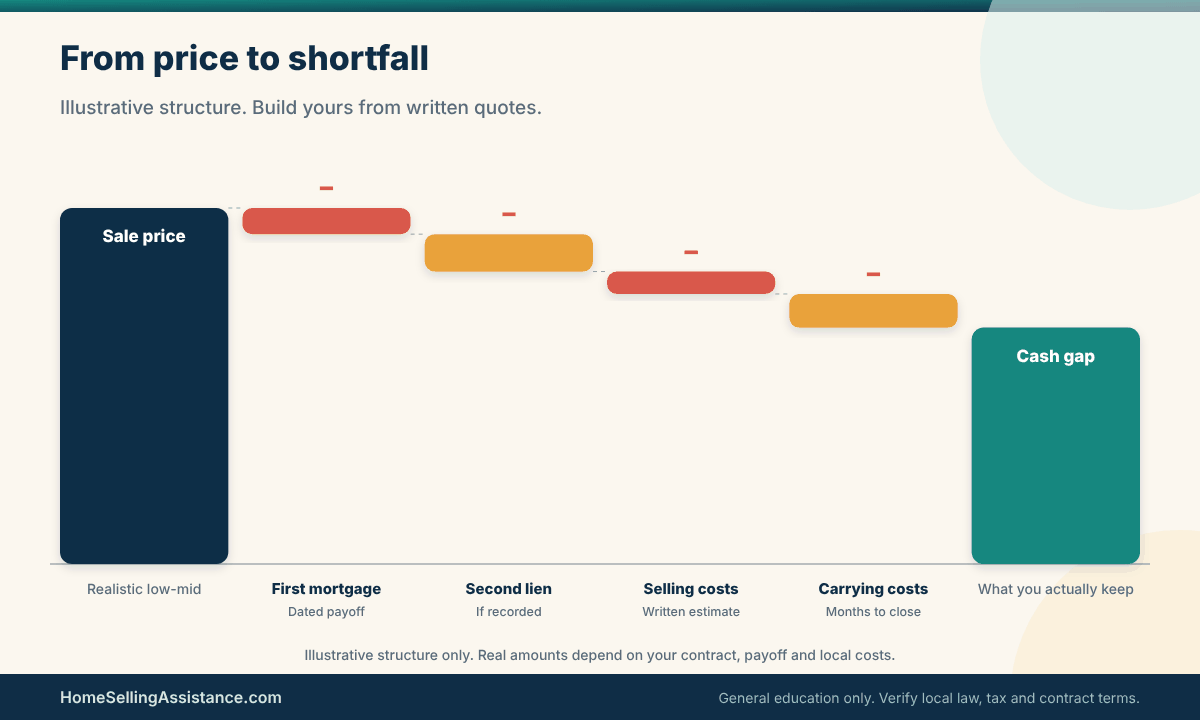
The picture above shows an underwater mortgage sell house example and how how a sale price shrinks as each deduction is subtracted. When the final bar falls below zero, the difference is the cash you would need at closing or the amount a lender would have to accept as a loss. Seeing the staircase helps you spot which deduction is most movable, whether it is a negotiable fee, a lien that can be released, or a repair you could skip with the buyer’s agreement.
Shortfall, deficiency, rate, and home-collateral risks you should price in
In an underwater mortgage sell house plan, a shortfall is the amount by which sale proceeds fall below what you owe. A deficiency is the legal claim for that leftover amount, if the lender is allowed to pursue it and chooses to. Those are different ideas. A short sale approved by a lender may include a written release of the deficiency, may leave it open, or may substitute a repayment plan. Foreclosure rules differ even more by state, and some states limit or bar deficiency claims on certain residential loans.
The home itself is collateral. Until the lender releases its lien, the lender can pursue foreclosure under the loan documents and state law. That is why a plan to wait often carries an extra risk: if payments stop, the lender’s options expand, and costs such as late fees, legal fees and inspection fees can be added to the balance. If you are weighing a short sale against letting the house go, read our comparison of a short sale versus foreclosure.
Evidence to gather: the loan note, state rules, and written releases
For an underwater mortgage sell house review, locate your promissory note, your mortgage or deed of trust, and any modification or forbearance agreement. The note and security instrument describe your obligations and the lender’s remedies. Then identify whether your state treats the lender’s right to a deficiency differently depending on whether the sale is judicial or non-judicial, or on whether the loan was used to buy the home. A local attorney, legal aid office or your state attorney general’s consumer division can explain this in plain language.
Ask whether a second lienholder must also agree to a short sale. Junior lenders often have to approve the sale and may ask for a separate payment in exchange for releasing their lien. Without their release, a buyer cannot get clear title. If a junior lienholder refuses, the whole sale can stall, and that risk should be flagged to the buyer’s agent as early as your agent allows.
Whatever underwater mortgage sell house deal is reached, insist that any release of liability be in writing and signed by someone with authority at the lender or investor. Keep copies of the final closing statement, the approval letter and any correspondence. If the lender later sells your loan, a clear paper trail becomes your protection. If you see unfamiliar charges or a lender that will not explain them, the Consumer Financial Protection Bureau publishes plain-language mortgage guidance and accepts complaints.
A scenario with a fallback, and the questions to put to a professional
Consider Elena and Tom, an underwater mortgage sell house couple, again with illustrative figures. They owe a first mortgage and a small second lien and expect a buyer will only pay below the combined balance. They have limited savings. Their servicer tells them it will consider a short sale after a hardship package. Their attorney warns that the second lender has its own process.
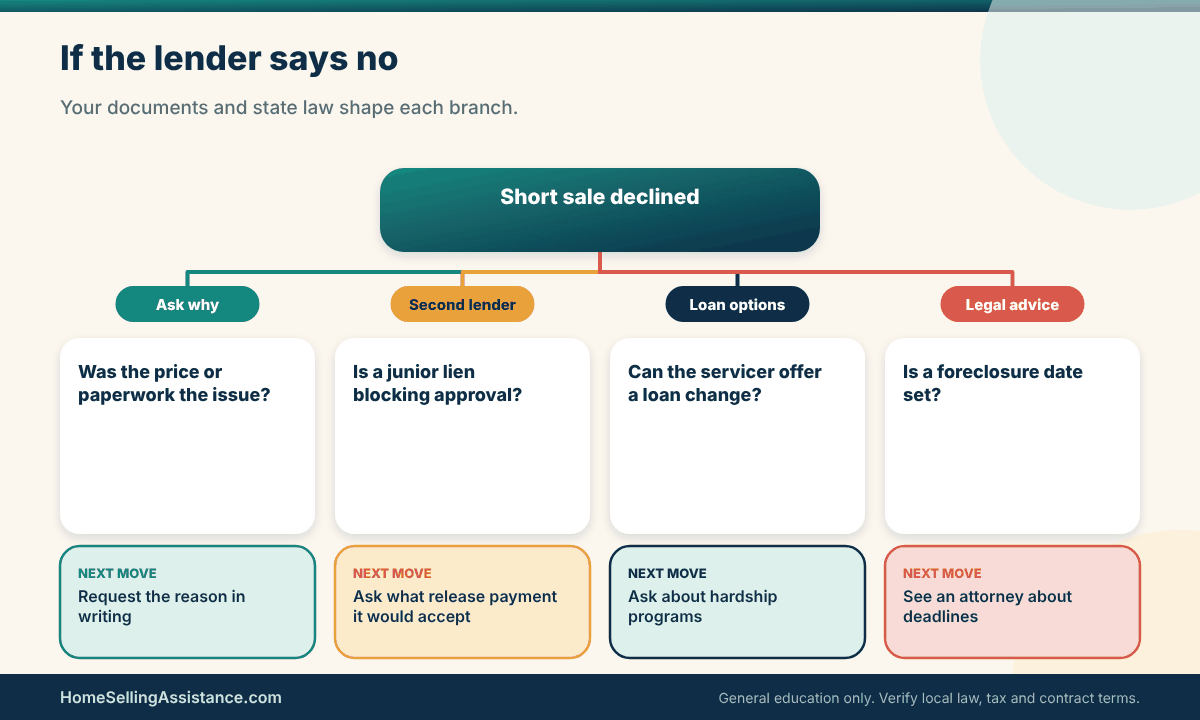
Their plan has three branches: if both lenders approve, sell and move; if the second lender balks, ask for a modest contribution in exchange for a release; if both refuse, discuss a deed in lieu or other alternatives.
The exception to watch for is a deficiency that the first lender waives but the second does not. Elena and Tom would need that spelled out before signing, because a waiver from one lender says nothing about the other. This is also the point where scammers appear, offering to “take over” a loan or buy the house for a fee. Our piece on foreclosure rescue scams lists the warning signs.
Questions to put to professionals include: Will the lender release me from any remaining balance, in writing? Is a second lien involved, and will that lender approve? How will this be reported on my credit file? Could any forgiven amount be taxed as income, and how would I show insolvency if that applies? Are there state programs for homeowners facing hardship? Those questions can fit on one index card, and answers should come back by email.
The tree above maps the underwater mortgage sell house fallbacks: what to do if a lender says no, or if the offers you receive come in lower than the payoff. Keep it nearby, because the worst moment to design a fallback is the day the answer arrives. A fallback you wrote while calm is usually a better plan than one invented under pressure.
Use scenarios with explicit assumptions for underwater mortgage sell house choices
A scenario is only useful if every assumption is written down where you can challenge it. “The house will sell for about this much” is a guess. “The house sells at the low end of three agent opinions, costs run at the written estimate, and the buyer closes in sixty days” is an assumption you can test. For an underwater mortgage sell house plan, we suggest three scenarios: a cautious one, a middle one and a hopeful one, each with its own price, cost and timing.
Below we build one underwater mortgage sell house example with round, clearly illustrative numbers, then show how sensitive it is to small changes. None of the figures are typical of any market. They exist so you can rebuild the arithmetic with your own documents and see how quickly a small change in one input shifts the shortfall.
A worked example you can rebuild with your own figures
For an underwater mortgage sell house illustration, assume that a home is likely to sell for 300,000 dollars. The first mortgage payoff is 315,000 dollars, a home equity line adds 20,000 dollars, and total selling costs are estimated at 18,000 dollars. Selling costs here lump together broker compensation, title and escrow, prorations and a small repair credit. The seller has 10,000 dollars in savings they could put toward a closing.
The arithmetic runs in three steps. Sale price minus selling costs leaves 282,000 dollars. The liens total 335,000 dollars. The difference is a shortfall of 53,000 dollars. With 10,000 dollars of the seller’s own cash, 43,000 dollars would still be uncovered. In this example a conventional sale does not work unless the seller finds more cash, or the lenders agree to accept less than they are owed.
Evidence to gather: matching each number to a document
Attach a document to every line of the underwater mortgage sell house example. The 300,000 dollar sale price should trace to a written comparative market analysis with closed sales. The 315,000 dollar payoff should trace to a dated payoff statement. The 20,000 dollar line should trace to the second lender’s payoff and, ideally, a title search confirming it is recorded. The 18,000 dollar cost estimate should trace to a title company or attorney estimate plus the broker’s agreement.
If any line has no document, the example is not yours yet. A good habit is to colour-code the page: green for confirmed, yellow for estimated, red for unknown. Do not make an irreversible choice, such as signing a listing agreement with unusual terms or agreeing to a buyer’s contract, while red lines remain on the page. Our guide to home sale net proceeds offers a longer worksheet for the same job.
A note on rounding: use whole hundreds or thousands in early drafts so you can see the structure, then replace them with exact figures when documents arrive. Many sellers find that the final number differs from the early draft by a few thousand dollars in either direction, largely because of interest, prorations and fees that only fix in the final days.
A scenario, an exception, and your next step on the worked example
Now run three versions of the underwater mortgage sell house example. In the cautious version the sale price is lower, costs are at the high end of the estimate, and the closing takes longer. In the middle version the example above holds. In the hopeful version a strong offer arrives, costs come in lower and closing is quick. The spread between cautious and hopeful tells you how uncertain your plan is, and how much cash cushion you would want before relying on any one path.
An exception to watch: some lenders and investors allow a short sale with a seller contribution, and some do not. In others, a lender may accept a note for part of the shortfall, so the deficiency is converted into a payment plan. Which of these is on offer depends on the loan, the investor and the state. The example is therefore a framing tool, not a prediction of what any lender will approve.
Your next step: rebuild the underwater mortgage sell house example in a spreadsheet or on paper using your own inputs, then write one sentence beneath each version, such as “In the cautious case I would need X in cash or lender approval.” That sentence is a decision rule, and it is much easier to follow than a vague hope. Share the page with your counselor and your attorney so they can correct assumptions you cannot see.
Quick scenario
A seller’s cautious case shows a 53,000 dollar gap, but a counselor points out that the servicer offers a hardship short sale review. The seller still builds the underwater mortgage sell house worksheet, because the lender will ask for the same income, hardship and price documents anyway. Preparing early shortened the back-and-forth later. All figures here are illustrative.
Sensitivity and break-even checks before you sign anything
In an underwater mortgage sell house plan, a sensitivity check asks a simple question: if one number moves, how much does the outcome move? In an underwater sale the answer is often sobering and also useful. A ten thousand dollar change in sale price changes the shortfall by roughly ten thousand dollars, less any costs that scale with price. A month of delay changes it by one month of carrying cost plus interest accrued. Seeing those sizes helps you decide what is worth fighting for.
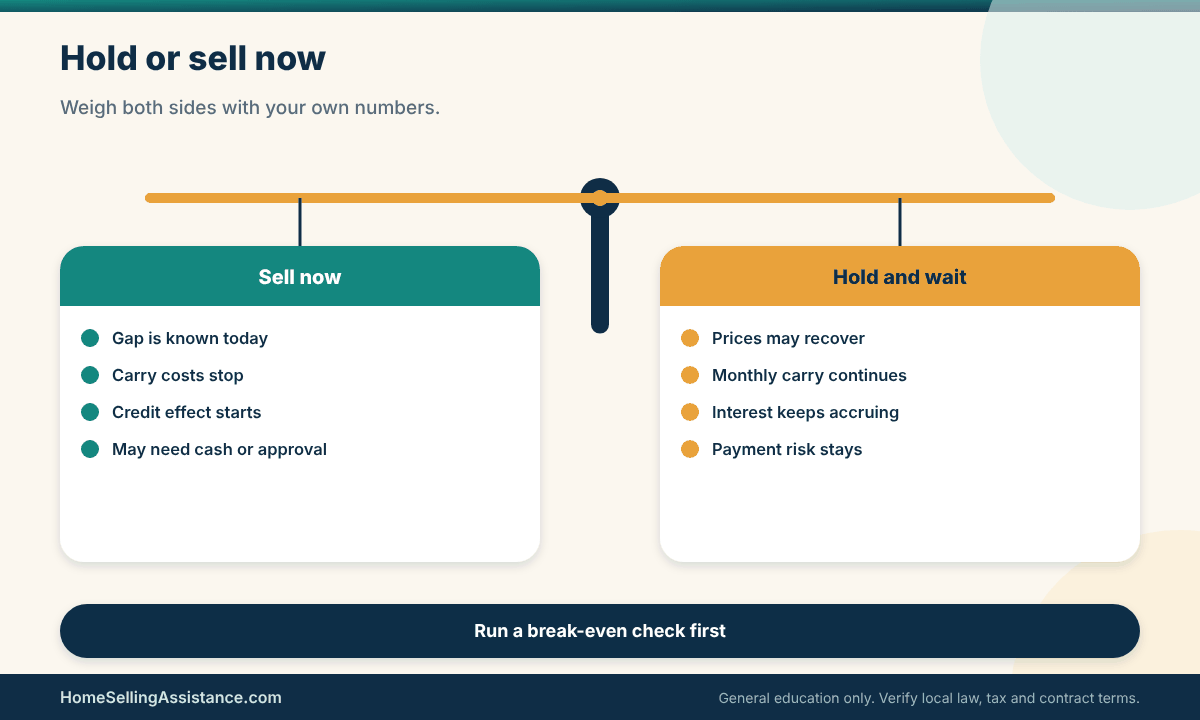
An underwater mortgage sell house break-even check asks what price, cost level or timeline would make each route work. For a cash-to-close route, the break-even is the price at which your available cash covers the remaining gap. For a short sale, it is the price at which the lender’s expected recovery beats its alternatives, which only the lender knows. For holding, it is the market change you would need to see, and how many months of payments you can fund while waiting.
Evidence to gather: monthly carry, interest per day, and local trend data
Collect your monthly carrying total from the earlier worksheet, plus the per-day interest figure on the payoff statement. If your illustrative monthly carry is 2,500 dollars, then six extra months cost 15,000 dollars, which could exceed the gain from waiting for a modestly higher price. Track local closed-sale prices and days on market over several months from agent reports or public records, and treat a single month’s swing with caution. Our article on seller closing statement shows how interest affects the final figure.
For a hold decision, check whether your loan has a rate you cannot match today, since selling means losing it. Compare that against the monthly savings of leaving. Also confirm your homeowner’s insurance, property tax and any HOA assessment trends, since those can shift the carry cost. Where an HOA lien or back property taxes might be involved, our guides on selling with an HOA lien and selling with back taxes cover the added steps.
A scenario, an exception, and your next step on break-even
Consider an underwater mortgage sell house seller whose cautious case needs 43,000 dollars after savings. Waiting twelve months at a carry of 2,500 dollars costs 30,000 dollars, and prices would need to rise by more than that for waiting to pay off, with no promise that they will. In another case, the seller has a very low-rate loan and a moderate gap, and holding for years could be rational. Both sellers used the same method and reached different answers because their inputs differed.
The exception is a seller who cannot afford the carry at all. For that seller the break-even is not about price; it is about the earliest date they can no longer pay, and the best use of the time before it. In that case, speaking to the servicer, a counselor and an attorney now is worth more than any spreadsheet. Programs, deadlines and protections differ, and early contact usually widens options.
Your next step: add an underwater mortgage sell house sensitivity table to your worksheet, with three prices across the top and three cost levels down the side, and fill in the shortfall for each cell. Circle the cells you could actually fund or get a lender to approve. If no cell works, that tells you to focus on the lender-approved or loan-change routes rather than on pricing tweaks. If several cells work, you have room to be patient.
The scenario table below summarizes common seller situations, a typical assumption for each, the estimated effect, the main risk and a question for a professional. Read it as a prompt for conversation, not as a forecast for your loan.
| Seller situation | Sale, loan or tax assumption | Estimated effect | Key risk | Professional question |
|---|---|---|---|---|
| Current on payments, moving for work | Price near low comps, modest gap | Cash to close or hardship short sale | Gap larger than savings | Does my servicer review short sales before a missed payment? |
| Behind two payments, some savings | Lender reviews hardship package | Short sale may be possible | Deficiency left open | Will the release be in writing? |
| Second lien or HELOC present | Junior lender must approve | Extra negotiation, added time | Sale stalls without release | What payment will the second lender accept? |
| Low-rate loan, steady income | Hold and wait for recovery | Carry cost, possible later equity | Prices may not recover | How long can I fund the carry? |
| Lender forgives part of the debt | Form 1099-C may be issued | Possible taxable income | Unexpected tax bill | Does an exclusion such as insolvency apply? |
| Foreclosure date already set | Short timeline for a sale | Fewer options, tight deadlines | Auction before closing | What are my state’s deadlines and protections? |
To use this table, find the row that looks most like your situation, then read across to see what to double-check. Add a row for any detail that is unique to you, such as a divorce, an estate or a rental use. The last column is the useful one: carry those questions into appointments so your time with professionals is spent on your facts, not on general explanations.
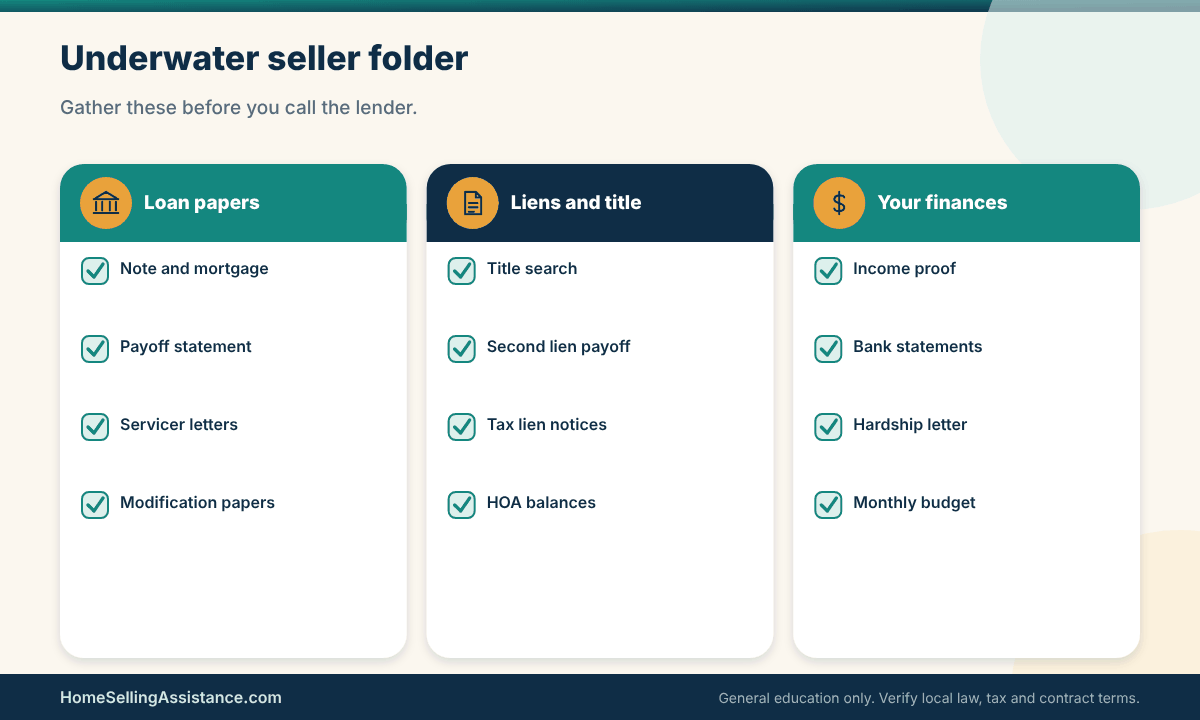
The last picture is an underwater mortgage sell house checklist of the documents and questions to keep in one folder. Gather them before you speak with lenders, because requests tend to come fast once a short sale or loan change is under review, and missing papers are a common reason for delay. A tidy folder also makes it easier for a counselor or attorney to help quickly, which matters when a notice carries a deadline.
If you want neutral help with budget, lender conversations and options, a HUD-approved housing counselor can walk through your situation, usually at little or no cost. Be wary of anyone who asks for a large upfront fee, tells you to stop talking to your lender, or asks you to sign over the deed. And for a broader look at the sequence of choices when a loan is in trouble, see the foreclosure and hardship section of our library.
Frequently asked questions about underwater mortgage sell house plans
Can I sell my house if I owe more than it is worth?
Yes, but the sale must produce enough money to pay every lien, or the lenders must agree to accept less. That means you bring cash to closing, or you request a short sale, or you change the loan before selling. An underwater mortgage sell house plan is mostly a matter of choosing which of those routes you can afford and verifying each lender’s rules in writing.
What is the difference between a short sale and bringing cash to closing?
With cash to closing, you pay the shortfall yourself and the lenders are paid in full. With a short sale, the lender agrees to accept less than the full balance. The short sale needs lender approval, takes documentation and time, and may or may not release you from the remaining debt. Which one costs less overall depends on your savings, your lender’s terms and your state’s rules.
Will the lender come after me for the remaining balance?
It depends on the loan, the investor, the written approval terms and state law. Some short sale approvals release you from the remainder, some leave it open, and some convert it into a repayment arrangement. Do not assume a release exists unless it is in the approval letter. A local attorney can explain how deficiency claims work in your state.
Is forgiven mortgage debt taxable?
Sometimes. Cancelled debt can count as income under federal rules, but exclusions and special provisions may apply, and they have changed over time. A lender may send a Form 1099-C. Read the IRS guidance on selling your home and ask a tax professional to review your specific facts before you sign anything.
What if I also have a second mortgage or HELOC?
Every lien must be paid or released for a buyer to receive clear title. A junior lender may need to approve a short sale and may ask for a payment in exchange for its release. Ask a title company to run a search early so you know which lenders are involved and how many approvals your underwater mortgage sell house plan will require.
Should I stop paying my mortgage to get a short sale approved?
Do not make that choice without advice. Missed payments can add fees, damage credit and accelerate legal steps, and in some places they change what a lender can later pursue. Some servicers consider hardship sales before a missed payment. Ask the servicer what it requires, and talk to a counselor and an attorney before deciding.
Can I refinance if I am underwater?
It is often difficult, because lenders usually want some equity or a specific program. Some servicers offer loan modifications, repayment plans or forbearance for hardship, but availability depends on your loan and investor. Ask your servicer directly which options exist, and request answers in writing so you can compare them with the cost of selling.
How long does an underwater sale take?
There is no standard answer. A cash-to-close sale can move at the speed of an ordinary sale, while a short sale adds lender review that can take weeks or months and varies by servicer. Build a longer carrying-cost estimate than you think you need, and ask the servicer for its current review timeline when you apply.
Who can help me for free?
A HUD-approved housing counselor can review your budget and explain options without a sales pitch. Legal aid offices may help if you qualify, and many state bar associations run referral services. Be careful with anyone who charges an upfront fee, pressures you to sign a deed, or guarantees to stop a foreclosure. The Federal Trade Commission describes common rescue scams.
Should I wait for prices to recover?
That depends on how long you can afford the carrying cost and on how much recovery would be needed to close the gap. Nobody can promise a market recovery, so test the idea with a break-even check using your own monthly carry. If waiting is not affordable, spend your time on lender-approved routes, not on hoping for a market change.
Your next move on an underwater mortgage sell house plan
Start with the one-page worksheet: price range, payoffs, other liens, costs and cash. Then make three calls, to your servicer, a housing counselor and an attorney, and ask for every answer in writing. The underwater mortgage sell house decision is hard but manageable when it rests on documents, not on fear. This article is general education, not legal, tax or financial advice, so confirm your facts with licensed professionals who can read your loan.