Understanding taxes when selling a home starts with one idea that surprises almost every seller: the IRS does not tax your sale price, it taxes your gain, and for many people who lived in the house as their main home, some or all of that gain may never be taxed at all.
Sellers tend to arrive here worried. A friend once told them that “the government takes a big bite,” or a neighbor insisted that you only escape tax if you buy again within a year, or an online calculator gave a number that seemed to come from nowhere. Most of that noise comes from mixing up three different figures: what the buyer pays, what lands in your bank account after closing, and what the tax law treats as profit. They are rarely the same number.
This guide is the cornerstone of our home sale tax library. It explains, in plain language, how gain is figured, how the main-home exclusion works, why your basis and your records matter so much, which selling costs count, and how special situations such as inherited houses, former rentals and divorces change the picture. We will use clearly labelled round numbers to show the mechanics, and we will point you to deeper articles whenever one topic deserves more room.
One firm boundary before we begin. This is general education, not tax advice. Federal rules are fairly stable, but your facts are your own, state rules differ, and the details of ownership, use and depreciation can change the answer. Treat what follows as a way to ask better questions and to arrive at a professional’s desk with the right papers in hand. That distinction matters more than it seems in questions about taxes when selling a home.
Key takeaways
- Tax is figured on gain, not on the price. Gain is generally what you realize from the sale minus your adjusted basis, so a large price does not automatically mean a large tax bill.
- The main-home exclusion can be generous. Federal law lets many sellers exclude up to $250,000 of gain, or up to $500,000 on certain joint returns, if the ownership and use tests are met.
- Basis is built from paper. Purchase costs, true improvements and later adjustments all live in your records, which is why a tidy file can reduce stress and sometimes reduce tax.
- Selling costs reduce the amount realized. Certain costs of selling count in the calculation, but repairs done only to help the sale along are treated differently from improvements.
- Special situations change the rules. Inherited homes, former rentals, divorces and short ownership periods each follow their own logic, so identify your path early.
- Use a professional for fact-specific questions. A CPA, enrolled agent or tax attorney can apply the rules to your actual numbers, and your state may add its own tax questions.
Why taxes when selling a home depend on gain, not on the sale price
Think of the sale as a story with two prices in it. The first price is what you paid, plus the money you put into the property over the years. The second is what you receive, reduced by the costs of getting the house sold. The difference between those two stories is your gain or loss, and that difference is where the tax conversation actually begins. Keep that in mind, because taxes when selling a home reward patience more than speed.
That framing also explains why two neighbors can sell identical houses for the same price and end up in very different tax positions. One bought in a year when prices were low and never touched the kitchen. The other paid more at purchase, replaced the roof, finished the basement and kept every receipt. Same price on the closing statement, different gain on the tax return. Few sellers hear this early, yet it shapes how taxes when selling a home play out.
Below we work through the question in the order a careful seller would: first your own situation, then the main paths a sale can take, then the variables that move the number, and finally the records and professionals that keep you from guessing. If you want the wider selling roadmap alongside this one, our guide to how to sell a house covers the whole process from first decision to closing day. Treat it as a rule of thumb for planning, not a ruling on your own taxes when selling a home.
Know your own situation before you read any rule
Tax rules are written for categories, and you are a person with a particular history. Before you read a single rule, write down the facts that decide which category you fall into. It takes about fifteen minutes and saves hours of confusion, because most of the “it depends” answers in this subject depend on a short list of facts you can already state. Experienced preparers see this pattern again and again in taxes when selling a home.
The facts that matter most are surprisingly ordinary. When did you buy the property, and when did you move in? Did you live in it as your main home the whole time, or did you rent it out for a stretch? Is anyone else on the deed? Did you inherit it, receive it in a divorce, or buy it with a business partner? Did you claim a home office deduction or depreciation at any point? Each answer points toward a different set of rules.
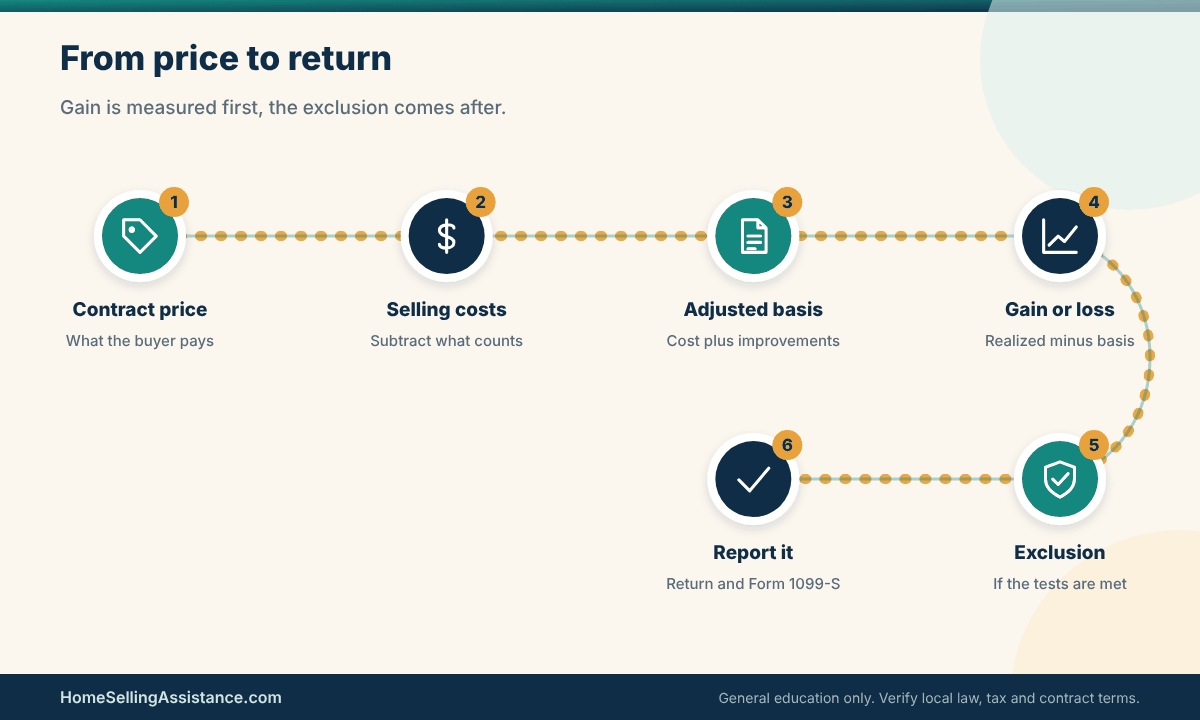
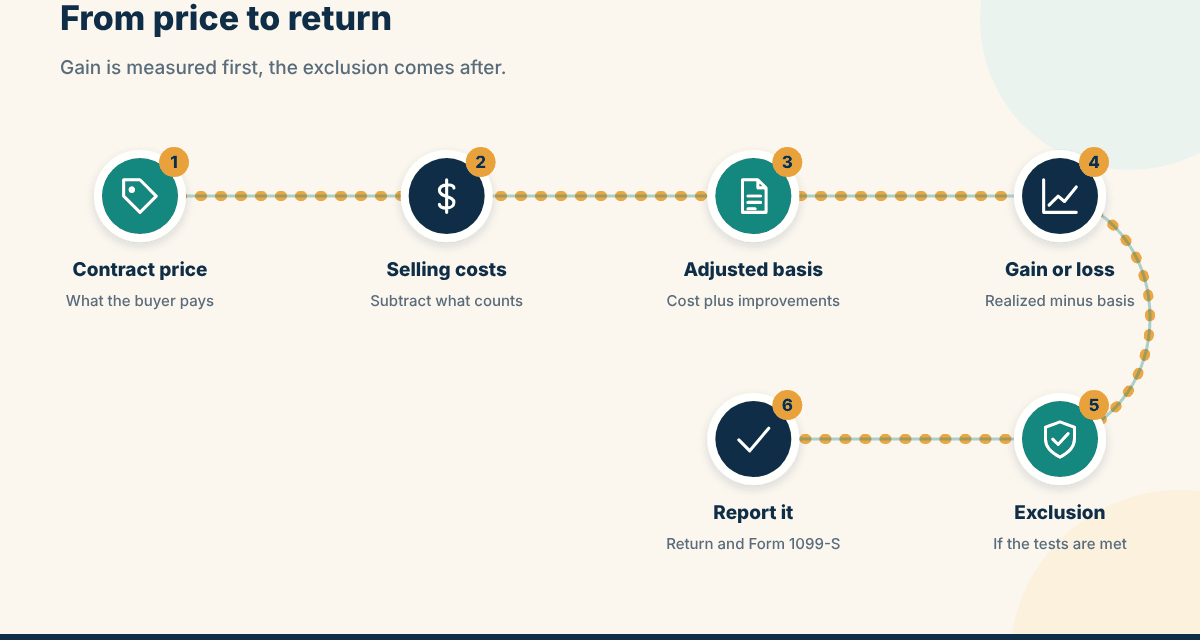
The illustration above pulls those steps into one picture. It shows the usual order for working out the tax result of a sale, from the contract price to the figure that finally lands on a tax form. Notice that the exclusion comes late in the sequence, after gain has been measured. Many sellers try to apply the exclusion to the sale price, which is the wrong starting point and leads to wildly wrong estimates. If you remember one thing about taxes when selling a home from this section, let it be this.
Evidence to gather: deed date, move-in date and the closing statement
Start with the documents that prove the basic dates. Your deed shows when you took title and who is named on it. Your original closing statement from the purchase, sometimes called a settlement statement, shows what you paid and many of the costs you incurred when you bought. If you refinanced, you may have several closing statements, and the one you want for basis is the purchase, not the refinance. It is easy to overlook, and it can quietly change the result of taxes when selling a home.
Next, find evidence of when you actually lived there. Utility bills, driver’s license records, voter registration, tax returns listing the address and moving receipts all tell the story of your main home. The IRS looks at facts and circumstances, and for most sellers the answer is obvious. But if you travel for work, split time between two properties, or moved out and back, written proof of the pattern helps both you and your preparer. That is the practical side of taxes when selling a home that rarely makes headlines.
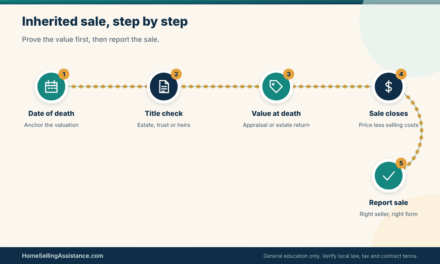
Then gather the sale-side papers as they arrive: the listing agreement, the executed purchase contract, the closing disclosure or settlement statement, and any Form 1099-S that the closing agent sends. A 1099-S reports the gross proceeds of the sale to you and to the IRS. It does not report your gain, and it does not mean tax is due. It simply means the IRS has been told about the sale, so your return should be consistent with it.
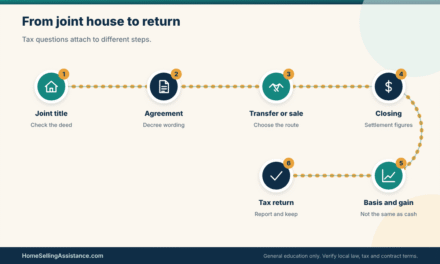
Finally, collect the facts about the ownership structure. If a trust, an LLC, a spouse or a co-owner is involved, note who held title and when it changed. The federal ownership and use tests are applied person by person on certain returns, so a quitclaim deed between family members several years ago can matter more than you would guess. The IRS Publication 523 on selling your home walks through these tests with worksheets, and it is worth reading alongside this guide.
A practical tip: scan everything into one folder as you find it, and name each file by date and subject. A closing statement called “scan0042” is easy to lose, while “2014-purchase-closing-statement” is easy to hand to a preparer. We will come back to this when we talk about records in the final section. This is where many questions about taxes when selling a home begin.
A scenario, an exception, and your next step: the seller who moved out early
Here is a scenario with illustrative facts. Dana bought a house, lived in it for several years, and then took a job in another city. She moved out, left the house vacant while she decided what to do, and listed it fourteen months later. Does she still qualify for the main-home exclusion? The general federal test asks whether she owned the home and used it as her main home for at least two of the five years before the sale. Her years of living there probably count, even though she moved out before selling.
Now change one fact. Suppose Dana had rented the house to a tenant for the whole period after she moved out, and she had claimed depreciation deductions on her return. The two-of-five-year test could still be satisfied, but the depreciation she took, or was entitled to take, can create a separate piece of taxable gain that the exclusion does not shelter. That distinction between the exclusion and depreciation is one of the most common surprises in this area, and we cover it in our article on taxes when selling a former rental home.
The exception worth remembering is that the five-year window is a lookback from the sale date, not a promise tied to when you left. If Dana had waited longer to sell, her main-home years could have aged out of the window. Timing matters, which is why people who are about to move out of a house they might sell later should understand the clock before they hand over the keys to a tenant. Handled early, this keeps taxes when selling a home from becoming a last-minute scramble.
Her next step is the same step yours would be. Write down the purchase date, the date she stopped living there, any months of rental use, and whether any depreciation was claimed. Then compare those dates against the two-in-five test using the worksheets in the IRS publication, or hand the timeline to a preparer. A clean timeline on one page is the single most useful document a seller can bring. The same logic applies whenever taxes when selling a home involve more than one person.
If your own timeline has gaps, do not guess. Missing dates are common, especially for houses held a long time, and they can usually be reconstructed from old tax returns, mortgage statements, insurance policies and utility records. It is far easier to reconstruct them before the closing than after, when you are also answering questions about payoff letters, repair requests and moving trucks. It may feel like extra work, yet it is the heart of sound planning for taxes when selling a home.
A closing thought on this scenario: do not let a rule of thumb overrule the actual test. You may hear that you must “live there two years in a row” or that “moving out ends your eligibility.” Neither statement matches the general federal rule, which counts periods of use within a five-year window and does not require them to be consecutive. The details deserve care, and they are the reason our dedicated page on the home sale capital gains exclusion exists.
The main paths: a main home, an inherited house, a former rental or a divorce sale
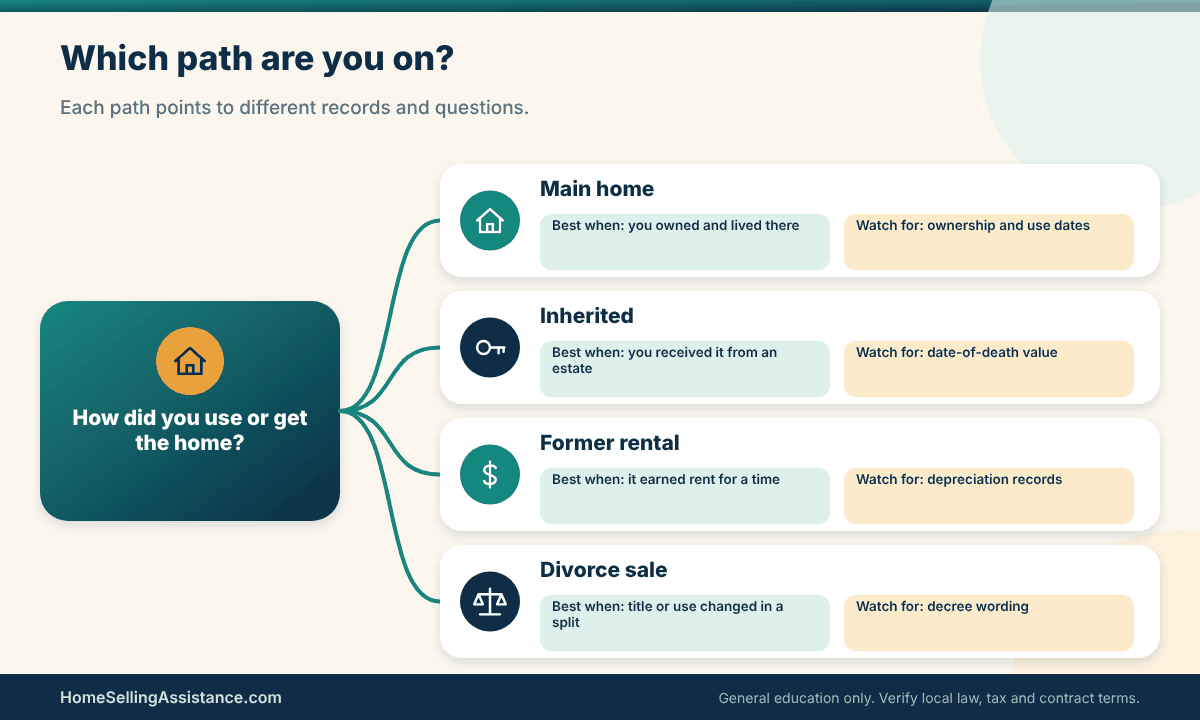
Most home sales fall into a handful of paths, and each path changes the starting point of the calculation. A seller who has lived in the home for many years is usually on the most familiar path, the main-home sale. Others arrive by inheritance, by splitting a marriage, or by converting a rental back and forth. Naming your path early tells you which publication to open and which professional questions are worth asking first. Put differently, taxes when selling a home are a measurement problem before they are a rules problem.
These paths are not mutually exclusive. A house can be inherited and then used as a main home, or a couple’s home can become a rental after one spouse moves out. When more than one path applies, the rules tend to layer rather than replace each other, which is why a short written timeline works better than trying to memorize a decision chart. A calm, documented approach makes taxes when selling a home far easier to manage.
The decision illustration above gives a quick way to sort yourself. It is a conversation starter, not a verdict. Each branch leads to a different set of records and a different set of questions, and the rest of this section explains what changes along each branch. This is also why generic advice about taxes when selling a home so often misses.
Before the details, it is worth clearing away a few myths that make taxes when selling a home feel scarier than they are. One myth says that every seller pays a large tax on a sale. Another says that you must reinvest the money in a new house to avoid tax. A third says that the exclusion is automatic for anyone who ever lived in the house. None of these matches the general federal rule, and each one leads people to make poor choices about timing, pricing or paperwork.
The truth is more modest and more useful. For a typical long-time owner of a main home, the exclusion often covers most or all of the gain, and the real work is proving the dates and the basis. For people outside that typical profile, such as heirs, landlords and divorcing couples, the outcome turns on specifics. A helpful habit is to ask, for every claim you hear about taxes when selling a home, “what facts would make that statement true or false?”
That habit also protects you from sales pitches. Some businesses that buy houses, market homes or sell financial products will describe the tax picture in ways that favor their offer. You do not need to assume bad faith, since many people simply repeat what they have heard. But a confident claim from someone who has not seen your records is still just a claim, and the primary sources listed in this guide are the place to check it.
Evidence to gather: how each path changes the starting number
On the main-home path, your starting number is your purchase price plus qualifying purchase costs plus improvements. Your records of those items are the evidence. If you lived in the house as your main home for at least two of the last five years and have not used the exclusion on another home during the previous two years, you may be able to exclude a substantial amount of gain. That is the usual route for people who simply bought, lived and now want to sell.
On the inherited path, the starting number is usually not what the decedent paid. For many inherited properties, basis is generally reset to the fair market value at the date of death, a rule often called a step-up, though it can also be a step-down. The evidence is a date-of-death valuation, often an appraisal, plus estate documents. Our guide to inherited home sale taxes explains how this works in practice, and IRS Publication 559 covers survivors and executors.
On the former-rental path, the starting number is reduced by depreciation that was allowed or allowable while the property produced income. The evidence is the prior tax returns, especially depreciation schedules, and any records of improvements made during the rental years. IRS Publication 527 discusses rental property, and it is the right companion to the main-home publication if the house ever earned rent. Getting this right early makes the rest of taxes when selling a home easier to follow.
On the divorce path, the transfer of a home between spouses, or between former spouses as part of a divorce, is generally not a taxable event at the moment of transfer. The receiving spouse typically takes over the original basis rather than a fresh one, and the time that a former spouse lived in the home may be counted toward the use test under certain conditions. The evidence is the divorce decree or separation agreement, and IRS Publication 504 covers divorced and separated individuals. We discuss the topic in divorce home sale taxes.
Across all four paths, the quality of your evidence limits the quality of your answer. Where records are thin, you can often rebuild them from public sources. County recorder offices hold deeds, many assessors keep property record cards, and former lenders can supply payment histories. A preparer can tell you which reconstructed figures are acceptable and which would need stronger support. Many errors in taxes when selling a home start with exactly this kind of assumption.
If you are unsure which path you are on, say so out loud to whoever helps you. “I think I qualify as a main-home seller, but the house was a rental for two years” is a perfectly good opening sentence, and it gives a professional exactly the fact they need to ask the next question. Vague confidence is more dangerous than honest uncertainty. Little details like this are what separate a smooth file from a stressful one when taxes when selling a home are on the table.
A scenario, an exception, and your next step: two owners, one house
Consider two siblings, Marcus and Elena, who inherited their mother’s house. Marcus moved in and lived there for three years as his main home. Elena lived elsewhere and never used it. They now sell and split the proceeds evenly. Do both of them get to exclude gain? Not necessarily. The exclusion depends on each owner’s own ownership and use, so Marcus may be able to claim it for his share while Elena, who never used the home as a main residence, may not.
For many inherited homes, the high basis at the date of death means there is little gain to begin with, which can make the exclusion question smaller than it first appears. If the house sells soon after the owner dies for roughly its date-of-death value, the gain may be minimal. If it appreciates during a long holding period, or if the heirs make improvements, the answer can change, and so can the distribution of gain between co-owners.
The exception to watch is a co-owner who is not a spouse. Unmarried co-owners, siblings, friends or partners, are each treated individually, and each applies the tests to their own share. The $250,000 and $500,000 limits are not pooled in the way sellers sometimes assume. A joint maximum applies to certain married couples filing jointly, not to any two people who happen to share a deed. It is a modest step, and it makes taxes when selling a home easier to explain to a preparer.
The next step for Marcus and Elena is to talk before the listing, not after. They should agree who will provide records, how basis was established, how closing costs and repairs will be shared, and how the closing agent should split proceeds. Many families find it useful to have one person gather the file and one person speak with the title company, so that questions are answered once. Every seller can do this, whatever the size of the house or the gain, and it helps with taxes when selling a home.
If the estate is still open, an executor or personal representative may be the one signing the sale documents, and the question of who reports what can depend on the estate’s structure. The rules for estates vary by state, so a probate attorney or the local probate court can explain who has authority. Our guide on selling an inherited house goes through the authority questions in detail. Think of it as groundwork for taxes when selling a home rather than a chore.
A last point on shared ownership: if anyone on the deed is unhappy with the plan, the sale can stall for reasons that have nothing to do with tax. Settle the family conversation first. A tax answer is only useful if every owner is willing to sign the contract it is based on. None of this is exotic, and it applies to most cases of taxes when selling a home.
What moves your bill: basis, improvements, selling costs, time and use
Once you know your path, the next job is to understand what actually pushes the number up or down. The pattern is consistent across nearly every version of taxes when selling a home: a bigger basis shrinks the gain, a bigger amount realized grows it, and the exclusion, when available, absorbs a slice of whatever remains. Everything else is detail about what qualifies for each of those buckets.
It helps to picture the calculation as a short sequence. You begin with the contract price. You subtract certain costs of selling to reach what the law calls the amount realized. You then subtract your adjusted basis to find the gain. Only after that do you test whether an exclusion applies, and only the leftover gain, if any, reaches your return. The infographic below shows that flow with round, illustrative stages. This is a place where careful sellers quietly save themselves trouble with taxes when selling a home.

The graphic makes one point that many sellers miss: net proceeds and taxable gain are different measurements. Net proceeds are the cash you receive after the mortgage payoff and closing charges. Taxable gain ignores your mortgage balance entirely, because paying off a loan is not an expense of the sale. Someone with a large mortgage can have small cash proceeds and a large gain, while someone with no mortgage can have the reverse. Our article on seller closing costs explains the cash side of the ledger.
Basis, improvements and timing: the variables that shape the gain
Basis is simply your investment in the property for tax purposes, and it starts with what you paid. If you bought the house for a certain amount, that amount is your starting basis. Certain costs of buying, such as some title charges, recording fees and transfer taxes you paid, can be added. Other costs, such as loan origination points or insurance premiums, follow different rules and are usually not added. The distinction is technical, so check it against your actual settlement statement.
From there, basis moves. Capital improvements add to it. Casualty losses, insurance reimbursements and depreciation reduce it. Over a long ownership, the adjusted figure can end up far from the original purchase price, which is why the question “what did you pay?” is only the first question, not the last. IRS Publication 551 on basis of assets is the reference to keep open while you work. Nothing here requires special training, only attention to taxes when selling a home as they apply to you.
Time also matters in two ways. The first is the holding period: gain on property held longer than a year is generally treated as long-term, which usually receives more favorable rates than short-term gain. The second is the five-year lookback for the exclusion tests. A seller who sells earlier than expected, or who waits just a few months longer, can end up with a different result for reasons that have nothing to do with the housing market.
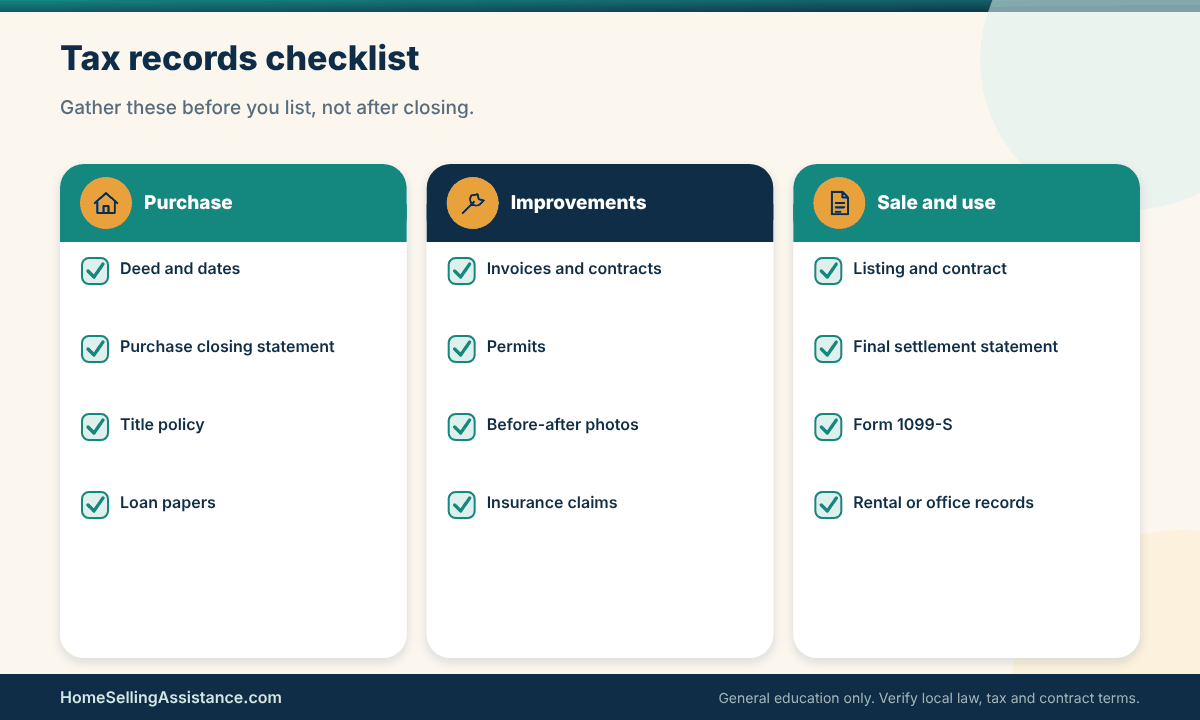
The checklist illustration above groups the records that support each of these variables: the ownership papers, the money papers and the condition and improvement papers. Use it as a gathering list. Every item on it is something a preparer, an auditor or a curious buyer’s lender could ask about, and each item tends to be much harder to find after the closing than before it. It is a good example of why taxes when selling a home deserve a plan.
Two practical points deserve a place in any plan for taxes when selling a home. The first is the holding period. Gain on a property held for one year or less is generally short-term, which is usually taxed at ordinary income rates, while gain on a property held longer is generally long-term. For a house you have owned for years this is a non-issue, but for a quick flip, an inherited property or a recent purchase, the distinction can change the bill.
The second point is state tax. Federal rules get most of the attention, but a state may have its own income tax, its own treatment of gain, and its own rules for sellers who live elsewhere. Some jurisdictions also impose transfer or conveyance taxes that appear on the closing statement. Because these vary widely, ask your title company or closing attorney what applies locally, and check your state department of revenue website for current rules instead of trusting a general article.
It also helps to know that tax law changes over time. Limits, rates and thresholds can be adjusted by Congress or updated by the IRS, and a guide published a few years ago may be out of date. The exclusion amounts we mention are long-standing federal rules, but you should still confirm them in the current edition of IRS Publication 523 before relying on them in a real transaction. When in doubt, the primary source wins. The lesson carries across most situations involving taxes when selling a home.
Worked example: building an adjusted basis from paper
Let us walk through a clearly illustrative example. Assume a seller bought a house years ago for a round figure of $300,000 and paid eligible purchase costs of $4,000. The starting basis is $304,000. Over the years the seller finished the basement for $30,000, replaced a worn-out roof for $15,000 and added a deck for $11,000. Those are capital improvements, so the adjusted basis rises to $360,000. These numbers are not typical of anything; they are chosen to make the arithmetic easy.
Now assume the home sells for $520,000, and the seller pays selling costs of $31,000 that count under the tax rules. The amount realized is $489,000. Subtract the adjusted basis of $360,000 and the gain is $129,000. If the seller meets the ownership and use tests and has not recently used the exclusion on another home, that entire figure sits comfortably below the $250,000 single limit, and the taxable portion of the gain would be zero. That is a fair summary of how taxes when selling a home usually work in practice.
Change the example slightly and the story changes. Assume the same seller never kept receipts for the basement, deck or roof. With no proof, the adjusted basis falls back to $304,000, and the gain becomes $185,000. It still sits under the exclusion limit, so the tax outcome may not change here, but a seller in a larger-gain situation could lose real money by being unable to prove the improvements. Records are not paperwork for its own sake; they are the number.
The takeaway from this arithmetic is to separate two questions that sellers blur together. The first question is whether your gain will exceed the exclusion. The second is whether you can prove the basis you are claiming. A seller who is nowhere near the limit may not care about the second question today. But if the house was held for decades, prices rose sharply, or a spouse has died, the gap between the gain and the exclusion can narrow quickly.
For a deeper treatment of how each adjustment works, see our guides to adjusted basis in a home sale and to home improvements and cost basis. They go through what counts, what does not, and how to document each item. Keep it simple, and let the documents carry the weight in taxes when selling a home.
A final note on rounding and estimates: do not use your estimate as a filing figure. For planning, a rough range is perfectly useful and lets you decide whether the tax question is large or small. For the return itself, use the actual numbers from the closing statement, the improvement receipts and the depreciation schedules, because those are the numbers that will be compared against the Form 1099-S and the lender’s records. Clarity on this point makes every later step in taxes when selling a home smoother.
A scenario, an exception, and your next step: a kitchen remodel versus a repainted fence
The line between an improvement and a repair confuses many sellers, and it matters. In general, an improvement adds value to the home, prolongs its useful life or adapts it to a new use. A repair keeps the property in ordinary working condition. A new kitchen, an added bedroom, a new roof or a new heating system tends to be an improvement. Patching a leak, repainting a room or fixing a broken window tends to be a repair.
Consider a seller who spent the year before listing on two jobs. The first was a full kitchen remodel with new cabinets, counters and appliances. The second was repainting the fence, patching drywall and replacing a few cracked tiles. The remodel generally goes into basis. The paint and patching generally do not, because they maintain the home rather than improve it. Both may have helped the sale, but only one of them changes the tax calculation. It also explains why professionals ask so many questions about taxes when selling a home.
There is an exception worth knowing about. Certain repairs done as part of a larger remodel may be treated as part of that larger project and included in basis. The classic example is painting a room that is being renovated as part of a broader improvement. The rule depends on the facts, which is the reason receipts, contracts and photographs of the work are valuable. Pictures of a house before and after a project can answer questions that invoices alone cannot.
Another exception involves fix-up costs. Some work done in the final stretch before a sale can be treated as a fixing-up expense that may reduce the amount realized, but only under specific conditions, such as work performed within a limited period before the contract and meant to help the home sell. Because the conditions are technical and do not apply to improvements that otherwise qualify for basis, check the current IRS guidance rather than relying on a rule of thumb from an article or a neighbor.
The next step for any seller who has done significant work is to sort the receipts into three stacks: clear improvements, clear repairs and unclear items. The first stack goes into the basis file. The second can usually be set aside. The third deserves a short conversation with a preparer, who can say how each item should be treated and what proof is needed. That conversation costs little compared with the time spent reconstructing receipts years later.
If you hired a contractor, ask for a final invoice that describes the work in plain terms. “Kitchen remodel: cabinets, counters, plumbing relocation” is far more useful than “labor and materials.” If you did the work yourself, keep receipts for materials and notes of what was built and when. The cost of your own labor is not added to basis, but the materials you bought may be, and clear notes make the difference. This habit is cheap, and it improves nearly every part of taxes when selling a home.
Selling costs, exclusion limits and the details that change taxes when selling a home
Selling costs are the other half of the arithmetic. Costs that are directly connected to the sale, such as certain agent fees, title charges, attorney fees and transfer taxes paid by the seller, generally reduce the amount realized. The effect is the same as adding them to basis: they lower the gain. A seller who forgets to include them is paying tax on money that never reached their pocket. Sellers who skip it often meet the problem again when taxes when selling a home reach the return.
Broker compensation has been in the news, and it is worth stating plainly that compensation is negotiable and must be put in writing. What you agree to pay your own representative, and what you agree to contribute toward a buyer’s representation, will be recorded on your closing statement. If a portion goes to buyer-side costs as part of the deal, ask your preparer how the amounts should be treated. Do not assume one answer fits every contract, and see our home sale tax library for related articles.
The exclusion itself has limits and conditions. In general, you may exclude up to $250,000 of gain if you meet the ownership and use tests, and up to $500,000 if you are married, file jointly, either spouse meets the ownership test, and both spouses meet the use test. You generally may use the exclusion only once in any two-year period. Gain above the limit, and gain that the exclusion does not reach, may be taxable. The takeaway is small but durable for anyone studying taxes when selling a home.
Some details reduce or complicate the exclusion even when you qualify on paper. Periods when the home was not used as a main home after 2008, known as nonqualified use, can reduce the excluded amount in certain cases. Depreciation claimed after May 6, 1997 is not shelterable by the exclusion. And rental or business use of part of the property may require allocating the sale between the portion that qualifies and the portion that does not. The tests are mechanical, but their details reward careful reading.
The summary table below pulls the most common situations into a single decision-support view. Read it by finding the row closest to your facts, noting the key fact, and then looking at the practical action and the trade-off. Treat the last column as a place to start looking for proof rather than as a guarantee of any result. Take it as a reminder that taxes when selling a home are personal and factual.
| Situation | Key fact | Practical action | Trade-off | Source or document |
|---|---|---|---|---|
| Long-time main home | Ownership and use tests may be met | Estimate gain, compare with the exclusion limit | Weak records can hide basis | Closing statements, receipts, Publication 523 |
| Moved out before selling | Two-of-five-year window runs backward | Write a dated timeline and sell within the window | Waiting may cost eligibility | Utility bills, lease, tax returns |
| Former rental | Depreciation may be taxable | Pull prior depreciation schedules early | Exclusion may not cover everything | Prior returns, Publication 527 |
| Inherited house | Basis often resets at date of death | Get a date-of-death valuation | Late appraisals are harder to support | Appraisal, estate papers, Publication 559 |
| Divorce sale | Transfer between spouses is generally not taxed | Put home-use terms in the decree | Vague language invites disputes | Decree, Publication 504 |
| Sale after under two years | Partial exclusion may be possible | Document the reason for moving | Reduced limit, more proof needed | Employer letter, medical records, Publication 523 |
Use the table the way you would use a map legend. It is meant to orient you, and every cell has exceptions. If your situation sits between two rows, such as an inherited house that later served as a rental, you are on the overlap, and the safest move is to bring both sets of documents to a professional. Seen this way, taxes when selling a home become a matter of facts and paper.
Worked example: gain, exclusion and a small taxable remainder
Return to illustrative numbers, this time with a seller whose gain is larger. Suppose a single seller bought a home long ago, with a final adjusted basis of $250,000, and sells it for $700,000 with $40,000 of qualifying selling costs. The amount realized is $660,000, and the gain is $410,000. If the seller meets the ownership and use tests, the exclusion may absorb up to $250,000, leaving $160,000 of potentially taxable gain. In real files, this is often the detail that decides how taxes when selling a home resolve.
Now suppose the seller were married and filing jointly, with both spouses meeting the use test. The potential exclusion rises to $500,000, which exceeds the $410,000 gain, so no federal tax on the gain may be due. The same house, the same price and the same costs produce different outcomes because of filing status and eligibility. That is why it is a mistake to apply one rule of thumb to everyone. A little attention here can spare you a long email thread about taxes when selling a home later.
The taxable remainder, if there is one, is generally taxed as a long-term capital gain when the property was held longer than a year. Rates depend on your overall taxable income, and higher-income sellers may face an additional tax on net investment income. This guide does not state those rates, because they change and because your total income decides which applies. Your preparer can estimate them using your actual return. That is why we keep returning to evidence when discussing taxes when selling a home.
If you are looking at a taxable remainder, you may also owe estimated tax payments, because withholding from a paycheck will not cover a gain that arrives in a single year. Many people learn about estimated payments only after an underpayment penalty shows up. Raise the question with your preparer before closing so you can decide whether to set money aside or adjust payments during the year of the sale. It is the kind of point that gets lost in broad advice on taxes when selling a home.
There is a planning idea hidden in this example. If you are close to the limit, small adjustments in your records can matter: finding improvement receipts, documenting selling costs, or confirming whether a period counts as main-home use. If you are far below the limit, those details matter less. Knowing which side of the line you are on, even approximately, tells you how much effort the documentation deserves. Use it as a checkpoint whenever taxes when selling a home start to feel fuzzy.
Another point worth making: a loss on the sale of a personal residence is generally not deductible. Sellers who bought at a high price and sell for less sometimes hope to claim a loss, and that hope is usually disappointed. The calculation can still be useful, because it shows you do not owe tax, but it does not create a deduction to offset other income. Rental property follows different rules, which is why the property’s use history matters.
A scenario, an exception, and your next step: partial exclusion when life moves faster than two years
Life does not always cooperate with a two-year rule. A seller takes a job in another state after thirteen months in the house. Another needs to move closer to a family member who is ill. A third faces an unforeseen event that makes the home unaffordable. The federal rules provide for a reduced exclusion in some of these cases, where the primary reason for the sale is a change in employment, health or certain unforeseen circumstances. It is a useful test to run on any claim about taxes when selling a home.
The reduced amount is generally prorated by how much of the two-year period you satisfied. As a simple illustration, a seller who met the tests for a little over half of the required time might be allowed a little over half of the maximum exclusion. The exact calculation uses months or days, and the worksheet in the IRS publication walks through it. Our article on the partial exclusion when you sell before two years gives examples. Once this is settled, taxes when selling a home usually feel more manageable.
The exception is that a reason which merely feels compelling is not automatically a qualifying reason. A move to a nicer neighborhood, a desire for a larger yard or a general wish for a change is not the same as a qualifying employment or health situation. Documentation matters here: employer letters, physician statements and other contemporaneous records help show that the reason was real and primary. This fits neatly with everything else we have said about taxes when selling a home.
Your next step, if you suspect you fall short of the two-year tests, is to write down the dates and the reason for the move, and then ask a preparer whether a reduced exclusion could apply. Do this before you accept an offer, not after, because it can influence how you think about timing. In some cases a few extra months of ownership change the picture; in others, they do not, and it is better to know in advance.
Be careful not to build a plan on a hopeful reading of the rule. If you cannot document the reason, or the reason is a preference, plan as though the full gain will be tested and treat any partial exclusion as a pleasant surprise. Conservative planning is cheaper than a surprise tax bill, and you can always celebrate later if your preparer confirms more favorable treatment. Plan around it, and taxes when selling a home hold fewer surprises.
Members of the uniformed services and certain other government employees may be able to suspend the five-year test for a period while on qualifying duty, and similar relief exists for some others. If that sounds like you, ask about it specifically, since it can change the outcome. The IRS publication describes the details and should be checked directly because the conditions are specific. That small habit pays off every time taxes when selling a home come up.
A verification roadmap for taxes when selling a home
By this point you have the vocabulary: amount realized, adjusted basis, gain, exclusion. The last job is to turn that understanding into a plan you can actually follow. A verification roadmap answers three practical questions. Which documents do you need? Which people should look at them? And which decisions must be made before the sign goes in the yard, as opposed to those that can wait until a real offer sits on the table? Good records turn this into a short conversation instead of a long one about taxes when selling a home.
The reason we call it verification is that nearly every claim in the tax conversation can be checked against paper or against a primary source. Your purchase price is on a closing statement. Your dates are on a deed and in utility records. The rules are in IRS publications. Where something cannot be verified, treat it as an estimate. Good planning for taxes when selling a home is mostly the habit of separating what you know from what you are assuming.
One more framing point. Sellers sometimes believe that tax planning means finding a clever trick. In practice, the most valuable planning is dull: confirm eligibility, collect records, ask a preparer about your specific facts, and decide whether the timing of the sale helps or hurts. The people who get into trouble are usually those who skipped the dull steps and relied on a confident stranger. It sounds basic, and it is, which is why it works for taxes when selling a home.
Records and professionals to involve before you list
You do not need a large team. For many straightforward main-home sales, you will deal with your listing agent if you have one, a title or escrow company or a closing attorney, and a tax preparer you may already use for your annual return. Your lender will be involved through the payoff. What matters is that each person has the information they need and that you know which of them is responsible for which answers.
Real estate agents and closing professionals can explain the mechanics of the transaction and the numbers on the closing statement, but in most places they are not licensed to give tax advice. A good one will tell you so and recommend that you speak with a tax professional. If anyone offers confident statements about how much tax you will owe without seeing your records, treat that as a reason to slow down rather than a reason to relax.
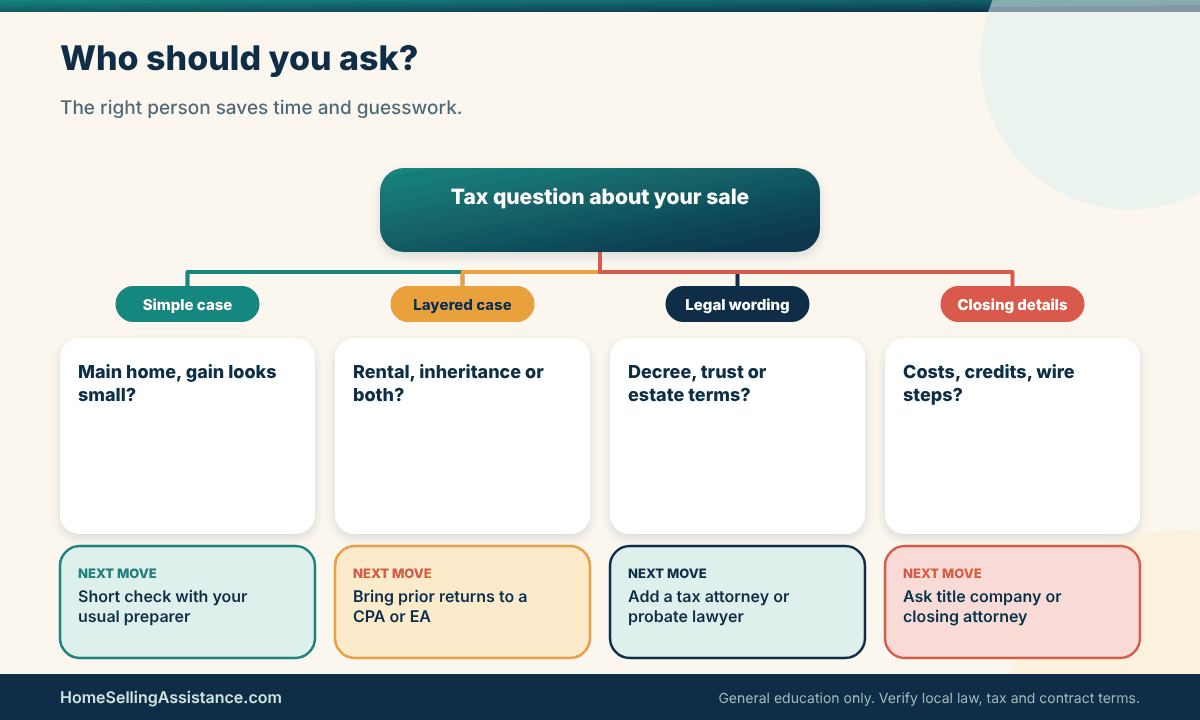
The illustration below shows a simple way to decide whom to ask. It sorts common questions by the kind of professional best placed to answer them, and it reminds you that a question about the contract is different from a question about the return. Matching the question to the right person saves time and avoids paying someone to guess. It is a simple idea, but it sits at the center of taxes when selling a home.
If you are working in a state where attorneys routinely handle closings, you may have a lawyer already involved before listing. That lawyer can often explain how the settlement statement will be prepared and who signs what. But the lawyer who handles the closing is not always the one who prepares your tax return, so confirm who will review the tax side. Our guide to closing costs and net proceeds covers the money side of closings in more detail.
Evidence to gather: the records file you will thank yourself for
A tax-ready records file for taxes when selling a home is not complicated, but it is specific. Start with the purchase documents: the closing statement, the deed, the title policy and the loan papers. These establish your original basis and your ownership dates. Add the improvement records: invoices, contracts, permits, and before-and-after photographs for any project that changed the house. Add insurance and casualty records if anything damaged the property and a claim was paid.
Next, add the use history. If the property was ever a rental or a home office, include the leases, rent records and prior tax returns showing depreciation. If you can produce the returns for the years in question, you will answer a large number of questions at once. If you cannot, ask the IRS or your preparer about obtaining transcripts, and be ready for the process to take a little time.
Add the sale-side documents as they arrive: the listing agreement, the accepted contract and any addenda, the final closing statement, any repair credits, the payoff letter and the Form 1099-S. Keep the closing statement in a safe place permanently, since you may need it long after you have forgotten the details. Many people keep the whole file for as long as they own the next home, and then for several years after that sale too.
How long to keep records is a common question. A general principle is to keep records that support basis for as long as you own the property, plus the period during which a return that relies on them could be examined. Because the length of that period can vary with circumstances, ask your preparer for guidance, and err on the side of keeping the file longer. Our article on home sale tax records covers retention in more detail.
Digital storage is fine, and in some ways better than paper, as long as it is organized and backed up. A shared folder that you and your spouse or co-owner can both reach reduces the risk that the only copy lives on one person’s laptop. If the records belong to an estate, the executor should hold the master file and give copies to heirs who need them. Passwords and account numbers belong in a password manager, not in a document you email around.
Finally, treat the file as a living document. Add notes about decisions you made and why. If you decided not to claim a certain item because the proof was weak, write that down. If a preparer gave you advice on a particular point, note the date and the substance. A year later, when memory has faded, those notes explain your reasoning to anyone who asks, including yourself.
Scammers like the closing window too, and you should be careful with wire instructions and emailed requests to change payment details. Verify any change by phone using a number you already trust. Our page on home sale fraud and seller safety explains the common patterns, and the FBI’s Internet Crime Complaint Center accepts reports of wire fraud. Sellers who understand this tend to find taxes when selling a home much less intimidating.
A scenario, an exception, and your next step: when to call a CPA, an EA or a tax attorney
Different professionals fill different roles. A certified public accountant, or CPA, and an enrolled agent, or EA, both prepare returns and advise on tax issues, and many sellers do well with either. A tax attorney becomes more useful when the questions are legal as well as numerical: a disputed estate, a complicated trust, a divorce decree with unclear terms, or a notice from a tax authority. Your own preparer, if you have one, is usually the natural first call.
Consider a seller with a simple profile: single, long-time owner, one main home, no rental use, and a gain comfortably under the exclusion. That seller may need nothing more than a short call to confirm eligibility and a reminder to keep the closing statement. Now consider a seller who inherited a house from a parent, rented it for two years, and then moved in. The mix of inheritance, rental depreciation and later main-home use is exactly the kind of layered situation where a professional’s time is well spent.
The exception is that cost is a legitimate factor. Not every seller needs, or can afford, extended professional help. If your situation is simple, a modest consultation may do. If it is complex, an hour with a professional before the sale often costs less than the mistakes it prevents. You can reduce the cost either way by arriving with a one-page timeline and a tidy file, so that billable time goes to analysis and not to hunting for papers.
Questions worth asking at the first meeting include these. Do I appear to meet the ownership and use tests, based on these dates? Is any part of my gain likely to be outside the exclusion? What basis adjustments should I verify? Should I plan for estimated payments in the year of sale? Are there state tax issues I should know about? How should the sale be reported? Writing the questions down beforehand keeps the meeting efficient.
If you are in the middle of a divorce, the tax conversation should take place before the settlement is signed, not after. Who keeps the house, who is responsible for the tax on a later sale, and how basis and use periods are treated are all affected by what the agreement says. Our guides to divorce home sale taxes and selling a house during divorce explain why the wording matters.
Your next step is simple. Pick the professional who fits your situation, ask what they need from you, and send it early. If you are choosing someone new, ask how they approach home sales, whether they have handled similar situations, and how they charge. A good professional will answer plainly and will not promise a particular tax outcome before seeing your records. This is one of the quieter lessons about taxes when selling a home.
What to decide before listing and what can wait until an offer
Not every tax question needs an answer on day one. Some choices must be made before you list, because they shape the timing and the structure of the sale. Others can safely wait until you are looking at a specific offer with a specific closing date. Knowing which is which keeps you from either rushing a decision that needs thought or postponing one that cannot be undone.
Before listing, you should know three things: whether you probably qualify for the main-home exclusion, roughly how large your gain may be, and who needs to be involved in the decision. If you cannot answer those, you are pricing and timing the sale without a key piece of information. A rough estimate is enough at this stage, and you can refine it once the contract is signed.
After you receive an offer, the questions become concrete. How will the closing costs and credits in the contract affect the amount realized? Does the closing date fall inside or outside a tax window that matters to you? Will the buyer’s requests for repairs or credits change your net? These are easier to answer once actual terms exist. The transaction table below shows how the stages line up, who is responsible at each step, and what to do if something slips.
| Stage | Seller responsibility | Buyer or professional dependency | Deadline | Fallback |
|---|---|---|---|---|
| Before listing | Build the dated timeline and records file | Preparer confirms eligibility questions | Before the first showing | Rebuild records from returns and county files |
| Pricing and listing | Estimate gain and net, not just price | Agent supplies comparable sales | Before signing a listing agreement | Revisit price if net falls short of the goal |
| Offer and contract | Read costs, credits and closing date | Attorney or agent explains terms | Contract response dates | Counter on date or credits if timing hurts |
| Inspection and repairs | Track which work is repair and which is improvement | Inspector, contractor, buyer | Inspection period in contract | Offer a credit instead of work if paperwork is thin |
| Closing | Review the final statement and payoff | Title company or closing attorney | Closing date | Ask for corrections before signing |
| After closing | Keep the file, watch for Form 1099-S, plan payments | Preparer reports the sale | Tax filing and payment dates | Amend or ask for an extension if papers arrive late |
Read this table across, one row at a time. In each row, you are the first column’s owner, and the later columns show who you depend on and what to do if the plan slips. The point is not that every sale looks like this; it is that every sale has handoffs, and tax questions attach to several of them, not just to the last day. Remember that taxes when selling a home are about your facts, not anyone’s average.
Checklist in prose: decisions to settle before the sign goes up
First, confirm the ownership structure. Who is on the deed, and who will sign? If a trust, an estate or an LLC owns the home, the tax questions and the signing authority both depend on that fact. Settle this early, because an unclear owner list delays closings and can complicate the tax picture. If someone is deceased, a recent death certificate and estate documents will be needed.
Second, estimate whether your gain is likely to exceed the exclusion. A rough calculation using the framework above is enough. If the result is clearly below the limit, you can relax about the amount and focus on records. If it is close to or above the limit, plan to speak with a professional before you accept an offer, since small choices could shift the outcome. This estimate also helps you judge whether to hold a little longer.
Third, decide whether timing is flexible. A seller who is a few months away from satisfying the two-year test, or from a change in filing status, may want to weigh a later closing against the risks of waiting. That is a real trade-off, because markets, interest rates and personal circumstances all move. No article can decide it for you, but a preparer can show you the tax side so you are weighing complete information.
Fourth, think about the next home. If you plan to buy another house, remember that the old rule allowing deferral of gain by buying a more expensive replacement home no longer applies. Today the exclusion is the main tool, and buying a pricier home does not by itself change the tax on the sale. The question of whether to buy first or sell first is mostly a cash-flow and risk question, which we discuss in sell first or buy first.
Fifth, line up your records and your professional, as described above. Sixth, decide how you will handle the proceeds. A large check arriving in a single week can create temptations and risks, including fraud attempts. Some sellers move the funds directly to a safe account, set aside an amount for possible tax, and pause before making other big decisions. None of that is a requirement, only a way of keeping the moment calm.
Finally, write down anything that remains uncertain. A short list headed “questions for my preparer” turns vague worry into an agenda. Items on the list might include a missing receipt, a rental period, a co-owner’s situation or a state tax question. Once the list exists, the stress usually drops, because uncertainty with a plan attached is far more manageable than uncertainty without one. You will see this theme again, because taxes when selling a home keep circling back to records.
A scenario, an exception, and your next step: reporting the sale and planning for the return
After closing, the tax work continues. Your closing agent may send a Form 1099-S reporting the gross proceeds. If your gain is fully excluded and you meet certain conditions, you may have limited or no reporting requirements beyond responding properly to the form, but if the 1099-S is issued, many preparers still address it on the return so that the IRS record and your return agree. If part of the gain is taxable, the sale is generally reported on forms that detail the transaction, such as Form 8949 and Schedule D.
Imagine a seller whose gain falls within the exclusion and who receives a 1099-S in the mail. Panic is common at this point, since the document shows the full sale price. But the form simply reports proceeds. The seller’s preparer can explain how to handle it so that the return reflects the exclusion. The key is to not ignore the form and to keep the closing statement and basis records on hand.
The exception is the seller whose gain exceeds the exclusion, or who does not qualify. That seller may owe tax and may need to make estimated payments to avoid an underpayment penalty, depending on how much tax was withheld from other income. A preparer can project the liability, and the seller can then decide whether to set aside funds from the proceeds. Having this conversation before closing, when the numbers can still guide decisions, is better than facing it in April.
State taxes deserve a mention. Many states follow the federal treatment of gain in some way, but not all do, and a few have their own rules on withholding for sellers who live out of state or on transfer-related taxes. The details differ, so check with your state’s department of revenue, your title company or a local preparer. Do not assume that a federal exclusion automatically means no state tax or that the reverse is true.
Your next step after closing is to update the file. Add the final closing statement, the 1099-S, the payoff confirmation and any notes from your preparer, then store everything with your other permanent records. If you are buying another home, start a fresh basis file for it right away, so that the next sale is easier. A good habit started now will make a future seller of you, perhaps years from now, very grateful.
If you are responsible for an estate, a former rental or a home shared with a former spouse, treat the post-closing period as part of the project. Reporting requirements may differ, and different people may share responsibility. Our guides on the capital gains exclusion and selling costs and capital gain offer more detail for those cases. It is worth pausing here, since taxes when selling a home can look different from one seller to the next.
A few mistakes come up often enough in conversations about taxes when selling a home that they deserve a short list of their own. The first is treating the sale price as if it were the gain. The second is forgetting that the exclusion has conditions and that those conditions are tested against dates and use, not against intention. The third is assuming that an inherited property carries the same basis the original owner had, when the date-of-death value often matters more.
The fourth is mixing up repairs with improvements, and the fifth is losing track of rental or business use that happened years earlier. A sixth, quieter mistake is waiting until after closing to look for records. By then the title company has closed the file, the contractor may have moved on, and the seller is juggling a move. If you do only one thing from this article, gather your records before you list.
Another trap is relying on a single online calculator. Calculators can be helpful for a first estimate, but they depend entirely on the inputs you give them, and they rarely ask about depreciation, nonqualified use or co-owner status. A tool that says “no tax due” is only as good as the facts typed in. Use calculators to frame questions, then verify the answers against the IRS publications and with a preparer who has seen your documents.
Finally, watch for advice that sounds too neat. Rules such as “always buy a bigger house to avoid tax” or “just add improvements at the end to wipe out the gain” ignore how the law actually works. Improvements must be genuine and documented, and buying a bigger home no longer defers gain. Healthy skepticism toward neat slogans is one of the best protections a seller has, and it costs nothing.
Here is a quick way to keep the whole subject in your head. Ask four questions in order. What is my gain, after selling costs and adjusted basis? Do I qualify for the exclusion, and for how much? What is left, and how is it taxed? And can I prove every number I used? If you can answer all four with paper in hand, you have done most of the work that anyone, professional or not, could do for you on taxes when selling a home.
Quick scenario
Imagine a couple who bought a house, lived there for most of a decade and finished the basement along the way. They sell, receive a Form 1099-S showing the full price, and worry. Because the form reports proceeds, not gain, they compare their adjusted basis, selling costs and joint exclusion, keep their records and ask their preparer how to report it. The form was an alert, not a bill.
Frequently asked questions about taxes when selling a home
Do I owe tax on the whole sale price?
No. The general approach is to tax gain, which is your amount realized minus your adjusted basis, not the contract price. Your mortgage payoff is not subtracted as an expense, and it does not reduce gain, but it also is not part of gain. Many sellers owe nothing because the exclusion or a small gain absorbs the result. Your records and filing status decide the outcome.
How much gain can I exclude on my main home?
Federal law generally allows up to $250,000 of gain for a single filer and up to $500,000 for certain married couples filing jointly, if the ownership and use tests are met. Those tests generally require owning and using the home as a main home for at least two of the five years before the sale. There are exceptions, reductions and limits on repeated use. Confirm your facts against IRS Publication 523.
Do the two years have to be consecutive?
Generally no. The ownership and use periods are measured within the five years before the sale, and they do not have to be continuous or run at the same time. Short temporary absences, such as vacations, usually count as time of use. A longer absence needs more care, so write a dated timeline and have it checked against the worksheets.
What counts as basis?
Basis generally starts with your cost, plus certain purchase costs, and then grows with capital improvements and shrinks with items such as depreciation or casualty reimbursements. Routine repairs usually do not add to basis. Your closing statement and receipts are the evidence. Our guide to adjusted basis goes into the details, and IRS Publication 551 is the primary reference.
Can I deduct selling costs?
Certain costs of selling, such as agent compensation you pay, title charges and seller-paid transfer taxes, generally reduce the amount realized rather than appearing as a separate deduction. That has the same effect of lowering the gain. Which costs count depends on what you actually paid, so use the final settlement statement. See selling costs and capital gain for examples.
What if I lived there less than two years?
You may qualify for a reduced exclusion if the main reason for the sale was a change in employment, health or certain unforeseen circumstances. The reduction is generally prorated by the time you met the tests. Documentation of the reason matters, and a preference for a different home does not usually qualify. Our page on the partial exclusion explains the approach.
How is an inherited house treated?
For many inherited properties, basis is generally set to fair market value at the date of death, which can leave little gain if the house sells fairly soon afterward. Holding periods and estate rules can add wrinkles, and some property is treated differently. The IRS addresses this in Publication 559, and our inherited home sale tax guide gives a plain-English overview.
What if the home was once a rental?
Depreciation that was allowed or allowable generally reduces basis, and the exclusion does not cover gain attributable to depreciation claimed after May 6, 1997. Periods of rental use can also affect the tests. This area is technical, so read Publication 527 and our article on former rental home taxes, and consult a preparer.
Does divorce change anything?
A transfer of a home between spouses, or between former spouses incident to a divorce, is generally not taxed when it happens, and the receiving spouse usually carries over the existing basis. A former spouse’s period of use may count toward the use test in some cases. The wording of the decree matters. See Publication 504 and divorce home sale taxes.
How long should I keep my records?
Keep documents that support basis for as long as you own the property, and then for the period in which a return that relies on them could be reviewed. Because that period can vary, ask your preparer, and lean toward keeping things longer. A well-labelled folder is one of the cheapest forms of insurance a seller can buy. Our home sale tax records guide has a retention walk-through.
Before you list
The best preparation for taxes when selling a home is unglamorous: a dated timeline, a tidy records file and one honest conversation with a professional who has seen your numbers. You do not need to master the whole tax code, only to know which questions apply to you. This article is general education, not legal, tax or financial advice, and rules change, so verify the details against current IRS guidance and your state before you act.