A title search seller home sale review is the quiet background check that decides whether you can actually hand a buyer clean ownership, and it usually happens in the first days after your contract is signed, long before anyone talks about moving trucks. Someone, typically a title or escrow company, reads the public record behind your property and reports what they find: who owns it, what debts are attached to it, and what claims other people have made against it.
Most sellers never see the search itself. What reaches you is a short document, often called a title commitment or preliminary report, with a list of items that must be paid, signed, released or explained before the policy can be issued. If your file is tidy, that list is short and dull. If there is an old mortgage nobody released, a contractor who never got paid, a judgment against a person with your name, or an unpaid assessment from your HOA, the list becomes a to-do list with a deadline attached.
The good news is that almost every defect is fixable, and the earlier you learn about it, the cheaper and calmer the fix tends to be. A title search seller home sale process is not a verdict on you or your house. It is a map of loose ends. This guide shows you how to read that map, which documents control each type of problem, what you owe the buyer, who to call for each kind of snag, and how to keep your own file current so nothing surprises you at the closing table.
A few honest limits first. Recording systems, lien priority, who pays for title services, attorney involvement and curative procedures differ by state and sometimes by county. We will use clearly labelled round numbers to show how the pieces fit, but they are illustrations, not quotes. Your contract, your title commitment and a licensed professional in your state decide what applies to you.
Key takeaways
- A title search seller home sale check reads public records, not your mind. It finds recorded mortgages, liens, judgments, deeds and claims, and it can miss things that were never recorded or were recorded under a different name.
- The commitment is your to-do list. Requirements are things that must happen before closing, while exceptions are things the policy will not cover. Read both, and ask what each line means for you.
- Names and signatures matter as much as debts. Everyone who holds an ownership interest, or a legal right to sign for an owner, has to be identified early, including heirs, ex-spouses and trustees.
- Most defects are curable, but cure takes time. Payoff letters and releases can move within days, while corrective deeds, court orders or HOA disputes can take weeks, so start early.
- Rules vary locally. Federal law sets few title rules for private sellers, so state statutes, county recorders and your contract control most of the details. Verify them with a local professional.
- Re-check before signing. Payoffs, assessments and judgments change between contract and closing, so ask for updated figures and a final bring-down of the search.
Start with the people and the property before any title search seller home sale begins
Before a single record is pulled for a title search seller home sale, two questions shape everything that follows: who exactly is selling, and what exactly is being sold. That sounds obvious until you meet a house owned by a deceased parent, a divorced couple, a trust, or a person who bought it as a single woman and later married. Each of those situations changes who must sign, which documents the title company asks for, and how long the file takes to clear.
Think of the title search seller home sale as a conversation between your memory and the public record. You know the history in stories. The record knows it in filed documents, spelled exactly as they were typed. When the two disagree, the record wins until someone proves otherwise. The picture below shows the usual path a title search seller home sale follows from order to clean closing, so you can see where you fit in the flow.
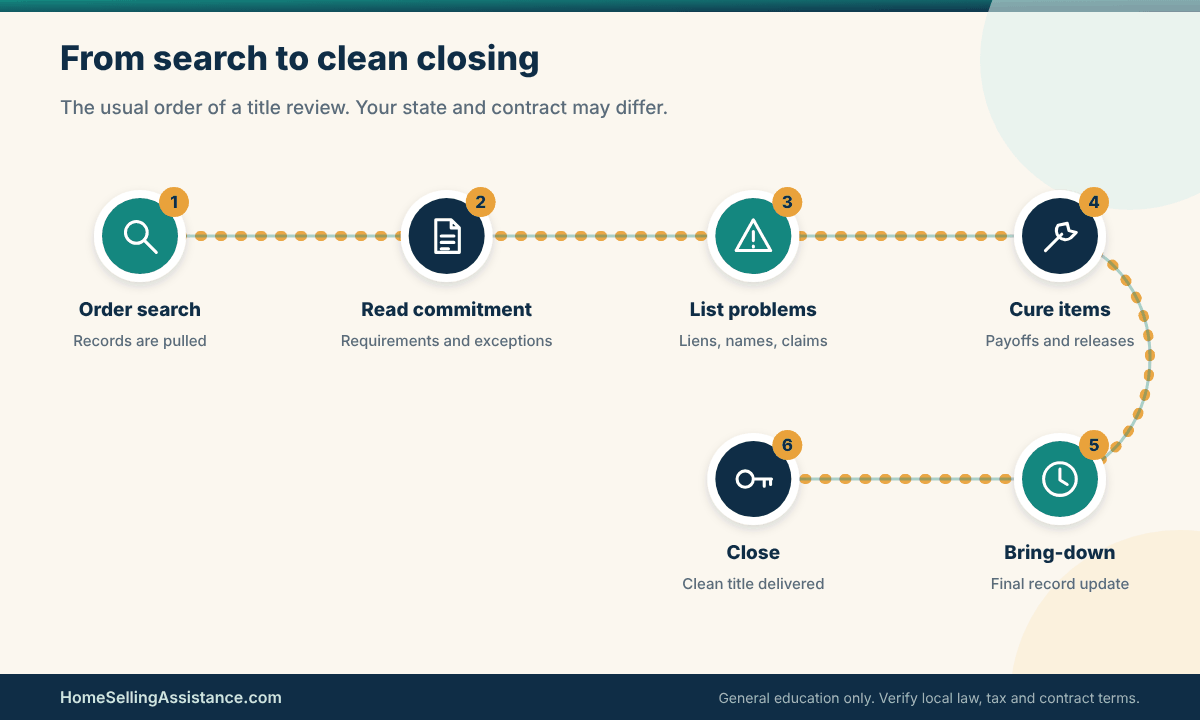
Notice how many steps of a title search seller home sale sit before anyone writes a check. Ordering the search, reviewing the commitment, curing the items, and updating the file are all separate stages, and sellers who treat them as one blur are the ones who feel ambushed by the closing date. If you can sketch the stages in your head, you can tell your agent, attorney or escrow officer exactly where you think your file stands and ask whether they agree.
Who owns the property, who signs, and which document decides
Ownership sounds binary in a title search seller home sale, yet on paper it comes in layers. A person can hold full title, a share of it, a life estate, a trustee’s authority, or only a right to sign on someone else’s behalf under a power of attorney or a court appointment. A title search seller home sale review starts by asking which of those layers actually applies to the people listed on your listing agreement.
The document that controls is usually the deed that put the current owners into title, often called the vesting deed. Other papers can modify its effect: a trust agreement, a death certificate and letters from a probate court, a divorce decree, a marriage-related name change, a recorded power of attorney, or a corporate resolution for an entity seller. Your job is to find out which of these exist before the buyer’s side asks.
Evidence to gather: the vesting deed and the names on it
Start with your own closet. Find the deed you received when you bought, the owner’s title policy that came with it, and the closing statement from that purchase. Together they tell you how title was taken, for example as individuals, as joint owners, as spouses, or in the name of a trust or company. The policy also lists the legal description and any exceptions the insurer carried forward back then.
Next, for your title search seller home sale file, compare the spelling of every name on the deed with the names on your photo identification and your current mortgage. Missing middle initials, maiden names, a suffix like Jr., or a hyphenated surname can each trigger a request for a signed name affidavit. This is routine, and the form is short, but it adds a signature to someone’s schedule, so ask about it early.
If you can, pull a copy of the same deed from the county recorder or register of deeds. Many offices post images online, and some charge a small copy fee. Seeing the recorded version lets you spot a typo in the legal description, a missing owner, or a stray reference to a prior document you never heard of. A free afternoon here can save a delayed closing later.
Finally, write down what you do not know about the history. Your title search seller home sale goes best when gaps are shared. Did a relative live in the home and ever hold a share? Was there a refinance where someone was added or removed? Did a spouse sign a quitclaim at some point? Telling the title officer about these gaps up front is not an admission of trouble. It lets them search the right names and date ranges the first time.
A scenario, an exception, and your next step for names that do not match
Picture a seller named Maria who bought the house ten years ago as “Maria L. Alvarez, a single woman.” She later married and now goes by Maria Alvarez-Brooks. Her husband never appeared on the deed. The title company asks for an affidavit confirming that Maria L. Alvarez and Maria Alvarez-Brooks are one person, and, depending on the state, may ask her husband to sign or acknowledge something about marital or homestead rights.
That last point is where local law matters. Some states give a non-owner spouse a legal interest or a signature right in the family home, even if the name never made it onto the deed. Other states do not. You cannot guess which camp you are in, and your agent should not guess either. A real estate attorney or the title officer can say which statute applies.
The exception to watch for is the owner who cannot sign. If someone is incapacitated, absent, or deceased, a recorded power of attorney or a court-appointed representative may be needed, and the authority has to be proven with certified paperwork. Your next step is simple: tell the title officer today, and ask for a written list of every signature and document they will need from each person.
Federal rules, state rules and what the county records actually show
People often ask which law governs a title search seller home sale, and the honest answer is that no single federal rule tells a private seller how to run one. Federal law touches title indirectly. Lenders who fund the buyer’s loan operate under federal mortgage rules and usually require a lender’s title policy, and the IRS can file a federal tax lien against a person’s property. Most of the actual mechanics, though, come from state statutes and local custom.
State law decides what counts as marketable title, how and where documents get recorded, which liens get priority, what a seller must deliver in the deed, and who typically pays for the search and the policies. County offices hold the records themselves. The practical lesson is to treat the county recorder, your state’s real estate regulator and a local attorney as the authorities, and treat national articles, including this one, as orientation only.
Evidence to gather: the recorder, the policy and the statute
Three sources tell you most of what you need for a title search seller home sale. The first is the county recorder, register of deeds or land records office, which holds the chain of deeds, mortgages, releases, liens and many court-related filings. The second is your own title policy and the new commitment. The third is your state’s statutes or your state real estate commission’s consumer materials, which explain disclosure and closing customs in plain language.
The matrix below sorts common title search seller home sale issues by what controls them, what you owe or can choose, the usual timing, and how to check locally. Use it as a conversation starter with your title officer rather than as a rule book, because the deadline column in particular depends on your contract and your state.
| Issue | Controlling document or authority | Seller obligation or choice | Typical timing | Local verification |
|---|---|---|---|---|
| Existing mortgage | Recorded mortgage or deed of trust, payoff letter | Pay off at closing from proceeds | Payoff good through a stated date | Lender payoff department, closing agent |
| Unreleased old mortgage | Recorded satisfaction or release | Obtain release from lender or its successor | Start at commitment review | Recorder, lender, title officer |
| Contractor or mechanic’s lien | Recorded lien notice, state lien statute | Pay, dispute, or post a bond if allowed | Before closing or at closing | Recorder, attorney, state lien law |
| Judgment lien | Court judgment and abstract | Confirm identity, pay, or contest | Before policy issues | County clerk, attorney |
| Property tax or assessment | Tax collector record | Pay or prorate at closing | Closing date | Tax collector, closing statement |
| HOA assessment or lien | Governing documents, HOA ledger | Request payoff or estoppel letter | Request early, expires quickly | HOA manager, recorder |
| Owner cannot sign | Power of attorney or court order | Provide certified authority | Before signing day | Title officer, attorney |
Read across a row, not down a column. If the item is an unreleased mortgage, for example, you can see that the controlling paper is a recorded release, that the choice is to get one rather than argue about it, and that the best check is a call to the recorder and the lender. Your own file may add rows, which is perfectly normal, and any row you cannot fill in is a question for a local professional.
Scenario: a lien you did not know about and who to call
Suppose a seller named Dev, in the middle of a title search seller home sale, learns from the commitment that a roofing company recorded a lien two years ago. Dev remembers paying the roofer in full, but a supplier of the roofer was never paid, and the supplier filed against the property. Dev is not at fault in a moral sense, yet the lien still clouds the title until it is resolved. This is one of the more common surprises in a title search seller home sale file.
Options exist, and the right one depends on your state. Dev might ask the roofer to settle with the supplier and obtain a recorded release, pay the amount from sale proceeds with a written payoff, or, where state law allows, ask about posting a bond or deposit with the title company so the sale can proceed while the dispute continues. Every one of those routes needs paperwork.
Your next step in a case like this is to call the title officer and your attorney or agent the same day, gather the receipts and contract with the roofer, and ask the title company in writing what it will accept as proof of release. For a deeper walk-through of the money side, see our guide to how to sell a house with a lien and how liens show up on the closing statement.
Turn the title search seller home sale findings into a seller workflow
Once the commitment from your title search seller home sale arrives, the work changes from reading to doing. A tidy way to handle it is to turn every requirement and exception into a single line in your own tracker: what the item is, who has to act, which document proves it is solved, and the date it needs to be finished. Sellers who keep that tracker rarely miss a closing date because of paperwork, and the ones who do not often find out three days before.
The title search seller home sale workflow below is general, because contracts differ. Your purchase agreement usually sets a window for the seller to deliver marketable or insurable title, along with what happens if you cannot. Read that clause alongside the commitment. If the contract allows a cure period, the date matters more than any other number in the file, and it deserves its own reminder on your phone and your agent’s.
It also helps to know what a title search seller home sale will not do. It does not inspect the house, confirm the boundary on the ground, or discover a lien that was never recorded. Some of those gaps are filled by a survey, by your own disclosure, and by honest answers. We cover the related disclosure of easements and encroachments in a separate article on easement and encroachment disclosure, which pairs well with this one.
Disclosures, notices and the paperwork you owe the buyer
Title is one half of what a buyer needs to know beyond the title search seller home sale itself. The other half is the condition and legal situation of the property as you understand it. Your state may require a written seller disclosure form, and many forms ask about liens, boundary disputes, shared driveways, unpaid assessments, pending legal actions and recorded restrictions. What you say there should line up with what the commitment shows.
When the two disagree, buyers and their lawyers notice. A form that says “no known liens” next to a commitment listing a recorded contractor lien is a problem you created yourself, even if you forgot about the lien. Take ten minutes to compare the two documents side by side, and correct your form before the buyer does it for you. Our overview of seller disclosure requirements explains how those forms usually work.
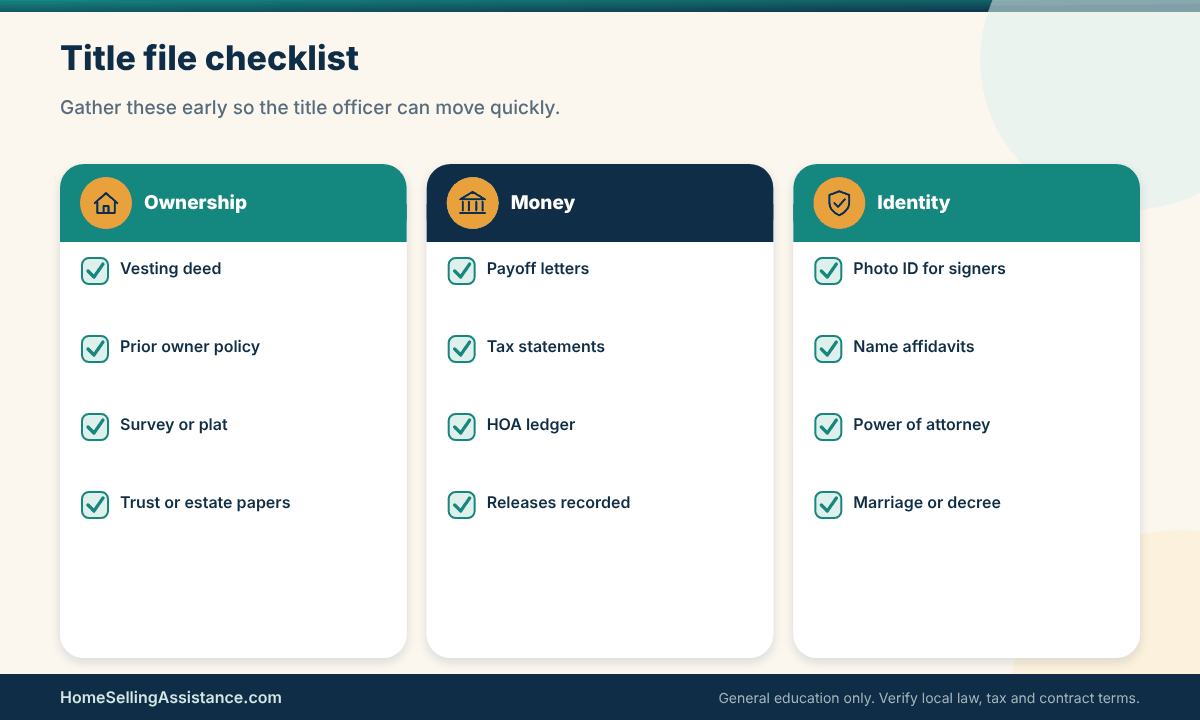
The checklist above groups the documents most sellers end up needing when a title search seller home sale file is under review: ownership papers, money papers and condition papers. You will not need every item. Treat it as a prompt for what to look for in your own files, and ask your title officer which ones they consider essential for your specific situation.
Evidence to gather: payoff letters, releases and estoppel statements
A payoff letter is a lender’s written statement of what it will accept to release its lien as of a stated date, including daily interest after that date. It differs from the balance on your monthly statement. In a title search seller home sale, request it in writing through your title or escrow officer, who normally sends the lender an authorization signed by you. If you want to understand the figures better, our guide to mortgage payoff when selling a house goes through each line.
A release or satisfaction is the recorded paper showing a lien is gone. Lenders typically record it after payoff, within a time that state law or the loan documents set, and the record may not show up for days or weeks. Because of that gap, title companies often rely on the payoff and their own procedures at closing, then confirm that the release was recorded afterward. Ask how your title company handles this so you are not caught off guard.
For HOA matters, an estoppel or payoff statement from the association lists unpaid assessments, fines, transfer fees and any claims it holds, usually good only for a short window. Because the numbers move, order it close to the closing date, but not so close that the HOA cannot answer in time. Our article on HOA resale fees for sellers covers the typical charges and why they appear.
Tax lien and tax certificate records come from the tax collector rather than the recorder in many places. Ask for a current tax statement showing paid, due and delinquent amounts. If there is a federal tax lien, the IRS has a process to request that a lien be discharged from a specific property, but the timing is not fast and the process is not something to start for the first time in the last week.
A scenario, an exception, and your next step for a stale payoff
Here is a simple title search seller home sale example with round, illustrative numbers. Say your lender’s payoff letter on the first of the month shows an amount that is good through the twentieth, with a small extra daily interest figure after that. Closing slips from the nineteenth to the twenty-eighth because the buyer’s lender needs more time. The old letter no longer matches reality, and a wire sized to it would come up short by nine days of interest.
That is not a disaster, but it does mean new paper. Ask the closing agent to order an updated payoff as soon as the date moves, and confirm that the per-day figure is on the letter. Many sellers also keep their regular payment going until the loan is actually paid, so no late fee or credit mark appears while the closing slides. That is a general habit rather than advice for your loan, so check your note.
The exception to flag is a payoff that cannot be sent in time because of a lender backlog, a holiday or a servicing transfer. When a loan has recently changed servicers, payoff requests sometimes bounce between companies. Escalate early to your title officer, who often has a direct contact. Your next step is to keep a log of who you asked, when, and what they said.
The waterfall below shows how the money typically flows once the liens are known. It uses round numbers for an invented sale to illustrate the structure only. Real figures come from your payoff letters and your closing statement, which our guide to the seller closing statement explains line by line.
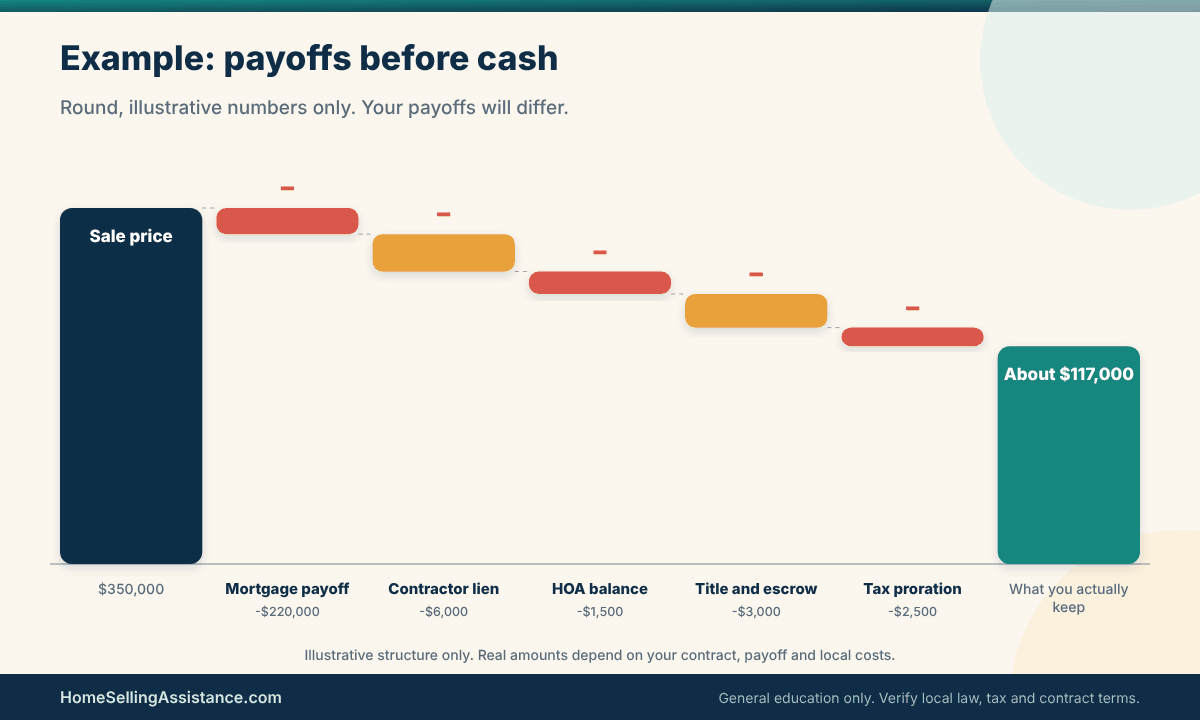
Notice that in any title search seller home sale the lien payoffs come out before you see a penny. That is why it is worth learning your lien amounts early, since a surprise of a few thousand dollars changes your plans for the next home. If the number scares you, the better response is not to hope but to ask, in writing, for every known payoff figure so you can run your own net-proceeds estimate with real inputs.
Handoffs to the buyer, the title company, the HOA, the court and your attorney
A title search seller home sale file passes through many hands, and most delays happen at the handoffs. The title officer waits on the lender, the lender waits on the HOA, the HOA waits on a manager who is on vacation, and everyone assumes someone else is chasing. You cannot control the whole chain, but you can decide who owns each task and tell them in writing.
A useful rule of thumb is to match each problem to the person with authority to solve it. Payoffs belong to lenders and their servicers. Association balances belong to the HOA or its management company. Judgments and probate matters belong to a clerk of court and, usually, a lawyer. Corrective deeds and affidavits belong to the title officer working with the signers. Your agent, if you have one, coordinates but usually does not decide legal questions.
Evidence to gather: who holds the answer for each item
Start a one-page title search seller home sale contact sheet. For each open item, list the organisation, the person you spoke with, their direct number or email, the date you asked, and the document you expect back. It sounds fussy, yet it prevents the common conversation in which a seller is told “we sent that” and has no way to prove or disprove it.
Ask the title officer two direct questions about your title search seller home sale. First, which of the commitment items are requirements for you personally and which are standard exceptions that stay on every policy? Second, which items does the lender on the buyer’s side care about? Lenders often impose stricter conditions than the title insurer, and a requirement that seems optional to you may be mandatory for the buyer’s loan to close.
Ask the buyer’s side for their timeline too. If the buyer has a rate lock that expires on a certain date, your cure period is effectively shorter than the contract says. Communicate through your agent or attorney, and put dates in email so everyone is working from the same calendar. Quiet files are not always healthy files.
If an HOA is involved, find out whether it has a management company, how long it takes to deliver a payoff statement, and whether rush fees apply. If a court is involved, ask the clerk about hearing calendars, because a judge’s schedule can add weeks that no amount of seller effort can shorten. Our companion article on how to sell a house with an HOA lien goes further on that specific case.
The scenario table below compares situations sellers commonly meet during a title search seller home sale. The columns show what the seller can usually do, what the main risk is, which document to read first, and where to escalate. Again, the specific answers depend on your state and contract, so use the table to frame questions rather than to settle them.
| Situation | Seller options | Main risk | Document to review | Escalate to |
|---|---|---|---|---|
| Old mortgage never released | Request release or a lost-lien affidavit | Delay if lender is defunct or merged | Recorded mortgage, payoff history | Title officer, attorney |
| Contractor lien disputed | Pay, settle, or bond where allowed | Closing delayed or escrow holdback | Lien notice, contract, receipts | Attorney, title underwriter |
| Judgment against similar name | Sign identity affidavit, show records | Wrong-person claim not cleared in time | Judgment abstract, ID documents | Title officer, court clerk |
| Unpaid HOA assessments | Pay from proceeds, ask for itemized ledger | Fees and fines keep growing | HOA statement, governing documents | HOA manager, attorney |
| Heir or co-owner missing | Locate, obtain signature, or seek court help | No authority to convey full title | Deed, probate filings, family records | Probate attorney |
| Legal description error | Record corrective deed or affidavit | Buyer or lender refuses to proceed | Vesting deed, survey, plat | Title officer, surveyor |
To use the table, find the row closest to your case and read across. The risk column is as important as the options column, since it tells you what to prepare for if the first option fails. The final column is not a threat or a trap. It is simply the point at which the situation is no longer a do-it-yourself project and a licensed professional should take the wheel.
A scenario, an exception, and your next step when a co-owner or heir is missing
Imagine a title search seller home sale for a house inherited by three siblings. Two of them live nearby and want to sell. The third moved abroad years ago and has not answered letters. The commitment shows all three as owners, so the buyer expects three signatures. A title search seller home sale process cannot conjure the missing signature, and no agent can waive it. Our article on selling an inherited house with multiple heirs explores the options at greater length.
Typical paths include a documented search for the sibling, a notary or consulate signing arrangement abroad, a negotiated buyout, or, in some states, a court proceeding that lets the sale go forward. Each carries cost and time, and none is guaranteed to work. Which one fits depends on state probate and property law, which is why a local probate attorney belongs in the conversation early.
The exception to expect is a sibling who responds and objects. Disagreement among owners can stop a sale as completely as silence. Your next step is to put everyone on the same written timeline, share the commitment with each owner, and agree who speaks to the title officer. If tax questions come up, the IRS publishes general guidance for survivors, executors and administrators, which is a good background read before you meet the attorney.
A related risk deserves a short mention. Criminals sometimes target vacant, inherited or lightly occupied homes with forged deeds or fake sellers, and some of that activity surfaces during a title search. If anything in the record looks wrong, such as a deed you never signed, stop and read our piece on title and deed fraud, then report concerns to your title company and local authorities.
Finally, here is how the path forward looks when you find a lien in the middle of an otherwise clean file. The tree below lays out four branches, each depending on what kind of lien turns up and how much control you have. It does not replace advice from your attorney, but it gives you a sensible order of questions to ask when the first surprise lands.
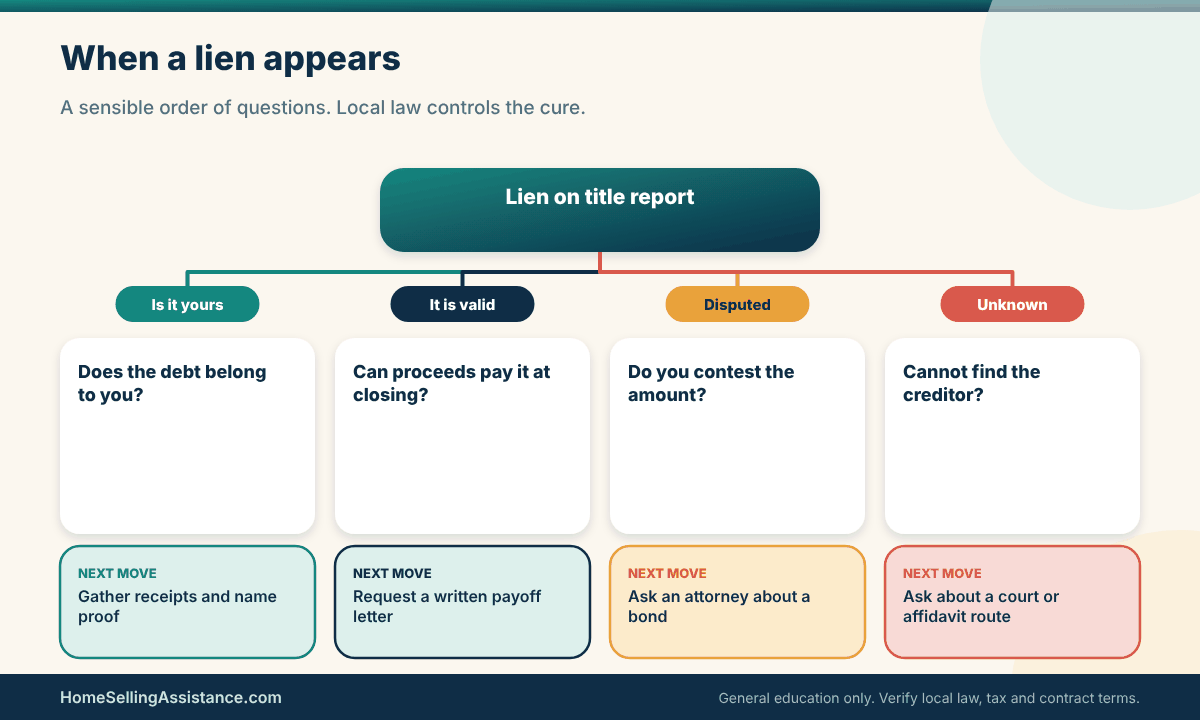
The branches of a title search seller home sale response share one idea: identify the lien, confirm that it is really yours, and pick the cure that fits both the law and the calendar. If a branch ends with “ask your attorney,” take that literally. A thirty-minute consultation about a recorded claim is cheap compared with the cost of discovering the same claim at the closing table with a buyer waiting.
Build a verification checklist you can trust before closing
By now your title search seller home sale has produced a commitment, a contact sheet and a tracker. The last job is to verify, with your own eyes where possible, that the story the paperwork tells matches the public record and the closing figures. Verification is not the same as trust. A friendly title officer, a careful agent and an honest buyer can all be wrong, simply because records change daily and typing mistakes happen.
Good verification in a title search seller home sale has a particular rhythm. You check sources early to find problems, again midway to confirm fixes, and one last time right before signing to catch anything new. Each pass is quick if your tracker is clean. The aim is not perfection but a short, dated list of confirmed facts that you can hand to anyone who asks, including a buyer’s attorney or your own.
It also helps to remember that title work sits inside a larger set of seller costs. Who pays for the search, the owner’s policy, recording fees and escrow services varies by state and by negotiation, and it feeds into your net proceeds. Our cornerstone guide to seller closing costs shows where those line items usually sit, and the closing costs and net proceeds category collects the related articles.
Official sources and recorded documents you can confirm yourself
You do not need to become a title examiner to handle a title search seller home sale, yet you can check several things without special access. County recorder websites often let you search by name or parcel number and view images of recorded deeds, mortgages and releases. Tax collector sites show what is paid and due. Court clerks may post judgments and civil filings. A few minutes on each can confirm that the commitment says what it should.
Be careful about what an online search can and cannot tell you. Indexes can lag behind the actual filing date, names can be indexed wrongly, and some counties restrict images. A clean result online does not guarantee clean title, and a messy result may be a clerical error that a title officer can clear with a phone call. Use public searches as a cross-check, never as the final word.
Evidence to gather: a short list of records worth pulling yourself
For your title search seller home sale, pull the vesting deed and any later deeds, to confirm legal description and owner names. Pull every mortgage or deed of trust, then look for its release or satisfaction. A mortgage you paid off years ago without a recorded release is more common than you might think, particularly after a lender merged, and it is the classic cause of an unexpected cure request.
Next, search your own name, any former names, and the names of anyone else on the title, in the civil judgment index for your county and nearby counties where you have lived. Make a note of anything that appears, even if you are sure it is not yours. A title officer would rather see your question than discover a lookalike match at the last minute.
Then check the tax collector for current and prior year status, including special assessments and any payment plan. After that, ask your HOA, if you have one, for the governing documents and a current ledger. Compare the legal description on the deed with the one on the survey if you have it. Small differences, like a lot number mismatch, deserve a question rather than an assumption.
Finally, keep copies of everything you pull in one folder, labelled with the date you retrieved it. When the buyer’s side asks for proof that a lien was released, you will be able to answer in minutes. For official background on fraud warning signs in closings, the FTC maintains consumer guidance at consumer.ftc.gov, which is a sensible stop if anything about a request feels off.
A scenario, an exception, and your next step when the record and the paperwork disagree
In one title search seller home sale, say your closing agent’s commitment lists a mortgage from 2009 as an open requirement, but your bank statements show the loan was refinanced in 2014. The old lender was acquired by another bank, which later sold its servicing rights. Nobody recorded a release when the refinance paid off the first loan. The record shows an open lien on a debt that no longer exists.
The usual cure is to locate the current successor and ask it to issue and record a satisfaction, often supported by your refinance closing papers and proof of payoff. Some states also have statutory procedures to clear paid-off liens when a lender cannot be found. Those procedures are not interchangeable, so the title officer or attorney needs to pick the right route for your county.
The exception arises when the lender no longer exists and no successor can be identified. That is rare but real, and it can take significantly longer. Your next step is to hand over your payoff proof, ask the title company for its specific curative plan in writing, and ask whether an affidavit, a bond or a court filing is likely. Ask for a rough time estimate too, with the caveat that estimates can shift.
What must be current in your title search seller home sale file before signing
Time is the enemy of every title search seller home sale file. A search is a snapshot as of a date, and a lot can be recorded between the search date and the day you sign. A new judgment, a mechanic’s lien from work finished last week, an HOA fine, or a tax installment that came due can all appear after the first report. That is why a final update, often called a bring-down or date-down, is standard practice.
Your job is to make sure everything with an expiry date is fresh enough to rely on. Payoff letters expire, HOA statements expire, tax figures change on installment dates, and ID or notary information can lapse. A quick review a few days before closing, with each item’s date next to it, will catch most of those. Mark any item older than the contract or title company’s tolerance and ask for a refresh.
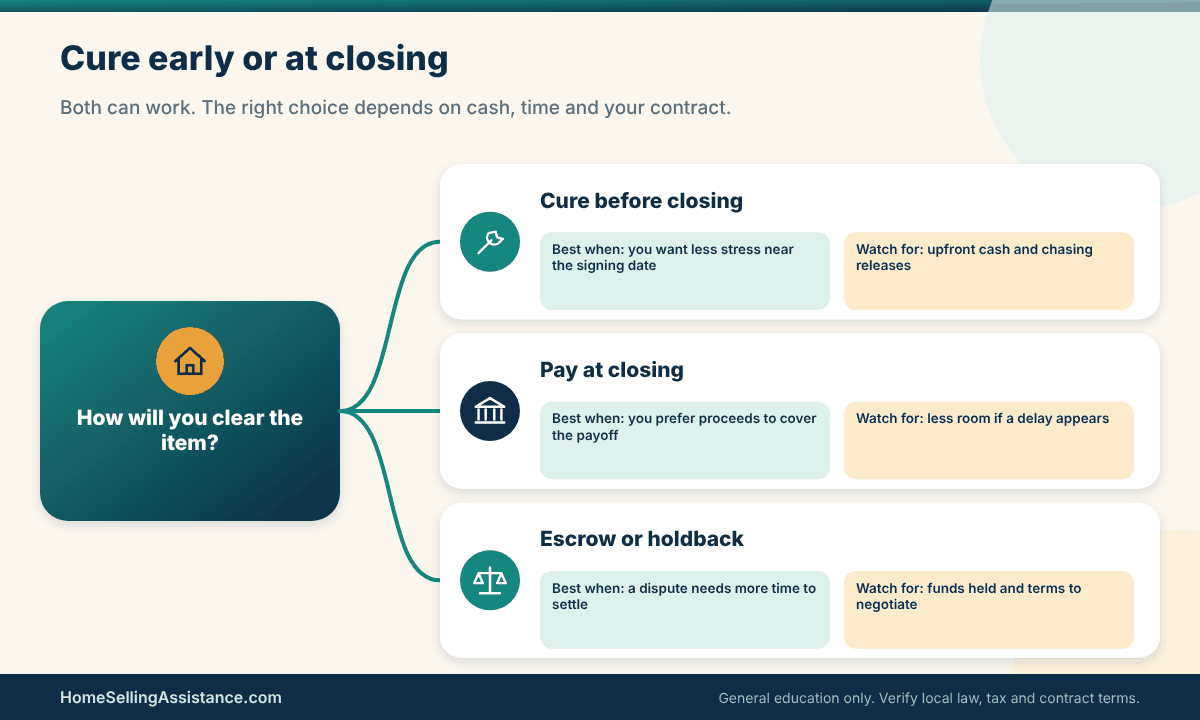
The fork above frames a decision many sellers face near the end: cure an item before closing, or let the closing agent pay or hold funds at closing to resolve it. Neither path is automatically better. Curing early lowers last-minute stress but may cost cash up front, while resolving at closing keeps your money flexible but leaves less room for delays.
Evidence to gather: dated documents and the final bring-down
Create a final-week title search seller home sale list with the date on each document: payoff letters, HOA statements, tax receipts, releases, signed affidavits, powers of attorney, and notary or ID details for every signer. Ask the title officer for the latest version of the commitment, and request the bring-down search results as soon as they are available. Compare any new item to your original list so you can tell what is new and what is old.
Read the draft closing statement against your payoff letters, line by line. The amounts for lien payoffs, tax prorations and HOA charges should match the documents you collected. If a number does not match, ask which document the closing agent used. Our guide on the home sale net proceeds calculation can help you check whether the bottom line makes sense.
Confirm wiring instructions by phone, using a number you already know and trust, before sending or accepting any money. Wire fraud targeting closings is a known problem, and fraudsters sometimes imitate title companies or agents by email. If you suspect an attempt, contact your title company by phone, and consider reporting it to the FBI’s Internet Crime Complaint Center. Our guide on real estate wire fraud for sellers adds more detail.
Finally, confirm who is signing, where and when, and that each person brings valid identification. If someone signs by mail, through a remote notary or under a power of attorney, ask the title officer whether the closing agent has approved the method. Last-minute signature problems are among the most avoidable closing delays, and they are almost always avoided by asking a day earlier.
A scenario, an exception, and your next step when something new appears at the last minute
Imagine the bring-down of your title search seller home sale the day before closing shows a new recorded judgment against a person with a similar name to yours. You are not that person, but the title company cannot ignore it. They ask for an identity affidavit and a copy of your ID, and they notify the buyer’s lender. The closing might hold if the paperwork is signed in time, or slip a day or two if not.
That is a fairly gentle version. A harsher one is a genuine new lien, such as unpaid contractor work you commissioned and forgot, or a tax debt that has been recorded. Then the question becomes how the closing agent can pay it from proceeds, and whether the buyer or lender will agree. Contracts often give both sides some options, but they rarely give the seller unlimited time.
The exception to prepare for is a closing date that is firm because of a rate lock, a move-out date or a connected purchase. If you are buying another home with these proceeds, a hiccup in your title search seller home sale file can ripple through the next deal. Your next step is to talk to your agent or attorney about contingency plans, such as a short extension, before the problem appears. For more on timing risks, browse the disclosures and seller paperwork category.
Quick scenario
In one title search seller home sale, a seller lists a house in early spring and signs a contract within two weeks. The commitment shows a mortgage to be paid, a small unpaid HOA balance, and an old equity line that the seller thought was closed years ago. Because the seller asked for the line’s payoff letter and a written closure statement on day two, the lender issued a release request before the closing was even scheduled. In this illustration, the seller saved days simply by acting the same week the commitment arrived.
Frequently asked questions about title search seller home sale
Who orders the title search, the seller or the buyer?
Practice differs by state and contract. In many areas the seller’s side orders a search and commitment soon after the contract is signed, while in others the buyer’s side or a closing attorney handles it. Your purchase agreement should say who selects the title company and who pays. If it is unclear, ask your agent or attorney before anyone books services.
How long does a title search seller home sale review usually take?
A routine title search seller home sale on a straightforward property can finish in days, but there is no fixed timetable. Older properties, several prior owners, estates, open liens or backlogged county offices can add time. Ask the title officer for an estimate and for the items most likely to slow things down. Treat any estimate as a guide, not a promise.
What is the difference between a title search and title insurance?
The search is the review of public records, while title insurance is a policy that may protect against covered defects the search missed or that arise later. Owner’s and lender’s policies cover different parties, and each has its own exceptions and limits. Read the policy form and ask what is excluded. Who pays for each policy varies by state and local custom.
Can I sell a house if the search finds a lien?
Often yes, because many liens can be paid from the sale proceeds at closing or released beforehand. Some, such as disputed claims or older unreleased liens, may need more work or a legal process. Whether the buyer or lender will proceed depends on your contract and the specific item. Ask the title officer what they will accept as proof of cure.
What if a judgment shows up against someone with my name?
This is a common situation. Title companies usually ask for an identity affidavit and sometimes a copy of identification to show that the judgment belongs to a different person. Details such as middle names, addresses and Social Security digits, which are kept private, are used to tell people apart. Respond quickly so it does not hold up the closing.
Do I have to disclose a lien or claim to the buyer?
Many states require a written seller disclosure covering known legal and title matters, and contracts typically promise a certain quality of title regardless. What you must say depends on your state and agreement. As a rule, it is safer to be accurate and consistent between your disclosure form and the commitment, and to ask a local attorney if you are unsure.
Who pays to fix a title problem?
Usually the seller pays to clear liens and defects that sit against the seller’s ownership, especially debts the seller owes. The contract may allocate certain costs differently, and some buyers agree to take title subject to specific items. This is negotiable and local, so read the title clause in your agreement. Your attorney can explain what applies in your state.
What is a bring-down or date-down search?
It is an update run shortly before closing to catch anything recorded since the original search date. It helps the title company confirm that no new liens, judgments or transfers have appeared. Ask when it will be done and request the results so you can review any new items. A clean bring-down does not remove the need for your own final check.
Can an HOA claim affect a title search seller home sale file?
Yes. Unpaid assessments, fines or transfer fees can be recorded as liens or collected through closing, depending on the governing documents and state law. Ask the association for a current payoff or estoppel statement and read it against the commitment. Because the figures change, plan for a refresh close to the closing date.
When should I talk to a real estate attorney?
Consider it when the search finds anything beyond a routine payoff: heirs or missing owners, judgments, disputed liens, boundary problems, a trust or an estate seller. An hour of advice early is usually cheaper than a delayed closing. Ask about fees up front and bring your commitment and contract. Attorneys in your state can tell you what applies locally.
Before you sign anything
A title search seller home sale review is less frightening once you treat it as a checklist instead of a verdict. Read the commitment line by line, keep a tracker, get every payoff and release in writing, and refresh anything with an expiry date before closing. This article is general education, not legal, tax or financial advice, and rules differ by state and contract. Confirm the details with your title officer, your attorney and your county records, and you will meet closing day with fewer surprises.