Getting the mortgage payoff when selling house plans right is the single biggest step between a signed contract and money you can actually count on, because the payoff is almost always the largest line on your closing statement and it is rarely the same number as the balance printed on your monthly bill.
Most sellers look at the last mortgage statement, subtract that figure from the expected sale price, and treat the remainder as their profit. Then the real payoff quote arrives with a few more dollars of interest, a small fee or two, and a “good through” date that may already be inconvenient. None of that is a scandal. It is simply how a loan works when it is paid off in the middle of a month rather than on a payment date.
Sellers also tend to assume the mortgage payoff when selling house details are handled automatically. In practice, several people each hold one piece: you know your loan, the servicer knows the exact figure, and the title company moves the money. Your role is to keep those pieces connected, which mostly means asking a few questions early and writing the answers down.
This guide explains the mortgage payoff when selling house transactions in the order you will meet them: what a payoff quote is, why daily interest keeps ticking, what happens to your escrow account, and what a release or satisfaction of the lien really means. We will use clearly labelled illustrative numbers, never real rates or fees, and we will point to the people and documents that can confirm the facts for your loan and your state.
If you want the bigger picture first, our cornerstone guide to seller closing costs shows where the payoff fits among every other deduction (the full closing costs and net proceeds category collects our related guides), and the companion piece on home sale net proceeds turns the payoff into an estimate you can plan around.
Key takeaways
- A payoff quote is not your statement balance. It adds interest accrued through a stated date, may add fees, and is only valid until that date.
- Daily interest is a budgeting detail, not a trap. Each extra day before funding adds a small, calculable amount, so a closing delay has a price you can estimate in advance.
- Request the payoff in writing and early. Title or escrow normally orders it, but you can ask your servicer for a quote too and compare the two.
- Your escrow balance does not pay the loan. Any leftover tax and insurance money is usually refunded after payoff, on a separate timeline from closing day.
- Payoff is not finished at closing. Confirm that the lien release or satisfaction is recorded and keep the paperwork for your records.
- Verify wire instructions by phone. Payoff and proceeds are prime targets for fraud, so use contact details you looked up yourself.
Gather the payoff facts before the sale gets busy
The weeks before and just after listing are the quiet window. Nobody is waiting on you, no contract clock is running, and you can collect loan information without pressure. Sellers who use that window usually find the mortgage payoff when selling house process boring, which is exactly what you want.
Know exactly what you owe and who you owe it to
Your loan has a servicer, which is the company you send payments to, and possibly a separate investor or owner of the loan that you have never heard of. The servicer is the one who issues a payoff quote and later releases the lien. Sorting out those names, your loan number, and any second loans takes about an hour and prevents a surprising amount of delay.
Start with the most recent statement and the original loan documents if you still have them. If your mortgage was transferred, check the notices you received about the new servicer, since a payoff request sent to the old company goes nowhere. Then look for any additional liens recorded against the property, such as a home equity line of credit, which can hide behind a different company name.
Different loan types can behave a little differently here. A government-backed loan, a conventional loan and a portfolio loan held by a local bank may each have their own payoff request form, fax or portal, and turnaround. Learning those habits ahead of time makes your mortgage payoff when selling house schedule far more predictable than guessing after you are under contract.
Evidence to gather: statements, loan numbers, and every lien holder
Pull the latest mortgage statement and write down the servicer name, loan number, current principal balance, interest rate, and the escrow balance if the statement shows one. Add the same details for any second mortgage or HELOC. If you are unsure what is recorded against the property, a title search will list it, and our guide to the title search for sellers explains how to read the result.
Also note whether your loan is a conventional, FHA, VA or another type, because the servicer’s payoff procedures and timelines can differ slightly. Check the original note for any prepayment language. Prepayment penalties are uncommon on modern home loans, but they exist in some older or specialized products, and it is far better to learn that now than from the closing statement.
Finally, write down a direct phone number and a secure portal login for the servicer’s payoff department. You will want them later when you verify the figures.
A good habit is to log in to the servicer portal now and download every document it offers, including the escrow analysis, the annual interest summary and the original closing paperwork if it is stored there. Old statements are useful when something looks wrong later, and having them in one folder keeps a mortgage payoff when selling house project from turning into a document hunt.
Picture a seller who bought three years ago, refinanced once, and assumes one loan is all there is. The title search reveals a small HELOC opened two years earlier for a kitchen project, with a balance of a few thousand dollars. Nobody told the closing team, so the payoff request covers only the first mortgage, and the HELOC lender has to be located in the final week.
The exception to watch is a loan that was recently sold or transferred, where the old and new servicers may both appear in records. Your next step is simple: make a one-page list of every lender and loan number, and hand it to your agent and title company on day one.
If you hold the property with someone else, such as a spouse or a co-owner, both names usually matter on the payoff request and on the authorization. Agree early on who will speak with the servicer. Our guide on mortgage payments during a divorce sale covers what changes when two people are tied to one loan.
Four numbers shape your payoff: the unpaid principal, the interest accrued since your last payment, any fees the servicer charges to close the account, and the date the quote stays valid. The principal moves very little in a few weeks. The accrued interest moves every single day. Understanding the difference lets you build an estimate that is honest instead of hopeful.
It helps to separate what you control from what you do not. You control when you ask, how organized your file is, and whether you verify the figures. You do not control how fast a servicer responds or how a buyer’s lender schedules funding. A sensible mortgage payoff when selling house plan puts effort into the first group and leaves slack for the second.
A simple way to see it is to imagine the loan as a meter that keeps running until the moment the money arrives. The payoff quote is a photograph of the meter at a specific time, plus a prediction for the day you plan to close.
Sellers sometimes ask whether they could simply pay the loan down in advance to avoid the final interest. Paying extra principal before closing does reduce the balance, but it ties up cash you may need, and the mortgage payoff when selling house result is only a modest saving. Talk to your servicer and your tax or financial adviser before moving large sums, and keep records of anything you send.
Source and calculation: how daily interest turns into a payoff figure
Most mortgages charge interest in arrears, meaning each monthly payment covers the interest that built up during the previous month. When you pay the loan off partway through a month, you owe the interest that has accrued since the last interest period was paid. Your servicer calculates that using a per-day amount, often called the per diem.
A handful of loans handle interest differently, so read your own note. Some products have unusual payment structures, and a few use daily simple interest in ways that make the timing of each payment matter. If your mortgage payoff when selling house quote looks strange compared with the arithmetic above, ask the servicer to explain the method in writing.
Here is an illustrative example with round numbers only. Suppose the unpaid principal is $240,000 and the rate is 6 percent. A rough per-day interest figure is $240,000 times 0.06 divided by 365, about $39 a day. If your last paid interest period ended 15 days before the closing, the accrued interest would be roughly $590, and the payoff would be principal plus that amount plus any fees.
Servicers differ on the day-count method and on how they treat the day of funding, so treat this as a way to sanity-check a quote, not as a way to replace one. The authoritative number is whatever the servicer states in writing, as explained in our guide to selling a house with a mortgage.
A quick reasonableness check is worth the two minutes it takes. Multiply your unpaid principal by your rate, divide by 365, and compare the result with the per-day figure on the quote. They should be close. If they are far apart, ask whether the servicer uses a 360-day year or another method, because the mortgage payoff when selling house arithmetic should be explainable in plain words.
Take two sellers with the same loan. One closes on the first business day of the month and the other closes at month end. Their principal is identical, but the second seller pays noticeably more accrued interest, simply because more days have passed since the last interest period. Neither did anything wrong, yet their net proceeds differ.
An exception is a payment that has not posted yet. If you make a regular payment right before closing, ask the servicer whether the quote already reflects it, because a stale quote and a fresh payment can double count or miss each other. Your next step is to keep paying on time until the loan is actually paid off, and to tell title about any payment you make during the closing window.
It can feel odd to send a payment on a house you are about to sell, but skipping it rarely helps. A late payment may add fees, mark your credit and force a new quote. Most sellers find it simpler to make every scheduled payment right up to the funding date and let the mortgage payoff when selling house calculation sort out the difference.
The payoff request and the gaps you still need to fill
Even a well-prepared seller has open questions at this stage: which closing date will hold, whether the quote needs to cover a second loan, and how the escrow refund will reach you. Naming those gaps early is what separates a calm closing from an urgent scramble. The sections below show how to close each one.
Think of it as building a short list of questions with owners and dates. Some belong to you, some to the servicer, and some to the title company that will actually send the funds.
Source and evidence: what the quote must show before you rely on it
A usable payoff statement normally lists the unpaid principal, interest through a stated good-through date, any late charges, recording or release fees, a daily interest amount for dates after that, and wiring or mailing instructions. It should identify the loan, the property address, and the borrower names. If any of these items are missing, ask the servicer to reissue it before the closing date, not on it.
Compare the quote against your own rough calculation. If the difference is more than a few days of interest or a small fee, ask what is included. Sometimes the answer is an unpaid escrow advance or a returned payment, both of which are worth knowing about before closing.
Fees on a payoff quote deserve a second look, though not an alarmed one. Some servicers charge a modest statement or processing amount, and some pass along a recording or release charge. Ask for an itemized list. A fee that cannot be explained is worth questioning, and a clear explanation usually settles it. Either way, you want those items known before your mortgage payoff when selling house figure goes on the settlement statement.
The CFPB publishes general consumer information about mortgage servicing at consumerfinance.gov, which is a helpful neutral place to read about your rights when a servicer is slow to respond.
A scenario, an exception, and your next step
A seller learns two days before closing that the quote on file expires the day before the scheduled funding. The title officer asks the servicer for an updated figure, which arrives with an extra day of interest and a small fee for expedited handling. Nobody is happy, but the number is still just arithmetic.
Exceptions include loans in forbearance, loans with an unresolved modification, or accounts with a pending dispute. These can complicate the quote, and you should tell your agent and title company right away. The next step is to note the good-through date on every quote you receive and to ask for a fresh one whenever the closing date moves.
For a feel of how the payoff slots into the rest of the settlement, the guide to reading a seller closing statement shows exactly where the figure appears and how it is netted against the sale price.
Follow the mortgage payoff when selling house from offer to funding
Once a buyer signs, the payoff stops being a private calculation and becomes a task with deadlines, several people, and real consequences if it slips. The order below is the one most sellers experience, though the exact sequence depends on your state, your title company and whether an attorney or an escrow officer runs the closing.
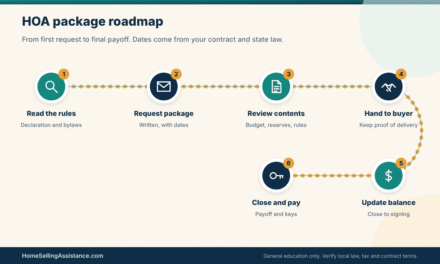
The picture below lays out the sequence from the first quote request to the final recorded release, so you can see where each handoff happens before we walk through them one by one.

Early action on the mortgage payoff when selling house: order the quote, set the date
In many transactions the title or escrow company requests the payoff directly from your servicer once the contract is signed, using an authorization you provide at or after listing. That works well, but it should not be your only source. A seller who also holds a recent quote can spot an obviously wrong number the moment it appears.
If you are selling without a listing agent, the title company or closing attorney becomes even more central to the payoff. A seller who handles the sale directly should ask early who will request the figure, because nobody else in the transaction is guaranteed to. Treat the mortgage payoff when selling house step as your own job unless someone confirms otherwise.
Early is also when you choose, together with the buyer, a closing date. The date matters to your payoff because every day moves the accrued interest and can push the quote past its good-through date.
Your agent or attorney can tell you how long payoff quotes usually take in your area, since turnaround varies by servicer and by season. Asking the question at the start of a mortgage payoff when selling house transaction gives you a realistic buffer, and it keeps you from promising a buyer a closing date that the lender’s processing time cannot support.
Evidence and calculation: the cost of moving the closing date
Use the per-day interest from your quote to price a delay. In the illustrative example from earlier, about $39 a day means a ten-day slip adds roughly $390 to what you owe, before any new fee. That is not a reason to rush an inspection or skip a contingency, but it is a fair number to weigh when a buyer asks for a longer closing in exchange for a better price or terms.
Here is how to think about it. If a buyer offers a slightly higher price in return for an extra two weeks, compare the price difference with two weeks of interest and with any other costs you carry, such as utilities and insurance. Sometimes the extra time is a bargain, and sometimes it is not.
Cash flow matters too. If you are buying your next home at the same time, the net amount from your sale may fund your next down payment, so a surprise of a few hundred dollars in payoff interest can matter. Build a small cushion into any estimate that depends on a mortgage payoff when selling house figure, and update it each time the quote is refreshed. The guide to selling with a mortgage has more on that planning.
If you are considering a rent-back after closing, the arrangement does not change your payoff, since the loan must be paid off on the day of funding. Our guide to the steps after accepting an offer shows how those pieces fit around the payoff.
A scenario, an exception, and your next step
Imagine an offer with a 45-day closing because the buyer is waiting on the sale of their own home. Your servicer’s first quote is good for 30 days, so you will need at least one refreshed quote. A smart seller asks the title company at the start who will request updates, and writes the answer down.
Longer closings are not unusual, and they are not a problem if you plan for them. Ask the servicer how far in advance a quote can be issued and how often it can be refreshed. A sensible mortgage payoff when selling house plan for a long closing includes a calendar of refresh dates, so no quote lapses unnoticed during a quiet week.
The exception is a buyer who wants an early possession date before closing. That is a separate negotiation with its own risks, and it does not alter what you owe the lender. Next step: ask your agent or attorney how quotes are refreshed locally and who calls the servicer if the date changes.
Handoffs among servicer, title, buyer and agent
A payoff touches four parties. The servicer states the number, the title or escrow company sends the money, the buyer’s side reviews the settlement figures, and your agent or attorney coordinates timing. Most delays happen in the gaps between them, rarely in the math itself.
The workflow table below turns those gaps into a checklist you can use from the day the contract is signed. Read across each row to see the stage, what you need in hand, the action to take, the deadline that matters, and who gets the baton next.
| Stage | Information to gather | Action | Decision deadline | Next handoff |
|---|---|---|---|---|
| Before listing | Servicer name, loan number, all lien holders | Make a one-page lender list | Before the first showing | Listing agent, then title |
| Contract signed | Executed contract, closing date | Sign payoff authorization if asked | Within the first days after acceptance | Title or escrow officer |
| Quote received | Principal, interest, fees, good-through date | Compare with your own estimate | Before the closing disclosure review | Title, then your agent |
| Date change | New closing date, per-day interest | Request an updated quote | As soon as the date moves | Servicer, then title |
| Final figures | Draft settlement statement | Check payoff line against quote | Before signing day | Closing agent |
| After funding | Confirmation of payoff | Ask for release and escrow refund timing | Within the first weeks | Servicer, county recorder |
Use the table as a prompt, not a rulebook. Your closing may add steps, such as a second lender or a power of attorney, and your state may set the deadlines differently. If a row does not match your situation, replace it with what your contract and your closing agent actually say.
If you work with a listing agent, ask how their office tracks the mortgage payoff when selling house steps. Some teams use a transaction coordinator who follows every deadline, while others leave it to the title company. Neither approach is wrong. What matters is knowing which one you have, so a missed handoff is caught by someone with the job of catching it.
Evidence to gather: who is responsible for each step in writing
Ask the closing agent to confirm by email which party orders the payoff, who receives the quote, and who will tell you if the numbers change. A short written reply removes the most common source of confusion, which is each person assuming someone else made the call. It also gives you a record to point to if something goes missing.
It is reasonable to ask the closing agent to send you the draft settlement statement a day or two ahead of signing, rather than at the table. Reading it calmly at home is far better than reading it under pressure. Your mortgage payoff when selling house line is the first one to check, followed by the sale price, the commission lines and any credits.
Keep every quote and every email in a single folder. When a number changes, the folder tells you why. Do not rely on a phone call alone for a figure that will move thousands of dollars.
Photograph or download anything you sign, too. If a mortgage payoff when selling house question arises later, such as whether an authorization was ever signed or when a quote was issued, a dated copy settles the matter in seconds. It is a small habit, but sellers who keep their paperwork in order spend much less time arguing about who said what.
If your state uses attorneys for closings, the attorney’s office may order the payoff, and the process is largely the same. The question to ask is the same too: who requests it, and when will I see it?
A scenario, an exception, and your next step
Consider a seller whose servicer is slow. The title company requested the quote a week ago and has heard nothing. Because the seller kept their own contact details, they call the payoff department, confirm the request is in the queue, and learn it was missing an authorization signature. A same-day fix keeps the closing on track.
Persistence works better than anger here. Servicers handle large volumes of payoff requests, and the person who answers the phone usually wants to help but depends on a queue. A polite follow-up with the loan number, the property address and the closing date helps a mortgage payoff when selling house request move to the front of that line more often than a heated call does.
The exception is a servicer with an online payoff tool that produces an instant figure but limits what it will release to third parties. In that case, ask title whether the portal figure is acceptable or whether a formal statement is required. Your next step is to ask, in writing, what form of quote the closing agent needs.
The graphic above condenses the paperwork into a short list. It shows the items a servicer, a title company and a closing attorney typically want, so you can gather them once. Having them ready speeds up a mortgage payoff when selling house request, and it prevents the familiar delay where the servicer waits on a missing signature.

While the quote is moving, the same title team is also checking for other liens and recorded claims. Those can add to what must be paid at closing, and our overview of selling a house with a lien explains how they are resolved.
Close the loop: confirm, fund, release and keep records
The final stretch is where an otherwise tidy sale can stumble, and almost never because of anything dramatic. It is usually a missing digit, an unverified wire instruction, or an escrow refund nobody mentioned. A short routine of written confirmations handles nearly all of it, and it is the part of the mortgage payoff when selling house that deserves your closest attention.
Confirm every mortgage payoff when selling house figure in writing
Before signing day, the closing agent prepares a draft settlement statement. Your job is to find the payoff line and match it to the written quote you hold, including the good-through date and the per-day amount. If the statement shows a payoff that is lower than the quote, ask why, because a short payoff can leave a balance behind and delay the lien release.
If you are working with an attorney, ask them to explain any line you do not understand. Many closings use standard forms with abbreviations that mean little to a first-time seller. A short explanation of each payoff-related entry costs a few minutes and makes the mortgage payoff when selling house portion of the paperwork much easier to trust.
A mismatch in either direction is worth a polite phone call. It might be a rounding difference, an updated quote, or a typo. Take the time to understand it rather than assuming someone else already checked.
Look at the date, too. If the settlement statement is built on a funding date that is later than the one in your quote, the payoff line may need to be higher. Closing agents handle this all the time, and good ones update the figure without being asked. Still, a seller who checks the dates is the best backstop a mortgage payoff when selling house transaction can have.
Evidence to gather: the quote, the statement line and the wire instructions
Lay three documents side by side: the servicer’s written payoff statement, the draft settlement statement, and the wiring instructions the title company will use. The figures should agree, the loan number should match, and the receiving party should be your servicer or its designated payoff processor.
If a figure is wrong, ask for the corrected document in writing, not a verbal promise. A new quote or an amended statement leaves a trail, and the trail protects you if a dispute arises. A clean paper record is the quiet backbone of any mortgage payoff when selling house closing, and it costs nothing to ask for.
Fraud is a real risk at this exact moment. Criminals impersonate title companies, agents and lenders with last-minute “updated” wire instructions. Always confirm instructions by calling a number you looked up independently, never one from the same email. Our guide to real estate wire fraud walks through the warning signs, and you can report a suspected incident to the FBI’s Internet Crime Complaint Center.
When your seller proceeds are being sent to you, apply the same caution. The choice between a wire and a check has its own trade-offs, covered in wire versus check for seller proceeds.
Whatever method you choose, make sure your bank account details and name match exactly, and ask about any delivery timing the title company or your bank applies. A mortgage payoff when selling house transaction can be perfect on the lender side and still leave you waiting if your own paperwork has a typo. Our guide to when a seller gets paid describes the usual sequence.
A scenario, an exception, and your next step
A seller receives an email, supposedly from the title office, saying payoff wiring details have changed and asking for new proceeds instructions as well. The tone is urgent. The seller calls the title office using the number printed on the original contract and learns that nothing changed. The email is deleted and the incident is reported.
Fraudsters also like to reach sellers by text message and by phone, and they often know the address and closing date because those details are public or were taken from a compromised inbox. The safest mortgage payoff when selling house habit is to treat any change of instructions as unverified until you hear it from a known person on a known number.
An exception worth knowing: some closings are completed by mail or through a notary without everyone in the room, and the same verification applies. Your next step is to agree with the title company in advance on how any change in instructions will be communicated and confirmed.
To see how the issues in this section play out across a whole transaction, the table below pairs each common payoff issue with the evidence you hold, who else weighs in, the risk, and a fallback. Think of it as a pre-closing review you can run with your agent or attorney.
| Issue | Seller evidence | Buyer, agent or title input | Risk | Fallback |
|---|---|---|---|---|
| Quote expires before funding | Written quote with good-through date | Title requests a refreshed figure | Short payoff, delayed release | Add per-day interest to the payoff |
| Second loan or HELOC found | Lender list and statements | Title search results | Unpaid lien, closing delay | Second payoff and freeze letter |
| Payoff does not match statement | Your own quote and notes | Closing agent reviews the draft | Overpay or underpay | Correct before signing day |
| Unfamiliar wire instructions | Servicer phone number you found | Title confirms by phone | Funds sent to a criminal | Stop and verify; report fraud |
| Closing date moves | Per-day interest figure | Buyer or agent proposes new date | Quote lapses | Refresh quote, recalc proceeds |
| Escrow refund unclear | Statement showing escrow balance | Servicer states refund timing | Surprise cash gap | Budget without the refund |
Use the table by reading down the column that matches your risk. Where the evidence cell is empty for you, that is your task for the week. Where a row names someone else, ask them for a confirmation by email, so that you are not relying on memory.
Notice that most fallbacks cost little when they are used early and a lot when they are used late. A refreshed quote costs a phone call before closing and an awkward correction after it. That pattern is the heart of mortgage payoff when selling house planning: problems are small when someone is watching, and expensive when nobody is.

Escrow balance, lien release and records after your mortgage payoff when selling house
Once the lender receives the money, three things still need to happen: the servicer must apply the payoff and close the loan, the lien must be released of record, and your leftover escrow balance should come back to you. Each has its own timeline, and none of them is a reason to stop paying attention on closing day.
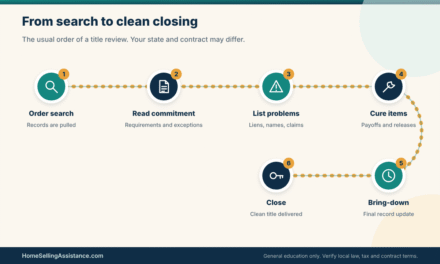
The decision tree above shows what to do when a figure or an instruction looks wrong, and the sections below explain the items that sellers most often misunderstand.
Source and evidence: how escrow refunds and lien releases work
If your lender collected property tax and insurance payments through an escrow account, the balance is not part of the payoff. It stays with the servicer until the loan is paid off, and then the servicer refunds it, typically by check, within a period set by federal servicing rules and any state requirements. Ask the servicer for the expected timeline, and do not count that refund as part of the funds you need on closing day.
Ask the servicer whether the escrow refund is paid by check or deposited, and whether it will be sent to the address on file. Some sellers receive it in a few weeks and others wait longer, so treat the refund as a bonus rather than a part of your mortgage payoff when selling house budget, and avoid committing it to a purchase.
Separately, the lender must record or deliver a release of the lien. Depending on the state, that document may be called a satisfaction of mortgage, a release of lien, or a deed of reconveyance. Who records it and how quickly are set by state law and by the lender’s procedures, so check with your title company or your county recorder’s office.
Keep in mind that the escrow refund is a separate question from the tax proration at closing, which determines who owes property taxes for the part of the year each of you owned the home. Our explanation of property tax proration at closing clarifies why both can appear on your paperwork without being double counting.
If you pay your own taxes and insurance without escrow, the picture is simpler, because there is no balance to refund. You still owe the prorated taxes through closing day, and the mortgage payoff when selling house figure remains unaffected. Ask your closing agent how local tax bills are handled, since billing cycles and due dates vary by county and state.
A seller closes on a Friday and, three weeks later, still has not received their escrow refund. They call the servicer and learn the check was mailed to the old property address. Because the seller had submitted a forwarding address with the servicer, the check is reissued quickly. Without that step, it might have been returned to the servicer as undeliverable.
The exception is an escrow shortage or a payment that posted after the payoff statement, which can reduce or delay the refund. Your next step is to give the servicer a forwarding address and a contact number as soon as the closing is scheduled.
If you will be moving a distance or living between homes, consider a mailing address that will still work in two months, or a trusted contact who can collect mail. A mortgage payoff when selling house transaction produces letters long after closing, including escrow refunds, annual tax statements and release notices, and a missed envelope can hide a problem.
A closed sale is not quite a finished one. Your homeowners insurance, any automatic payments, and your tax paperwork all depend on the loan really being gone. A few small checks in the weeks that follow save a lot of confusion months later.
Evidence to gather: confirmation of payoff and the recorded release
Within a few weeks of closing, request a written payoff confirmation or a zero-balance letter from the servicer. Then ask the title company or look up the county record to verify that the release or satisfaction has been recorded. If the document has not appeared after the period your state allows, call the servicer first and your title company second.
Keep the payoff confirmation with your closing statement and other sale records for as long as you might need them, which can be many years if tax questions arise. Make digital copies, and store at least one off your own computer. The mortgage payoff when selling house documents are small files, but they are the ones you will want if a dispute ever appears.
Also cancel automatic payments and make sure the old loan does not draft your bank account again. Cancel or transfer your homeowners policy only after the sale has funded, and ask the insurer about any refund for the unused part of the term.
Look at your bank statements for the first couple of months after closing. A stray automatic draft or a charge from the old servicer is a sign that the mortgage payoff when selling house loop is not fully closed. Call the servicer, ask for the account status in writing, and keep that note with your other closing records.
If you sold at a gain or loss, keep the closing statement. It supports the numbers you may need later for taxes, and the IRS explains the basics of reporting in Publication 523.
Years after a sale, a former owner discovers that their old mortgage still appears as an open lien on the county record, because the release was never recorded. Sorting it out takes weeks of calls and letters, and it would have taken one call if noticed at the time. This is rare, but it does happen.
The exception is a lender that records releases electronically in bulk, which may take a little longer. Your next step is to put a reminder on your calendar to check the record and the escrow refund about a month after closing.
People who inherit a home or sell one with several owners should also ask whether the release must be signed or recorded in more than one place. The rules differ in each state and each situation, and the mortgage payoff when selling house steps are the same in spirit but may involve extra documents. See our guide to the inherited house with a mortgage for that case.
Quick scenario
Dana sells on the 18th of the month. The servicer’s quote shows principal, interest through the 20th, a small release fee and a per-day amount. Closing slips to the 24th. Dana asks title for a refreshed quote, which adds six days of interest. Dana also confirms the wire instructions by phone, requests a zero-balance letter, and checks the recorded release a month later. Nothing dramatic happens, which is the goal.
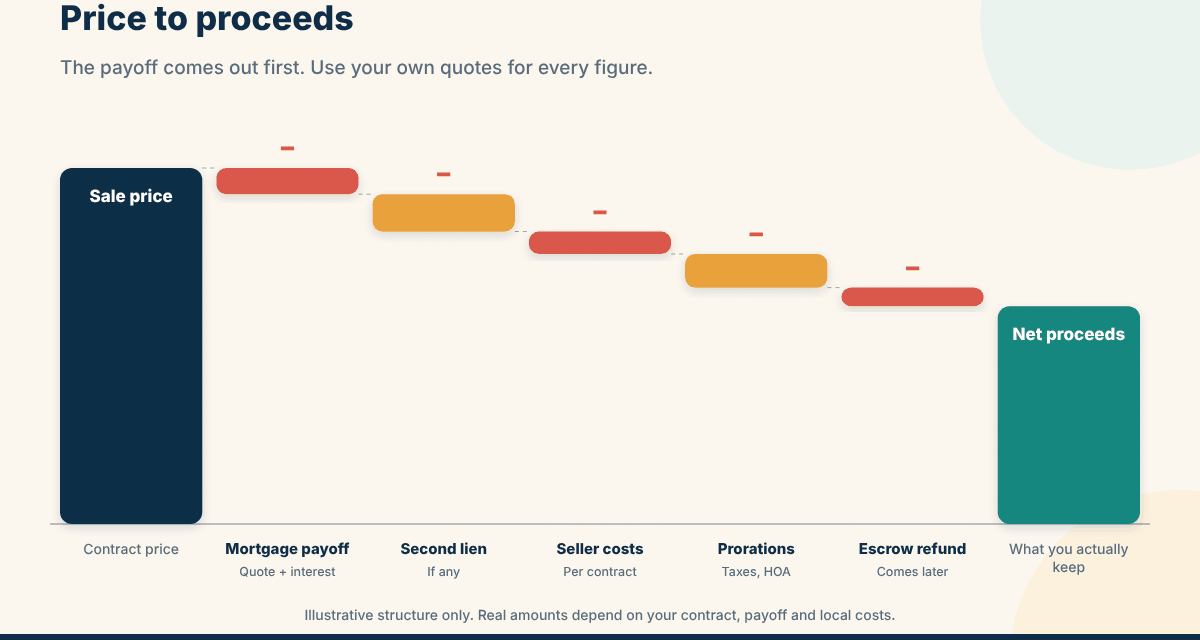
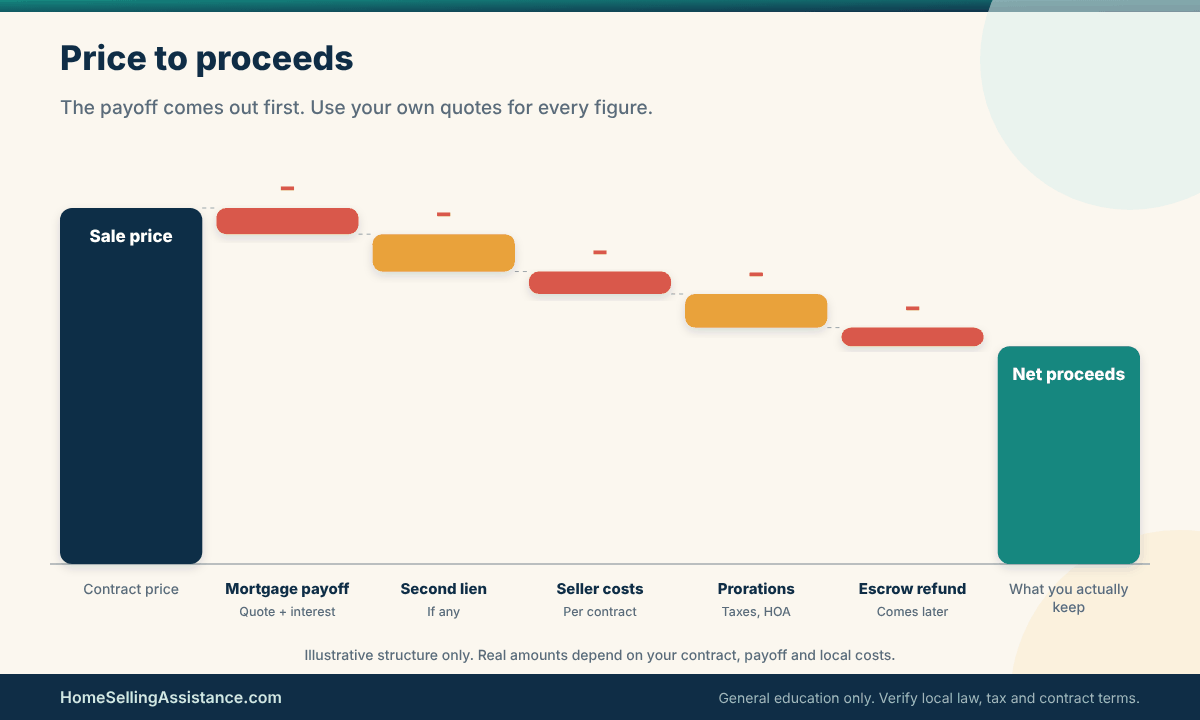
The last graphic compares the two numbers sellers confuse most often, the balance on a monthly statement and the figure on a payoff quote, so you can see at a glance why they differ.

Frequently asked questions about mortgage payoff when selling house
How is a payoff quote different from the balance on my monthly statement?
The statement balance is the unpaid principal as of the statement date. A payoff quote adds interest accrued through a specific good-through date, plus any fees the servicer charges to close the account. For that reason the quote is almost always a bit higher than the number on your bill, and it is only reliable until the date printed on it.
Who orders the mortgage payoff when selling house figure, me or the title company?
In many transactions the title or escrow company, or the closing attorney, requests it once the contract is signed, using an authorization from you. You can still request your own quote for comparison. Ask your closing agent in writing who is responsible so that nobody assumes someone else did it.
How much does one extra day cost?
Roughly the unpaid principal times the annual rate divided by 365, though servicers vary in the day-count method. With illustrative round numbers, a $240,000 balance at 6 percent costs about $39 a day. Your own quote should state the real per-day figure, so use that for planning a mortgage payoff when selling house timelines.
Do I have to keep paying while the house is under contract?
Yes, even during a mortgage payoff when selling house transaction, unless the loan is actually paid off. Missing a payment can add late charges, harm your credit and complicate the payoff. If a payment falls close to the closing date, ask the servicer or the title company whether it will be reflected in the quote.
What happens to my escrow account after a mortgage payoff when selling house closing?
The escrow balance is not part of the payoff. The servicer normally refunds what is left after the loan is closed, within a period set by federal servicing rules and any state requirements. Ask the servicer for the timing and a forwarding address policy, and do not plan to use that refund at closing.
Can a prepayment penalty apply when I sell?
Some older or specialized loans contain one, though they are uncommon on typical modern home loans. Check your note or ask the servicer directly. If one exists, it should appear on the payoff quote and on the settlement statement, so it will not come as a surprise if you check early.
What if I have a HELOC or second mortgage?
Each lien needs its own payoff, and a HELOC usually needs to be frozen and closed as part of the payoff, which may require a signed request. Your title search will show recorded liens, so share the results with your agent early. Without a second payoff, the buyer’s title insurer will not be able to clear the title.
What is a lien release and who records it?
It is the document stating that the loan has been paid and the lender no longer has a claim on the property. It may be called a satisfaction of mortgage, release of lien or reconveyance depending on the state. The lender or the title company records it, and the timeline is set by state law and lender procedure, so ask the title company how it works locally.
What if the payoff is more than the sale price?
That situation is often called being underwater, and the options depend on the lender, the contract and your state. They can include bringing cash to closing or asking the lender about a short sale, which is not guaranteed to be approved. Read our guide on selling an underwater house and speak with a housing counselor, an attorney or a HUD-approved counselor before deciding.
Can I trust an email that changes my payoff wire instructions?
Treat it as suspicious until verified. Call a number you looked up yourself, not one in the message, and confirm with the title company. If you think you have been targeted, contact the title company and your bank at once and report it to the FBI’s IC3 and the FTC.
A calm payoff is a prepared payoff
A mortgage payoff when selling house is mostly a matter of asking the right questions early: which lenders, which date, which figure, and who verifies it. Keep your quotes, check them against the settlement statement, confirm instructions by phone, and follow up on the release and escrow refund after closing. This article is general education, not legal, tax or financial advice. For decisions about your own loan, ask your servicer, your title company, your attorney or a qualified professional in your state.