The documents needed to sell house are rarely the glamorous part of a sale, yet they decide how smooth the next two months will feel: a seller who can hand over a clean deed copy, a current loan statement, a permit history and a folder of receipts spends the contract period answering easy questions, while a seller who cannot spends it hunting through email, calling the bank and apologizing to a buyer’s agent.
Most people picture the documents needed to sell house as something that happens at the closing table. In practice, the first documents are asked for long before that, sometimes within days of listing. Your agent, if you use one, needs the legal description to write the listing correctly. The buyer’s side wants to know what is owed on the property, whether anyone else has a claim to it, and what has been built, repaired or replaced over the years. The title company wants proof that the person signing is the person who owns the home.
This guide to the documents needed to sell house is a working list, not a lecture. It covers ownership papers, loan and payoff records, tax and association paperwork, permits, warranties, repair history and the legal documents that apply when a house is held in a trust, an estate or by two spouses. It also covers what to do when a document is simply gone, which happens more often than anyone admits. It sits inside our wider how to sell a house roadmap and goes one level deeper on the paper side of that process.
One honest caution before we start. Requirements differ by state, county, city and even by individual association. Disclosure forms, transfer certificates, smoke detector rules, point-of-sale inspections and recording practices are local. Use this article to build your list of documents needed to sell house and your questions, then confirm the local specifics with your state real estate commission, a title or escrow company, or a real estate attorney.
Key takeaways
- Start gathering early. The documents needed to sell house are easiest to collect while you still have time to request copies, and some records take days or weeks to arrive.
- Ownership and payoff come first. Among the documents needed to sell house, a deed copy, a recent loan statement and a written payoff request answer the two biggest questions: who can sell, and what must be paid at closing.
- Permits and receipts protect you. Within your documents needed to sell house, a tidy record of work done, with permits where they were required, prevents last-minute doubts about unpermitted changes.
- Missing paper is fixable. Most lost documents can be re-ordered from the county recorder, your lender, the title company or the installer, as long as you ask before you need them.
- Disclosure is its own track. State seller disclosure forms and the federal lead-paint rule for older homes are not optional extras, and the rules vary by location.
- Keep the file afterward. Your closing papers and improvement records support future tax questions, so store them for the long term.

Build the file of documents needed to sell house before the sign goes up
Think of the documents needed to sell house as a single folder, paper or digital, that you could hand to a stranger and have them understand your property. Everything in this first section is about assembling the documents needed to sell house into that folder and noticing what is not in it yet. We keep it separate from the broader seller checklist before listing because paperwork has its own lead times, and they are longer than most sellers expect.
Two habits make collecting the documents needed to sell house faster. First, scan or photograph everything as soon as you find it and name the files plainly, such as “2019-roof-invoice” or “county-tax-bill-latest.” Second, keep a simple running list of what you still need and who you asked. That list becomes your memory when the weeks get busy.
The paper, the numbers, and the people behind each document
Every one of the documents needed to sell house has three parts: the document itself, a number or fact inside it that matters, and a person or office that can replace it. Sellers who write down all three move quickly. Sellers who only collect the paper often discover they cannot read a loan number off a photocopy or cannot remember who handled the roof job.
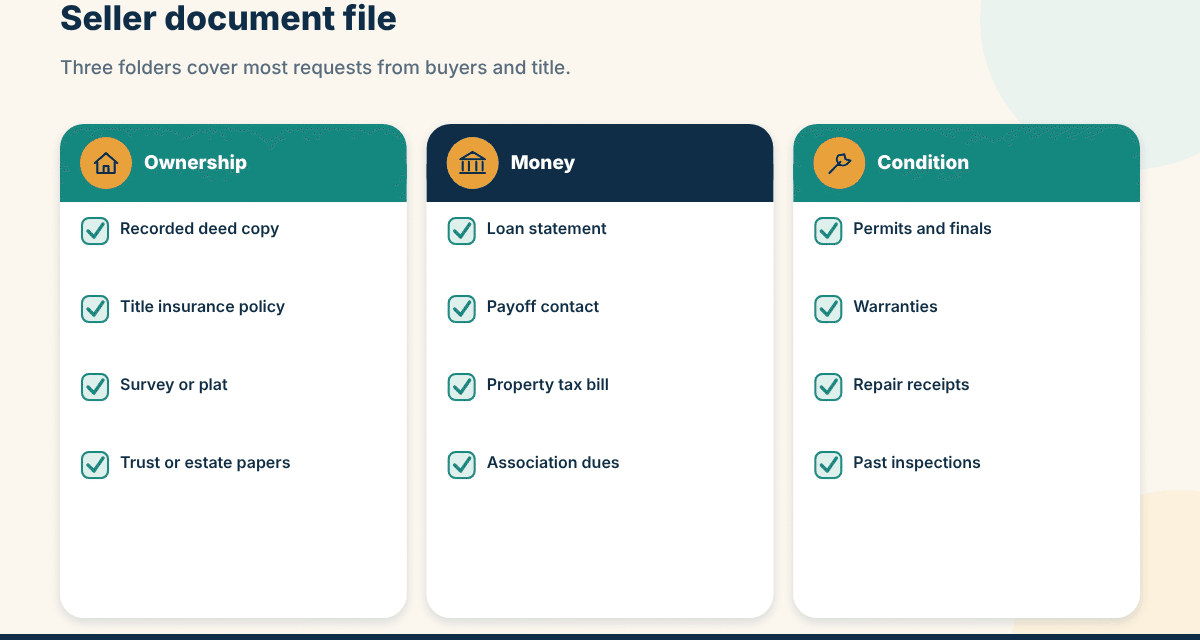
Here is the core set of documents needed to sell house that most sellers should plan for, adjusted for the property. Ownership: the recorded deed or a copy of it, any owner’s title insurance policy from your own purchase, a survey or plat if you have one, and your property’s legal description. Loan: a recent mortgage statement, the lender’s customer service contact, and a written payoff statement requested later in the process. Taxes and fees: the latest property tax bill and any association statements.
Where each document comes from and what it proves
The deed shows how title is held, such as one owner, two owners, a trust or an entity. If you have lost your copy, the county recorder or register of deeds can usually provide a copy of the recorded deed, often for a modest copying fee that varies by county. Many counties have online search, though some still require a request by mail or in person. Your closing package from the day you bought, if you kept it, often has the deed, the settlement statement and the title policy together.
The title policy is a different thing. It is an insurance contract that lists exceptions, such as easements, and it tells a new title company what to look for. It does not prove current ownership by itself. For that you want the deed and, later, a fresh title search. Our guide to the seller title search explains what that search usually turns up and why surprises are common with older homes.
A survey shows boundaries, fences, driveways and sometimes encroachments. Not every seller has one, and not every state expects one. If you have it, keep it. If you do not, ask a title company whether an existing survey exists on file before you consider paying for a new one.
The mortgage statement shows the lender, the loan number, the approximate balance and whether the account is current. It is not a payoff figure, because a payoff includes interest through a specific date and any fees. Treat the statement as a starting point only, and request the real payoff in writing when you have a contract and an expected closing date.
A seller who had the paperwork and one who did not
Picture two neighbors on the same street, each gathering the documents needed to sell house, both selling in the same month. The first, Dana, spent a Saturday pulling the deed, scanning her last tax bill, collecting the roof invoice and the transferable warranty paperwork, and writing the lender’s phone number on a sticky note. When her buyer’s agent asked about the age of the water heater and whether the sunroom was permitted, she answered both in one email.
The second, Marcus, planned to “find everything when we need it.” The buyer asked about the sunroom permit in the first week. Marcus did not know whether one had been pulled by the previous owner, so he called the city building department, waited several days for a callback, and spent part of the inspection period uncertain. His sale may well have closed fine, but he gave the buyer time to feel uneasy.
Neither story is a prediction. It simply shows that the same house can feel very different to a buyer depending on how quickly the questions get answered. Having the documents needed to sell house ready does not guarantee a faster closing, and the contract, lender and title work still set the pace, but it removes the avoidable delays that were entirely in your hands.
The table below turns that logic into a seller workflow. Read it by stage: find the row that matches where you are, see what to gather, take the action, note the deadline that really matters, and then identify who receives your work next.
| Stage or symptom | Information to gather | Action | Decision deadline | Next handoff |
|---|---|---|---|---|
| Thinking about selling | Deed copy, loan statement, tax bill | Scan and name each file | Before you interview agents | Agent or attorney |
| Cannot find the deed | Address, parcel number, purchase year | Request a copy from the county recorder | Before the listing is written | Title or escrow company |
| Unsure about past work | Invoices, permits, contractor names | Search permit portal and call installers | Before photos and disclosure forms | Listing agent |
| Older home built before 1978 | Known paint history, past reports | Prepare federal lead-paint disclosure materials | Before the contract is signed | Agent and buyer |
| Community with an association | Rules, dues, assessments, contacts | Request association documents | Right after listing | Management company and title |
| Contract accepted | Written payoff request, final records | Send payoff authorization to lender | Per contract timelines | Title company |
Information still missing from your documents needed to sell house
Once the obvious folders are in order, a second layer of questions appears. These are the facts that do not sit in a single document: why the basement has a sump pump, whether a neighbor shares the driveway by agreement, what the previous owner told you about the fence line. Buyers care about all of it, and so does your disclosure form.
Missing information is different from missing paper. A lost invoice can be replaced, but a forgotten detail has to be reconstructed from memory, photos and the people who were there. Treat this stage as detective work, and keep your tone plain and factual. The goal is not a perfect history, only an honest one.
Almost every seller finds a gap in the documents needed to sell house. The deed is in a safe-deposit box in another state, the warranty card was thrown out, the contractor retired, or the home was inherited and no one knows what was done to it. A gap is not a crisis if you find it early. It becomes one when you find it on day three of a ten-day contract deadline.
The useful question is never “do I have this?” but “if I do not, who can give me a copy, and how long will it take?” Sort your gaps into three groups: things you can retrieve yourself today, things that require another office and some waiting, and things that cannot be recovered at all and need a written explanation instead.
For the documents needed to sell house, ownership and recording gaps go to the county recorder or register of deeds. Loan gaps go to the servicer, whose customer service number is printed on every billing statement. Tax gaps go to the county assessor or tax collector, and many publish bills online. Title policy gaps go to the title company that issued it, which can often locate old files by property address and approximate date.
For improvements, start with the contractor and the manufacturer. Many roofing, window and HVAC companies keep job records for years and can reissue an invoice or warranty certificate. Permit history usually lives with the city or county building department, and some jurisdictions offer a searchable online portal. If the work is older than the portal, a records request may be needed.
Association documents come from the HOA or its management company, and the seller usually requests them, sometimes for a fee that varies by association and state. Because those can take time, our note on HOA resale fees and paperwork is worth reading if you live in a community with dues.
When you request anything, keep a short written trail. A date, a name and a confirmation email are enough. If a record truly cannot be found, write a brief factual note saying so, rather than guessing at details you do not remember.
Suppose you inherited a house, and the previous owner’s papers are a shoebox of mixed envelopes. You do not know if the roof was replaced, you cannot find the deed, and some utility bills are in a name you do not recognize. The useful next step is not to search the shoebox for hours. Start with the county recorder for the deed, then ask whoever is handling the estate which legal papers prove authority to sell.
The exception to watch for is a document that exists but contradicts what you believed. A permit that was opened and never finalized, a lien filed by a contractor, or a deed that lists an owner you thought was removed years ago are all examples. When you find one, do not hide it and do not try to solve it alone. Share it with your agent or attorney and the title company so a plan exists before a buyer discovers it.
The next step in every case is the same: write the gap on your list, name the person who can fill it, and set a date to follow up. That tiny habit prevents more delays than any clever trick.
Evidence to gather: facts the paper does not capture
Because the documents needed to sell house never tell the whole story, walk the house and the lot with a notebook, one room at a time. Write down every appliance and system with its approximate age, who installed it and whether you know of a warranty. Write down every repair you remember, even small ones, and every moisture, pest or settling issue you have seen. Your future disclosure form will ask about many of these, and doing the walk now means you answer from notes rather than from pressure.
Use the photos on your phone. Pictures with dates attached can confirm when a deck was built, when a kitchen was updated or what a basement looked like before a repair. Email threads with contractors are another good source. Search your inbox for the word “invoice,” a contractor’s name or the word “warranty,” and you may find in two minutes what hours of searching a drawer would not.
Ask long-time neighbors only about objective facts, such as who maintains a shared drive or when a street was repaved. Do not ask about the neighborhood’s people, and do not repeat comments about who lives nearby. Fair housing rules apply to how homes are marketed and described, and you can read the basics from HUD’s fair housing office.
Finally, check your own insurance history. Past claims for water, fire or storm damage often matter to a buyer’s insurer, and you may be asked about them. Your insurance company or agent can tell you what is on record for the property, and you may also be able to request a claims history report on the home in your own name.
A scenario, an exception, and your next step
Say that while you collect the documents needed to sell house you remember the finished basement flooded once, years ago, and a contractor fixed the drain. You have no invoice and the contractor is gone. You could leave it out and hope it never comes up, but that is the wrong instinct. A buyer’s inspector may find staining, and a hidden story that surfaces later can sour trust and invite disputes.
A better plan is to write down what happened, when, who fixed it as best you remember, and what has happened since. Share that with your agent or attorney and ask how it should appear on your state’s disclosure form. Disclosure standards differ widely, and our overview of seller disclosure requirements explains the general logic without pretending one rule fits every state.
The exception is information you honestly do not know. In that case, say so rather than guessing. “Unknown” is acceptable on many forms, while a confident wrong answer is the more dangerous choice. Your next step is a short, dated memo of what you know, stored with the rest of the file.
Move through the sale in order, with paper ready at each handoff
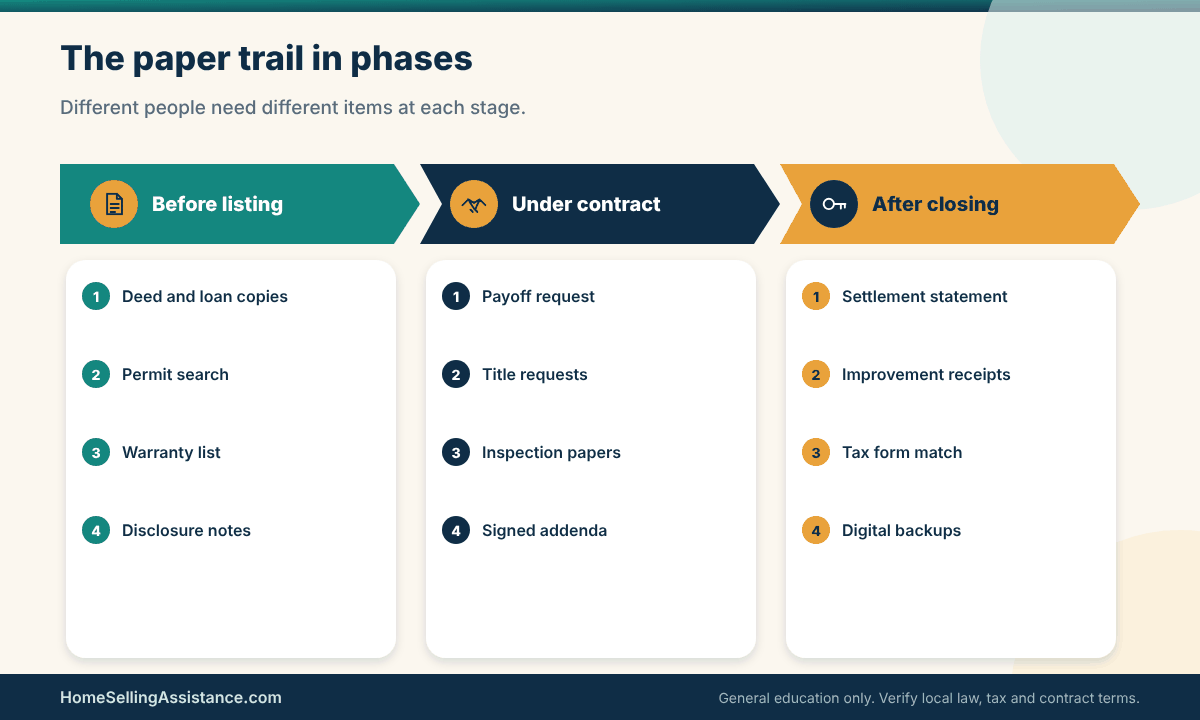
A sale has a rhythm. The documents needed to sell house are wanted at different moments, by different people, and in a roughly predictable order. If you know the order, you can stay one step ahead and avoid the sinking feeling of receiving a request you did not see coming. This section follows the paperwork from the first conversation with an agent or attorney to the moment a buyer’s lender and the title company start asking for their own items.
Our home selling timeline lays out the calendar side of the same story. Here we focus only on which papers belong at which step and what decisions hang on them.

Early action and decision points before the first showing
The weeks before listing are the cheapest time to make decisions, because nothing is under a deadline yet. The documents needed to sell house help you make those decisions with facts instead of hunches. They tell you whether you can sell on your own schedule, whether something must be fixed or disclosed first, and whether anyone else needs to sign.
Three decisions deserve to be made with paper in hand. The first is who has authority to sell. The second is what you owe and what you might net. The third is whether anything about the home’s history needs professional advice before a buyer sees it. All three become easier when the file is current.
Evidence to gather: authority, payoff and a first look at your net
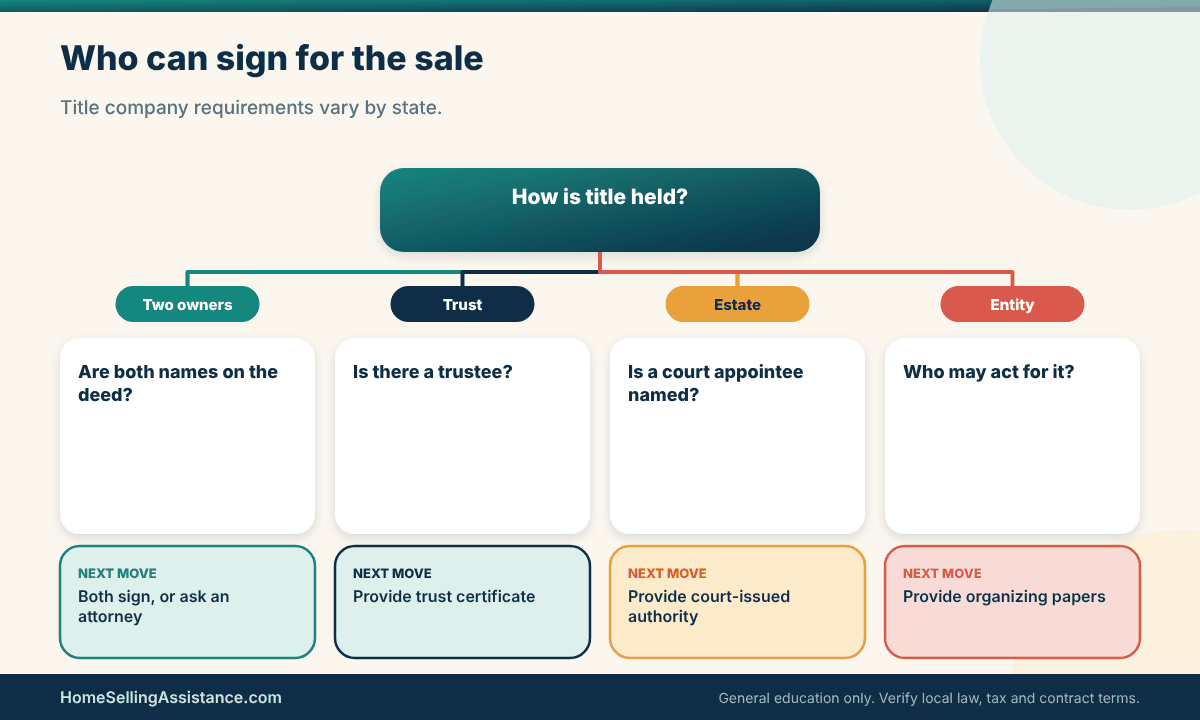
Among the documents needed to sell house, authority is about names. If the deed lists two owners, both normally need to sign, even if one has moved out. If the home is in a trust, the trustee signs, and the title company will usually ask for a trust certificate or a similar summary. If an estate owns the home, a court-appointed representative generally signs, and the proof is issued by the court. Entity owners, such as an LLC, need organizational papers and proof of who may act for the company.
A power of attorney can also let someone sign for an owner, but title companies tend to review those closely, and some require specific wording or recording. If an owner is unable to attend closing because of travel or illness, raise that early with the title or escrow company, since arranging a proper signing can take time.
For money, gather your latest loan statement, any home equity line statement, and any other debt secured by the property, such as a second mortgage or a solar financing agreement. Our guide to mortgage payoff when selling a house explains why the payoff amount differs from the statement balance. Then do a rough net estimate using clearly labelled assumptions. For example, an illustrative round sale price of $400,000 with a $250,000 payoff leaves $150,000 before fees, credits and prorations, which are still unknown. The numbers are only an example, but the method keeps you honest.
If you have used any federal or state program tied to the property, such as certain assistance or deed-restricted purchase programs, bring the paperwork. Restrictions can limit resale price or require notice to an agency, and they are often recorded against the title.
A scenario, an exception, and your next step
Imagine a couple gathering the documents needed to sell house who bought together, and one partner has since moved out. The remaining partner assumes they can list the home alone because the mortgage statements come to them. The deed, however, names both. Without both signatures, or a legal document that changes the situation, the title company will not be able to close.
The exception is when circumstances such as a divorce, a death or an incapacity change who can sign. Those situations have their own legal paperwork, and the rules are strict and local. If one of them applies, a real estate attorney is usually the right first call, and our pages on divorce and co-owned homes and inherited homes and probate cover the broader picture.
Your next step, in nearly every case, is to compare the names on the deed to the names of everyone who expects to sign, and to resolve any mismatch before you list. It is a ten-minute check that can save a failed closing.
Handoffs, negotiations and contingencies in the documents needed to sell house
After you accept an offer, the documents needed to sell house multiply. The signed contract goes to the title or escrow company. The buyer’s lender orders an appraisal and reviews the file. The inspector writes a report. Each party asks you for something, usually through your agent or the title company. Our walkthrough of what happens after you accept an offer covers the whole sequence, and here we only trace the documents needed to sell house.
The key idea is that every handoff has an owner. If you know who is waiting on you, and what they need, nothing sits in an inbox for a week. A simple list with the requester, the item, the date asked and the date sent is enough.
Evidence to gather: what each party will ask you for
The title or escrow company typically asks for your identification, your loan information, a payoff authorization, association contacts and forwarding address, and sometimes a signed affidavit about unpaid work or unknown claims. The details vary by state, and the closer you stay to their checklist, the quicker the file moves.
The buyer’s agent may ask for your seller disclosure form, utility cost history, warranty transfer details and permit information. Offer the documents needed to sell house that you hold in a single organized email instead of in pieces. Pieces cause repeated follow-up, and repeated follow-up wastes inspection days.
The buyer’s lender does not usually deal with you directly, but its appraiser may ask for access and for information about recent improvements. If you replaced a roof or finished a basement, an invoice and permit can help the appraiser understand what changed, though the appraiser’s conclusion remains independent and no document guarantees a particular value.
Inspection and repair negotiations generate their own paper: the inspection report, a repair request, your response and any amendment to the contract. Everything that changes the deal should be in writing and signed by the right people. A friendly phone call is not a contract change. For more on the contract side, our cornerstone guide to home sale contingencies shows how those deadlines interact.
A scenario, an exception, and your next step
Consider a buyer who requests proof that a finished attic was built with a permit. You have no permit. The inspector noted the attic during the walkthrough, and the buyer’s agent now asks how you want to proceed. This is a decision point, and the options differ by place: some sellers disclose and sell as-is, some offer a credit, some explore retroactive permitting, and some decide it is not worth the cost. Which option makes sense depends on local rules, cost, time and the buyer’s reaction.
The exception is when the problem is serious enough that a lender or insurer may refuse to proceed. Our article on selling a house with unpermitted work goes through the common paths without promising an outcome.
Your next step is to ask your agent or attorney what is typical in your county, write down the choice you make, and document the agreement through a signed addendum. A calm, written response beats an improvised one every time.
The second table is a transaction check. Use it when an issue with the documents needed to sell house appears: find the issue, see what evidence you should already be holding, note who else supplies input, understand the risk of ignoring it, and look at the fallback if the evidence is weak.
| Issue | Seller evidence | Buyer, agent or title input | Risk | Fallback |
|---|---|---|---|---|
| Name mismatch on the deed | Deed copy, marriage or name-change records | Title company review | Closing delayed | Corrective document or attorney advice |
| Payoff differs from statement | Written payoff letter with per-diem interest | Title company confirms figure | Net proceeds shrink | Update your estimate before final figures |
| Unpermitted work | Permit search results, contractor records | Buyer’s inspector and lender questions | Renegotiation or lender hesitation | Disclosure, credit or retroactive permit |
| Missing warranty paper | Installer invoice, serial numbers | Buyer asks about transfer rules | Buyer loses confidence | Say what is unknown, offer manufacturer contact |
| Open lien or judgment | Release documents, payoff letters | Title search results | Title cannot clear | Pay at closing or resolve beforehand |
| Association paperwork late | Request confirmation and date | Buyer reviews resale package | Review period issues | Escalate to management, ask for extension in writing |
If you find yourself in the right-hand columns often, take that as a sign to start earlier next time, or to ask for help from a professional. None of the fallbacks are guaranteed to work, and the right one depends on your contract, your lender and your location.
Close the loop on the documents needed to sell house and keep the records
The last part of a sale, when the documents needed to sell house turn into signatures, is where careless sellers lose money and careful ones simply check things off. It includes confirming in writing what was agreed, reviewing the final settlement figures, and then keeping a clean set of records for years afterward. The sale is not really finished until your own set of documents needed to sell house is filed away.
This section is shorter in time but heavier in consequence. The signatures you give at closing are binding, and the numbers on the settlement statement decide what you receive. Read it all, and ask questions before you sign rather than after.

What to confirm in writing before you sign
Verbal promises are fragile. Anything that matters, such as a repair credit, a move-out date, a rent-back arrangement, a personal property item that stays or goes, or a warranty transfer, should appear in the contract or a signed addendum. If a buyer says “we will work it out,” ask for it to be written down.
Confirmation in writing also includes the settlement figures that rest on your documents needed to sell house. Your title or escrow company should provide a draft of the seller’s side of the closing statement before closing. Compare it to your contract and your payoff letter. Our article on the seller closing statement explains how to read each line, and its companion on home sale net proceeds helps you check the bottom line.
Evidence to gather: the final paper trail
Start with the contract and every amendment, since they sit at the top of your documents needed to sell house. Confirm the sale price, closing date, possession terms, items included or excluded and any credits. Then compare your lender’s final payoff letter with the amount on the draft settlement statement. If they differ, ask the title company to explain it, since small differences can come from per-day interest or fees that were added after your first quote.
Check property tax and association prorations. These are shares of bills split between you and the buyer based on closing date, and they follow local custom and contract wording. You do not need to calculate them yourself, but you should ask how they were figured and whether the figures use the correct bill.
If you have repair credits, make sure they are shown correctly, and that any receipts the buyer needed to see were delivered. If you agreed to complete repairs before closing, confirm that you have invoices and, where needed, permit sign-offs. Missing proof can turn a straightforward credit into an argument at the table.
Finally, confirm wire and payment instructions through a channel you already trust. Wire fraud targets sellers as well as buyers, and fraudulent emails often copy real title company names. Verify any change in instructions by calling a number you found independently. Our guide to home sale fraud and seller safety goes through the warning signs, and you can report suspected wire fraud through the FBI’s Internet Crime Complaint Center.
A scenario, an exception, and your next step
Imagine you receive an email, apparently from the title company, saying the proceeds wire details have changed and asking you to reply with your bank information. The signature looks right and the logo is correct. That is exactly how these scams look. The safe move is to stop, call the title company at a phone number from your contract or from their official website, and confirm.
The exception is a legitimate change, such as a new account or a rescheduled closing. Real changes can be confirmed by phone in a minute, and a real company will not mind the call. If anyone pressures you to hurry, that pressure itself is a signal.
Your next step is simple: before closing, write down the title company’s direct phone number from a reliable source and agree with them how you will exchange sensitive details. Treat anything that deviates from that plan as suspicious until proven otherwise.
Records and follow-up after closing
After closing, the temptation is to shred everything and celebrate. Resist for a while. Your final settlement statement, the deed you delivered, your original purchase records and your improvement receipts may matter later, especially for tax reporting. The settlement agent usually reports the sale to the IRS, and you may receive a form about it, so your numbers should match what you kept.
You should also close open accounts and notices. Utilities, insurance, association accounts, mail forwarding and any home-related subscriptions should be handled in a planned order. A short after-closing list prevents surprise bills and lets you hand over a clean property.
Evidence to gather: what to keep and for how long
Keep these documents needed to sell house after closing: the signed purchase contract and addenda, the final seller settlement statement, the recorded deed or a copy, payoff confirmation from your lender, and proof of any repairs or credits. Also keep records from when you bought the home and receipts for major improvements, since those can affect your tax calculation. The IRS explains the details of selling a main home in Publication 523, and how basis works in Publication 551.
A well-known federal rule is worth knowing in general terms: a seller who owned and used a home as a main residence for at least two of the five years before sale may qualify to exclude up to $250,000 of gain, or up to $500,000 for certain joint filers, subject to the IRS’s conditions. Whether you qualify depends on your facts, so treat this as a pointer to the publication and to a tax professional, not as a conclusion. Our overview of taxes when selling a home covers the broader landscape.
How long to keep records is a question for your tax adviser, but many people keep home purchase and sale records for as long as they own the home plus several years after reporting the sale. When in doubt, keep them longer. Digital copies in two places, such as a cloud folder and an external drive, cost almost nothing.
A scenario, an exception, and your next step
Suppose you sold your house four years ago and kept few of the documents needed to sell house and now a letter arrives asking about the gain you reported. You remember replacing a kitchen and a deck, but you threw away the receipts. Reconstructing costs from bank records, card statements and old contractor emails is possible, but it is slower and less convincing than having original invoices.
The exception is when you rented part of the home or used it for business, which can change both the paperwork and the tax treatment. The IRS explains rental use in Publication 527, and a tax professional can say how it applies to you.
Your next step today, even if you are only thinking about the documents needed to sell house, is to create a permanent folder called something like “Home sale records” and put the closing papers there the moment you receive them. Future you will be grateful.
Quick scenario
A seller in a townhouse community with half of the documents needed to sell house ready lists on a Thursday. By Saturday, a buyer’s agent asks for the association’s rules, the current dues and any planned special assessments. The seller has the dues from a statement but has never requested the full resale package. Because the seller asked the management company on Friday, the package arrives within the buyer’s review window. A seller who waited for the contract to ask might have faced the same request with the clock already running.
A final habit is worth building before you close this chapter of the sale: read your documents needed to sell house once, as if you were the buyer. Where would you have questions? Which item feels thin? That fifteen-minute read often finds the one gap you missed, and it is far cheaper to fix on a quiet weekday than during an inspection period.
It also helps to keep a clear line between what you gather and what you decide. Gathering the documents needed to sell house is clerical and you can do it yourself. Deciding what to disclose, whether to pull a retroactive permit or how to handle a lien is where professional advice matters. Our full sale roadmap shows where those decision points fall, and the selling process and timeline category collects the related guides.
Frequently asked questions about documents needed to sell house
What are the main documents needed to sell house in most states?
Most sellers need proof of ownership, such as a deed copy, a recent mortgage statement, the latest property tax bill, any association paperwork and their state’s seller disclosure form where one is required. Many also add permit records, warranties, repair receipts and past inspection reports. The exact list depends on your state, county and property type, so confirm it with a title company or real estate attorney.
Do I need the original deed to sell my home?
Usually not. The title company works from the recorded deed and a fresh title search, and you can order a copy from the county recorder if yours is lost. What matters is that the public record shows you as the owner and that your name matches your identification. If anything looks off, such as a misspelled name, mention it early.
How early should I start collecting the documents needed to sell house?
As early as you can, ideally before you interview agents or take photos. Some records, such as association packages or permit histories, can take days or longer to arrive. Starting early also gives you time to notice gaps and decide how to handle them without a contract deadline pressing on you.
What if I cannot find my title insurance policy?
The title company that handled your purchase can often locate a copy, and your old closing package may include it. A new title search will be done anyway for the buyer, so a missing policy rarely blocks a sale. It is still useful to have, because it lists exceptions the earlier company noticed.
Do I need permits for past renovations, and what if there are none?
Permit rules differ widely by city and county, and some small projects need none at all. If work that normally requires a permit has none on record, talk to your agent or attorney about how to disclose it and whether retroactive permitting is realistic. Avoid assuming that silence is safe, since inspectors and appraisers sometimes notice.
Is the lead-based paint disclosure required for every house?
The federal rule applies to most housing built before 1978, and sellers must give buyers certain information and a federal pamphlet before the contract binds them. The EPA’s real estate disclosure page describes the requirements, and our note on lead paint disclosure for sellers adds practical context. Newer homes are generally outside this rule, though state forms may still ask related questions.
Which documents does a trust or estate need to provide?
A trustee typically provides a trust certificate or similar summary, and an estate representative provides court-issued authority. Requirements vary by state and by title company. Ask the title or escrow officer for their specific list as soon as you decide to sell, because estate and trust paperwork can take longer to prepare than ordinary seller documents.
Should I request a payoff statement before I list?
You can contact your lender to understand the process, but the official payoff letter is usually requested after you have a contract and a likely closing date. Payoff figures include interest through a particular day and can change if closing moves. Until then, use your latest statement as a rough estimate and label it as such.
What records should I keep after the sale?
Keep the final settlement statement, the contract and addenda, your original purchase records and receipts for major improvements. Among your documents needed to sell house, these support tax reporting and help answer questions that may come up years later. Many sellers store digital copies in two places, and a tax professional can say how long to keep them in your situation.
Can a missing document stop my closing?
It can, if it is something the title company or lender must have, such as proof of authority to sign or release of a lien. Most missing items, such as a warranty card or old invoice, simply need an honest explanation. The practical way to protect your closing is to ask the title company early which items are truly required.
Before you list
A complete set of documents needed to sell house will not make a buyer appear, and it cannot promise a price or a closing date. What it does is take avoidable stress out of the sale and keep you in control of the questions that matter. Start with the deed, the loan and the permits, write down what is missing, and ask early for what you cannot find. This article is general education, not legal, tax or financial advice, so check local rules with your state real estate commission, a title company or an attorney before you act.