Few family conversations get tense faster than the moment one heir wants to sell inherited house property while a brother, sister or cousin wants to keep it. The house is rarely just a house. It holds holidays, a parent’s handwriting on the pantry shelf, and an unspoken question about who gets to decide what happens to all of it.
This article is for the heir who wants out, and equally for the heir who wants to stay. We will look at who actually has the legal power to sign a deed, what the realistic exits are (a buyout, a negotiated sale, mediation, or a court-ordered partition), and how each choice changes the paperwork a title company will ask to see. We will keep the focus on process rather than on taking sides.
A word of honesty up front. The rules that decide these disputes are state law, and they differ in ways that matter.
Whether the house passes through probate, whether an executor can sell without every heir agreeing, and how a court divides a co-owned property all depend on where the property sits and on what the will, trust or deed says. Nothing here replaces a conversation with a local probate or real estate attorney. What it can do is help you walk into that conversation prepared.
If you want the broader picture of how an estate house gets sold, our guide to selling an inherited house covers the full path. Our guide to multiple heirs selling an inherited house and our overview of the inherited homes and probate library give more background. Here we stay narrow: a disagreement among people who share an inheritance, and the practical ways to resolve it without wrecking the family or the value of the property.
Key takeaways
- Ownership comes first. Before anyone argues about selling, find out who legally holds title today: the estate, a trust, or the heirs themselves.
- One heir rarely has a veto, and rarely has a trump card. Whether a single heir can force or block a sale depends on state law and on the controlling document.
- Buyouts are the quietest exit. An appraisal, a written price and a clear financing plan can settle things without a courtroom.
- Mediation is cheaper than a lawsuit. A neutral facilitator often reveals that the real fight is about fairness or grief, not price.
- Partition is the backstop. A court can order a property sold or divided, but it is slower, costlier and less predictable than an agreement.
- Verify before you sign. Recorded documents, court orders and current title status matter more than anyone’s memory of what Mom wanted.
Before we get into mechanics, notice that these disputes usually come in two flavors. In the first, everyone agrees the house is a financial asset, and the argument is about price, timing or who does the work.
In the second, at least one person is attached to the home and the argument is really about loss. The tools are the same, but the tone you use to approach each one is different, and picking the wrong tone is the most common way a solvable disagreement turns into an expensive one.
Sort out ownership first when one heir wants to sell inherited house property
When one heir wants to sell inherited house assets and another objects, the first useful question is not “who is right?” It is “who is legally able to do what?” Many families skip this step and argue for months about a sale nobody has the power to complete, or the reverse, a refusal that has no legal force. The next two sections take the ownership question apart so you can see where you stand.
Who holds title today and which document controls the decision
A house can be held in several different ways after a death, and each one changes who needs to sign. Title might still be in the deceased person’s name with no probate opened.
It might be held by an estate with a court-appointed personal representative. It might sit in a living trust with a named successor trustee.
It might even have passed automatically to a surviving co-owner or to a named beneficiary under a transfer-on-death arrangement. These are very different situations, and heirs often assume the wrong one. In short, the legal answer to “can we sell?” changes with each ownership form, so check the form before debating whether one heir wants to sell inherited house property for good reasons.
Evidence to gather: the deed, the will or trust, and the court record
Start with paper you can verify. Pull the current recorded deed from the county recorder or land records office, many of which offer online search. The deed shows whose name is on title and whether any transfer-on-death or survivorship language was recorded. Next, locate the will or trust instrument. If a probate case exists, the court clerk can tell you the case number and whether a personal representative has been appointed and received letters of authority.
Ask for copies instead of summaries. A sibling’s description of the will is not evidence, and a title company will want certified or recorded copies anyway. If a trust holds the house, you may need a certification of trust, which is a short document confirming who the trustee is and what powers they hold without revealing the whole trust.
Keep a simple folder with the deed, the death certificate, the will or trust, and any court letters. That folder will answer more arguments than any family meeting. Agreement on facts is the first win whenever one heir wants to sell inherited house and a relative disagrees. Heirs who keep that folder tidy tend to resolve a case where one heir wants to sell inherited house far faster than those who rely on memory.
It also helps to write down the dates. When did the owner die? When was probate opened, if at all? When was the personal representative appointed? Those dates frequently explain why a sale that “should have been possible” has not been, and they matter for deadlines that some states attach to claims against an estate and to the timing of distributions. These dates often explain why a sale stalled even though one heir wants to sell inherited house and everyone else seemed willing.
A scenario, an exception, and your next step
Imagine three adult siblings who inherit a house under a will that leaves everything equally. One sibling, Dana, wants to sell now. Another, Marcus, wants to keep it as a family place.
The third has not weighed in. Dana’s first instinct is to call a listing agent. But if probate is open and an executor has been appointed, Dana is not the person who can sign a listing agreement for the estate. The executor is, and our piece on an executor selling a house explains why, and the executor has duties to all three siblings, not just the one pushing hardest.
An exception worth knowing: if no probate was ever opened and the house passed by a recorded transfer-on-death deed or a trust, the situation changes again. The beneficiaries or successor trustee may be able to act without a court. Dana’s next step is simple and non-confrontational: confirm in writing, with documents, who currently holds title and who holds authority to sell.
Share that summary with everyone. It lowers the temperature because it replaces opinions with facts. None of this makes the dispute disappear, but it does show the family how the law frames a situation where one heir wants to sell inherited house.
What federal, state and local rules actually decide
There is very little federal law that decides who gets to sell an inherited house. Federal rules show up around the edges: tax treatment of the sale, lead-paint disclosure for older homes, and fair housing rules that apply to how the property is marketed. The question of authority, who must agree, and how a court resolves disagreement is almost entirely a matter of state law and, in some places, local court practice.
Evidence to gather: the state statute, local court rules and practice
To find what governs your situation, look in the state where the house is located, not where the heirs live. Most states publish their probate code and their rules on co-ownership online.
Many probate courts also post self-help pages that explain, in plain language, how estates are opened, what a personal representative can do, and whether court approval is needed to sell real estate. A state bar association lawyer referral service can connect you with an attorney who handles this regularly. Whether one heir wants to sell inherited house and others resist, the same state-by-state lookup applies, so do it before anything else.
Pay attention to terms of art, because they change from state to state. Some places call the person in charge an executor, others a personal representative or administrator. Some states let a representative sell without court approval when the will grants that power, while others require notice to heirs or a hearing, especially if any heir objects.
The point is not to memorize the rules. It is to know which questions to bring to a local professional. A case in which one heir wants to sell inherited house can look quite different across state lines because the vocabulary and the procedure both change.
On the federal side, the IRS explains how inherited property is treated for tax purposes in IRS Publication 559, which covers survivors, executors and administrators. It does not tell you who may sell, but it helps you understand why timing and records matter once a sale happens.
A scenario, an exception, and your next step
Consider a house that sits in one state while all the heirs live in another. A sibling reads an online article about “how partition works” and assumes the rules from their own state apply.
They do not. The law of the state where the real estate is located controls, and an out-of-state judge or lawyer may not be much help with the details. The same confusion arises whenever one heir wants to sell inherited house and relatives live far apart from each other and from the property.
The exception is when a trust or other document names a particular process, such as requiring mediation before any lawsuit or specifying how a buyout price is set. Those private rules often matter more than the general statute, as long as they are valid under state law. Your next step is to ask a local attorney two questions.
First, who has authority over this property right now? Second, what does the document or the statute say happens if the heirs disagree? Write the answers down and send them to the whole group.
Before we move on, it helps to see the ownership questions side by side. The matrix below lists the issues that tend to come up when one heir wants to sell inherited house assets and others hesitate.
For each issue it names the document or authority that usually controls, what the sellers can choose or must do, any typical timing concern, and where to verify the answer locally. Treat it as a map of questions, not a set of answers, because every state fills in the details differently.
| Issue | Controlling document or authority | Choice or obligation | Typical timing concern | Where to verify locally |
|---|---|---|---|---|
| Who can sign a listing or sale contract | Letters of authority, trust certification, or recorded deed | Authority holder signs; heirs may need to consent | Before listing | Probate court clerk, county recorder |
| Whether every heir must agree | Will, trust terms, state probate statute | Depends on whether the estate or the heirs hold title | Before accepting an offer | Local probate attorney |
| Court approval of a sale | State probate code and local court rules | Seek approval or notice if required | Often adds weeks or months | Court self-help center |
| Buyout of one heir’s share | Written agreement between heirs | Agree on price, funding, closing date | Set a firm funding deadline | Attorney, title company |
| Forced sale by one co-owner | State partition law | File a partition action if talks fail | Court calendar controls | State statutes, civil court clerk |
| Debts, liens and mortgage | Payoff letters, title search | Pay from proceeds or settle first | Before closing | Title company, lender |
| Tax reporting of the sale | Federal and state tax rules, basis records | Gather date-of-death value evidence | Before filing | Tax professional, IRS publications |
Use the matrix as a conversation starter. Print it, write the real answers next to each row, and note who is responsible for finding each one. A shared page like that often settles half the arguments, because most of them begin with someone assuming a rule that does not exist. Families facing a case where one heir wants to sell inherited house often find that filling in this matrix together cools the room.
Notice how many rows lead back to a recorded or court document. That is not an accident. In estate property, the paperwork is the power. Feelings about what a parent would have wanted matter a great deal to families, but they do not move title. Documents do. That is why the plan for a case where one heir wants to sell inherited house should always begin with the paperwork.
Turn the disagreement into a plan when one heir wants to sell inherited house assets
Once you know who holds authority, you can look at the practical exits. They fall into two groups. The voluntary routes are a buyout, a negotiated sale on agreed terms, and mediation. The involuntary route is a court process. Most families do better by trying the voluntary routes first, partly because they are cheaper and partly because relatives who still talk to each other are worth more than any house.
The buyout route and how to price it fairly
A voluntary solution means everyone ends up agreeing, even if some of them agree reluctantly. The three common versions ask different things of each person. A buyout asks the heir who wants to stay to find the money.
A negotiated sale asks that same heir to let go, usually in exchange for something such as time, first choice of contents, or fairly structured proceeds. Mediation asks everyone to sit with a neutral person and look for terms. We start with the buyout because its numbers are the easiest to check.
Evidence to gather: an appraisal, a payoff figure and a funding plan
A buyout lives or dies on three numbers. The first is value. A licensed appraiser can provide a written opinion of market value, and many families use one appraisal agreed by all, or one from each side and an average.
A real estate agent’s broker price opinion can also help as a rough check, though it is not an appraisal. The second number is what is owed: any mortgage, home equity loan, tax lien, or estate debts that attach to the property. A title search and a lender payoff letter will show these.
The third number is how the buying heir will pay. A heir who wants to keep the house typically needs either cash, a new loan in their own name, or an agreement to pay the others over time. Lenders have their own rules for this kind of transaction, so talk to a mortgage professional early. A buyout offer without a credible funding plan is only a wish. Ask for proof, such as a lender’s written prequalification, before anyone turns down a market sale.
Here is a simple illustration with round, made-up numbers. Suppose the house appraises at 400,000 and carries no mortgage, and three heirs share equally. A buyout of one heir at appraised value would, before costs and adjustments, be about a third of that.
Real deals adjust for selling costs that would have been saved, for repairs, for unpaid taxes, and for money one heir already spent keeping up the property. These figures are for illustration only. This is the kind of arithmetic that helps when one heir wants to sell inherited house and a sibling wants to keep it.
A scenario, an exception, and your next step
Picture two sisters, Priya and Leena, who inherit equally. Priya wants to sell and use her share to pay off student loans. Leena grew up in the house and wants to keep it. They agree to order one appraisal and split the cost. Leena meets with a lender and learns she can qualify for a loan that covers roughly what Priya’s share would be.
They sign a short written agreement with a price, a deadline for funding, and a fallback: if Leena cannot close by the date, the house goes on the market. Their story is a typical example of how a case where one heir wants to sell inherited house can end without a lawsuit.
The exception is that lenders sometimes decline, appraisals sometimes come in different than expected, and one heir may feel the number is unfair. When that happens, a fallback clause is what keeps the deal from collapsing into resentment. Your next step, if you are the heir who wants out, is to propose a buyout framework and a market-sale fallback in the same message.
Offering both signals that you want a fair result, not a fight. If you are the heir who wants to stay, ask for time in writing and be ready to show how you will fund your side. When one heir wants to sell inherited house, a fallback clause is a kind of insurance for the relationship.
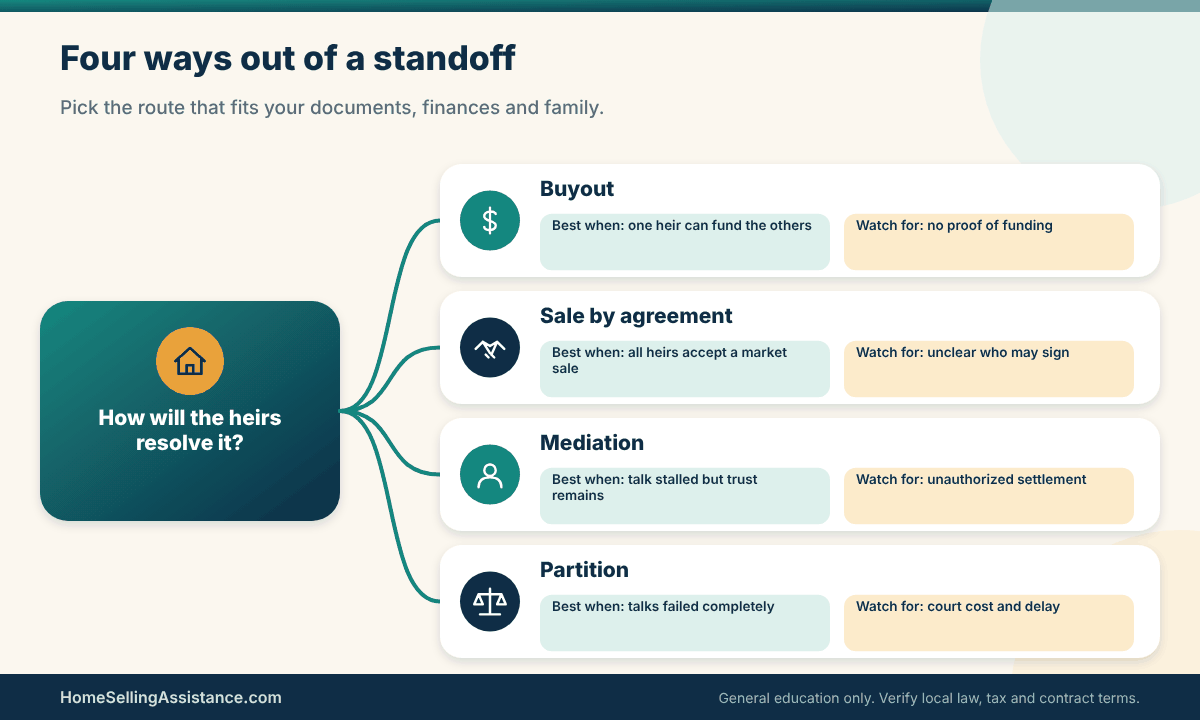
The picture above sums up the usual fork. At the start, everyone is stuck at the same question: sell or keep. The voluntary branches (buy out, sell by agreement, or ask a mediator to help) each lead toward a signed agreement, while the court branch is the last stop when talks fail. Seeing it laid out helps families realize that a refusal today does not mean the end of options, and that picking a path is itself a decision everyone can participate in.
Mediation, partition and the handoff to attorneys, courts and title
Evidence to gather: what mediation actually produces
People often imagine mediation as a soft conversation that changes nothing. In practice it produces something concrete: a written settlement that the parties sign, often reviewed by their own attorneys before it becomes binding. Community mediation centers, court-connected programs and private mediators who focus on probate or family property all exist in many areas. Fees and availability vary, so ask about cost, the number of sessions, and whether the process is confidential before booking.
Go into mediation with documents. Bring the deed, the will or trust, any appraisal, a list of expenses the heirs have paid, and a clear statement of what you would accept.
A mediator cannot force an outcome, but a prepared participant makes it far easier to reach one. If you are worried about talking face to face, many mediators can run separate-room sessions or conduct them by video. A prepared participant is especially valuable where one heir wants to sell inherited house and emotions run high.
A scenario, an exception, and your next step
Take three cousins who inherit a house from an aunt. One lives nearby and has been paying the property tax and insurance for two years. Another lives far away and wants to sell.
In mediation they discover the disagreement is less about the house than about who has carried the burden. The settlement credits the nearby cousin for documented expenses, sets a six-month window to sell, and allows each cousin to pick items from the house first. This pattern is common when one heir wants to sell inherited house and another has quietly carried the costs.
The exception is that mediation only works if everyone participates in good faith and has the legal authority to settle. If someone is hiding assets or cannot be reached, a different route may be needed. Your next step is to ask one neutral question in writing: would you be willing to try a single mediation session before anyone hires a lawyer to file anything? Many people say yes when the alternative is a lawsuit.
Now for the route nobody wants but everybody should understand. If talks fail and one heir wants to sell inherited house property that the others will not release, the fallback in many states is a partition action.
In plain terms, a partition asks a court to end the co-ownership. The judge can sometimes divide the property physically, which rarely works for a single house, or order it sold and the money split according to each owner’s share. Details, including who may file, vary widely by state.
Two features of partition surprise people. First, it generally applies to heirs who hold title together, so it may not be available while an estate is still open and the personal representative holds the property for administration. In that case the executor’s authority and the probate court come first.
Second, a court-ordered sale is often slower and more expensive than a negotiated one. Legal fees, appraisal costs and a sale conducted under court supervision can reduce what everyone receives. Related reading on co-owned homes adds context, and our deeper look at partition sales of co-owned houses explains the general mechanics. Understanding them helps anyone deciding what to do when one heir wants to sell inherited house and talks stall.
Some states also give the heirs who want to keep the property a chance to buy out the one who wants to sell, at a value the court helps set. Others lean on the sale. You do not need to guess which approach your state takes. A local attorney can say in one conversation, and many offer a short initial consultation for exactly this question. The goal of that conversation is to learn the likely path and the rough cost before anyone files a thing.
Whatever route you pick, expect the handoffs to multiply. An attorney drafts or reviews the agreement. A title company searches the record and issues the commitment that a buyer’s lender will require.
The probate court may need to approve the sale or at least receive notice. A listing agent, if the house goes on the market, has to be told who holds authority and who must sign each document. Keeping a single shared folder and a short list of who is responsible for each handoff prevents the delays that make everyone more irritable. This is true of every case where one heir wants to sell inherited house, regardless of which exit the family chooses.
The scenario table below pulls these situations together. Each row describes a common version of the standoff, the realistic options, the main risk, the document that deserves a careful read, and the point at which you should escalate to a professional instead of trying to settle it informally. It is general education only; your facts and your state will change the picture.
| Situation | Realistic options | Main risk | Document to review | Escalate when |
|---|---|---|---|---|
| Probate open, executor named, one heir objects to a sale | Executor seeks consent or court approval | Delay and legal fees | Will and letters of authority | Executor and objector disagree on authority |
| Heirs hold title together, one wants out | Buyout, sale by agreement, mediation | Unfunded buyout promises | Deed and appraisal | No written deal after a set period |
| Trust holds the house, trustee wants to sell | Trustee acts under trust powers | Beneficiary claim of breach | Trust instrument and certification | A beneficiary threatens to sue |
| One heir lives in the house rent-free | Negotiate occupancy terms or a move-out date | Disputes over costs and condition | Occupancy agreement, expense records | Occupant refuses to leave or to cooperate |
| One heir cannot be located or will not respond | Attorney seeks notice or court direction | Title cannot be cleared | Heirship records, service attempts | Right away; a title company will not close without a fix |
| Mortgage or lien remains on the property | Pay from proceeds or refinance in one name | Missed payments and added fees | Payoff letter, title search | Any missed payment or default notice |
To use the table, find the row closest to your situation, then read across. If your own row says to escalate to a professional, believe it. A short consultation early costs far less than a contested filing later, and attorneys can often tell you within one meeting whether your dispute is solvable by agreement. Whether one heir wants to sell inherited house or all of them hesitate, the right row tells you what to do next.
One more practical point. If any heir lives in the house, collects rent from it, or pays its bills, keep clear records from day one. Heirs who are generous with each other in month one can become suspicious by month nine, and a simple ledger of who paid what turns arguments into arithmetic. Clear records are one of the cheapest forms of protection when one heir wants to sell inherited house.
Carry the decision into the sale and verify it when one heir wants to sell inherited house assets
Agreement among heirs is not the finish line. It is the starting line for a real estate transaction with its own steps, and each step needs the right person to sign. This is where a disagreement that seemed settled can fall apart again, because nobody noticed that a signature, a document or an approval was missing. We will walk through the pieces in the order a seller usually meets them.
Disclosure, notice and approval steps in a disputed estate sale
When one heir wants to sell inherited house property and the group finally agrees, the sale has to follow the same rules as any other, adjusted for the estate setting. Disclosure duties, notice requirements and approvals all come into play. The person signing for the estate or the heirs may have different disclosure obligations than an owner who lived in the home, and states handle this differently, so verify locally.
Evidence to gather: disclosure forms, notices and approval documents
Start with what the state requires for sellers of a property that passed through an estate. Some states exempt personal representatives from certain disclosure forms because they have never lived in the house, while others still expect a written statement of what is known. Check with your state real estate commission or a local attorney. Federal rules still apply to older homes: for housing built before 1978, sellers must give buyers the lead-based paint disclosure and pamphlet, as explained by the EPA lead disclosure guidance.
Collect any court orders or written consents too. If a hearing or notice period applies, calendar it and keep proof of mailing. A buyer’s attorney and the title company will ask whether the person signing has authority and whether every required notice was given. Having a tidy packet with letters of authority, the death certificate and any consents prevents the last-minute scramble that has cost many estates a buyer. Our overview of seller disclosure requirements shows how these forms usually work.
It also helps to be candid about what the heirs do and do not know. A house the family has not lived in for years may have leaks, pests or deferred maintenance nobody has seen. Saying so in plain terms, and letting the buyer inspect, is both fairer and safer than guessing.
A scenario, an exception, and your next step
Think of a house where the executor has never lived there and has no idea whether the roof leaks. One heir who wants to sell assumes that means no disclosure is needed.
That is a risky assumption. Even where state law limits what an estate representative must disclose, an agent or attorney will usually still recommend sharing known issues and ordering an inspection, so nobody is accused later of hiding something. The question of disclosure comes up in nearly every case where one heir wants to sell inherited house.
The exception is a state that expressly exempts estate sellers from a particular form. Even then, the contract may include its own representations, and a buyer may ask for more. Your next step is to ask the listing agent or attorney, in writing, which disclosures apply to this sale and who will sign them. Then give the answer to every heir so nobody is surprised.

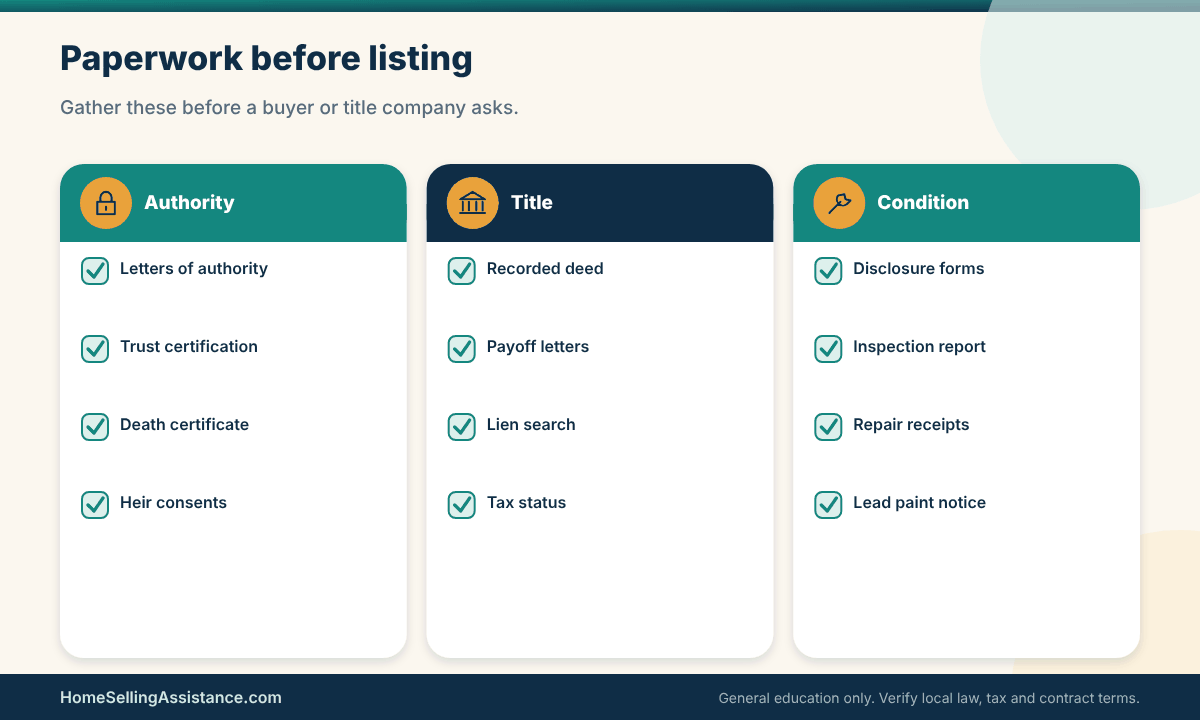
The checklist graphic above groups the paperwork that usually must be ready before a listing goes live: proof of authority, ownership and title documents, and the condition and disclosure materials. If one group is thin, the sale will stall at that point.
It is easier to gather everything in a weekend than to chase one missing signature while a buyer waits and the contract clock runs. Thin paperwork is the usual reason a deal collapses after one heir wants to sell inherited house and the family finally agrees.
Build a verification checklist: what must be current before signing
Estate sales go wrong in a predictable way. Everyone relies on information that was true six months ago, then signs. A death certificate was ordered but the court letters expired. A payoff figure was quoted in March and closing is in June.
An heir agreed to sell but later moved, changed their mind, or filed for bankruptcy. A verification checklist guards against all of that. It does not need to be fancy, just dated and shared. This is especially true where one heir wants to sell inherited house and trust is already thin.
Evidence to gather: official sources and recorded documents to confirm
The best evidence lives in official records, not in anyone’s memory. Pull a fresh copy of the deed and check the county recorder for any liens, judgments or recorded affidavits since the death. Ask the probate court clerk whether the personal representative’s authority is current and whether any objection, petition or hearing is pending. Request a current payoff letter from any lender, and confirm property tax and HOA status directly with the taxing authority or association.
Then ask the title company to run a title search early, not at the end. Our explainer on the title search for a home sale describes what shows up and why surprises tend to appear in estate properties: unrecorded transfers, unpaid taxes and old liens are common. A title company can also tell you what it will need from each heir, such as signatures, notarization, or an affidavit of heirship, so you can plan instead of react.
For the money side, remember that the sale proceeds of an inherited house are generally taxed based on the property’s value at the date of death rather than what the original owner paid, though details depend on the facts. The IRS explains basis rules in IRS Publication 551. If you want to understand the idea in plain language, our guide to inherited house cost basis walks through it, and a tax professional can confirm how it applies to you.
Keep one master document that lists each item, who verified it, the date, and where the evidence is stored. When one heir wants to sell inherited house assets and others are watching closely, this transparency is a form of fairness. It shows that nobody is hiding anything, and it protects the person doing the work from later accusations. It is a small habit with large benefits wherever one heir wants to sell inherited house.
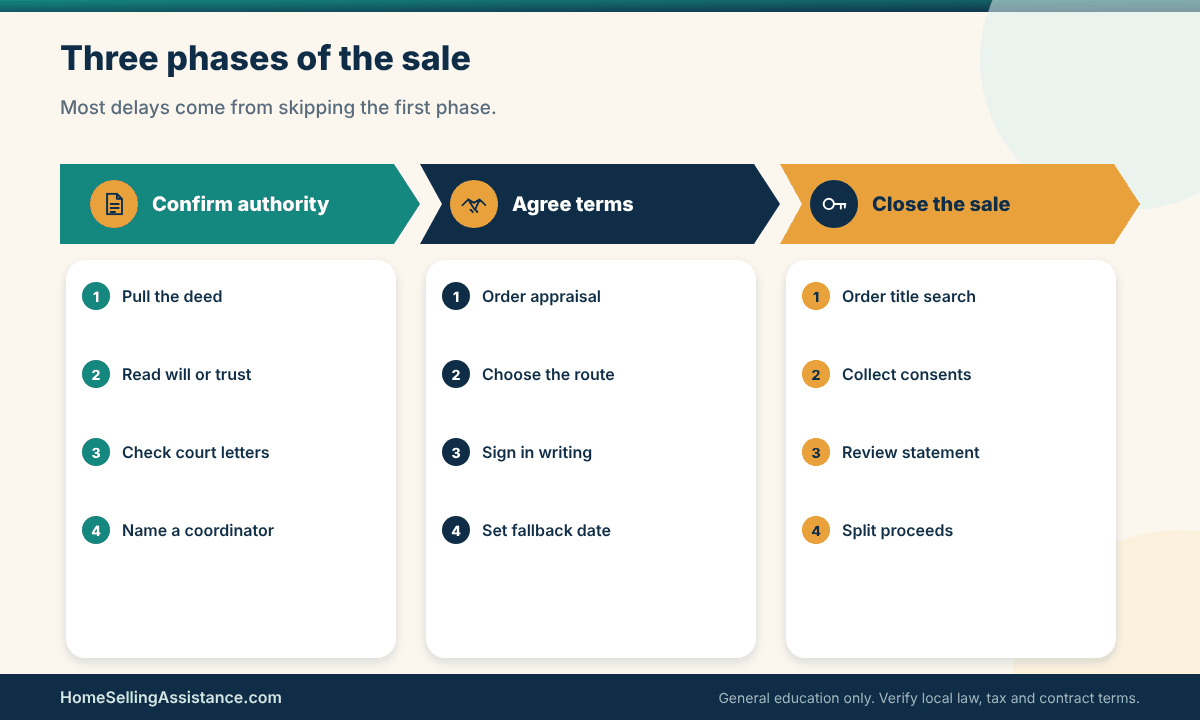
The roadmap above shows the typical order of operations once heirs agree: confirm authority, order the appraisal or valuation, resolve debts and liens, make the buyout or listing decision, handle disclosures, and finally move to closing. Skipping a step usually means returning to it later, with a buyer waiting. Treat the order as a reasonable default rather than a rule, because your state or your documents may reorder some of it.
A scenario, an exception, and your next step
Imagine four heirs who agreed in March to list the house. By June they have an offer, but the title search reveals an unpaid contractor lien from before the owner died, and one heir has moved without telling anyone. The closing date slips twice.
Each delay adds carrying costs, such as taxes, utilities and insurance, which reduces what everyone receives. Nothing was anyone’s fault, but a refreshed checklist before contract signing would have caught both issues. Cases in which one heir wants to sell inherited house often hide this kind of problem until late.
An exception worth knowing is that some problems cannot be solved quickly, such as a missing heir or a disputed will. In those cases, the right move is to tell the buyer honestly and, if needed, extend or withdraw rather than force a closing that cannot happen. Your next step is to set a recurring date, maybe every two weeks, to refresh the checklist until closing. Anyone can call for an update, and every heir receives the same version.
Before closing, assemble a handoff package. It usually includes proof of authority, a certified death certificate, the will or trust excerpts the title company requested, any court orders, signed heir consents, payoff letters, the settlement statement draft, and instructions for how each heir wants to receive money. Our guide to the seller closing statement explains how to read the numbers, and our piece on estate home sale closing covers what is different when an estate is the seller.
Check that names match across every document. A middle initial that appears on the deed but not on the death certificate, or a married name on one form and a maiden name on another, can hold up a closing. Ask the title officer to review the package early so any mismatch is corrected while there is still time. Also confirm how proceeds will be split and whether any heir’s share must go to a creditor or a court-supervised account first.
Finally, decide in writing who will speak for the heirs during closing. Having one coordinator, perhaps the executor or an attorney, keeps messages clear. Everyone else can still ask questions, but the buyer’s side should not have to call four people to confirm one fact. That single decision steadies a process where one heir wants to sell inherited house and nerves are frayed.
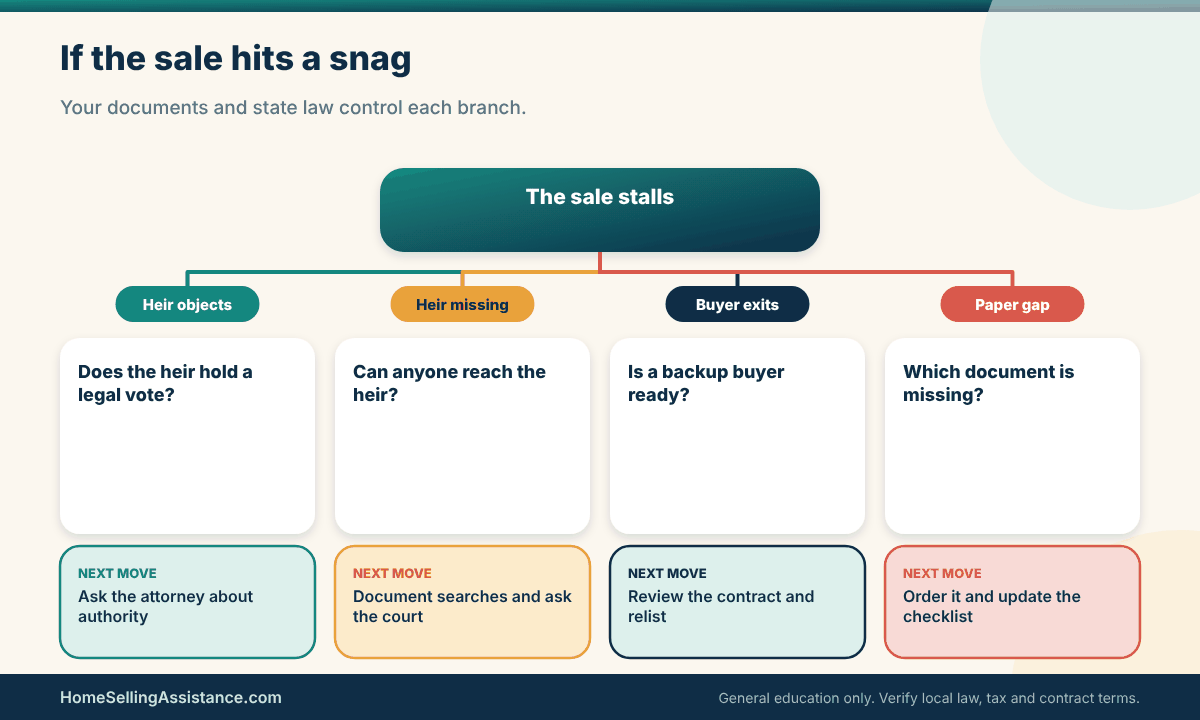
The last graphic shows a simple fallback tree for when something goes wrong: a buyer backs out, an heir changes their mind, or a document is missing. Each branch ends with a concrete next move, such as asking the attorney, reopening mediation, or relisting. Having a plan for setbacks lowers the odds that one problem becomes a family crisis. Setbacks are normal, particularly after one heir wants to sell inherited house and the others finally agree to move.
Frequently asked questions about one heir wants to sell inherited house
Can a single heir force a sale of an inherited house?
Sometimes, but it depends on who holds title and on state law. If the heirs own the property together, many states allow one co-owner to ask a court to order a sale through a partition action. If an estate is still open, the personal representative usually controls the property, and the process runs through probate instead. When one heir wants to sell inherited house property, a local attorney can explain which path applies.
Can one heir block the sale if the others want to sell?
It depends on the same ownership question. If the executor or trustee has authority to sell without every heir’s consent, one objecting heir may be able to raise concerns with the court but not stop the sale alone.
If title is held by all the heirs, every owner generally has to sign unless a court orders otherwise. Check the will, trust and state statute before assuming anyone has a veto. Again, the same rules apply whenever one heir wants to sell inherited house and the others disagree.
What is the quickest way to resolve a disagreement among heirs?
There is no sure-fire fast route, but a written buyout offer with a funding plan is often the simplest. Mediation can also move things along because it brings everyone to one table with a neutral guide. Court processes usually take longer and cost more. If one heir wants to sell inherited house assets soon, proposing a buyout and a sale fallback together can show good faith.
How is the price set in a buyout?
Families usually rely on a licensed appraisal, sometimes one agreed by all heirs or one from each side. A broker price opinion from an agent can serve as a rough cross-check. The final number often adjusts for selling costs avoided, needed repairs, and expenses one heir paid. There is no universal formula, so write the method into the agreement before anyone gets the number.
What if the heir who wants to stay cannot afford a buyout?
They can explore a loan in their own name, a payment plan agreed by the others, or a partial buyout with a shared period of ownership. Lender rules vary, so talk to a mortgage professional early. If funding falls through, a written fallback date for a market sale protects everyone. A HUD-approved housing counselor, found through HUD’s counselor finder, can also help someone understand their options.
Does mediation cost a lot?
Fees vary by region and by mediator, and some community or court-connected programs charge less than private mediators. Ask about hourly rates, how many sessions are typical, and whether the process is confidential. Even a paid mediation is often cheaper than a contested lawsuit. It is also less likely to damage family relationships, which matters when one heir wants to sell inherited house assets that carry sentimental weight.
What happens if an heir cannot be found or will not respond?
A title company will generally not insure a sale without a valid signature or a court order that covers the missing owner. An attorney may be able to petition the court for notice by publication or for direction on how to proceed.
This takes time, so start early. Keep records of every attempt to reach the person, because courts usually ask for proof of a diligent search. Delays like this are common after one heir wants to sell inherited house and another heir has moved away.
Who pays for repairs, taxes and upkeep while heirs disagree?
The answer depends on the will, the trust, state law and any agreement among the heirs. In practice, one person often pays and later asks for credit.
Keep receipts and a running ledger, and agree in writing whether those expenses will be reimbursed from sale proceeds. Without that agreement, the argument about who paid what can become bigger than the argument about selling. This comes up in almost every case where one heir wants to sell inherited house and the house sits empty.
Will the sale trigger taxes?
Possibly, but it depends on the sale price compared with the property’s tax basis, usually its value on the date of death for inherited property, along with other facts. Federal rules are summarized in IRS Publication 523, and our article on taxes when you sell an inherited home gives the general picture. A tax professional can look at your records and tell you what applies. Never assume any particular result.
Should we hire one attorney or separate attorneys?
An executor or trustee may hire an attorney for the estate or trust, but that lawyer represents the fiduciary, not each individual heir. If your interests differ, you may want your own counsel for advice about your rights.
Some families agree to use one neutral mediator and then have each person’s lawyer review the written agreement. Ask any attorney who they represent before sharing sensitive information. Their roles matter a great deal when one heir wants to sell inherited house and interests diverge.
A calmer way forward
When one heir wants to sell inherited house property and another wants to keep it, the best outcomes usually come from sorting out authority first, offering a buyout or mediation before a lawsuit, and keeping every decision on paper. You do not have to be the loudest voice in the family to protect your interests.
You only need accurate documents, patience and the right professionals at the right moment. This article is general education, not legal, tax or financial advice, so confirm the details with a qualified local attorney and tax professional before you sign anything.