Working out your adjusted basis home sale number is the single most useful bit of tax homework a seller can do before listing, because it decides how much of your sale price the IRS treats as gain and how much it treats as simply getting your own money back. Most people remember what they paid for the house. Far fewer remember what they spent on the roof, the sunroom, the new septic line, or the closing fees that quietly belong in the total.
That gap matters more than it looks. Many sellers never owe tax on the sale of a main home, thanks to the federal exclusion, and so they shrug off recordkeeping for twenty years, which is exactly when an adjusted basis home sale review becomes hard. Then prices rise, the exclusion limits stay where they are, and a gain that once looked safely small is suddenly close to the line. At that point the difference between a sloppy basis guess and a documented adjusted basis home sale calculation can be the difference between a calm tax season and an awkward one.
This guide explains basis in plain language. We start with what the word actually means, then walk through what raises it, what lowers it, how the result feeds into your gain, and which exceptions deserve a professional’s eyes. We use round, clearly labelled example figures, never real quotes or promises, and we point you to the official IRS publications so you can check every rule against the source instead of trusting a blog.
One boundary up front. This is general education about a federal tax concept, written for a US home seller. It is not tax advice for your situation, and it cannot tell you what your own return should show. Where your facts are unusual, such as a rental year, a divorce, an inheritance or a home office, we say so and suggest the questions to bring to a qualified preparer.
Key takeaways
- Basis is a running total, not a one-time number. It starts with what you paid or received, goes up with qualifying improvements and certain costs, and goes down with items such as depreciation and casualty reimbursements.
- Gain is not the sale price. Taxable gain is built from the amount you realize, which is the price less selling costs, minus your adjusted basis, before any exclusion is applied.
- Improvements count; ordinary repairs usually do not. The line depends on whether the work added value, extended life or adapted the home to a new use.
- Depreciation and other reductions can surprise sellers. Any year the home was a rental or had a business use deserves a careful, separate look.
- Records are the proof. Closing statements, invoices, permits and bank records make your adjusted basis home sale figure defensible if anyone asks, and rebuilding them later is slow.
Define the adjusted basis home sale question before you apply any rule
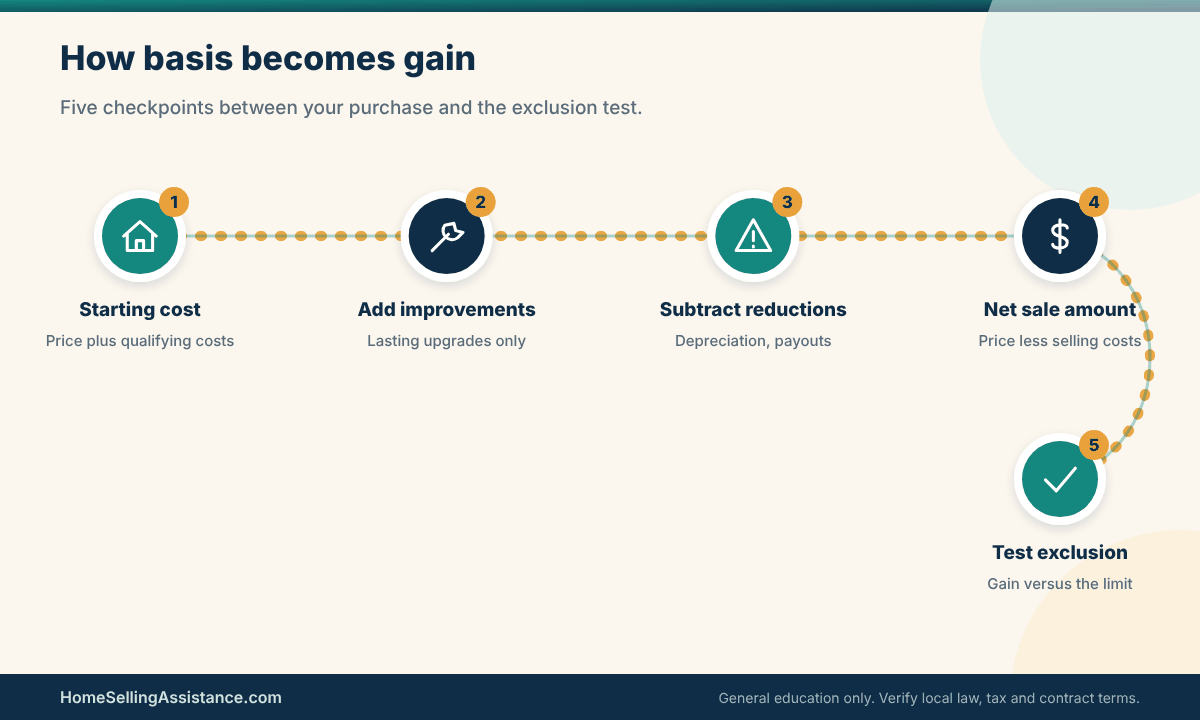
Tax rules only make sense once you know which question they are answering. For a home sale there are really three separate questions hiding in one transaction. First, how much did you sell for after expenses? Second, what is your adjusted basis in the property? Third, does any exclusion or special rule apply to the difference? Mixing those up is how people end up confidently subtracting the wrong numbers.
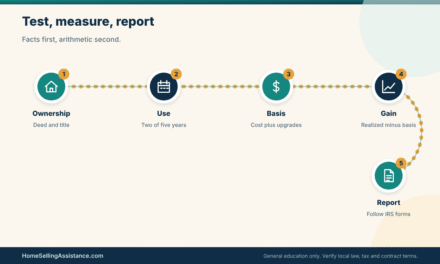
Figure 1 above shows the overall flow, and it is worth keeping in mind as you read. Your basis sits in the middle of the picture. It is the number you subtract from what you realized, and nearly everything else in this article is about making that number accurate, supportable and complete. If you also want the broader context for the federal rules, our guide to taxes when selling a home covers the whole landscape.
Ownership, use and the starting figure behind an adjusted basis home sale
Basis begins with how you came to own the home. If you bought it, your starting point is generally the cost, which means the price plus certain closing costs. If you built it, the starting point is the cost of land and construction. If someone gave it to you, or you inherited it, or you received it in a divorce, the starting point follows different rules. Each of those paths is explained in IRS Publication 551, which is the official reference on basis.
Use matters just as much as ownership. A home that was your residence the whole time is the simplest case. A home that was partly rented, partly used for business, or rented for a stretch before you moved in picks up extra adjustments. Because the starting figure and the use history both feed the final number, a good habit is to write down a short timeline before touching a calculator: when you acquired the home, how, and every way it was used since.
Sellers often ask whether the loan balance belongs anywhere in this. It does not. Your mortgage is how you financed the purchase, and paying it down does not change your adjusted basis home sale total. Basis is about the cost of the property itself, so the payoff matters for your cash at closing, not for your tax basis. Keeping those two ideas separate prevents a very common mistake.
Evidence to gather: the closing disclosure and the settlement statement
The best single document for your starting figure is the closing statement from the day you bought. Depending on when you purchased, it may be called a settlement statement, a HUD-1, or a Closing Disclosure. It lists the purchase price and every charge that was part of the deal. Dig it out first, because it saves you from relying on memory for numbers you last saw years ago.
Go through it line by line with two piles in mind. Some charges are generally part of the cost of the home, such as recording fees, legal fees connected to the purchase, title search and title insurance for the owner’s policy, survey costs, and transfer taxes the buyer paid. Other charges relate to the loan or to ongoing living costs, such as prepaid homeowner’s insurance, loan origination charges and prorated utilities, and these generally follow other rules.
IRS Publication 551 lists what is and is not added to basis, so use that list as your referee rather than guessing, and keep it beside your adjusted basis home sale notes.
If you cannot find the paper copy, you have options. Your title company or closing attorney usually keeps files for a long time, and a request for a copy of the settlement statement is routine. Your county recorder’s office can confirm the deed and sometimes the recorded transfer tax. Your old lender, if you have the same servicer, may have a copy in an online document center. Ask early, because older files can take weeks to retrieve.
Finally, write down the figures you find in a single place, with the document name beside each one. A short list titled “purchase price, deed and settlement costs added to basis” is plenty. When you later add improvements, you will be extending a clean ledger instead of rebuilding from scratch under deadline pressure.
A scenario, an exception, and your next step for first-time sellers
Picture a seller we will call Dana. In this made-up example, she bought a house years ago for a round figure of 300,000 dollars and paid a few thousand in qualifying settlement costs she barely remembers. She has lived in it ever since. Her starting basis is not 300,000. It is that price plus the qualifying costs, and her next job is to locate the settlement statement so she can name them precisely.
Now add an exception. Suppose Dana’s parents had given her the house instead of selling it to her. Her starting point would no longer be a purchase price at all. For gifts, the rules can carry over the giver’s basis, and in some loss situations they use a different figure, so the paperwork you need is the donor’s records and any gift tax filing. That is a very different document hunt, and it explains why we ask about ownership before anything else.
The next step for Dana, and for you, is simple and unglamorous. Collect the acquisition paperwork, write the starting figure and its source on one page, and mark anything you could not confirm. Unconfirmed items are not failures. They are the exact questions you can hand to a tax preparer or title company later, which is far better than discovering them the week of closing.
If you are weighing how basis relates to the rest of your sale economics, the same documents help with the proceeds side too. Our guide to seller closing costs explains what appears on the other side of the closing table, and the two lists work best when you read them together.
Where basis meets the exclusion and the reporting question
Basis does not exist in a vacuum. Its job is to help you answer a practical question: is there any gain left to report after the main-home exclusion does its work? For a qualifying main home, federal law lets a single filer exclude up to 250,000 dollars of gain and most joint filers up to 500,000 dollars, if the ownership and use tests are met. Those tests generally ask whether you owned and lived in the home for at least two of the five years before the sale.
Here is the catch that surprises people. The exclusion applies to gain, not to the sale price. A seller who sells for 700,000 dollars has not automatically exceeded a 500,000 dollar limit. Gain is the price after selling costs, minus adjusted basis. A higher adjusted basis shrinks the gain, so a well-documented adjusted basis home sale figure can keep a sale comfortably inside the exclusion. Our deeper guide on the home sale capital gains exclusion walks through the eligibility tests in detail, and it pairs naturally with an adjusted basis home sale worksheet.
Reporting is a separate matter from owing tax. Whether you must report the sale can depend on whether you received a Form 1099-S from the closing agent, whether you have a taxable gain, and whether you are claiming the exclusion in a situation the IRS wants to see. Because the rules depend on facts, treat this article as a map and confirm the current instructions in IRS Publication 523 and the tax form instructions for your sale year.
Evidence to gather: how gain is built from price, costs and basis
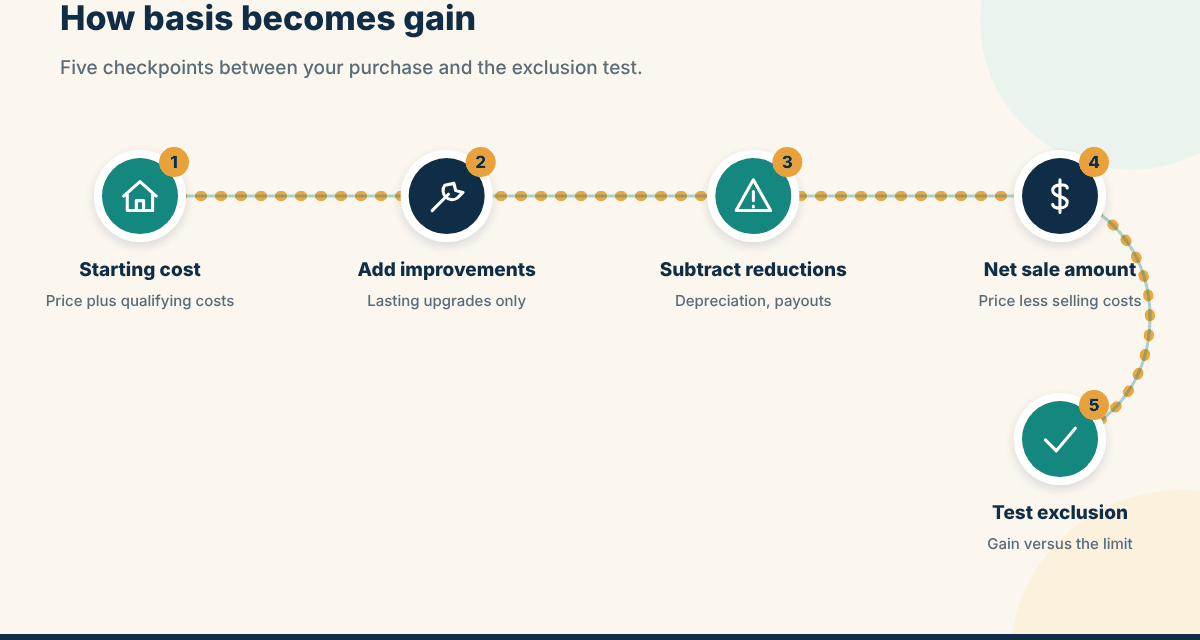
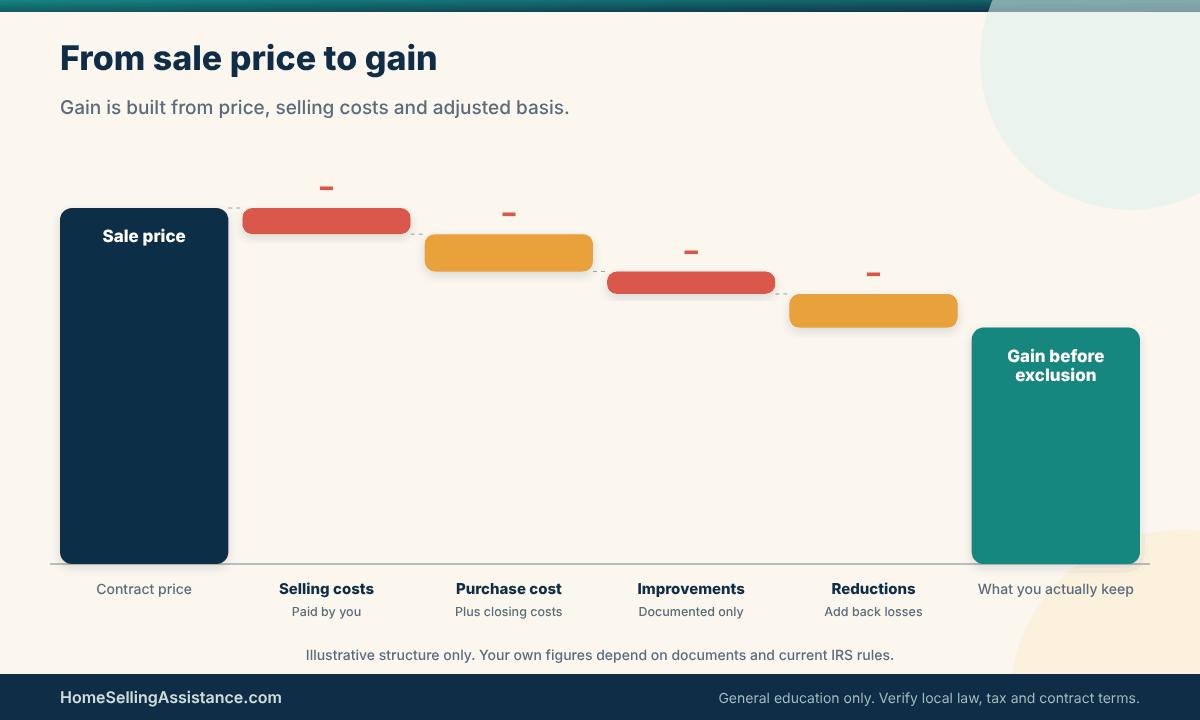
The calculation has a simple skeleton. Start with the selling price. Subtract selling expenses, which are the costs of making the sale, such as agent compensation if you paid it, title and escrow charges you paid, legal fees and transfer taxes you paid. That result is generally called the amount realized. Then subtract your adjusted basis. What remains is the gain or loss before the exclusion. Publication 523 includes worksheets that follow this same order, which makes them a good model for your own adjusted basis home sale workbook.
Figure 2 shows the same idea as a build-down. The shape matters more than the numbers in the picture, which are illustrative. The sale price is the top of the staircase, selling costs take a step, adjusted basis takes the biggest step, and what is left is the gain you test against the exclusion. Notice that your mortgage payoff does not appear anywhere on the staircase, because it affects your cash, not your taxable gain.
So what documents prove each step? For the price and selling costs, the final settlement statement from your sale is the anchor, and you will not have it until closing, so a preliminary estimate from your title company is a useful placeholder. For basis, you need the purchase closing statement, improvement invoices, and any records of adjustments. If you want a fuller look at deductible selling expenses, our guide to selling costs and capital gain goes through them one at a time.
A practical tip: build the adjusted basis home sale calculation twice. Build an optimistic version with your best-case basis and a conservative version that counts only items you can prove today. If both versions land inside the exclusion, you can relax. If only the optimistic one does, you have found exactly where better records would pay for themselves.
Scenario: when the exclusion covers the gain and when it does not
Let us run two clearly hypothetical sellers through that skeleton, using round numbers for illustration only. Seller A, a single filer who has lived in the home for many years, sells at 600,000 dollars with 30,000 dollars of selling costs. Their adjusted basis, after documenting improvements, is 380,000 dollars. The amount realized is 570,000 and the gain is 190,000, which falls under the 250,000 single-filer exclusion if every test is met.
Seller B is also single, with the same sale price and costs, but never kept improvement records and can only prove 300,000 dollars of basis. Their gain looks like 270,000 dollars, which is over the limit by 20,000. Same house, same price, different paperwork, and a very different adjusted basis home sale result. If Seller B actually spent more on improvements and can reconstruct the proof, the gap may disappear. If they cannot, part of the gain may be taxable.
Real life adds wrinkles. Perhaps the seller moved out two and a half years before the sale, or used part of the house as a rental, or is selling because of a job change before reaching two years. The partial exclusion rules cover some of these cases, and our article on the partial exclusion when you lived there under two years explains how they work in general terms. Whether any of it fits your facts is a question for the IRS publications and a qualified preparer.
The takeaway from both sellers is not that you should expect a tax bill. It is that your adjusted basis home sale number is the one lever you control after the fact, and it only works if you can prove it. That is why we spend the rest of this guide on what to count, how to count it, and how to keep the evidence.
Use current IRS rules and records to build your adjusted basis home sale figure
Tax rules change, and published limits and forms get updated. That is why every serious basis guide, including this one, tells you to check the current IRS publications for your sale year instead of trusting a number you remember from a friend or an old article. The core concepts in this guide are long-standing, but thresholds, form numbers and instructions can shift. The official pages for IRS Publication 523 and the basis publication for any adjusted basis home sale review are your source of truth.
The good news is that building an adjusted basis home sale figure is mostly bookkeeping, not mystery. You gather documents, sort them into added and subtracted items, and total them. The skill is in sorting honestly. A repair that merely kept the house working does not belong in the total, while a genuine improvement does. And a deduction taken in an earlier year may reduce your adjusted basis home sale figure even if you have forgotten it.
What records and calculations matter most
Four groups of records drive almost every residential adjusted basis home sale calculation. The first is acquisition: what you paid or received at the start. The second is additions: improvements and certain acquisition or legal costs. The third is reductions: depreciation, casualty reimbursements, and credits or deductions that the tax code says lower basis. The fourth is the sale itself: price, selling costs and reporting forms. If you keep these four groups separate in your files, the math becomes manageable.
Table 1 maps each input to the assumption behind it, the typical effect on your tax picture, the uncertainty to watch, and the document that verifies it. Use it as a working checklist for your adjusted basis home sale file. Do not treat the effects as predictions, because each one depends on your facts, your filing status and the rules in force for your sale year.
| Input | Assumption or source | Cash-flow or tax effect | Uncertainty | Verification document |
|---|---|---|---|---|
| Purchase price | Contract price at your closing | Starting point of basis | Gift, inheritance or divorce changes the start | Settlement statement or Closing Disclosure |
| Qualifying closing costs | Title, recording, legal, survey, transfer tax paid by you | Raises basis | Loan costs and prepaids usually do not count | Itemized closing statement |
| Capital improvements | Work that adds value, extends life or adapts use | Raises basis, lowers gain | Repair versus improvement line | Invoices, permits, bank or card records |
| Depreciation taken or allowable | Rental or business use of the home or a part of it | Lowers basis, can create taxable gain | Allowable counts even if never claimed | Past tax returns, preparer files |
| Casualty or insurance payouts | Reimbursements and deducted losses | Lowers basis | Interaction with later rebuilding costs | Claim letters, insurer payment records |
| Selling expenses | Costs you paid to make the sale | Reduces amount realized | Who paid what depends on the contract | Final settlement statement from your sale |
After you read down the table, look at the verification column and ask a blunt question about each row: do I have that document today? Rows where the answer is no are your homework list. A row with a vague assumption and a missing document is where mistakes hide, because the number feels real in your head and cannot be shown to anyone else.
Also notice what the table leaves out. Mortgage interest paid over the years, property taxes, routine utilities and homeowner’s insurance do not raise basis. They may have been deductible in their own years, or not, but they are not part of the cost of the home. If your first draft of an adjusted basis home sale total includes them, remove them now and save yourself a correction later. A clean adjusted basis home sale total is short and boring, and that is a good sign.
Evidence to gather: improvements versus repairs
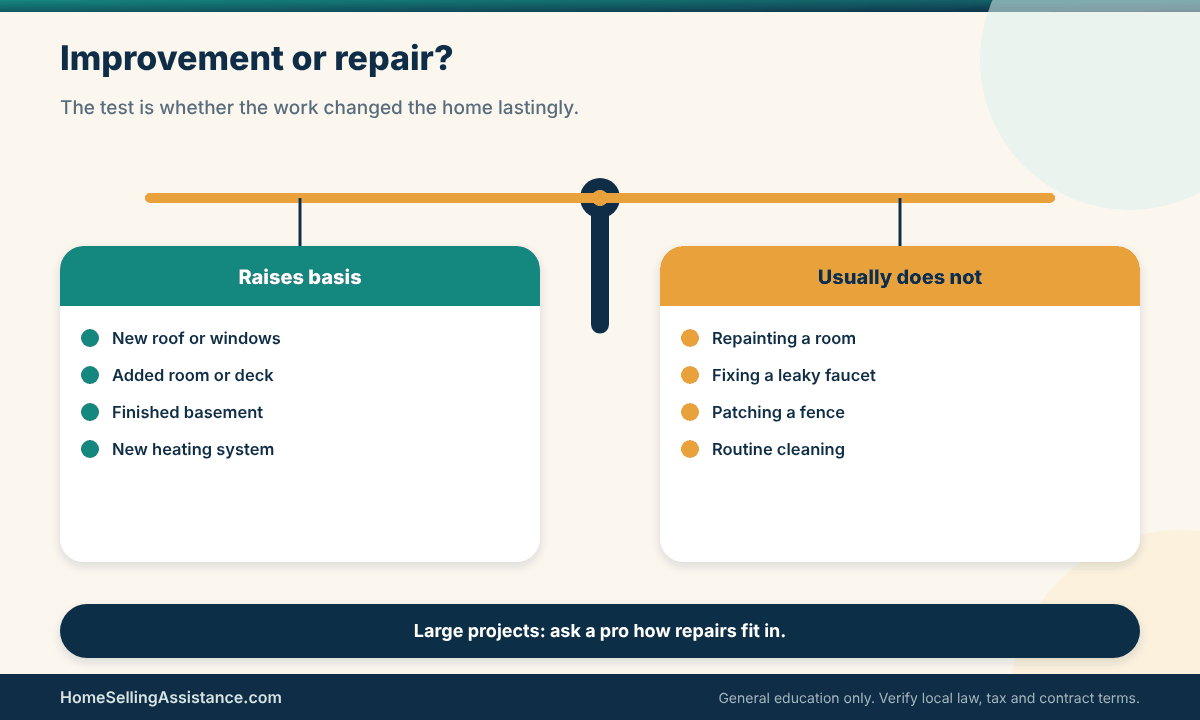
The improvement-versus-repair line is the most debated part of basis. In general terms, an improvement adds to the value of the home, prolongs its useful life, or adapts it to new uses. Think of a new roof, an added bedroom, a finished basement, a replacement furnace, new windows, a deck, a new driveway or a built-in kitchen overhaul. A repair, by contrast, keeps the home in ordinary working condition without adding anything lasting, such as repainting a room, fixing a leaky faucet or patching a small section of fence.
Figure 3 puts the two sides on a scale, and the honest answer to many gray-area projects is that it depends on the scope. Replacing one broken window pane is a repair. Replacing every window with new units is generally an improvement. Patching a few shingles is a repair. Installing a whole new roof is an improvement. The question to ask is whether you changed the home in a lasting way or simply kept it as it was, because only the first kind lifts an adjusted basis home sale total.
Repairs can still matter in one narrow case. If a repair is part of a larger project that qualifies as an improvement, for example painting after a major remodel, the repair-type work done as part of the project may be treated together with it. The IRS publications describe this idea, and a tax professional can tell you how it applies. Our companion article on home improvements and cost basis goes through the common categories with more examples.
Here is how to document each improvement so it holds up. Keep the contractor’s invoice showing scope and price, proof of payment such as a cancelled check, bank statement or card record, and the permit or inspection sign-off if one was required. Add a one-line note in your own words: what was done, when, and why. That note turns an invoice into usable adjusted basis home sale evidence. Photos taken before and after are optional but powerful, because they show what changed in a way a total on a page cannot.
If you did the work yourself, your materials count, and your own labor generally does not. Keep the receipts for lumber, tile, fixtures and rental equipment, and treat your time as free. That feels unfair to people who spent a summer building a deck, but it is the rule. If you hired helpers, their invoices or payment records count the same as any contractor.
A final thought on removed items. If you tore out a kitchen to replace it, the old kitchen’s cost may have been part of your adjusted basis home sale total, and writing it off in some situations is a technical question. Most sellers should not try to be clever here. Ask the preparer, show them the invoices, and let them decide whether any piece of the old work needs separate treatment.
Worked example: from purchase price to adjusted basis
Time for a full walk-through with round, illustrative figures. Imagine a couple who bought a house for 320,000 dollars. They paid 4,000 dollars in qualifying settlement costs, such as title fees and recording charges. Their starting basis is 324,000. Over the years they replaced the roof for 18,000, finished the basement for 30,000, and added a deck for 12,000. Those three projects add 60,000, so their basis is now 384,000.
Now they check for reductions. They had a small insurance claim after storm damage and received 5,000 dollars they did not spend on rebuilding. They also learned that they claimed a residential energy credit for a project in one year. Suppose the credit reduces basis by 1,000. After both reductions, the adjusted basis is 378,000. Every figure here is invented to show the mechanics of an adjusted basis home sale estimate, and your own totals will differ.
Next the sale. They sell for 620,000 and pay 36,000 in selling costs. The amount realized is 584,000. Subtract the 378,000 basis and the gain is 206,000 before any exclusion. If they file jointly and meet all the tests, that is well inside a 500,000 dollar exclusion. Notice how many separate inputs it took to reach one number, and how each one needs a document to stand behind it.
The couple should also run the conservative version. Suppose they only find invoices for the roof and the deck, not the basement. Their provable basis drops by 30,000, the gain rises to 236,000, and nothing changes because they are still inside the limit. That is a comfortable result, and it shows why people with big margins do not need perfection. The people who need precision are the ones near a threshold.
If you want to practice, copy this structure into a spreadsheet and replace the invented numbers with yours. Use four columns: description, date, amount and document. Add a total at the bottom of each group. When a number has no document, highlight the cell. Within an hour you will know exactly how strong your position is, and you will have a file you can hand to a preparer, and a first draft of your adjusted basis home sale answer.
Exceptions and uncertainty: depreciation, casualty losses, gifts and inheritance
Most sellers never meet these exceptions, but the ones who do tend to meet them hard. A rental year, a home office, an insurance payout or an inherited house can each change either the starting point or the reductions. The sensible approach to any adjusted basis home sale exception is to find out whether it touches your facts, and if one does, to stop estimating and get qualified help. The cost of a consultation is usually small compared with a mistake on a five- or six-figure gain.
Start with depreciation. If part of the home was used for business or rented, the tax rules allow, and in many cases require, depreciation deductions. Those deductions reduce basis, and the reduction applies for depreciation that was allowed or allowable, even if you never claimed it. That last phrase is a trap. Forgetting to claim depreciation does not erase the reduction to your adjusted basis home sale figure, so a rental year in your past matters even if your returns never mentioned it.
Gain attributable to depreciation claimed after a certain date in 1997 generally cannot be excluded under the main-home exclusion and may be taxed at a different rate than other gain. We will not quote rates here because rates and rules change. Our article on selling a former rental home explains the structure, and IRS Publication 527 covers residential rental property in detail.
Evidence to gather: Publication 551 and the basis adjustments list
IRS Publication 551 is the official guide to basis, and its lists of increases and decreases are worth reading with your own papers beside you. On the increase side you will see improvements, certain assessments for local improvements such as a new sidewalk or sewer connection, and legal fees to defend or perfect title. On the decrease side you will see depreciation, casualty and theft loss deductions and insurance reimbursements, certain tax credits, and payments received for easements.
Local assessments deserve a note. If your town charged you a special assessment for a street, sidewalk or water line that benefits your property, the amount may add to basis, while ordinary property tax and charges for maintenance generally do not. Because municipalities describe these charges in many ways, your tax bills and the municipality’s letter explaining the charge are the proof you need.
Gather the following in one folder: past returns for any year in which you claimed a casualty loss, a credit tied to the house, or any rental or business deduction; insurance claim letters and payment records; and any easement agreement. Each of those can reduce basis, and the facts are easy to forget. A tax software export or the prior preparer’s file can save you hours when you rebuild an adjusted basis home sale history.
If you cannot find the returns, you can request transcripts from the IRS or ask your previous preparer for copies. Do not guess at depreciation from memory when you assemble an adjusted basis home sale figure. If an old return is truly unavailable, a preparer can reconstruct a reasonable figure from the rental dates, the property values and the standard depreciation method, and that is exactly the sort of task worth paying a professional to do.
Scenario: a home office, a rental year or an energy credit
Take a seller with a dedicated home office who claimed a deduction in some years. Suppose the home office was a separate, regularly used part of the house. Depending on the facts, part of the basis may have been depreciated, and the gain related to that part may need separate treatment at sale. The exclusion may still cover most of the gain, but not necessarily the depreciation portion. A preparer can identify which pieces apply.
Take another seller who rented the house for two years after moving out, then moved back in for a while before selling. The ownership and use tests, the depreciation reduction, and the way gain gets allocated all come into play. The sale may still qualify for some exclusion, but the numbers can change meaningfully. Here the right next step is to bring the rental dates, rental income records and prior returns to a professional before listing, not after an offer.
Finally, take a seller who installed solar panels and claimed a federal credit. Credits for certain residential energy property can reduce the basis of the property by the credit amount, depending on the type of credit, so the improvement increases basis by its cost and the credit reduces it. The result can be a smaller net bump than the invoice suggests. The details vary by year and credit type, so check the rules for the credit you claimed.
Across all three cases, the pattern is the same. Collect the dates, the dollars and the documents. Mark every uncertainty. Take the package to someone qualified, and ask whether the exclusion, the depreciation rules or any credit changes your expected outcome. That is a far better use of an hour than trying to resolve it with search results.
Escalate fact-specific tax decisions beyond adjusted basis home sale basics
General education can take you a long way, and then it runs out. The point where it runs out is usually where the facts get specific: more than one owner, a rental history, an inheritance, a divorce, a large gain, or records that do not add up. Knowing when to stop researching and start asking is a skill, and it saves money. A short, well-prepared meeting is cheaper than a long, confused one, and much cheaper than an amended return.
Think of escalation in an adjusted basis home sale as a hand-off, not a surrender. You do the groundwork: the timeline, the documents, the draft calculation. The professional does the part that requires licensed judgment: applying the current rules to your facts, spotting issues you did not know to ask about, and standing behind the filing. Our overview of taxes when selling a home includes a broader map of when each type of help fits.
Professional questions worth asking before you sign a sale contract
Timing is the quiet advantage here. A conversation with a tax professional before you accept an offer lets you act on the answers. You can still decide whether to complete a project, whether to gather missing papers, or whether to adjust the closing date to cross a holding-period line. After closing, the same conversation can only describe what already happened. If your situation has any complication, book the meeting while the options are open.
Different professionals fit different needs. A CPA or an enrolled agent can prepare returns and advise on federal and state tax questions. A tax attorney is better suited to disputes, complex estates, entity ownership and anything involving legal documents or deadlines with consequences. A closing attorney or title officer can speak to the settlement statement and the recording, but not usually to your tax result. Ask what each person is licensed and experienced to handle, and whether they have worked on an adjusted basis home sale question like yours.
Table 2 sets out common seller situations, the assumption each one rests on, the kind of effect to expect, the main risk, and the professional question that gets you unstuck. The effects are described in general terms because the actual numbers belong to your return. Use the table to recognize your situation and to prepare a sharper question, not to predict your tax bill.
| Seller situation | Sale, loan or tax assumption | Estimated effect | Key risk | Professional question |
|---|---|---|---|---|
| Long-time owner, no rental use | Main home, ownership and use tests met | Basis likely mostly cost plus improvements | Missing improvement records | Which items can I support with what I have? |
| Former rental, moved back in | Some years of rental depreciation | Basis reduced; part of gain may be taxable | Allowed or allowable depreciation overlooked | How do dates and depreciation affect exclusion? |
| Inherited property | Basis often tied to value at date of death | Starting point differs from decedent’s cost | No date-of-death valuation on file | Which valuation applies and how do I document it? |
| Transfer in a divorce | Basis may carry over from the prior owner | Gain may reflect the earlier purchase | Unclear use and ownership period | How do the decree terms affect my basis and tests? |
| Home office or business use | Part of the home depreciated | Depreciation portion treated separately | Wrong allocation of space or years | How should the sale be split between uses? |
| Gifted home | Carryover basis from the giver, with loss rules | Starting point may be far below market | Donor’s records not available | How do I find and prove the donor’s basis? |
When you find your row, copy the professional question into your notes and add the documents that go with it. If none of the rows fits, that is itself a signal. Unusual facts are the reason people hire specialists, and an hour spent describing them clearly is worth more than a day of searching forums where nobody has seen your paperwork, however confident the adjusted basis home sale advice sounds.
Remember, too, that state tax rules can differ from federal rules. Some states follow the federal treatment of home sales closely and some do not, and transfer taxes, withholding for out-of-state sellers and local charges vary. Ask your preparer what applies in your state, and check your state tax agency’s website for official guidance rather than relying on a national article.
Evidence to gather: what to bring to a tax professional
Preparation is half the value of the meeting. Bring a one-page timeline showing when you acquired the home, how you acquired it, when you lived in it, whether any part was rented or used for business, and the expected sale date. Bring the purchase settlement statement, a list of improvements with dates, amounts and documents, and your draft adjusted basis home sale calculation with the uncertain items flagged. If a co-owner exists, bring their information too.
Add the paperwork for the sale as it develops. A copy of the purchase and sale agreement, an estimate of selling costs from your title company and, once available, the final settlement statement help the preparer complete the gain calculation. If you receive a Form 1099-S from the closing agent, give them that as well, since it reports gross proceeds to the IRS and should match your records.
Bring your questions in writing. A good list is short and specific: Which of these projects count as improvements? Do I have any depreciation to account for? Does the exclusion apply, in full or in part? Do I need to report the sale even if I owe nothing? How should I keep records after filing? People who write the questions down get answers to them. People who rely on memory forget half of them.
Finally, ask about fees before you start. Some professionals quote a flat fee for a sale review, others bill hourly, and some include it in return preparation. There is nothing rude about asking, and the answer helps you decide how much to bring and how to split the work. Beware of anyone who promises a specific tax outcome before seeing your documents.
Scenario: when a CPA, EA or tax attorney fits
Suppose a seller has a straightforward main home, a modest gain well inside the exclusion, and good records. A CPA or enrolled agent doing the normal return may be all they need, and the main task is making sure the sale is reported correctly if reporting is required. For many households, this is the whole story, and the best investment is the records you already kept.
Now suppose a seller inherited a house, lived in it a short time, and is selling at a gain after a long probate. Here a CPA with estate experience, and possibly an attorney handling the estate, can coordinate the valuation, the basis and the filing. Our guides on inherited home sale taxes and selling an inherited house cover the general picture, and IRS Publication 559 addresses property from a decedent.
Or suppose a couple is divorcing and one spouse will keep the house for a few years. The decree language, the transfer date and the use history all affect basis and the exclusion. Here, legal and tax professionals should talk to each other, ideally before the agreement is final. Our articles on divorce home sale taxes and selling a house during divorce explain the common issues, and IRS Publication 504 covers divorced and separated individuals.
The common thread is simple. When more than one legal document, more than one owner or more than one tax year is involved, the cost of professional help drops relative to the cost of getting it wrong. When the facts are plain, your own organized records may be enough. You do not need to hire help for every sale, but you should not skip it for a complicated adjusted basis home sale.
Records to preserve for as long as the IRS can ask
Records you keep after closing protect you in two ways. They support the numbers on the return you file for the sale year, and they carry forward if you buy another home, because your next basis can depend on this one in certain situations. A few folders and a regular habit can outlast every move you make, and they cost nothing but attention.
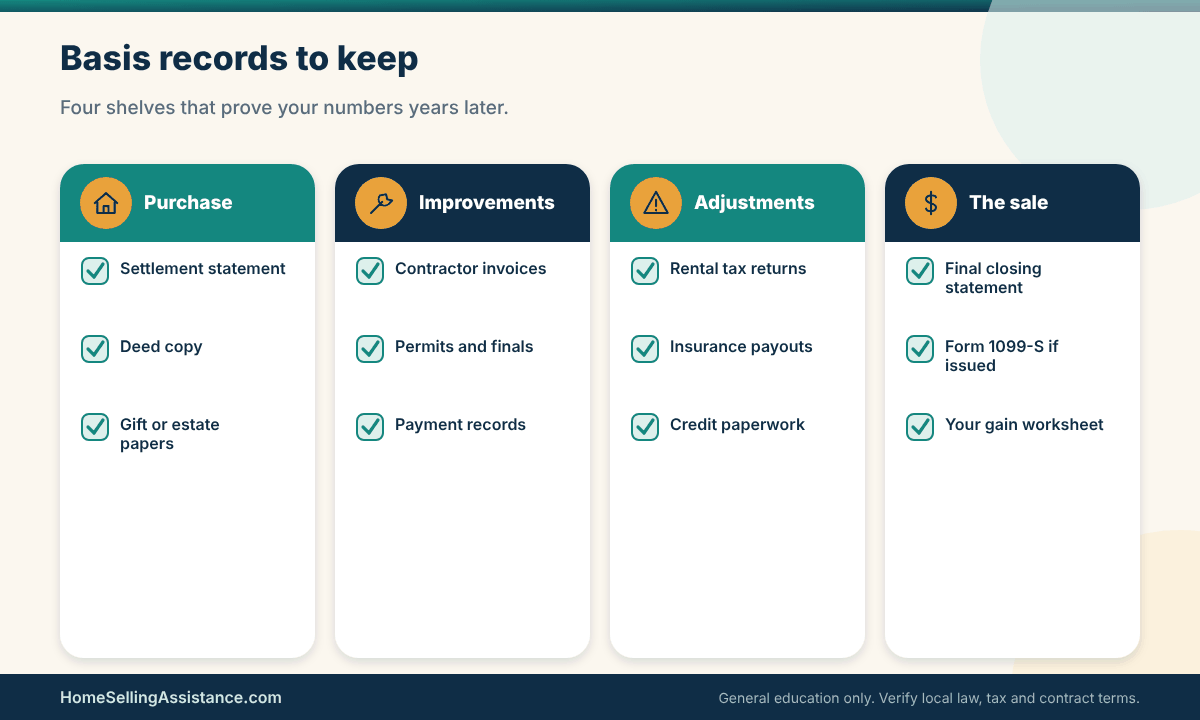
Figure 4 lists the main groups to keep. Think of the list as a set of shelves rather than a single pile: acquisition papers, improvement proof, adjustment records, and the sale package. Each shelf answers a different question later. The acquisition shelf proves where you started, the improvement shelf proves what you added, the adjustment shelf explains reductions, and the sale shelf shows the final math.
Evidence to gather: how long to keep each record
The general IRS guidance is to keep records relating to property until the period of limitations expires for the tax year in which you dispose of the property. In other words, the clock for your home records does not start when you buy or improve. It starts when you sell and file. That is why a seller who owns a home for thirty years may need to keep a thirty-year-old settlement statement.
The length of the limitations period depends on your situation, and it can be longer in certain cases such as substantial underreporting or unfiled returns. Rather than memorizing time frames, adopt a simple rule: keep adjusted basis home sale records for as long as you own the home, and for a generous period after the return that reports the sale. If you are unsure, ask your preparer or check the IRS recordkeeping guidance.
Digital copies are generally fine if they are legible and complete. Scan the settlement statement, invoices, permits, insurance letters and returns. Name files with the date and a short description, such as 2019-roof-replacement-invoice. Keep one backup in a different place from the original, ideally with an automatic sync, so that a failed drive or a flooded basement does not erase your adjusted basis home sale history.
For deeper guidance on organizing the paper trail, our article on home sale tax records lays out a filing system you can set up in an afternoon. The category page on home sale taxes collects the rest of the series, and it is a good place to browse if you have a more specific question.
Scenario: reconstructing records you no longer have
Not everyone has a perfect file, and the question is what to do when the file has holes. Suppose a seller remembers a new roof but cannot find the invoice. Options include asking the contractor for a copy, checking bank or card statements for the payment, looking for a building permit at the local building department, and checking whether the lender or insurer has a record.
Figure 5 shows the fallback order as a tree. Start with the best evidence, which is the original document. If it is gone, move to a duplicate from the source. If that fails, use indirect proof such as bank records and permits. If nothing else exists, ask a professional how to document a reasonable estimate, and be prepared to rely on a more conservative figure.
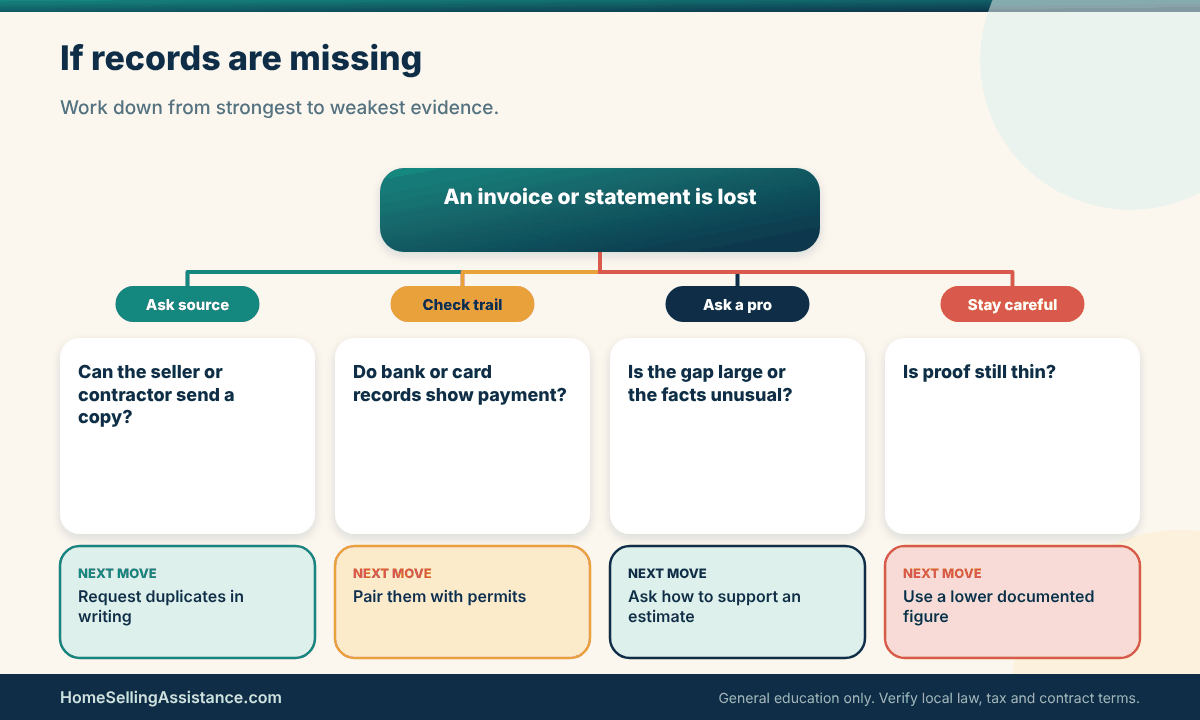
What not to do is just as important. Do not invent an invoice, round up a guess because it feels right, or include a project you are unsure about. Inflated basis is a risk, not a shortcut, because the numbers have to survive scrutiny if the return is ever examined. A conservative, documented figure with a note on the uncertainty is a much safer foundation than an optimistic estimate.
Then fix the habit going forward. Create a folder for the house today, move what you have into it, and add anything new right away. The best time to start your adjusted basis home sale file was the day you bought. The second best is before you list. Even a half-organized file is a major improvement over memory.
Quick scenario
A seller lists a house after fifteen years and assumes there is no tax issue. Before accepting an offer, they spend one evening building an adjusted basis home sale ledger with a purchase statement, three improvement invoices and one old insurance letter. The gain, using round illustrative numbers, lands comfortably under the exclusion. The seller now knows the answer instead of hoping, and the folder is ready for the preparer.
Frequently asked questions about adjusted basis home sale
What is adjusted basis in plain English?
It is your tax cost in the house, updated for what has happened since you got it. You begin with what you paid or received, add qualifying improvements and certain costs, and subtract items like depreciation and insurance reimbursements for damage. The result is the figure the IRS lets you subtract from your net sale proceeds to find gain, which is why an adjusted basis home sale number matters so much. It is not the same as market value or your mortgage balance.
Does my mortgage balance affect my adjusted basis home sale calculation?
No. The loan is how you paid for the home, and repaying it does not change basis. Your payoff affects the cash you receive at closing, which is a different question from taxable gain. Many sellers mix these up because both numbers appear on the closing paperwork, so it helps to keep the tax worksheet and the cash worksheet on separate pages.
Which closing costs from my purchase can be added to basis?
Generally, settlement costs that are part of acquiring the property, such as recording fees, legal fees for the purchase, title insurance for the owner, survey costs and transfer taxes you paid. Loan fees, prepaid insurance and prorated utilities usually follow other rules. The official list is in IRS Publication 551, and a preparer can confirm how it applies to your closing.
Is painting or fixing a leaky faucet an improvement?
Usually not. Those are repairs that keep the home in ordinary condition, and repairs generally do not increase basis. Improvements add value, extend the home’s life or adapt it to a new use, such as a new roof, an addition or a new heating system. If the repair is part of a larger improvement project, ask a professional how the project should be treated as a whole.
Can I include the value of my own labor?
Generally no. The cost of materials and equipment you paid for can count, but your own time does not. If you paid someone else to help, their invoices or payment records count like any contractor. Keep receipts for everything you bought for the project, and write a short note about what was done and when, since it helps jog memory later.
What happens to basis if part of the house was a rental?
Depreciation allowed or allowable for the rental use reduces basis, even if it was not claimed. That can create gain that the main-home exclusion does not cover, and the home may need to be analyzed in pieces. Rental history is a good reason to speak with a tax professional. Our guide to selling a former rental home explains the general structure.
How is basis different for an inherited home?
Often the starting point is tied to the home’s fair market value at the date of the previous owner’s death, not what that person originally paid. The exact rule depends on the circumstances and any alternate valuation election by the estate. Gather the appraisal, estate documents and the date of death for your adjusted basis home sale review, and review IRS Publication 559 or ask the estate’s preparer.
What if I have no records of my improvements?
Start by asking contractors for copies, checking bank and card statements, and looking for permits at the local building department. If those routes fail, speak with a preparer about reasonable ways to support an estimate. Do not guess high or invent documents. A conservative, documented figure is safer, and you can still keep the better records going forward for the next sale.
How long should I keep records after I sell?
The general IRS guidance is to keep property records until the period of limitations expires for the year you report the sale. Because that period can vary with the facts, many sellers keep home records for several years past filing, and some keep them indefinitely in digital form. Check the current IRS recordkeeping guidance or ask your preparer for a recommendation.
Do I have to report my home sale if I owe nothing?
It depends. Reporting may be required if you receive a Form 1099-S or if you have gain that you cannot fully exclude, and the rules and forms can change from year to year. Read the current instructions for your sale year and the guidance in IRS Publication 523, then ask a preparer to confirm for your facts.
Keep the ledger, then ask the question
A clear adjusted basis home sale calculation is built from ordinary paperwork: what you paid, what you improved, what reduced your adjusted basis home sale total, and what you spent to sell. Start the ledger before you list, mark the gaps honestly, and take the unusual facts to a qualified professional. This article is general education, not legal, tax or financial advice, and it cannot account for your circumstances. For the money side of closing, see our guide to closing costs and net proceeds.