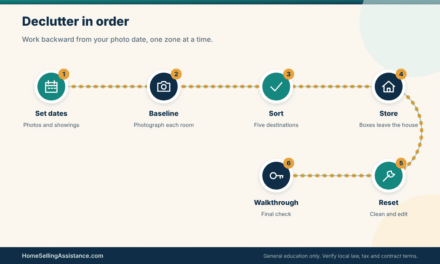
If you need to prepare house for showing in the next half hour, the good news is that thirty minutes is enough to make a home look clean, bright and cared for, and the better news is that none of those minutes has to go toward hiding anything. A showing-ready house and an honest house are the same house when you know where the line sits between presenting a home well and concealing what is wrong with it.
Most of us have been on both sides of this. As a buyer you walk into a home and feel, within about ten seconds, whether it was loved. As a seller you panic when the agent texts that someone wants to see the place in an hour, and the instinct is to shove everything into closets, spray something floral and hope. That instinct is understandable.
It is also where sellers get into trouble, because a fresh coat of paint over a water stain or a rug thrown over a soft floor can turn a small, fixable issue into a disclosure problem.
This guide gives you a realistic thirty-minute routine to prepare house for showing, and it explains the thinking behind each step so you can adapt it to your own house. It is one of the practical pieces inside our broader home staging guide for sellers, which covers the longer game of staging, photography and market positioning. Here we stay narrow on how to prepare house for showing: what to do right before a visit, what to leave exactly as it is, and how to keep a written trail that shows you were straightforward.
One honest caveat before we start. Disclosure rules, agency practices and showing customs differ by state, by county and sometimes by neighborhood, and this article is general education, not legal advice. Where a rule matters, we will tell you who to ask, whether that is your state real estate commission, a local real estate attorney, your title company or your listing agent.
Key takeaways
- Thirty minutes is enough. A calm, clean, well-lit house comes from a short sequence of small jobs done in a sensible order, not from a deep clean.
- Presenting is not hiding. You may tidy, clean, brighten and arrange. You may not cover, mask or misdescribe a known defect, and you should never say something untrue when a buyer asks a direct question.
- A fixed order saves time. Work from the front door inward, handle odors and light before clutter, and finish with a last-look walk-through as a buyer would.
- Paper beats memory. Keep condition notes, receipts and draft disclosures in one folder so answers to buyer questions are fast and consistent.
- Quick prep has limits. Mold, active leaks, pests, safety hazards and structural signs are not thirty-minute problems and need a qualified professional and a disclosure plan.
- Treat every visit fairly. Prepare the same way for every showing and follow fair housing rules, so your routine never depends on who is coming through the door.
Build the file you need to prepare house for showing without surprises
Before the first showing, spend an hour you will never regret, because it is the real way to prepare house for showing. Quick preparation to prepare house for showing works only when the slow work is already done: you know what is wrong with the house, you know what you will say about it, and you know where the paperwork lives. Think of this section as the foundation under the thirty-minute routine that comes later.
The papers, numbers and people to line up first
To prepare house for showing properly, build a showing-ready folder alongside the showing-ready rooms. The folder does not have to be fancy, and a paper accordion file or a shared cloud folder both work. What matters is that when a buyer’s agent asks about the roof, the water heater or the last time the septic was pumped, you or your agent can answer from a document rather than from a hazy memory.
To prepare house for showing with answers ready, start with the basics: the age of the major systems, any warranties that transfer, receipts for work you paid for, and permits or final inspection sign-offs for anything that required them. Add recent utility costs if you are comfortable sharing them, the name of the HOA manager if there is one, and your listing agent’s or attorney’s phone number. Keep a short written list of known issues, even the small ones, because that list is the seed of your disclosure forms.
Evidence to gather: condition notes, receipts and draft disclosures
Walk the house with a notepad and write down every flaw you already know about. A dripping hose bib, a window that sticks, a bedroom that runs cold, a past roof leak that was repaired. For each one, note when you noticed it, what was done, who did the work, and whether you still have the paperwork. This takes twenty minutes and becomes the backbone of your state’s seller disclosure form or property questionnaire.
Your state may require a specific form, and some states require none at all. To find out, check your state real estate commission’s website or ask your listing agent or a local real estate attorney. Our guides on seller disclosure requirements and material defects and what to disclose go deeper, and it is worth reading them before the first buyer walks through.
If your home was built before 1978, federal law adds a specific step: sellers must give buyers an EPA-approved lead hazard information pamphlet and disclose known lead-based paint hazards. The EPA real estate disclosure page explains the requirement. A showing is not the moment to improvise on this, so have the materials ready early.
A scenario, an exception, and your next step for the paperwork
Here is an illustrative case. Dana is selling a 1985 ranch and remembers that the basement once took on water after a very wet spring. She had a gutter fix and regrading done, and she has the invoice. Her notes say: “Seepage at northeast corner, spring of that year, regraded and extended downspouts, no issues since, invoice in folder.” That is a clean, factual line, and it gives her agent something truthful to say if a buyer asks.
The exception is when you honestly do not know. If you bought the house recently and never saw the problem, the note reads “Unknown, not observed during my ownership,” not “never had a problem.” Your next step in either case is to give the notes to your agent or attorney before the listing goes live so the disclosure forms and the showing conversations tell the same story.
The gaps you will only find by walking the house
Even a careful owner has blind spots. You stopped seeing the stain on the garage ceiling years ago, and you have learned to lift the bathroom door handle without noticing. A buyer sees all of it in the first five minutes. Before you prepare house for showing, walk the property once purely to find what you no longer see, and do it with fresh eyes, ideally with a friend who does not live there.
A useful trick is to take your phone and photograph every room as if you were writing a listing. Photos strip away the filter your memory applies. Cracked caulk, scuffed baseboards, a cord running across the floor and a dated light fixture jump out. The point of this exercise to prepare house for showing is not to fix everything, because plenty can stay. The point is to decide, on purpose, what you will fix, what you will leave and what you will disclose.

How to find the unknowns: a buyer’s-eye walk-through
Start at the curb and work inward, the way a visitor does. Notice the walkway, the front door hardware, the smell as the door opens and the first thing your eye lands on in the entry. Then check the places buyers always check: under sinks, inside the water heater closet, in the attic hatch area, around windows and along exterior walls in the basement or crawl space.
Look for the quiet signs of moisture, such as bubbling paint, rust at the base of a tank, white mineral crusts on pipes, musty air or a ceiling stain with a faint ring. Look for cracks wider than a hairline, doors that stick, floors that slope and windows that will not close. You are not diagnosing anything. You are building a list. Our guide on a pre-listing home inspection explains when paying a professional to do this is worth it.
Pay attention to safety items too, because they are the easiest to fix and the worst to leave: dead smoke detector batteries, a missing handrail, a loose stair tread, exposed wiring and a pool or deck with no safe access. A buyer who spots a hazard in a few seconds will wonder what else you missed, and a showing is the wrong time to find out your home has a trip hazard.
When the answer is “I don’t know yet”
Sometimes the walk-through turns up something you cannot explain. A damp patch under a window, a hum in the wall, a soft spot in the deck. The honest answer at that moment is “I don’t know yet,” and the right response is to find out, not to make the symptom disappear before anyone sees it.
Call the appropriate trade, whether that is a plumber, roofer, electrician or general contractor, and ask for a written finding. If the problem is bigger than expected, talk with your listing agent or a local attorney about what must be disclosed and how to word it. Sometimes the answer is a modest repair. Sometimes the answer is an as-is listing with a clear disclosure, which we cover in our piece on selling a house as is. Either path is honest, and either is better than guessing.
The 30-minute routine to prepare house for showing, step by step
With the folder built and the known issues written down, the routine to prepare house for showing is almost relaxing. You are no longer deciding what is wrong with the house, only making the best honest version of it appear for an hour. The sequence below is built around one idea: do the things that change the first ten seconds first, and the things that change the last five minutes last.
The picture below lays out the whole half hour as a path you can follow with a timer on your phone. The time boxes for how you prepare house for showing are guidelines, not rules, and a small condo will move faster than a four-bedroom house with a basement. What matters is the order.

Before the minute-by-minute part, it helps to be clear about the ground rules, because they decide what counts as a good use of your half hour. When you prepare house for showing, there are three kinds of jobs. Some jobs improve presentation, like cleaning and lighting. Some jobs fix a real problem, like replacing a broken stair tread. And some jobs would only hide a problem, like covering a stain or silencing a noisy pipe. The first two belong in your routine. The third never does.
A simple test keeps you honest: would you be comfortable explaining the job to the buyer’s agent, out loud, with the buyer standing next to you? Wiping a counter passes. Opening the windows passes. Painting over a spot you cannot explain does not. If the answer is “I’d rather they didn’t ask,” treat that feeling as information and talk with your agent or attorney before you do it.
The picture below shows the idea as a scale. On one side sit the things that make a house easier to see and feel good about, and on the other side sit the moves that would make a problem harder to see. Keep your thirty minutes entirely on the first side whenever you prepare house for showing, and your preparation will rarely cause trouble later.

Fair housing matters here too. Your routine should be the same for every visitor, whoever they are, and the way you prepare house for showing should never change based on a buyer’s race, religion, family status, disability or any other protected characteristic. Do not remove or add items on the assumption that a certain kind of buyer will like them, and do not make comments about who would or would not be a good fit. The HUD fair housing resources explain the basics, and our guide on fair housing for home sellers turns them into practical habits.
Safety is the other guardrail. Showings bring strangers into your home, and a quick prepare house for showing routine should include a security pass: valuables, prescriptions, jewelry, mail and anything with account numbers goes out of sight, and a spare key or garage code is never left where a visitor could find it. Your agent can screen visitors through a showing service. If you sell on your own, plan the screening yourself and keep someone with you for unscheduled visits.
Finally, a note on how much to do. Some sellers hear that a house must be spotless and spend the whole thirty minutes scrubbing grout. Buyers rarely notice grout. They notice odor, light, clutter and condition cues such as stains, cracks and hazards. If you are short on time, spend it on those, and let the rest go. A house that is clean enough and truthful beats a house that is perfect and evasive, which is a rule that holds every time you prepare house for showing, whatever your market looks like.
Minutes 0 to 15: early action and the decisions hiding inside it
The first fifteen minutes are about the senses. Buyers decide how a house feels before they notice any single feature, and the biggest swings come from smell, light and clutter on visible surfaces. If you only have time to do three things when you prepare house for showing, make them air, light and counters.
Open windows for a few minutes if weather and security allow, turn on every light including lamps and closet lights, and open blinds and curtains. Take out the trash, empty the kitchen sink, and clear the surfaces buyers touch and look at: counters, the table, the bathroom vanity. Then move to the floors in the entry, kitchen and main living area, since those are the spots that carry the first impression.
What to do first and why the order matters
Start with the trash and anything that smells, because odor is the one flaw you cannot stage around. As you prepare house for showing, take out kitchen and bathroom trash, wash anything in the sink, and check the refrigerator and pet areas. If you have a litter box or a pet bed, handle it now. Our guide to selling a house with pets covers odor, fur and the question of where animals should be during a visit.
Next comes light, because a bright room reads as larger and cleaner even if it is not. Switch on every bulb, replace any dead ones you have been meaning to replace, and open the window coverings. After that, clear surfaces. Move everyday items such as mail, chargers, toothbrushes and dish towels into a basket or a single closet. A quick pass with the vacuum or broom on the high-traffic paths finishes the stretch. If you want a calmer, more thorough approach to the stuff itself, see how to declutter a house before selling.
The reason order matters is that each step changes what you can see in the next one. You cannot judge clutter in a dark room, and you cannot judge a floor that has bags on it. Doing them in the wrong order means doing some of them twice.
A scenario with a bad smell, a stain and a sticky door
Imagine you get a call at 2:00 for a 3:00 showing. The kitchen smells like last night’s fish, there is a pale ring on the bathroom ceiling that you have meant to look at, and the back door sticks. What is the honest play?
The fish smell is a pure presentation problem, so air out the room, wash the pan, run the vent and take out the trash. The sticky door is a known minor issue; leave it as it is, and if a buyer mentions it, say so plainly. The ceiling ring is different. Do not paint over it ten minutes before a showing. A hurried coat of paint over a stain you have not investigated looks like concealment, even if your motives were innocent.
Leave it, note it on your disclosure list, and get a plumber or roofer to look at it this week.
Minutes 15 to 30: handoffs, buyer questions and what could go wrong
The second half of the routine is where you finish the rooms, set up the handoff to the visitor and prepare to be absent. The usual advice when you prepare house for showing is that sellers should not be present during showings, and for good reason: buyers speak more freely and linger longer when the owner is out. Our article on what the seller should do during a showing covers the reasons, the exceptions and how to make an early exit feel natural.
Use minutes fifteen through twenty-five to finish the rooms as you prepare house for showing: make beds, straighten towels, wipe the bathroom sink and mirror, and set the table or leave it bare. Spend the last five minutes on the handoff. Lock away valuables, medication and personal papers. Put the folder where the agent can find it, leave the lights on, and make a final walk through the front door the way a buyer would.
Before you step out, take a moment to set the thermostat to a comfortable temperature and check that nothing is running that should not be. A house that is too hot or too cold hurries people through, and a slow buyer is usually an interested one.
What you leave out for the agent and what you never move
Leave out the things that help the visit when you prepare house for showing: a feature sheet or flyer, copies of any available reports, the utility cost summary if you have one, and a list of what conveys with the home. Leave the disclosure documents where your agent or state practice says they belong. Your agent will tell you if access instructions, a lockbox or showing-service steps apply in your market.
Never move or hide the things that tell the truth about the house, however rushed you are to prepare house for showing. That means you do not pull the rug off a section of floor that you know is soft and then put it back after. It means you do not turn the water pressure off to hide a slow leak, flip the breaker to quiet a buzzing circuit, or stack boxes against a wall to cover a crack. If something is visible at normal height, a buyer is entitled to see it.
The same goes for the smell test. Strong air fresheners, candles and plug-ins may feel like cleanliness, but to many buyers they signal that something is being masked. Aim for neutral and clean instead of perfumed.
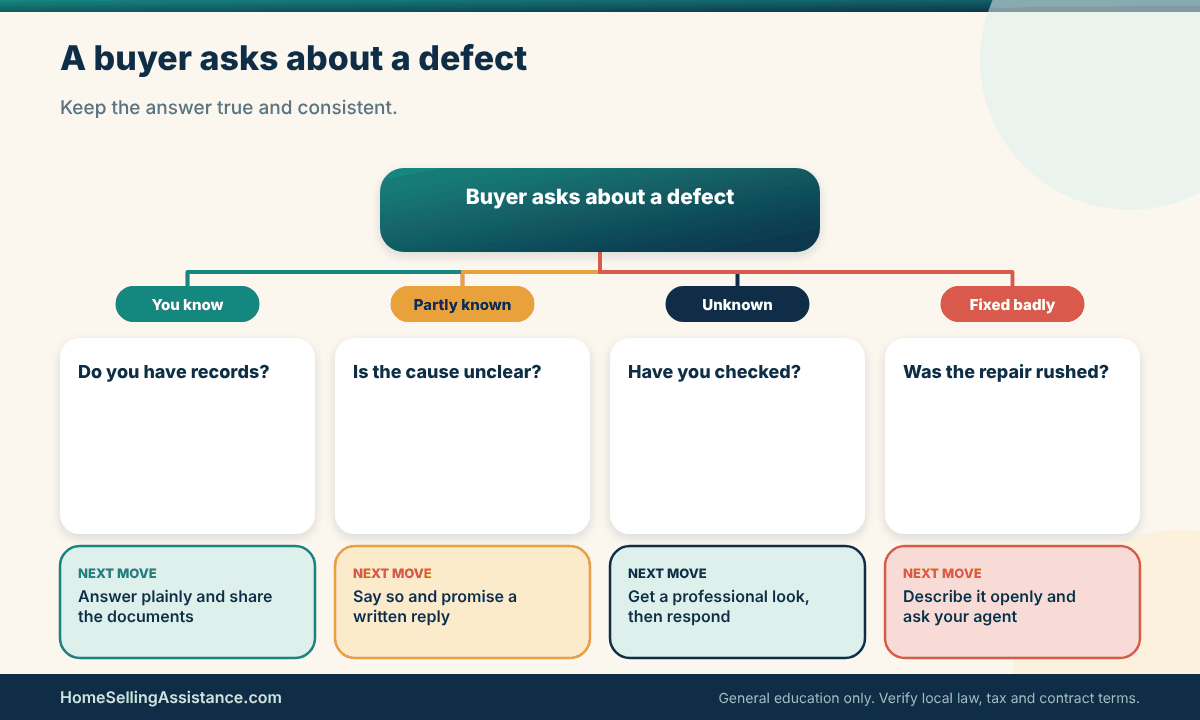
A scenario where a buyer finds the thing you fixed badly
Picture a seller who patched a drywall crack the night before listing with a quick skim of compound and a coat of paint. The crack came from settling, and the seller does not know whether it is active. At a showing, a buyer’s agent taps the wall, notices the fresh paint and asks directly, “Was there a crack here?”
The honest answer, and the best habit to prepare house for showing, is simple: “Yes, there was a crack. I repaired and painted it, and I’m not sure what caused it.” That sentence costs the seller nothing and protects the sale. The dishonest answer, “No, I just repainted,” can undo the whole transaction later and create exposure. The takeaway is that a repair you are willing to describe is fine, and a repair you would rather not describe is a warning sign.
For a visual of how this plays out when buyers ask about something hard, the decision path below helps you plan what to say before the question arrives.

The table that follows pulls the workflow together. Use it as a quick-reference card: find the stage or symptom in the first column, gather what the second column suggests, take the action, respect the decision deadline and pass the information to the right person. The deadlines are suggestions to build your own schedule around, not legal timelines.
| Stage or symptom | Information to gather | Action | Decision deadline | Next handoff |
|---|---|---|---|---|
| Musty or stale smell | Source: trash, pets, damp area | Remove source, ventilate; investigate dampness | Before the visit | Plumber or mold professional if damp |
| Ceiling or wall stain | Age, past leaks, repair receipts | Leave visible; get an opinion | Within days of spotting it | Roofer or plumber, then disclosure form |
| Sticking door or window | When it started, any related cracks | Ease if simple; do not hide cause | Before listing if possible | Handyman or agent for wording |
| Dim, dark rooms | Dead bulbs, dirty glass, blinds | Replace bulbs, open coverings | Day of the showing | None, routine task |
| Cluttered surfaces | What you need daily | Basket or closet, not the garage mess | Day of the showing | Agent for staging advice |
| Safety hazard | Location, severity, past incidents | Fix or mark clearly | Before any visit | Licensed trade, then agent |
| Buyer question you cannot answer | Documents, who did the work | Say you will find out in writing | Within 24 to 48 hours | Agent or attorney to reply |
Read the table from left to right and you will see the pattern behind how to prepare house for showing. Cosmetic items are done on the day. Items that might be a symptom of something larger get an investigation and a decision before the visit, or at least a visible note in your records. Questions you cannot answer on the spot get a promise of a written reply rather than a guess.
Close the loop after you prepare house for showing
The showing itself lasts maybe twenty minutes. What decides whether it helps you or hurts you later is what you did with the information around it: what you told people, what you wrote down and what you kept. A seller who manages to prepare house for showing well but leaves no trail is relying on memory in the one situation where memory is least reliable, which is a dispute months after closing.
This final section is about habits that keep your effort to prepare house for showing honest. They are small, they cost almost nothing, and they are the difference between a pleasant sale and a stressful one. They also keep you on the right side of the line we drew at the start, because a written record of what you knew and when you shared it is the best evidence that you were not hiding anything.
What to confirm in writing before and after each showing
Verbal agreements in real estate have a way of shrinking over time. A buyer’s agent says “we’ll probably want the roof looked at,” you say “sure, no problem,” and three weeks later each of you remembers a different conversation. A short written note, even a text or an email, turns a fuzzy exchange into something you can point to. The same applies to access instructions, to who is allowed in, and to any statement you make about the condition of the house.
Ask your listing agent how showing feedback and buyer questions will be passed along. In many markets, agents collect comments after each visit and relay them. If you are selling without an agent, a simple log in a notebook or a shared document does the same job. Our piece on open houses versus private showings explains how the two formats differ in the information they produce and the access you should expect to control.
Evidence to gather: what to write down, and where
Keep three kinds of notes while you prepare house for showing again and again. The first is a showing log with the date, the visitor’s agent or name if you have it, and any comment or question you hear. The second is a condition log: anything you noticed, repaired or learned about the house after listing, with a date. The third is a question-and-answer record, where you write down exactly what a buyer asked and exactly what you or your agent replied.
These notes do not need polish. A line like “Tuesday showing, buyer asked about basement dampness, agent replied with the regrading invoice and the written note from our folder” is plenty. Consistency is more useful than detail, because the goal is to be able to show that your answers were the same on Tuesday as on Saturday.
If you learn something new, such as a plumber diagnosing a slow leak, update your disclosure forms promptly and tell your agent. Many disclosure regimes expect updates when conditions change before closing, though the rules vary by state, so ask your agent or attorney how that works where you live.
A scenario, an exception, and your next step for the written record
Consider an illustrative sale where a buyer’s agent asks, on a showing, whether the upstairs bathroom has ever leaked. The seller answers honestly that a supply line leaked once, was replaced, and the receipt is in the folder. The agent says they will mention it to their client and requests the receipt. The seller emails a photo of the receipt that evening with a short note: “As discussed at the showing, here is the repair record for the upstairs bathroom supply line.”
That email is the whole habit, and it fits any plan to prepare house for showing. It is timely, factual and complete. The exception is when the issue is not fully resolved, in which case the same email should say so clearly and your agent should help word it. The next step for you is simple: after any showing with a condition question, send a short written follow-up the same day.
The picture below puts the same idea into a checklist you can keep on the fridge or in your notes app. It covers the minimum you want to have sorted before any buyer walks through, and it doubles as a reminder of the papers a buyer’s agent may ask to see.
The second table covers what happens when a showing turns up an issue and the conversation moves toward a contract. It is a check table: for each type of issue, it lists the evidence you should have, the input you might need from a buyer, agent or title company, the main risk and a sensible fallback. As with the first table, treat it as a starting framework and confirm specifics with your agent or attorney.
| Issue | Seller evidence | Buyer, agent or title input | Risk | Fallback |
|---|---|---|---|---|
| Past water intrusion | Repair invoice, photos, written notes | Buyer may order an inspection | Claim of concealment if undisclosed | Disclose in writing; offer records or a credit |
| Fresh paint over a stain | Date and reason for painting | Agent may ask what is underneath | Looks like masking | Describe it openly; get a professional look |
| Unpermitted work | Who did it, when, any permits found | Title company or county office may flag it | Closing delay or lender questions | Disclose; ask attorney about permit options |
| Old lead paint (pre-1978) | EPA pamphlet, any known hazard notes | Buyer may waive or use an inspection window | Federal disclosure violation | Provide required materials before contract |
| Pet odor or damage | Cleaning receipts, flooring records | Agent may request a credit | Price reduction or lost interest | Deep clean, replace carpet, or credit |
| HOA rule or fee question | Current statements, governing documents | HOA manager and title provide resale papers | Surprise assessment | Order HOA documents early and share |
Use the table the way a pilot uses a checklist when you prepare house for showing. You are not expected to memorize it, only to recognize which row you are in when a question comes up. If you cannot fill in the second column for an issue, that is your signal to go gather evidence before you answer. If the third column involves a title company or an inspector, call them early, because delays in those handoffs are where closing dates start to slide.
It also helps to know the mistakes that cause the most trouble, because they repeat from seller to seller. The first is the rush repair: a patch, a coat of paint or a caulk line applied an hour before a visit, with no record of what was done or why. The second is the vague answer, where a seller says “it’s fine” about something they have never checked. The third is the inconsistent story, where the seller tells one buyer the roof is five years old and another that it was done “a while back.”
The fourth mistake is over-preparing in ways that cost money without helping, such as buying new furniture for a house that mostly needs light and clean air. The fifth is under-preparing the documents while over-preparing the rooms. When you prepare house for showing, give the folder as much attention as the kitchen, because the folder answers the questions that rooms cannot.
A sixth mistake is forgetting that your agent is a partner in this, not just a gatekeeper. Tell your agent about issues before they hear about them from a buyer’s agent. Agents can only help you word a disclosure or plan a response if they know the facts early, and surprises make everyone look less credible. If you are selling without an agent, a local attorney can play a similar role for a modest fee, and it is worth asking before you list.
Last, watch for the temptation to treat quick preparation as a substitute for real repairs. If the same problem shows up in every showing, such as a smell, a sag or a stain, it is telling you something the market already knows. The cheaper and calmer move is usually to deal with it properly, or to price and describe the home honestly as it stands. Either choice is better than another round of fast cover-ups before the next visit.
If you want to see how presentation feeds into photos, look at our guides on real estate photography for sellers and curb appeal before selling. The exterior is the very first thing a visitor sees, and a few minutes spent on the walkway, door and porch can set the tone for everything that follows when you prepare house for showing.
Records and follow-up after the showing season ends
Once the house goes under contract, the showings stop and the need to prepare house for showing ends, but the paper trail does not. The same notes and emails you kept during the marketing period feed directly into inspection negotiations, repair requests and final walk-throughs. Sellers who kept tidy records tend to find those later steps calmer, because they already know what they told people.
After closing, hold on to the folder. Keep your disclosure forms, the showing log, repair receipts, inspection reports and the closing paperwork together in one place. The Internal Revenue Service explains in IRS Publication 523 why records of purchase price and improvements matter when you sell, and many of the same receipts that help you answer buyer questions also support your tax records. How long to keep them is a question for your tax professional, since the answer depends on your situation.
Evidence to gather: keeping the folder after closing
Scan or photograph everything you used to prepare house for showing and keep a digital copy in at least two places. Name the files so you can find them in a hurry, for example by date and topic. Include the final signed disclosure forms, the closing statement, the deed transferring the property, any repair credits agreed, and the last communication with the buyer’s side.
Add the paperwork that proves you handled the home responsibly: receipts for repairs, permits, warranties you transferred, utility transfer confirmations and the date and time you handed over keys. If a buyer later says something was not disclosed, the most useful reply is a dated document, not an argument.
Different states set different periods for claims related to disclosure and for how long records may matter, and those periods are not something we can state for your location. Ask a local real estate attorney or your state real estate commission how long to retain a transaction file. If in doubt, longer is better and storage is cheap.
A scenario, an exception, and your next step for the follow-up
Here is a sample ending. A seller sells in the spring, and eight months later receives a polite email from the buyer saying the basement has a damp smell after heavy rain. Because the seller kept the folder, they can reread what was disclosed, what documents were handed over, what the inspection found and what the buyer accepted in writing. They forward the relevant pages to their agent or attorney and ask how to respond.
That is the whole value of the folder you built to prepare house for showing: it lets you respond calmly and with facts rather than defensively and from memory. The exception is when the folder shows that something was missed. In that case the next step is not to ignore the email but to seek advice, because an honest correction early is almost always easier than a dispute late.
A related habit worth building after you prepare house for showing for weeks is a short debrief after the house closes. Write down what worked, what you would do differently and which routines saved the most time. If you ever sell again, or help a friend or relative sell, that page is more useful than any generic checklist. It is also a good moment to revisit our full staging guide and refresh your sense of how the whole process fits together.
Quick scenario
A seller gets a 45-minute heads-up for a showing. In the first fifteen minutes the seller airs out the kitchen, turns on every light and clears the counters. In the next ten, the seller makes beds and wipes the bathrooms. The last five go to locking away papers, setting the folder out and walking in through the front door once. The slightly stained ceiling in the hall is left as it is, noted on the disclosure list and scheduled for a roofer visit. That is how to prepare house for showing quickly and honestly.
Frequently asked questions about prepare house for showing
Can I really prepare house for showing in only 30 minutes?
Yes, for the presentation side of things, provided the slower work is already done. Thirty minutes covers air, light, surfaces, floors, bathrooms and a final walk-through. It does not cover repairs, deep cleaning or investigating a problem, which need their own time. If your house has an unresolved issue, a half hour will not fix it, and it should not be used to cover it either.
Is it legal to paint over a stain before a showing?
Painting itself is not the issue; concealing a known defect can be. Rules differ by state, and whether a seller must disclose a past or present leak depends on local law and on the facts. If you know the cause and have repaired it, painting is usually a normal part of a repair. If you do not know the cause, ask a professional first and talk with your agent or attorney about disclosure.
What counts as hiding a defect?
Generally, it means doing something that keeps a buyer from seeing or understanding a material problem you know about, such as covering a damaged area, silencing a symptom or giving a false answer to a direct question. Cleaning, decluttering and arranging furniture are not concealment. State laws define the details, so a local attorney or your state real estate commission is the right place to check.
Should I be home during a showing?
Most agents recommend that you are not, because buyers are more relaxed and more honest about what they think when the owner is away. Some sellers have reasons to stay, such as medical needs or a pet that cannot be moved. If you must be there, keep quiet, stay out of the way and let the buyer’s agent lead. Our piece on the seller’s role during a showing covers this in more depth.
What should I do about odors before a showing?
Find and remove the source first: trash, pet areas, damp towels, a refrigerator or drains. Then ventilate. Strong fragrances, candles and plug-in scents can read as masking and trigger sensitivities, so lean toward neutral. If the smell comes back after cleaning, it may point to moisture, mold or a plumbing issue and deserves a professional look rather than more air freshener.
Do I need to hide personal photos and valuables?
Putting away valuables, medications, mail and documents is both a security step and a courtesy. Personal photos are a stylistic choice, and many sellers remove most of them so buyers can imagine their own life in the rooms. This is about neutral presentation, not about guessing who the buyer is, and it should never be tied to any assumption about a particular group of people.
How do I handle a buyer asking about a known problem?
If you prepare house for showing well, you can answer truthfully, briefly and with documents if you have them, or say you will get back to them in writing. Your agent can help you word it. Avoid guessing, minimizing or changing the story from visit to visit. A consistent, factual answer protects you and often builds trust rather than losing the buyer.
What if a showing is booked with only an hour of notice?
Run the same routine to prepare house for showing in a compressed version: trash and smell first, lights and window coverings second, surfaces third, bathrooms fourth, last-look walk-through fifth. Skip anything that is not visible in the first ten seconds. If the house is really not ready, you can ask your agent about declining or rescheduling, though turning down showings can have a cost in lost momentum.
Do the rules change if I sell without an agent?
The honesty standard when you prepare house for showing does not change, but you will be handling the details an agent would normally manage, from access and screening to disclosure paperwork. Our guide on open house safety for sellers covers precautions for visitors you do not know. A flat-fee service, a local attorney or your state real estate commission can help you with the forms that apply where you live.
Where can I check the rules for my state?
Start with your state’s real estate commission website for disclosure forms and agent duties, then ask a local real estate attorney or your title company about anything specific. Your listing agent should also know the local customs for showings and access. For fair housing rules that apply nationwide, the HUD fair housing page is a trustworthy reference.
A calm way to finish
To prepare house for showing well, you do not need a perfect house, only an honest and cared-for one. Do the slow work early, prepare house for showing with the thirty-minute routine, run the thirty-minute routine in a sensible order, answer questions truthfully and keep a written trail. This article is general education, not legal, tax or financial advice, so check local rules with your agent, attorney, title company or state real estate commission. For the bigger picture, read our staging, photos and showings library.