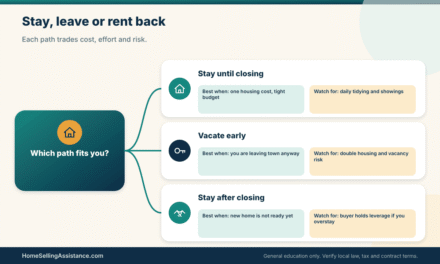
Selling house while living in it means running a household and a sales campaign out of the same four walls, and the strain shows up in small places first: the breakfast dishes at 8:55 when a showing request arrives for 9:30, the dog that has never met a stranger it did not bark at, the remote worker whose video call will not wait for a buyer’s agent.
Nothing about selling house while living in it is unusual. A large share of sellers never move out before listing, because they need the mortgage payment to keep flowing from a home they still use, because the next place is not ready, or because an empty house simply costs more to hold. The question is not whether you can do it. The question is how to do it without losing your evenings, your privacy, your patience, or your leverage with buyers.
This guide is built around the real friction points of how to sell a house when you are still in it: showing windows, pets, children, working from home, valuables, and the odd ways a buyer’s visit can collide with ordinary life. It stays general on purpose. Rules about access, disclosure and possession differ by state, contract and local custom, so we point you to the right place to check rather than pretending one answer fits everyone.
If you are weighing whether to stay put or leave before listing, our companion piece on moving out before selling a house covers the other side of that decision. Here we assume you have chosen selling house while living in it, at least for now, and want a workable routine that protects your home, your household and your sale.
Key takeaways
- Decide your showing rules before the first request. Written availability windows, notice expectations and a lockbox policy make selling house while living in it easier, because you set them once instead of negotiating each time.
- Plan for pets and children as logistics, not afterthoughts. A pet that cannot be home during showings needs a destination, and a child’s nap or homework time needs a protected block.
- Treat privacy as a checklist. Mail, documents, medications, jewelry, keys, devices and cameras should be secured or removed before strangers walk through.
- Possession is a negotiated term. If you need to stay after closing, that belongs in the contract in writing, not in a friendly verbal promise.
- Flexibility has a price tag on both sides. Tight showing limits can reduce traffic, while an always-open schedule can wear you out; local agent feedback helps you find the balance.
- Keep records. Notes on showings, agreements about access and move-out terms protect you if memories differ later.
Build a seller file before selling house while living in it
Every other section on selling house while living in it depends on this one. A seller who is still living in the property carries two lists at once: the ordinary documents any seller needs, and a second set of household facts that control how showings will work. Most of the frustration people report about selling house while living in it traces back to that second list being unwritten.
Think of the seller file for selling house while living in it as a folder, paper or digital, that you could hand to a listing agent, a co-owner or a spouse and have them understand how your home operates in one sitting. It is not complicated. It is just specific.
Household facts, documents, and showing rules to settle first
Start with the paperwork that every sale needs, then add the household layer. The ordinary file includes your deed or ownership information, a recent mortgage statement, tax and HOA statements if relevant, and any warranties or repair records. We keep a full list in documents needed to sell a house, so we will not repeat it here.
The household layer is what makes your situation different. It records who lives in the house, which rooms are in daily use, what hours are quiet for a reason, which animals are present, and which areas you want off the tour. It also records who has authority to say yes to a showing request, because a request that sits unanswered for six hours can cost you a buyer.
Evidence to gather: your schedule, pets, kids, and work calendar
Spend one week writing down what actually happens in your home before selling house while living in it. Not what you hope happens, what does happen. Note when you leave for work and return, when children are picked up and dropped off, when the dog needs a walk, when a baby naps, and which days include video calls you cannot move. Include recurring commitments such as sports practice or caregiving shifts.
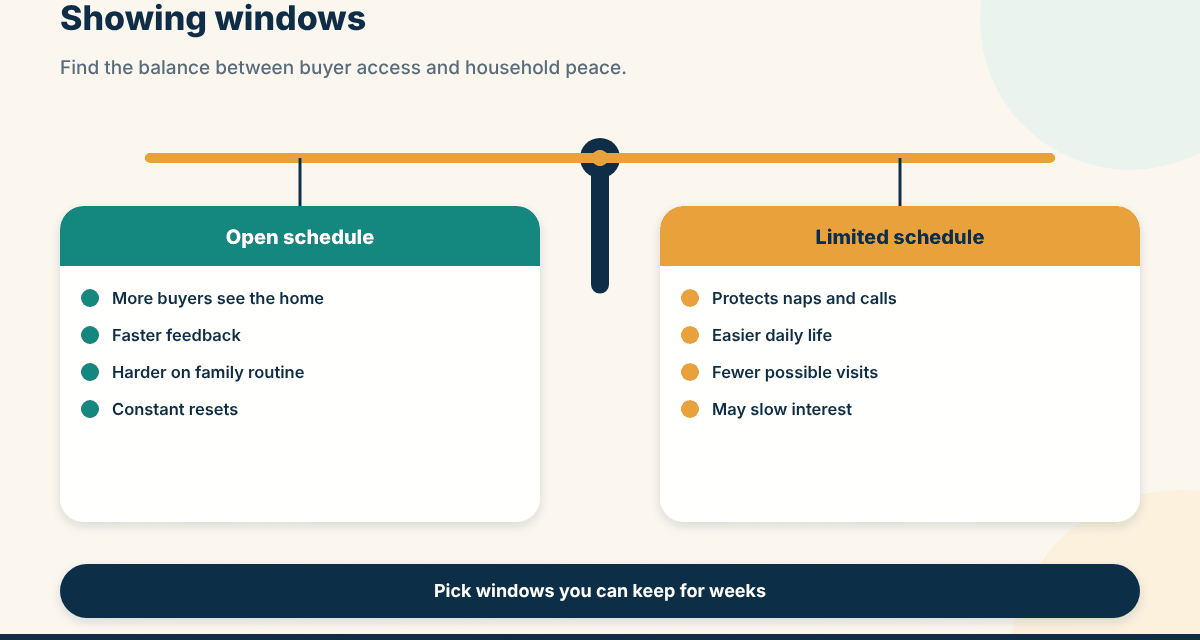
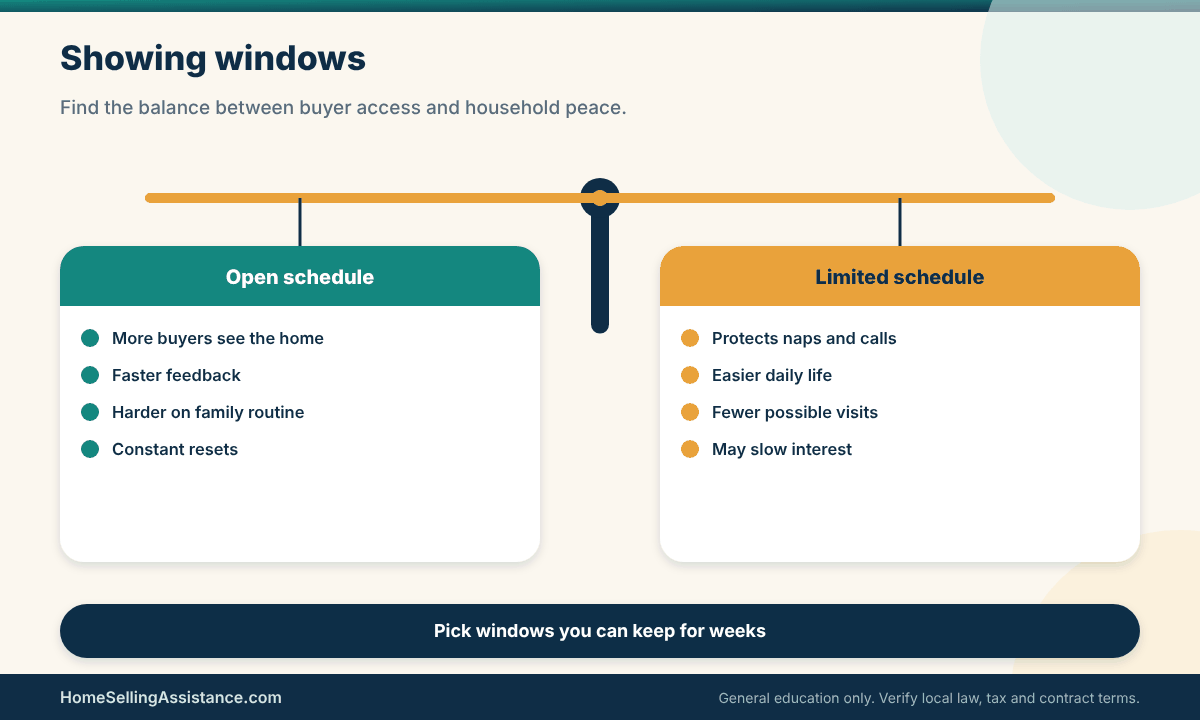
That week of notes becomes your evidence for deciding showing windows. If your listing agent asks what hours work, you can answer with something better than “mornings, I guess.” You can say that weekdays between ten and two are open because the house is empty, that evenings after seven are workable on two days, and that Sunday afternoons are best for open-house style visits.
Gather the household facts that a buyer’s agent or a showing service may need to know, too. How does the alarm work? Is there a pet door that cannot be locked? Does one stair squeak so loudly that it startles sleeping children? Does anyone in the home work nights? None of this needs to be shared with buyers, but your own agent should hear it before they promise anything on your behalf.
Finally, collect the practical evidence of what selling house while living in it takes in resets. Time yourself tidying the kitchen, the main bath and the entry. If a full reset takes forty minutes, a thirty-minute-notice showing is not realistic, and you should say so up front. Realistic numbers beat optimistic ones every time, especially when you are tired three weeks in.
A scenario with a night-shift parent and a next step
Picture a household where one parent works overnight and sleeps from about eight in the morning until early afternoon, while the other parent works a daytime office job and two school-age children are home from three-thirty. A standard “anytime with an hour’s notice” instruction would put strangers in the house during sleep and during homework. That would be exhausting inside a week.
A better setup for selling house while living in it looks like this, with every time here purely illustrative. Showings are welcome on weekday afternoons from two to three, when the sleeper is awake but the children are not yet home, and on weekend late mornings. Evenings are limited to one or two nights, with a longer notice requirement. The seller’s agent puts this in the showing instructions and in the notes visible to other agents.
The exception is a serious buyer who can only visit at a different hour. Plan how you will handle that in advance. Perhaps you decide that one-off exceptions require a phone call to you rather than an automatic approval. Your next step is simple: write your windows down, share them with your agent or your FSBO showing tool, and review them after the first week of real traffic to see whether they need loosening or tightening.
A common worry is that all this preparation sounds like a second job. It is, for a short while. The payoff is that selling house while living in it becomes a repeatable routine instead of a daily negotiation, and that routine is what keeps tempers calm when the fourth showing of the week is on the calendar.
Several sellers also find it helpful to name one person as the showing coordinator. That person answers requests, confirms with the agent, and tells everyone else the plan for the day. Without a coordinator, selling house while living in it often turns into five people giving five different answers to the same agent, which buyers notice and which slows approvals.
If you share ownership with someone who lives elsewhere, such as a former partner or an adult child on the deed, bring that person into the file from the start. Their signature may be needed on the listing and the contract, and their expectations about access matter too. Settling those expectations early keeps selling house while living in it from becoming a family dispute on top of a logistics problem.
Gaps in the plan you cannot see yet
No plan survives the first weekend untouched, so it helps to hunt for the weak spots before they find you. Most gaps fall into four groups: places buyers can see that you did not expect, things that can be taken or damaged, people who will be affected but were not consulted, and moments when two obligations collide. Naming them early is cheaper than reacting to them later.
What to check: neighbors, access, security, and valuables
Walk the property as a stranger would, starting at the curb. Where would a buyer park, and does that block a neighbor’s driveway? Which entrance will the lockbox or key exchange use, and can anyone see it from the street? If your sale involves a lockbox, ask your agent or the showing service how entry is logged and whether you receive a notice each time the box opens. When selling house while living in it, strangers will be in your space, so our general read on open house safety for sellers goes deeper on that point.
Next, inventory what should not be visible or reachable. Prescription medications in a bathroom cabinet, jewelry on a dresser, loose cash, passports, checkbooks, tax papers in a home office, spare keys on a hook, garage door remotes in a car, and laptops left open all deserve a decision. The safest default is to lock them away or take them with you on showing days. A small locked box or a bag you carry out works for most households.
Think about digital privacy as well. Smart speakers, indoor cameras and baby monitors can record or transmit during a showing. Rules about recording inside a home when strangers are present differ by state and are worth checking with your agent or an attorney. Many sellers simply switch indoor cameras off and say so in the listing notes, which avoids the question entirely.
Last, tell the neighbors what is coming. A short, friendly note that your home is on the market and visitors may park nearby heads off a surprising number of complaints. It also tends to produce an extra pair of eyes on the property when you are away.
Seasonal timing is worth a thought as well. Winter means wet boots and dim afternoons, summer means open windows and pollen, and school breaks change who is home. None of this changes the basic plan, but it affects how long a reset takes. When you plan for selling house while living in it, add buffer time in the weeks when your home is under extra pressure.
A second scenario and how to turn it into a next step
Consider a seller who works from home three days a week, shares the house with an adult relative, and owns a parrot that screams at unfamiliar voices. The seller assumed showings would simply happen on the other two days. Then the first buyer’s agent asked for a Wednesday visit, and the seller realized that nobody had decided what to do about the bird, the video calls or the relative’s quiet hours.
The gap here is not a failure of effort. It is a failure to ask, in advance, “who is affected and what do they need?” A useful next step is a ten-minute household meeting before listing. Each person names one thing they cannot give up, one thing they can tolerate, and one task they will take on. The relative may agree to be out on certain afternoons. The seller may reserve Wednesday for calls and approve Tuesday and Thursday.
Plan the bird, too. A pet that cannot be left with strangers needs a temporary home, a carrier and a quiet room, or a friend with a spare bedroom. We cover that kind of arrangement in our piece on selling a house with pets, and it is worth reading before the first request comes in, not after.
Move through selling house while living in it in the right order
Once the seller file exists, the sale itself runs in a fairly predictable sequence: preparing the home, going live, handling showings, receiving offers, negotiating, and moving toward closing. What changes when you live there is how each stage feels and how much each decision costs in household disruption. Our general home selling timeline lays out the stages; this section adds the live-in layer on top.
The table below is a working tool for selling house while living in it, not a prediction. It lists the stages where occupied-home sellers most often get stuck, what to collect at each stage, what to do about it, when the decision needs to be made, and who receives the handoff next. The deadlines are described as relative points, because your contract and your market set the real dates.
| Stage or symptom | Information to gather | Action | Decision deadline | Next handoff |
|---|---|---|---|---|
| Pre-listing prep feels endless | Room-by-room task list, timing of each reset | Declutter and stage in batches, box seasonal items | Before photos are booked | Photographer and listing agent |
| Showing requests collide with work or naps | One-week household schedule, notice limits | Publish windows and approval rules | Before the listing goes live | Listing agent or showing service |
| Pet cannot be home | Pet temperament, carrier, backup sitter | Arrange a standing alternative for showing days | Before first public showing | Sitter, friend or boarding facility |
| Valuables and papers in view | Inventory of sensitive items | Lock away, remove or relocate | Before each showing batch | Household members |
| Offer needs post-closing occupancy | Realistic move-out date, next-home timeline | Negotiate possession terms in writing | Before accepting the offer | Agents, attorney or title company |
| Buyer inspection and appraisal access | Access dates, pet and security plan | Confirm times, prepare rooms and utilities | When dates are scheduled | Inspector, appraiser, buyer’s agent |
Use the table as a prompt for a weekly check-in about selling house while living in it with your agent or co-owner. If a row has no answer yet, that is where your next conversation should start. Rows that look comfortable now may not be comfortable in three weeks, so revisit them whenever your household circumstances shift.
Before going live, try a dress rehearsal. Ask a friend or your agent to request a showing with thirty minutes of notice, and see what actually happens. Does the dog get out the door? Does the laundry get hidden? Does everyone know who locks up? A rehearsal for selling house while living in it exposes the weak steps in your routine while the stakes are still low.
Decide, too, how you will talk to children about the move. Younger kids may be confused by strangers in their rooms, and older kids may feel embarrassed about the tidying. A calm, honest explanation, a job for each child and a small reward for helping tends to work better than nagging. Selling house while living in it is easier when the children feel like part of the team.
Early decisions about showing windows, pets, and the children’s routine
The decisions you make before the listing goes live are the cheapest ones. After the first showing, your choices feel personal because real people have seen your home, and loosening or tightening your rules can feel like backpedaling. Settle the big questions up front and treat them as defaults you can adjust, not promises you must keep forever.
Evidence to weigh: showing feedback, notice times, and buyer behavior
The honest trade-off in selling house while living in it is that every limit you place on access can reduce the number of buyers who see the home, and every concession costs you some comfort. Nobody can tell you the right balance in general. What you can do is watch what happens locally. Ask your agent how comparable occupied homes performed with strict versus open schedules, and ask for real examples, not general reassurance.
After the first week, read the showing feedback with a skeptical eye. If several buyers’ agents say they could not get a slot that fit, your windows may be too narrow for your market. If buyers are touring but seem rushed or leave early, the problem may be clutter, odor or pet presence, not scheduling. Separate the two before you change your routine.
Notice times matter more than most sellers expect when selling house while living in it. A one-hour notice rule invites last-minute requests from buyers already in your neighborhood. A twenty-four-hour rule tends to produce planned, serious visits but may lose spontaneous ones. Neither is right for everyone. A middle path some sellers use is a standing instruction that same-day requests need a quick confirmation call, while next-day requests are approved by default.
For more on staging and showings beyond this topic, browse our staging, photos and showings guides. For a broader set of preparation habits, see our walk-through on how to prepare a house for a showing. It pairs well with this section because it focuses on the thirty minutes before the door opens.
A scenario with an anxious dog and a toddler, and your next step
A family has a nervous rescue dog and a toddler who naps from one to three. The family would like to limit showings during nap time and also keep the dog out of the house, because a barking animal can leave a poor impression and, in some cases, create a safety concern for visitors. Both preferences are reasonable, and both reduce availability.
The family chooses a plan. Nap hours are blocked on the calendar. Showings are welcome from three-thirty to six on weekdays and ten to two on weekends. On every showing day, one adult takes the dog to a relative’s yard, and the toddler goes out with the other adult. They keep a small bag by the door with leash, treats, water bowl and diaper supplies so leaving takes five minutes, not twenty.
The exception arises when a buyer’s agent requests a nap-time visit for a client who is relocating and in town for one afternoon. The sellers decide in advance that exceptions are allowed only for buyers who have been pre-approved for financing, which their agent can ask about politely. Your next step is to write down your own exception rule, so you are not improvising under pressure.
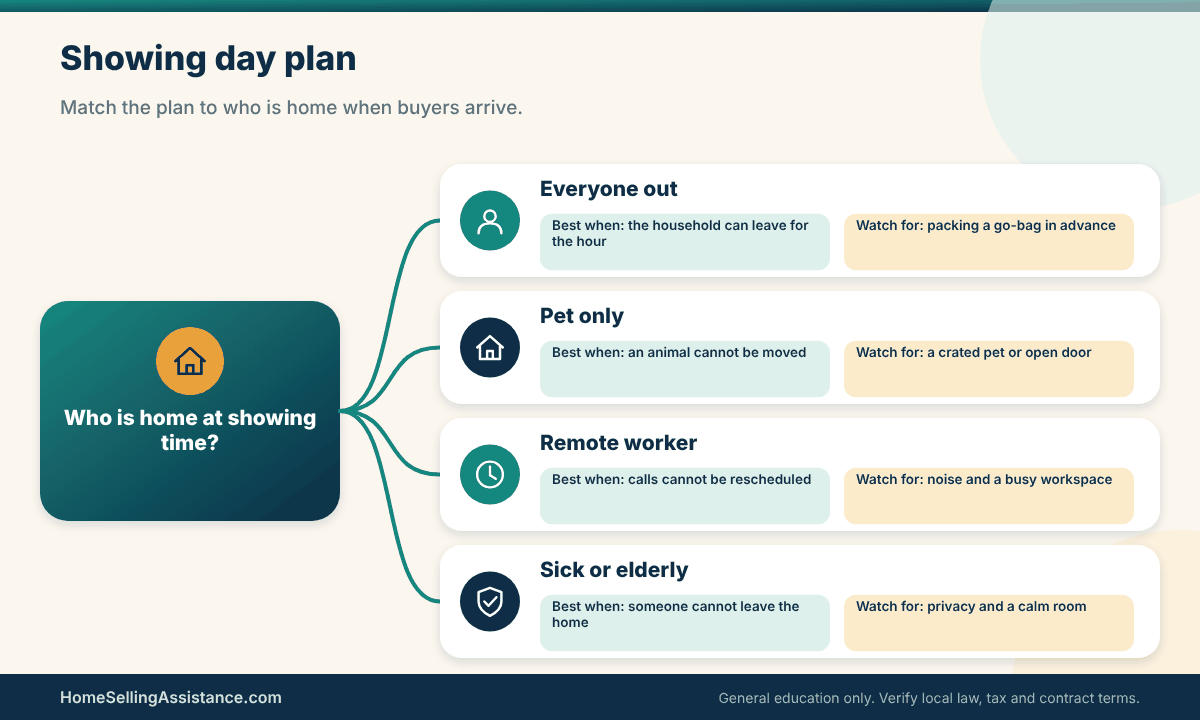
One more habit pays off in the early weeks: keep a simple log of each showing request, whether you approved it, and what feedback came back. After ten or twelve entries, patterns appear. You may see that evening requests rarely turn into offers, or that weekend visits generate the most interest. For anyone selling house while living in it, that log turns a vague feeling of being overrun into something you can discuss with your agent calmly.
It also helps to decide how you will handle photographers, stagers, cleaners and contractors, because they come into the home on a different schedule than buyers. Bundle those visits into the same few days where you can. Tell each visitor about the pet, the alarm and the off-limits areas. When selling house while living in it, fewer separate visit days means more ordinary days for the household.
Handoffs, negotiations, and contingencies when the sellers still live there
When an offer arrives, the conversation shifts from tidy-up logistics to contract terms, and the occupied-home details get more serious. Possession, move-out timing, access for inspections and appraisals, and the condition of the home on the final walk-through are all affected by the fact that you are living there. Each one should be addressed in the contract, not in side promises.
The table that follows is a transaction check table for selling house while living in it. It lists issues that often come up for occupied homes, the evidence a seller can bring, what the buyer, agent or title company will usually want to see, the main risk, and a fallback. Treat it as a conversation starter about selling house while living in it with your own agent or attorney, since terms and customs vary.
| Issue | Seller evidence | Buyer, agent or title input | Risk | Fallback |
|---|---|---|---|---|
| Possession after closing | Next-home contract or lease dates | Written occupancy terms from buyer’s agent | Dispute over move-out date | Short, clearly dated written extension |
| Inspection access | Calendar blocks, pet plan | Inspector’s expected duration | Missed appointment or damaged goods | Reschedule with notice, secure valuables first |
| Appraisal visit | Tidy rooms, utility access | Lender or appraiser instructions | Delay if access fails | Offer alternate windows in writing |
| Items left or removed | Written list of included fixtures | Contract inclusions and exclusions | Disagreement at walk-through | Photograph and list items before listing |
| Final walk-through condition | Photos from before and after move-out | Buyer’s walk-through checklist | Last-minute repair demand | Agree on a written cleaning and condition standard |
| Utilities and keys | Account numbers, transfer dates | Title company instructions, buyer’s start date | Gaps in service or key confusion | Schedule transfers and key handoff together |
To use this table well, pick the two or three rows that match your situation and ask the other side to confirm each one in writing. If a row feels vague, that is the row to clarify before signing anything, because vague terms are where friendly sales tend to turn into arguments.
Consider whether any parts of the home should be closed to showings by agreement, such as a locked home office, a bedroom where someone is sick, or a studio with expensive equipment. Buyers can still see the room in photos or a description, and your agent can explain why. This kind of boundary is reasonable when selling house while living in it, as long as it is applied consistently and does not become a way to hide known defects.
Evidence to bring: dates, photos, and written inclusions
Occupied homes carry a particular risk at the contract stage: the buyer is purchasing something you are still using. That makes documentation unusually valuable. Before the listing goes live, photograph each room and take a short video of the exterior, systems and any item that might be debated, such as window coverings, mounted televisions, appliances or garden fixtures.
Keep a written inclusions and exclusions list that matches the listing. If you plan to take the dining room chandelier, say so in the listing and the contract. Surprises at the final walk-through are among the most common sources of tension in an otherwise smooth sale, and they are almost always preventable with a sentence or two of clear writing.
For dates, gather real ones. Your next home’s closing or lease start, the school calendar if children are changing schools, and the availability of a mover are all facts that shape what possession terms you can offer. A seller who knows their true earliest and latest move-out dates can negotiate with confidence. A seller who guesses may agree to a date that turns out to be unworkable.
Finally, gather the facts about utilities and services. Know which accounts are in your name, whether there are final readings to schedule, and whether any services such as security monitoring, internet or lawn care are under contract and need to be cancelled or transferred. The title company or your agent can often tell you how local practice handles these items.
Offers also differ in how much they ask of an occupied home. Some buyers want a quick closing, which leaves you little time to find the next place, while others want long inspection windows and multiple visits. A thoughtful seller weighs not just the price but the burden each set of terms puts on the household. Selling house while living in it makes that burden concrete, because every extra visit is a morning you have to rearrange.
When two offers look similar on price, compare the occupancy terms, the inspection schedule, the proposed closing date and the buyer’s flexibility. Ask your agent what each buyer’s proposed timeline would mean in practice for your family. Selling house while living in it rewards the offer that fits your real calendar, not only the one with the largest headline number.
A scenario with a rent-back request and your next step
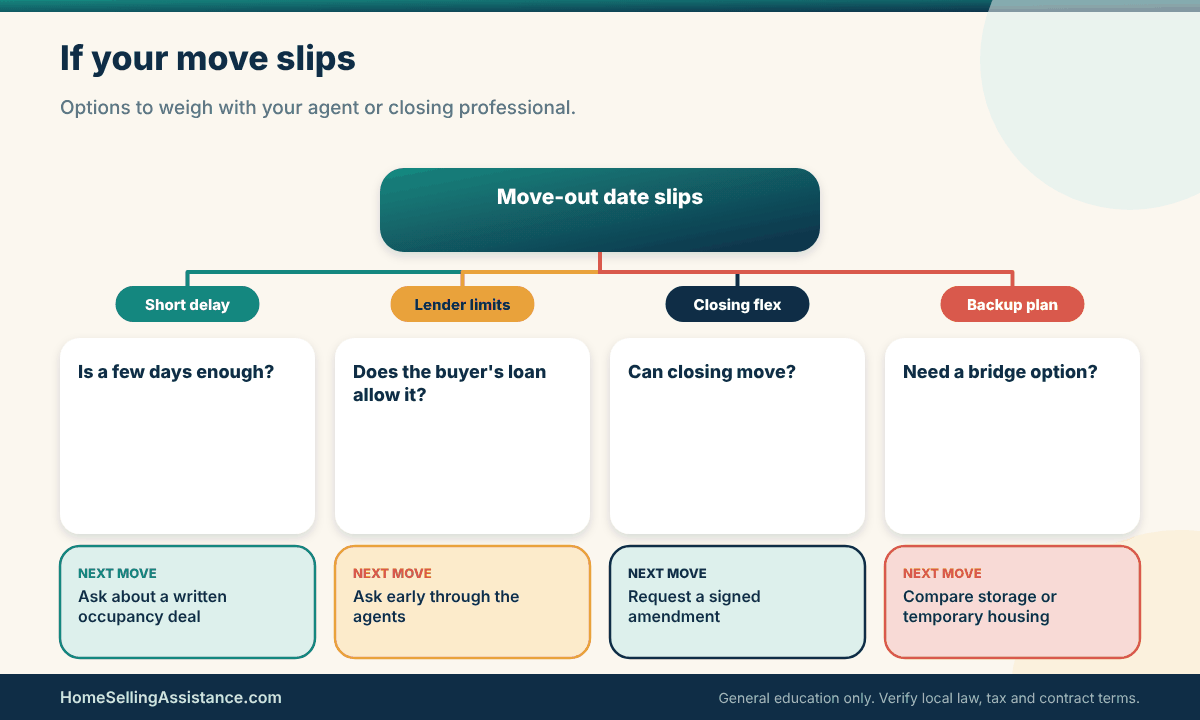
Say a buyer makes a strong offer, but the sellers have not yet closed on their next home and need a few extra days after closing. The sellers ask for a short post-closing occupancy period. The buyer is willing in principle but wants it written down, including a daily charge, a deposit or holdback, responsibility for utilities, insurance expectations and a firm end date.
This arrangement is often called a rent-back or post-closing occupancy agreement, and the rules and standard forms differ widely by state and local custom. Our overview of the rent-back agreement for sellers explains the typical pieces. For the specifics of your location, ask your agent, an attorney or your title company which forms are used and what lenders in your area will accept.
The exception to watch is a buyer’s lender. Some lenders restrict post-closing occupancy for certain loan types, and a surprise at the last minute can derail the plan. Your next step is to ask early, through the buyers’ agent, whether the lender is comfortable with the proposed occupancy period. If not, line up a fallback such as a slightly earlier move-out, a short storage arrangement or temporary housing.
Close the loop on selling house while living in it
The last stretch is where occupied-home sellers carry the most invisible work. You are packing, scheduling movers, forwarding mail, closing accounts, and still keeping the house presentable for a final walk-through. It is also where small informal understandings, made in a friendly spirit weeks earlier, tend to resurface. The cure is to turn every understanding into text and to keep what you need afterward.
Closing practices for selling house while living in it differ a great deal across the country. In some states an attorney leads the closing, in others a title or escrow company does, and the timing of key exchange, funding and recording varies. Ask your agent or closing professional to explain your local sequence in plain terms, so you know when you must be out and when the money arrives. Our piece on the move-out date versus closing date goes through the distinction.
A short note on tone: nothing here assumes the buyer is acting in bad faith. Most buyers and agents are reasonable. Written terms simply protect everyone from the ordinary memory failures that happen under stress, and in selling house while living in it stress is part of the package.
What to confirm in writing before you hand over the keys
By the time you reach closing week, the question is no longer whether selling house while living in it is possible. The question is whether every promise about the move is on paper. If you feel awkward asking for that, remember that a clear paper trail protects the buyer as much as you. Experienced agents and closing professionals expect these requests.
Evidence to collect: possession terms, walk-through standards, and utility dates
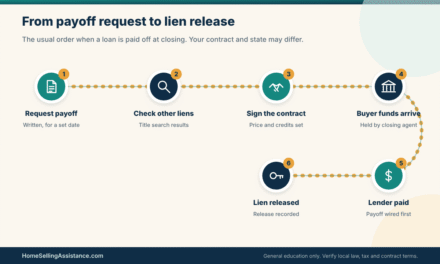
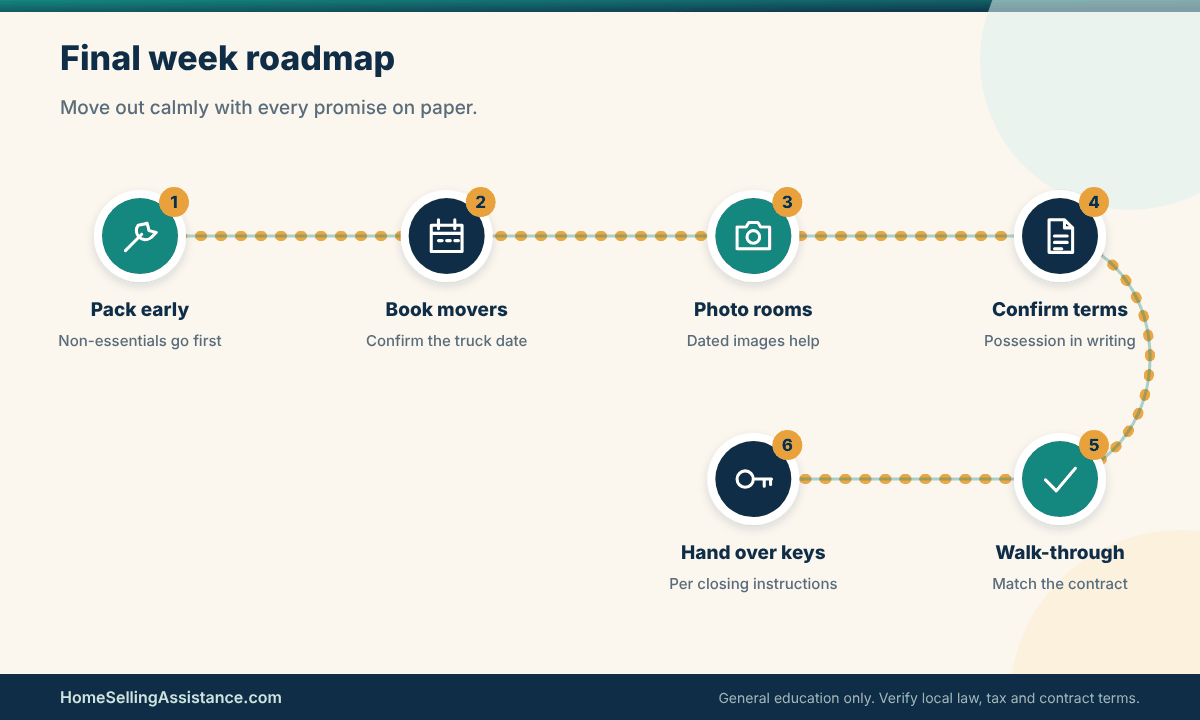
Start with possession. Your contract should state when the buyer takes possession, whether that is at closing, at funding, or after a post-closing occupancy period. If your sale involves a rent-back, the written agreement should include the end date, the daily or monthly amount if any, who pays utilities, who is responsible for damage, insurance expectations, and what happens if you stay past the agreed date. These are the points that cause problems when they are left implied.
Next, get the condition standard in writing. A final walk-through is usually a check that the home is in the condition promised in the contract, that agreed repairs were made, and that items that were supposed to stay did stay. Ask your agent what standard applies: broom-clean, professionally cleaned, or something else. If the standard is unclear, you may find yourself arguing about a scuff on the wall after the truck has left.
Confirm the inclusions list again. Fixtures, appliances, window treatments, outdoor items, garage shelving, smart-home devices, remotes, and keys should be listed. For smart devices, ask how accounts are to be reset or transferred, so that nobody keeps control of a thermostat or doorbell camera after the sale. Photograph the house the morning of the walk-through. A dated image is a better memory than your own.
Finally, confirm utility and service dates with a short written message to the buyer’s side. Include the planned date for final meter readings, the date you intend to cancel services, and the date the buyer expects to start theirs. For sellers still unsure what comes next in the process, our guide on what happens after accepting an offer covers the typical sequence from acceptance to closing.
Think about your move-out checklist as its own mini project. Book movers or a truck early, arrange boxes and tape, schedule cleaning, and decide what goes to storage, donation or the dump. Many people selling house while living in it start packing non-essentials before listing, because that is also the best decluttering. By closing week, the rooms are already half empty, which makes the final days calmer.
A scenario with a delayed move and a next step
Imagine a seller whose new home was supposed to be ready on Friday, but the builder pushes the date by five days. Closing on the old home is set for Monday. The seller panics, because the movers are booked and the buyers are expecting the keys. A friendly text to the buyers’ agent might produce a verbal “sure, take a few days,” which sounds like relief but is not a plan.
A safer path is to call the listing agent and the closing professional the same day and ask what options exist. Perhaps the closing date can move by a few days with an amendment. Perhaps a short post-closing occupancy agreement fits. Perhaps the buyer would prefer a firm earlier move and a storage arrangement. Whatever the choice, it goes in writing and is signed by everyone who needs to sign.
The exception is when the delay is long enough to affect the buyer’s own housing or lender timeline. At that point the buyer may have limited room to help, and the contract’s remedies for delay may come into play. We would not give advice on those remedies here. Ask an attorney or your closing professional to explain how your state’s contract language treats late possession, and keep the conversation factual and calm.
Records and follow-up after closing
For anyone selling house while living in it, closing day feels like the finish line, but a short tail of paperwork and housekeeping remains. Occupied-home sellers often have more of it, because the house is tied to daily routines: mail, subscriptions, school records, medical offices, bank addresses, vehicle registration and insurance. Giving yourself a post-closing list prevents surprise bills and missed documents.
Evidence to keep: closing documents, photos, and communication logs
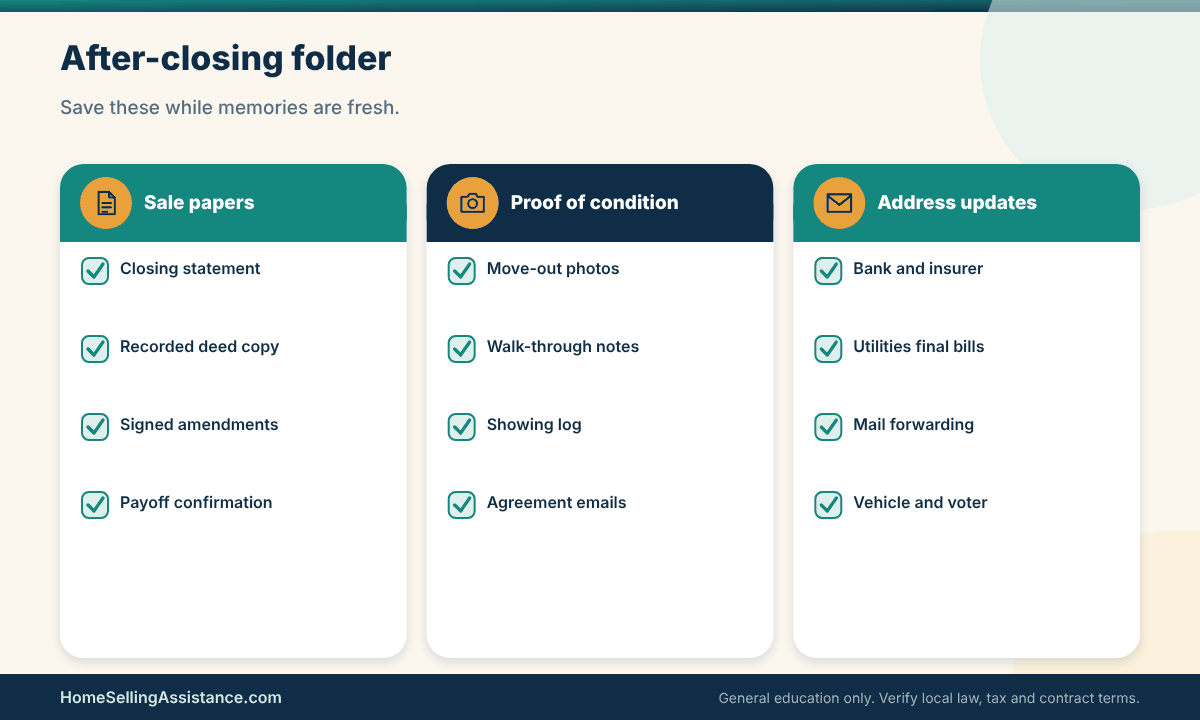
Save your closing statement, the deed or transfer document as recorded, payoff confirmation from your lender, the signed contract and any amendments, and receipts for improvements or selling expenses. Our piece on the seller closing statement explains how to read the numbers. Keep digital copies in two places, and keep paper copies in a folder you can find in five years.
Tax questions after a sale are individual, and general articles cannot answer them. Still, it helps to know that the IRS publishes plain-language material on selling a home, including how the ownership and use tests work and what records matter, in IRS Publication 523. A tax professional can apply it to your facts. Keep records of purchase price, improvements and selling costs, because the documents you throw away today are the ones you may need later.
Keep your communication log as well: the showing notes, the dates you agreed on, the emails confirming possession and walk-through terms, and the photos from before and after move-out. If a dispute appears months later, even a modest log can settle it. Most disagreements end up being about who said what, and dated records quiet that argument fast.
Finally, keep your final utility readings, service cancellation confirmations and a forwarding-address confirmation. Several months after closing, a stray bill or a tax notice sent to the old address can be sorted out faster when the evidence is already in a folder. Our broader home seller privacy checklist suggests what to update so personal information does not trail after you.
Give yourself a few extra notes for the weeks after the sale. Update your address with banks, insurers, schools, doctors, employers, voter registration and the motor vehicle office. Forward mail through the postal service and watch for strays. Anyone who finished selling house while living in it already knows how many everyday systems are tied to a single address, so a written list is kinder to your future self than memory.
Finally, take a moment to reflect on what worked. If you ever sell again, your notes on showing windows, pet arrangements and the reset routine become a head start. People who have gone through selling house while living in it once tend to say the second time is far easier, mostly because they already know which rules they will insist on from day one.
A scenario with a lingering bill and a next step
Consider a seller who moved out on closing day, forwarded the mail, and forgot that an irrigation service was billed annually. Four months later, a renewal invoice arrives at the new owner’s address, and then a collection notice finds its way to the seller. Without records, the seller would have to reconstruct who cancelled what and when.
With a tidy folder, the fix is quick. The seller sends the cancellation email, the closing date and the service account number to the company, and asks for the charge to be reversed. If the company does not respond, the seller can ask the title company or the buyer’s agent to confirm the date of transfer. The step that makes this possible was a short post-closing checklist, made in the week after closing.
The exception is a charge related to the property itself, such as a tax or association fee that should have been prorated at closing. If you suspect an error, contact the closing professional promptly with the statement in hand. Timing matters, and so does the paper trail.
Quick scenario
A couple sells while their two children are at home and one partner works remotely. They post windows of weekday afternoons and Saturday mornings, keep a small go-bag for the dog, lock away documents and medications, and agree on a three-day post-closing occupancy in writing. After closing they save the statement, photos and messages in one folder. The sale is not effortless, but nothing in it comes as a surprise.
Frequently asked questions about selling house while living in it
Is selling house while living in it a bad idea?
Not inherently. Plenty of people succeed at selling house while living in it, and many have no practical alternative because they need the home until the next one is ready. The trade-off is convenience and daily comfort against some added planning, since you need to keep the house show-ready while you use it. If you can set clear rules for access and a realistic cleaning routine, it can work well.
How much notice should I require for a showing?
There is no single correct answer. Shorter notice usually brings more flexibility for buyers and more disruption for you, while longer notice protects your routine but may reduce traffic. Ask your listing agent how showings are typically scheduled in your area, then set a rule you can live with for several weeks. You can adjust it after reading the first round of feedback.
Do I have to leave during showings?
Customs vary, but most agents strongly recommend that sellers step out. Buyers tend to speak more freely and look more carefully when the owners are not present, and sellers hear comments that are hard to ignore. If you have a reason to stay, such as a health condition or a caregiving duty, mention it to your agent so they can plan around it.
What should I do with pets during showings?
Move them out of the house if you can, or confine them in a safe, quiet area with clear notes on the door. Not every visitor is comfortable around animals, some are allergic, and a startled pet can bolt through an open door. Our guide on selling a house with pets goes into practical routines, from crates to odor control.
How do I protect valuables and personal information?
Lock away or remove medications, jewelry, cash, keys, checkbooks, passports and any paperwork with account numbers or Social Security numbers. Turn off or cover indoor cameras and smart speakers, and tell your agent that you have done so. Consider a small lockable cabinet or a bag you take with you. The more you handle before listing, the less you must remember on busy mornings.
Can buyers ask about my family or my personal situation?
Buyers may be curious, but you are not required to share personal details, and your agent can steer conversations toward the home. It is also important to keep fair housing principles in mind. HUD explains the basics on its fair housing and equal opportunity page, and our fair housing overview for home sellers covers the seller-side points in plain language.
What if the buyer wants to move in before closing, or I need to stay after?
Either arrangement should be negotiated in writing, with dates, costs, responsibilities and consequences spelled out. Practices and standard forms vary by state, and some lenders restrict occupancy before or after closing. Ask your agent, attorney or title company how it is usually handled where you live, and do not rely on a verbal understanding, however friendly the other side seems.
Should I stage the house if I am still living in it?
Light staging usually helps, and it does not require you to live like a showroom. The goal is to make rooms look spacious, clean and purposeful, which often means storing excess furniture and personal items. Our article on decluttering before selling covers a room-by-room approach, and you can combine it with the batch method from the table above.
How do I keep my family sane during selling house while living in it?
Treat it as a time-limited project with an end date, even if the end date is uncertain. Share the workload, agree on a “reset routine” that takes the same twenty or thirty minutes each time, and take real breaks from the cleaning. Many sellers also pick one room that stays off the tour and is allowed to be messy, which turns out to be a surprisingly effective relief valve.
What if I get a low offer or no offers after weeks of showings?
Do not read this as proof that you did something wrong. Review showing feedback, local sales of similar homes and how your price compares, and discuss adjustments with your agent or whoever is advising you. If the strain of staying has become too high, you may also revisit the idea of moving out before selling, at least for a while.
Make the routine fit your life
Selling house while living in it is a practical project: set your showing windows, plan for pets and children, protect your privacy, put every possession and move-out promise in writing, and keep your records afterward. Take one step at a time, and keep an eye on your own limits as well as the buyer’s. This article is general education, not legal, tax or financial advice, so confirm local rules with a licensed professional in your state.