Understanding your inherited house cost basis is the single most useful thing you can do before you sign a listing agreement or accept an offer on a property that came to you from someone who died. The number you start from decides how much of the sale price the IRS treats as profit, and in many estates it is far more favorable than people expect.
Here is the situation we see most often. A parent or relative passes away, the house sits for a few months, and the heirs begin talking about selling. Somebody remembers that the house was bought decades ago for a small fraction of today’s value and worries that a huge tax bill is waiting. Somebody else has heard that inherited property gets some kind of special treatment but cannot say what, or how to prove it.
The special treatment is real, and it has a name: a stepped-up basis. In general terms, the starting point for your inherited house cost basis is not what the previous owner paid. It is the property’s fair market value on the date the owner died, with a few exceptions we will cover. That one idea changes the math completely, but only if the value is documented well and the paperwork is kept.
This guide walks through how that value is found, which estate records support it, how the sale math works once you have a basis, and where the exceptions hide. It sits inside our wider guide to selling an inherited house, and it stays at the level of general education. Your own tax return is a job for a qualified professional who can see all of your facts.
Key takeaways
- The starting point is usually value at death, not the old purchase price. For most inherited homes, basis is reset to fair market value as of the date of death, which can sharply reduce the taxable gain on a later sale.
- Proof matters as much as the number. A date-of-death appraisal, estate inventory or similar record turns a guess into something you can show to a tax preparer or the IRS.
- Basis is only one part of the calculation. Selling costs, improvements you make after inheriting, and how long the house sits before sale also shape the result.
- Exceptions exist. Gifts made before death, jointly owned property, community property states, depreciation on a rental and elections made by the estate can all change the figure.
- Estates, heirs and states differ. Confirm your facts with the executor, a tax professional and official IRS publications before you rely on any number.
Define the tax question before you apply any inherited house cost basis rule
People often jump straight to a formula, and then the formula gives an answer to a question they never actually asked. Before anything else, decide what you are trying to find out. Are you estimating the taxable gain if the house sells next month? Are you comparing a sale now against holding the property and renting it? Are you deciding whether a buyout between siblings is fair? Each version needs the same inputs, but the answer is used differently.
The question also tells you who needs to be involved. If the estate itself will sell the house, the executor, the estate’s tax preparer and the closing attorney or title company are part of the picture. If the house was already distributed to you and recorded in your name, you are probably the seller, and your own return is where the gain is reported. Getting this straight early prevents a lot of confusion later.
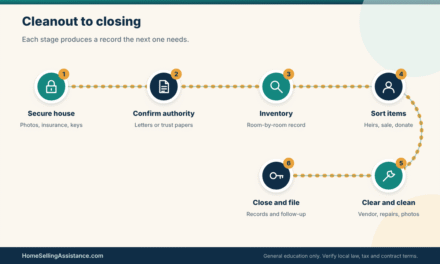
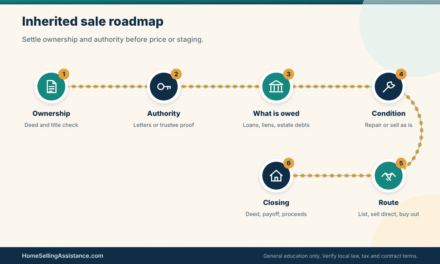
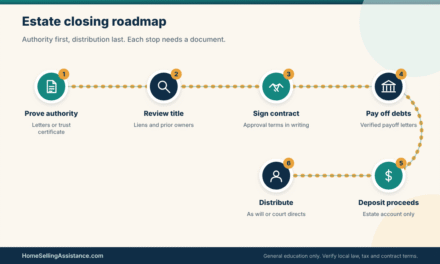
The roadmap below shows the order we suggest for the whole process, from confirming facts to keeping records. Each stop has a section in this guide, so you can jump to the one you need.
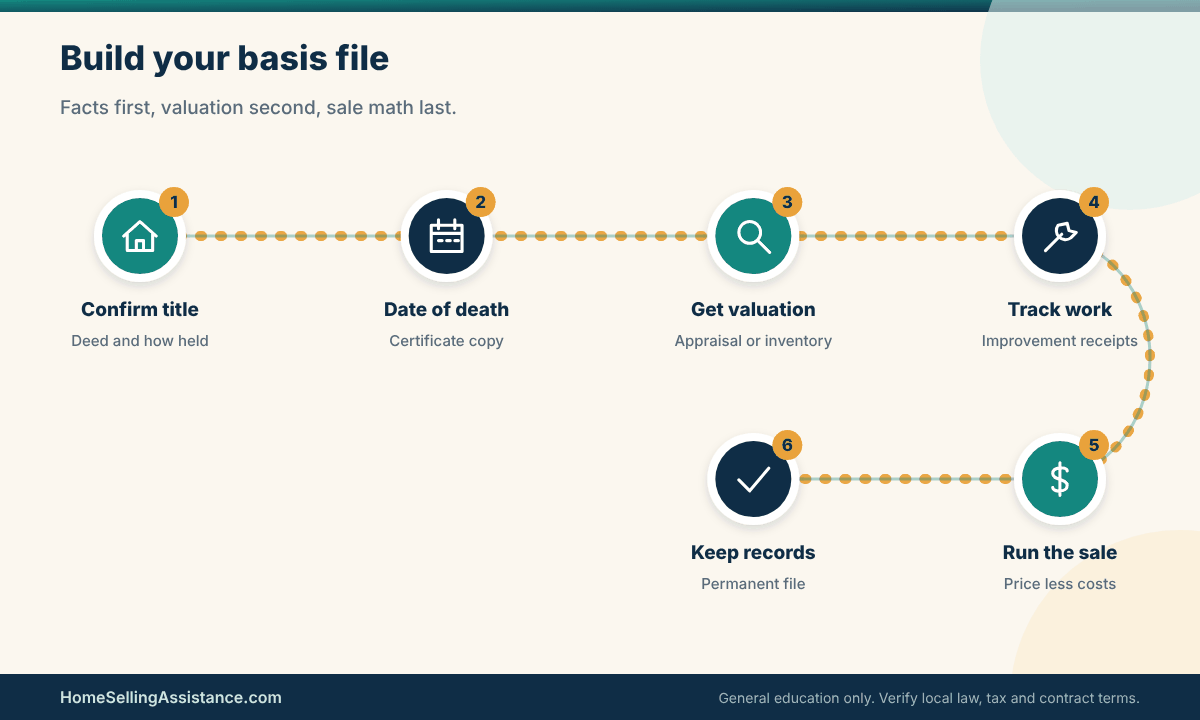
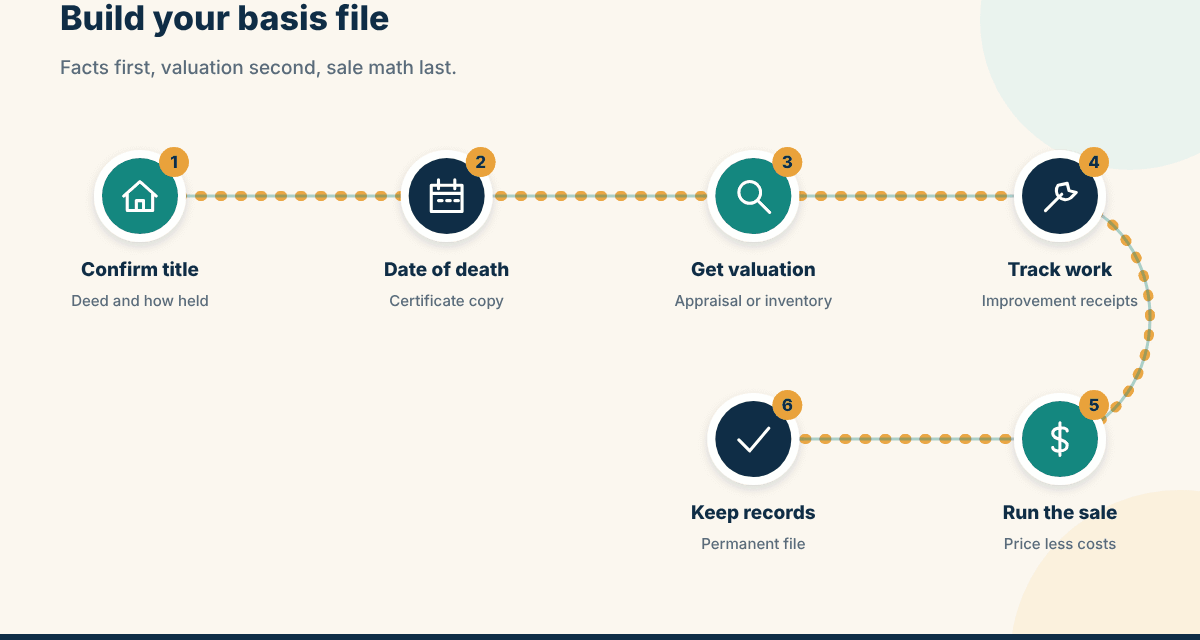
It helps to picture your inherited house cost basis as a small file rather than a single figure. The file holds a value, a date, a source for the value and a list of later adjustments. When any of those four pieces is missing, the inherited house cost basis is harder to defend, even if the number itself is perfectly reasonable. Building the file early, before a buyer is even in the picture, is the habit that pays off most.
Heirs sometimes ask whether the inherited house cost basis changes if the family sells for much more or much less than expected. It does not. The starting figure is fixed by the date of death and the valuation method, and the sale price only affects the gain or loss measured against it. That separation is useful, because you can settle the valuation calmly before the market tells you anything.
Ownership, use, and the facts that set your inherited house cost basis
Three plain facts do most of the work. First, who owned the house when the person died, and how was it titled? Second, on exactly what date did the death occur? Third, what has happened to the property since then: has anyone lived in it, rented it, repaired it, or paid its bills? Those facts feed directly into how an inherited house cost basis is built, so write them down in one place before you talk to anyone else.
Title matters more than most heirs realize. A house held solely by the decedent usually passes through the estate. A house held with another person as joint tenants with right of survivorship may pass outside the estate to the survivor, and the basis treatment can differ from what a sole owner leaves behind. Property held through a living trust brings its own paperwork. If you do not know how the deed reads, a copy from the county recorder will settle it.
The date of death is the anchor of an inherited house cost basis. It sets the valuation date for the usual rule, and it affects the holding period too. A well-known federal rule treats inherited property as long-term for capital gain purposes no matter how briefly you hold it. That is why an heir who sells soon after inheriting is generally not dealing with the short-term treatment, though your tax preparer should confirm how it applies to your return.
Evidence to gather: deed, death certificate, and title facts
Start with a short list of documents. You want the recorded deed showing how the decedent held title, a certified copy of the death certificate showing the date of death, and any letters testamentary or letters of administration if a court has appointed someone to act for the estate. If a trust owned the house, you want the trust document pages that show who can sell and who benefits.
Add the paperwork that tells the story of the property after death. Property tax bills, utility statements, insurance declarations and any invoices for repairs or cleanup all help later. They show who paid for what, they support improvements or selling expenses, and they help a tax preparer reconstruct the timeline. Keep copies in one folder, paper or digital, labelled with the property address.
A quick word about the deed. County recorder offices keep deeds on file, and many make copies available online or by request for a small fee that varies by county. If the deed is old, ask the recorder or a title company whether there are any later transfers, liens or recorded affidavits that never reached the family’s files. It is cheaper to learn this now than during a closing.
If the house is in a state with a transfer-on-death deed or a similar tool, the property may have passed to a named beneficiary outside probate. The tax idea is usually the same, because the inherited house cost basis still looks back to the date of death. What changes is who holds title and who signs at closing. Ask the county recorder whether a beneficiary deed was recorded after the death.
A scenario, an exception, and your next step for ownership facts
Take an illustrative case with round numbers. A mother bought a house many years ago and died owning it alone. The siblings inherit equally. The older purchase price is not the starting point for them, and the house’s fair market value on the date of death is. If a qualified appraiser puts that value at a figure the siblings can document, that figure is the starting point for the later sale math, your inherited house cost basis.
Now change one fact. Suppose the mother had added a daughter to the deed years earlier, as a joint owner, to avoid probate. That may change how much of the house is treated as inherited and how much is treated as a gift made earlier. The tax result can differ, sometimes significantly, and a short consult with a tax professional before listing is worth the time. Your next step is simply to get the exact deed and the date of death in hand.
A common worry is that reporting a sale at a low gain will draw attention. In practice, the opposite is more likely to cause trouble: a missing report, or a gain that does not match what the closing agent sent to the IRS. Using a documented inherited house cost basis lets you explain the difference between the sale price and the reported gain in one or two sentences.
Potential exclusion or reporting issue for an inherited house cost basis
Two questions tend to get mixed up here. One is whether any gain on the sale is taxable at all. The other is whether there is a form to file even if no tax is due. A stepped-up basis often leaves little or no gain, but a sale still has to be reported on the correct tax forms, and the closing agent may issue an information return of its own. A low gain from an inherited house cost basis is not the same as no paperwork.
You may also hear about the federal home-sale exclusion, which allows many homeowners to exclude up to $250,000 of gain, or $500,000 for qualifying married couples filing jointly, when they meet the ownership and use tests. That rule is aimed at people who owned and lived in the home themselves for two of the five years before the sale. An heir who never lived there generally cannot use it, though an heir who moves in and meets the tests might be a different story.
Evidence to gather: what the exclusion rules ask you to prove
If anyone is thinking about using the exclusion, collect proof of ownership dates and proof of use. The IRS tests look at two years of ownership and two years of use as a main home within the five years ending on the sale date. For an heir, the ownership clock and the use clock need separate documentation, such as the recorded deed or estate distribution date and records showing where you actually lived.
Useful evidence includes driver’s licenses, voter registration, tax returns showing your address, utility bills in your name and insurance records. None of these is magic, but together they show a pattern. The IRS publication on selling your home, Publication 523, explains the tests in plain language and is worth reading before you plan around them.
A scenario, an exception, and your next step for reporting
Picture an heir who inherits a house, keeps it vacant for six months while the estate settles, and sells at a value close to what it was worth on the date of death. The gain may be small. The sale still gets reported, and the heir still needs the basis records to support the figure on the return. Skipping the report because “nothing is owed” is the mistake to avoid.
An exception worth knowing about: if the estate sells the house before distributing it, the estate itself may report the sale and any gain, rather than the individual heirs. Who reports depends on how the estate is administered. Your next step is to ask the executor and the estate’s tax preparer who will report the sale and when you will receive any tax forms that reflect it. Our guide to inherited home sale taxes goes through the broader reporting picture.
Use current IRS rules and estate records to document your inherited house cost basis
Tax rules change, and the dollar thresholds around estates and home sales are adjusted from time to time. This article avoids quoting figures that move, and it points you to the primary source for each topic. For basis in general, the IRS has Publication 551 on basis of assets, and for estates and survivors there is Publication 559. Read the current year’s version, not an old copy a relative saved.
The records side is where most heirs lose time. The tax rule behind an inherited house cost basis is short. The proof is long. A defensible number for your inherited house cost basis usually comes from one of a handful of sources, and the best one depends on what the estate already did. The sections below take the records first and then the calculation that sits on top of them.
The table that follows is a working matrix you can copy into a notebook or spreadsheet. Each row is one input to the sale math. For every row you want to know where the number comes from, how it changes cash or tax, how sure you are of it, and which document backs it up. Use it as a prompt for questions, not as a replacement for a tax return.
| Input | Assumption or source | Cash or tax effect | Uncertainty | Verification document |
|---|---|---|---|---|
| Date-of-death value | Appraisal or estate inventory | Sets starting basis | Appraiser methods differ | Signed appraisal report |
| Sale price | Contract price | Gross amount realized | Credits can change it | Purchase contract |
| Selling expenses | Commission, title, transfer fees | Reduces taxable gain | Some fees are not deductible | Closing statement |
| Improvements after death | Capital work you paid for | May raise basis | Repairs versus improvements | Invoices and receipts |
| Mortgage payoff | Servicer payoff letter | Reduces cash, not gain | Per-diem interest changes it | Payoff statement |
| Holding costs | Taxes, insurance, utilities | Treatment varies | Who paid, estate or heir | Bills and bank records |
To use the matrix, fill the first column with your actual items and leave the other cells blank until you have evidence. If a cell stays empty, that is your to-do list. Where the uncertainty column says something varies, that is a good question for the estate’s tax preparer. A matrix with every cell sourced is a strong start for a conversation with a professional.
Think of the valuation report as the anchor of the file and everything else as support. When the report is solid, the inherited house cost basis rarely becomes a fight. When the report is weak, heirs spend months arguing about numbers that nobody can verify. If you are the person coordinating, make the valuation the first task, and let the other jobs follow from it.
For a deeper look at how basis adjustments work on any home sale, including purchased homes, see our explainer on adjusted basis in a home sale. The inherited case differs mainly in its starting point, while the later adjustments follow similar ideas. Reading both side by side can make the whole subject click.
Which records and calculations carry the most weight
Four records carry most of the load. The first is a date-of-death valuation, usually an appraisal, though some estates rely on an inventory filed with the court or on figures prepared for an estate tax return. The second is the closing statement from the eventual sale. The third is proof of improvements. The fourth is whatever documents show who paid carrying costs between death and sale.
The basic calculation for an inherited house cost basis is simple to describe. Start with the sale price, subtract the selling expenses, and you have the amount realized. Compare that with your inherited house cost basis, which is the date-of-death value plus qualifying improvements you made afterward. The difference is the gain or loss before any other adjustments. This is a general sketch only, and your return may involve additional steps.
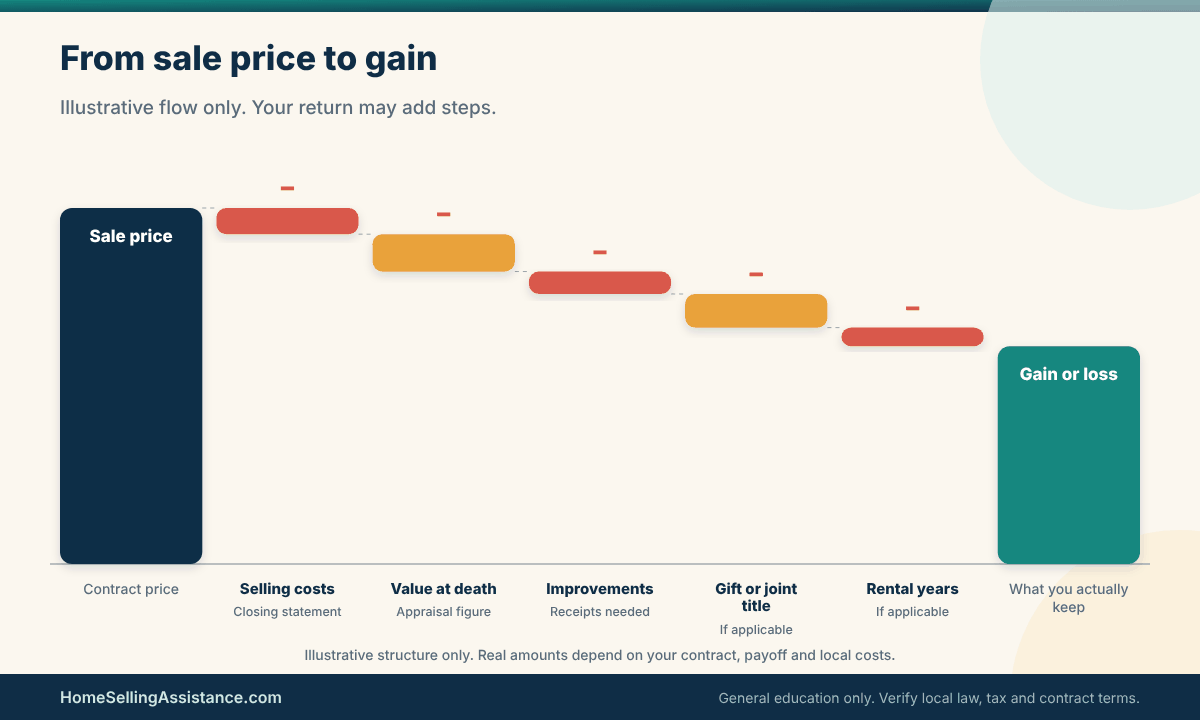
The sketch above is the waterfall of the sale: value in, expenses out, basis compared. The illustration shows that flow in a single picture, so you can see how an inherited house cost basis meets the sale price and which numbers come from the estate and which come from the closing table. When you later sit down with a preparer, walking through that same order saves time and avoids missed items.
When you hire an appraiser, describe the job exactly. You might say, “We need a report valuing this house as of the date of death, for estate and tax purposes, with the effective date stated on the first page.” That sentence tells the appraiser the purpose and the date. A report written for a mortgage lender or a listing is a different product, and it may not serve as support for your inherited house cost basis.
Evidence to gather: the appraisal, the inventory, and the estate tax file
A date-of-death appraisal is the cleanest evidence. It is usually prepared by a licensed appraiser who is asked to value the house as of a past date, and the report states the date, the method and the comparable sales used. Ask for the valuation date to be the exact date of death, and ask for the report to be addressed to the estate or the heirs so it clearly belongs to this transaction.
If no appraisal exists, check what the estate already filed. Probate courts in many places require an inventory of assets with values, and that inventory may include a figure for the real estate. Larger estates may have prepared a federal estate tax return, and when one is required, the estate generally must report the property values to heirs, which can include a statement of the basis figure. Ask the executor what was filed and request copies.
Be cautious with shortcuts. A county tax assessment, an online price estimate or a real estate agent’s opinion of value may help you decide whether to order an appraisal, but each can differ from what a careful valuation would show. Many people treat them as the final answer, and then find during a tax review that the figure does not hold up. Treat shortcuts as clues, not evidence.
Walk through the example once more with an eye on what you would need to prove. The inherited house cost basis of $400,000 needs an appraisal. The roof needs an invoice and a payment record. The selling costs need the closing statement. Three documents carry the whole calculation, which is why a short, orderly folder is worth more than a long, messy one. These are illustrative round numbers only.
A scenario, an exception, and your next step for calculations
Here is an illustrative example with round numbers only. Suppose a house was worth $400,000 on the date of death, the heirs spent $10,000 on a new roof before selling, and the house later sold for $430,000 with $20,000 in selling expenses. The inherited house cost basis would be $410,000, the amount realized would be $410,000, and the gain would be about zero. Real cases are messier, but the structure is the same.
An exception to keep in mind: if the heirs had owned the house for years as co-owners or the decedent had depreciated part of it as a rental, the starting figure and the adjustments may differ. In that case the numbers above would not apply cleanly. Your next step is to build a one-page timeline with dates and amounts, then ask your tax preparer to walk through it with you.
Heirs sometimes assume that any exception means a higher tax bill. That is not always true. Some exceptions help, some hurt and some simply change who reports what. The point of learning them is to avoid being surprised, because surprises tend to show up at closing, when little time remains to find documents. A thirty-minute conversation early can replace weeks of stress later.
Exceptions and uncertainty that can move your inherited house cost basis
The stepped-up basis rule is a general rule, and general rules have edges. Several situations can move the number, and it is worth knowing the list so you can ask the right questions. They include property the decedent gave away before death, jointly owned property, community property treatment for spouses, property held in certain trusts, depreciation claimed on a rental portion, and an election the executor may make about the valuation date.
Uncertainty is normal here. Appraisers can reach different conclusions, estates sometimes file late, and records are lost. The goal for an inherited house cost basis is not a perfect number, because a perfect number is rare. The goal is a reasonable, documented number that you can explain. That is also why we keep returning to records: a documented inherited house cost basis with a sensible method generally stands up better than a convenient one without support.
Evidence to gather: gifts, joint ownership, and community property
If the decedent gave the house to someone while alive, the recipient generally takes over the giver’s basis rather than receiving a step-up. That is called a carryover basis, and it can lead to a much larger gain on a sale. Look for any deed signed in the years before death, and ask the family whether any transfer happened, even an informal one, such as adding a child to the title.
For joint ownership between spouses, the rules often step up basis for part or all of the property when one spouse dies, and community property states have their own rules that can apply to both halves. Because inherited house cost basis rules for spouses depend on how title was held and where the couple lived, they are a classic reason to talk with a tax professional. Bring the deed, the marriage and residence history, and any prior tax filings.
Rental use is another record to find. If the decedent rented out the house and claimed depreciation, the depreciation they took generally does not follow the heir, because the step-up resets basis at death. But the facts of how much of the property was a rental, and for how long, can still matter for the final return. Publication 527 covers residential rental property and is the right place to check.
One more practical point: write down every assumption that sits behind your figure, and mark each as confirmed or unconfirmed. If your inherited house cost basis rests on an appraisal, say so. If it rests on a court inventory, say so. A short note of this kind lets a preparer see at a glance which parts are solid and which need follow-up, and it keeps the conversation focused.
A scenario, an exception, and your next step for uncertain facts
Imagine two siblings who disagree about the house’s value at death. One points to the county assessment, the other to an agent’s estimate, and the numbers are far apart. Rather than argue, they hire one appraiser to value the house as of the date of death and agree to use that report. The cost is modest next to the tax difference, and the argument stops because there is now one source.
The exception is an estate that elected an alternate valuation date, which is a limited choice available only in certain estate tax situations and generally tied to a six-month-later date. If that election was made, the inherited house cost basis may follow it. Your next step is to ask the executor directly whether any election was made on an estate tax return, and to get the answer in writing.
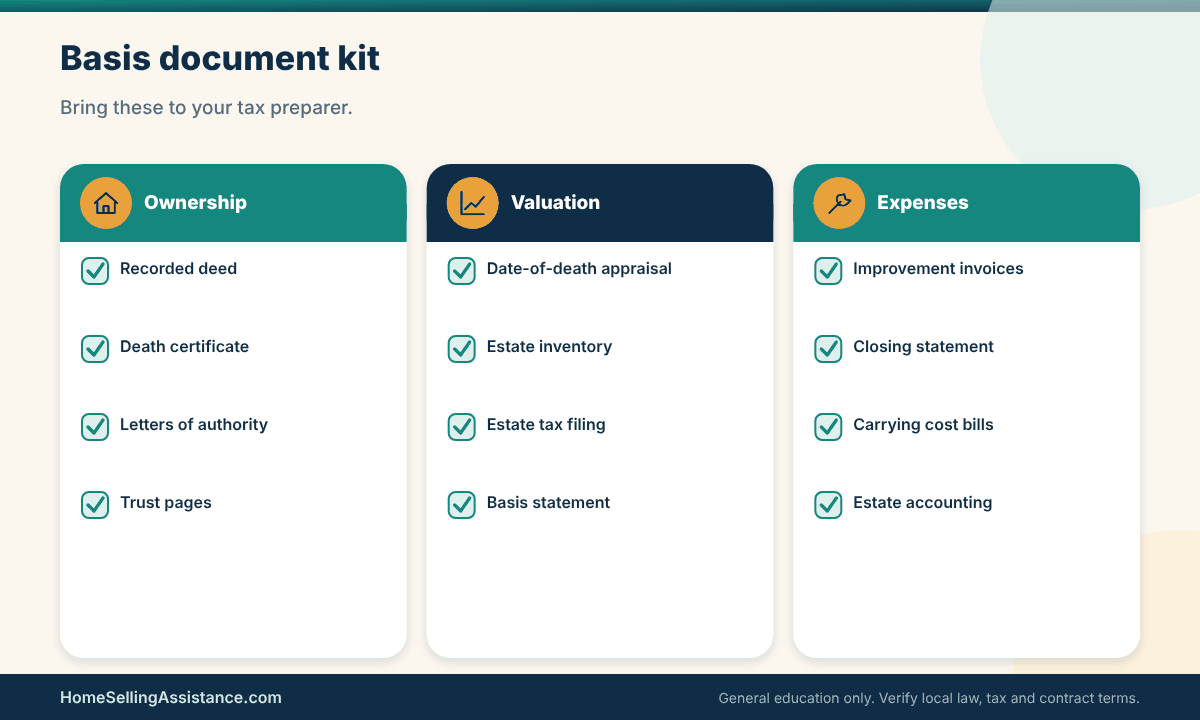
The checklist in the picture above is the document set to ask for before you talk about numbers. Think of it as a starting kit: the deed, death certificate, valuation report, inventory, improvement receipts and carrying cost records. If you have these, a preparer can usually give you a much firmer answer than if you arrive with a shoebox and a memory.
Escalate fact-specific questions about your inherited house cost basis
There is a point where reading stops being useful and a conversation with a professional becomes the better use of your time. You reach it when your facts do not fit the simple version: more than one owner, a trust, a rental period, a gift, an estate tax return, a house in a community property state, or a sale price far above or below the date-of-death value. Those are the cases where a few hundred dollars of advice can protect a much larger amount.
Escalating does not mean handing everything over and walking away. The best results come from heirs who arrive prepared, with a timeline, a document folder and a short list of questions. A tax preparer or estate attorney can do more in an hour with a clear file than in three hours with a pile. Our executor selling a house guide covers how the person in charge of the estate fits into this.
Before you pick up the phone, it helps to see how different situations change the inherited house cost basis math. The scenario table below shows several common heir situations side by side. The figures are not predictions. They describe what tends to move, so you know which question to ask. Every row is general, and none of it replaces a review of your own papers.
| Seller situation | Sale, loan or tax assumption | Estimated effect | Key risk | Professional question |
|---|---|---|---|---|
| Sole heir sells quickly | Sale near date-of-death value | Little or no gain likely | Weak value documentation | Is our appraisal enough? |
| Several heirs, one sale | Each takes a share of basis | Gain split by share | Unequal expenses paid | How are costs allocated? |
| Heir holds, then sells | Market rises after death | Gain above stepped-up basis | Missing improvement receipts | What counts as an improvement? |
| Prior gift of the house | Donor basis carries over | Possibly large gain | No step-up assumed in error | Did the gift change basis? |
| Former rental property | Rental use before death | Treatment depends on facts | Depreciation confusion | How do rental years affect us? |
| Heir moves in first | Possible exclusion tests | Depends on two-year tests | Timeline gaps | Can I meet ownership and use? |
To use the table, find the row that sounds most like you, then read the last column as your agenda. If two rows apply, bring both. A conversation that starts with “I think I am the third row and partly the fifth” is far easier for a professional to help with than a general request for tax advice. Keep notes during the call so you can repeat the guidance to other heirs accurately.
Cost matters, so be direct about it. Ask each professional how they charge, what a first call covers and whether a flat fee is possible for a defined task. Many appraisers and preparers will quote a clear price for a narrow job. A narrow question about your inherited house cost basis is also cheaper to answer than an open-ended request to review the whole estate.
If you are unsure where to start, a good first call is the estate’s attorney or the executor, who can tell you which professionals have already been involved. The estate may already have a valuation, a tax preparer and a calendar of deadlines. Reusing that work saves money, and it keeps every heir reading from the same set of numbers. Our guide to selling before probate is finished explains how timing and authority interact.
Which professional questions to bring to a tax preparer or estate attorney
Different people answer different questions. A tax preparer or enrolled agent knows how your return will treat the sale. An estate attorney knows who has authority, how title passes and what the court expects. A certified appraiser knows how to value the house at a past date. A title company or closing attorney handles the mechanics of the sale itself. When you know which question belongs to which person, you stop paying one professional to guess about another’s field.
It also helps to ask for the work in a form you can keep. A short email summarizing what the professional advised, based on the facts you provided, gives you a record and lets you spot misunderstandings early. Most professionals are happy to confirm in writing what they said on the phone, and a note like that is useful if another heir later asks why you made a choice.
Evidence to gather: a question list for each adviser
For the tax preparer, bring the date of death, the deed, any valuation report, the estimated sale price and any improvement receipts. Ask how the inherited house cost basis was determined, whether anything in your facts changes the standard treatment, who reports the sale, and what records they want to keep. Ask also whether estimated tax payments might be needed in the year of sale, since a large gain could create a payment obligation before the return is due.
For the estate attorney, bring the will or trust, any court papers and the list of heirs. Ask who has the legal authority to sign the deed, whether court approval is needed for the sale, and when proceeds can be distributed. For the appraiser, ask for a report valuing the property as of the date of death, with the effective date stated and comparable sales from around that time. The cost is usually a fraction of what a documented basis can protect.
Written questions beat memory. Put your list in an email or a shared document and number the items. Then, when you hang up, you can check whether every question got an answer. If a professional says a question depends on facts you have not yet found, that is useful too, because it tells you which document to look for next.
A different kind of escalation is worth mentioning. If you receive a letter from the IRS about a sale of inherited property, do not ignore it and do not guess. Gather the file, note the response date and contact a tax professional promptly. A well-kept inherited house cost basis file turns most of these letters into routine exchanges, and a missing file turns them into expensive ones.
A scenario, an exception, and your next step for professional advice
Consider an heir who calls a tax preparer with only the words “I inherited a house and want to sell.” The preparer will reasonably ask a dozen questions the heir cannot answer, and the first meeting is mostly wasted. Contrast that with an heir who sends the deed, the death date, a draft appraisal and a note that the house is listed next week. The second meeting can go straight to the interesting issues.
An exception worth planning for is timing. If the property is under contract and you only now discover a question about basis, the closing may not wait. For that reason, we suggest talking to the professional before listing, not after an offer arrives. Your next step is to schedule a short consultation, send documents in advance, and ask what additional information would change the advice.
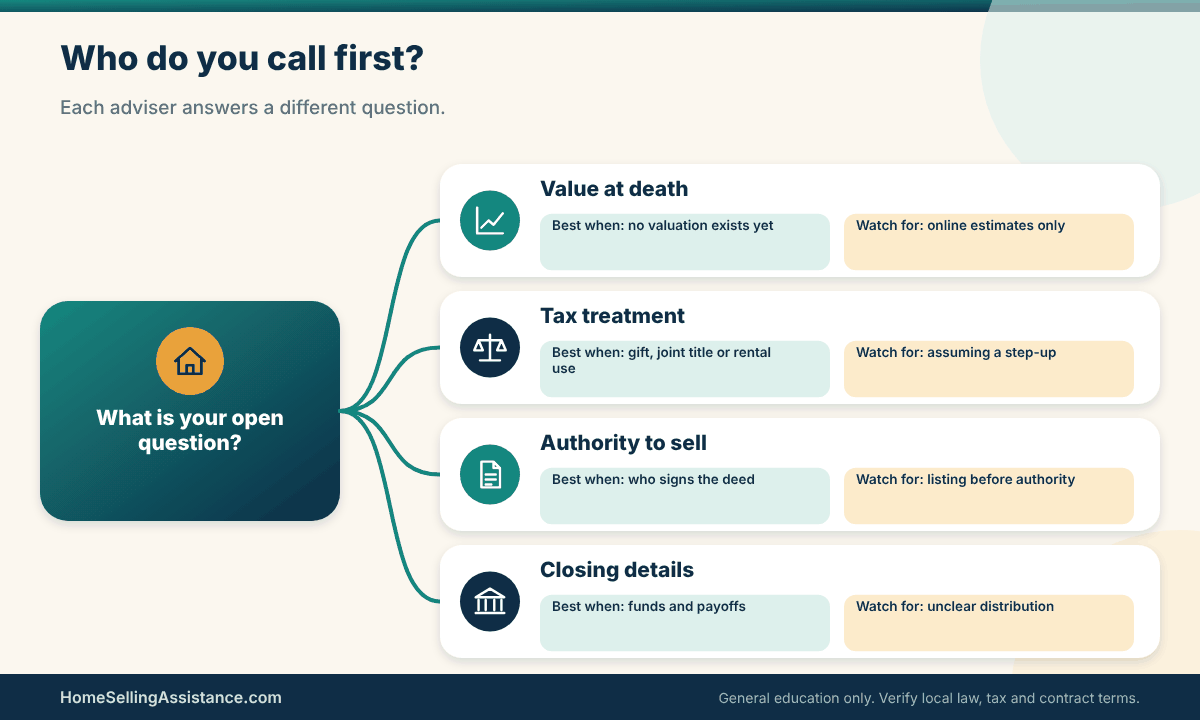
The decision fork above shows how the question usually branches: who owned the house, how the value was documented and what happened after death. If you follow the branch that matches your situation, you will see which adviser to call first. For many families the appraiser comes first, because the other professionals need that valuation before they can say much.
Closing day is a good moment to ask the title company or closing attorney for a complete copy of the settlement documents. Many heirs only receive a summary page. The full set, which usually includes the final closing statement, the deed and the payoff letters, belongs in the file beside your inherited house cost basis evidence. Our overview of the estate home sale closing process explains who signs and where funds go.
Records to preserve after the sale closes
People tend to relax after the closing, and that is when records get thrown away. An inherited house cost basis question can resurface years later, when a return is reviewed, when a sibling disputes how costs were shared, or when a surviving heir sells a related property. The usual guidance is to keep tax records for as long as they matter to the return that used them, and the IRS explains retention periods in its publications.
For property, that generally means keeping the basis records for as long as you own the asset plus the period when a return reporting the sale could be examined.
For an estate sale, that means keeping the closing statement, the valuation report, the improvement receipts, proof of who paid carrying costs, the executor’s accounting and any tax forms you received. If the estate was settled by an attorney, ask for a closing letter or a final accounting that you can file with the rest. Our guide to home sale tax records lists the paperwork a seller should keep.
Evidence to gather: the permanent file for the sale
To protect your inherited house cost basis, create one folder, physical or digital, titled with the property address and the year of sale. Inside, keep the deed, death certificate copy, valuation report, estate inventory, closing statement, improvement invoices, bank records for estate expenses and any correspondence with the tax preparer. Scan paper documents and store the scans somewhere other than the device you use every day.
Label each document with a short note saying what it proves. A one-line label such as “Date-of-death appraisal, supports starting basis” is worth the minute it takes to write. Years later, you will not remember which of three similar PDFs mattered. Backups matter too, and a second copy kept by another heir or the estate’s attorney can save you if your own files are lost.
If a form like a basis statement came from the estate, store it with the valuation report, since the two should agree. If they do not agree, raise it with the executor before the tax return is filed. A mismatch noticed early is a quick call, and a mismatch noticed during a review is a harder conversation. The consistent-reporting idea behind some estate tax forms exists for this reason.
If you plan to hold the house rather than sell it, keep the same file anyway. Your inherited house cost basis will matter whenever you eventually sell, and records are far easier to collect while the estate is fresh than ten years later. Add a yearly note listing improvements and carrying costs. A single page per year is plenty, and it gives your future self a clear paper trail.
Heirs who are curious what the house might be worth today, separate from its value at death, can read how to estimate what your house is worth. That figure helps with pricing a sale, while the date-of-death figure drives the tax math. Keeping the two numbers in separate columns avoids a classic mix-up.
A scenario, an exception, and your next step for record keeping
Imagine three siblings who sold a house and split the money. Years later one sibling is asked by the IRS to support the inherited house cost basis figure on a return. The sibling who kept the appraisal, the closing statement and the improvement invoices answers in an afternoon. The sibling who tossed the folder after closing has to pay for a retrospective valuation, which is costly and less persuasive.
The exception is shared custody of records. When several heirs sold together, one person often holds the file, and the others assume everything is safe. We suggest every heir keep their own copy of the core documents. Your next step is to ask the executor for a full set of copies now, before the estate closes and the contact information goes cold.
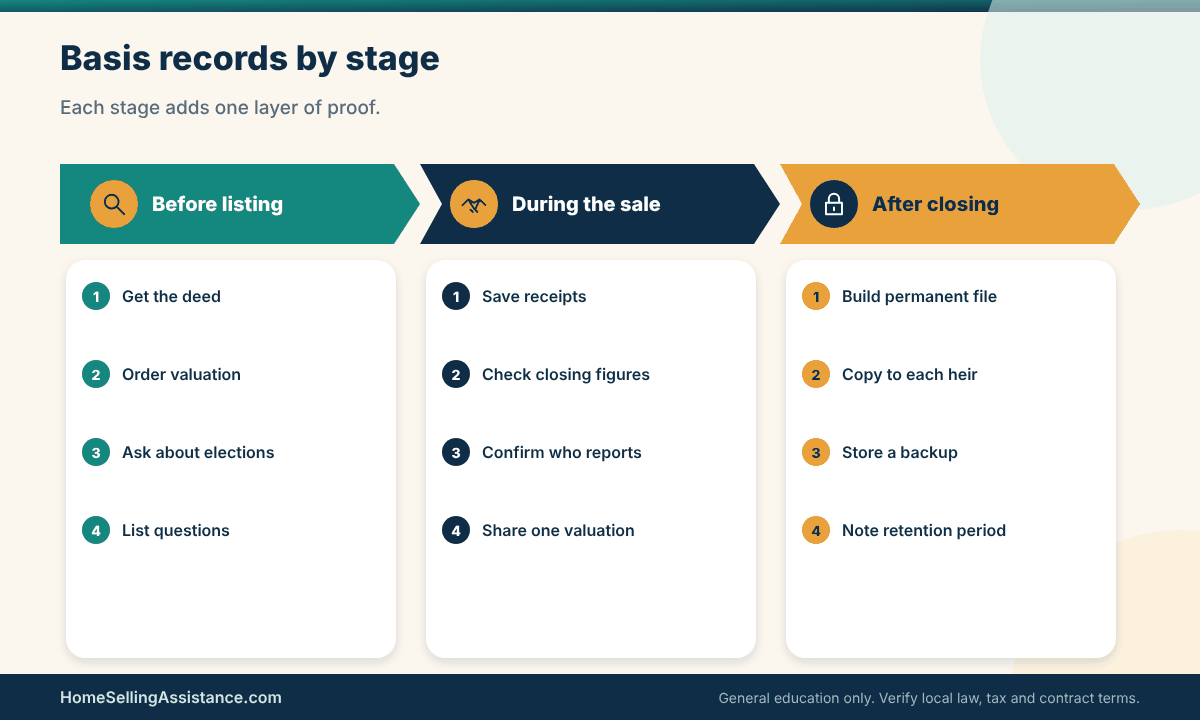
The final graphic summarizes what to do and what to keep across the whole process, so you can check your progress at a glance. If something on it is blank in your own file, that is where to put your effort this week. A small gap found now is easy to close.
Quick scenario
Two brothers inherit their father’s house and agree to sell it within a year. They order one date-of-death appraisal, split the cost, keep every repair receipt and ask the executor for the estate inventory. At closing the sale price lands a little above the appraised value, and the selling costs offset most of the difference. They bring one folder to the tax preparer. The numbers here are illustrative, but the habit is the point: one valuation, one folder, one set of questions.
Frequently asked questions about inherited house cost basis
What is an inherited house cost basis in plain terms?
It is the starting number used to decide whether you made a profit when you sell. For most inherited homes, that number is the fair market value on the date the owner died, rather than the price the owner originally paid. An inherited house cost basis can then be adjusted for certain improvements, and selling expenses are weighed against the sale price. Your own tax return is where the final figures are set.
Do I always get a stepped-up basis on an inherited house?
No, though it is the usual result for property that passes at death. Exceptions include houses the decedent gave away before death, some jointly held property, and situations shaped by community property rules or an estate election. Because of those edges, you should confirm how title was held and whether any transfer happened. An arrangement among several heirs adds another layer worth checking.
How do I prove the date-of-death value?
The strongest proof is a written appraisal by a licensed appraiser that states the date of death as its valuation date. An estate inventory or estate tax return may also contain a documented value. Online estimates and county assessments are weaker evidence and may not satisfy a reviewer. If no good record exists, a retrospective appraisal is often still possible.
Can I order the appraisal after the house has already sold?
Often yes, because appraisers can value property as of a past date, though the work is harder as time passes and comparable data gets harder to find. Doing it before listing is cleaner and usually cheaper. It also gives you a number to use while pricing the sale. For an inherited house cost basis, ask the appraiser how they handle past valuation dates and what they will need from you.
Does the holding period matter if I sell soon after inheriting?
In general, inherited property is treated as held long-term for capital gain purposes, no matter how briefly the heir owns it. That is a well-known federal rule, and it often surprises people who expect a short holding period. Your preparer should confirm how it applies to your return. Check the current IRS guidance rather than relying on a summary.
Do repairs I make before selling raise my basis?
Only some work does. Capital improvements that add value or extend the property’s life may increase basis, while ordinary repairs and maintenance usually do not. The line between the two is not always obvious, so keep every invoice and ask your preparer to classify them. Our guide to home improvements and cost basis explains the distinction in more detail.
Who reports the sale, the estate or the heirs?
It depends on whether the house is sold by the estate or after it has been distributed to the heirs. If the estate sells, the estate may report the gain. If title has passed to you, you probably report it on your own return. Ask the executor and the estate’s tax preparer which applies, and how you will receive any related tax forms.
What if the heirs disagree about the value?
Agree on one neutral source, ideally a single appraiser engaged for all of you, and share the report. Arguing over competing estimates is expensive and can lead to inconsistent tax reporting among siblings. If disagreement continues, an estate attorney or a mediator can help. It is better to settle the number before the sale than after the proceeds are divided.
Does the home sale exclusion help an heir?
Sometimes, but only if the heir meets the ownership and use tests, which generally means living in the home as a main residence for part of the period before sale. An heir who never lived there typically cannot claim it. If you plan to move in, read IRS Publication 523 first and talk with a professional before relying on it.
How long should I keep basis records?
Keep your inherited house cost basis records for as long as you own the property and for the period when the return that reports the sale could be reviewed, which the IRS explains in its guidance. For an estate sale, that means the appraisal, closing statement, receipts and estate paperwork. Storing a second copy somewhere separate is a cheap way to avoid a costly problem later.
Where to go from here
A well-documented inherited house cost basis turns a worrying tax question into a manageable one. Gather the deed and the date of death, order one solid valuation, keep every receipt and ask the right adviser the right questions. For the wider picture, see our inherited homes and probate section and the home sale taxes library. This article is general education, not legal, tax or financial advice.