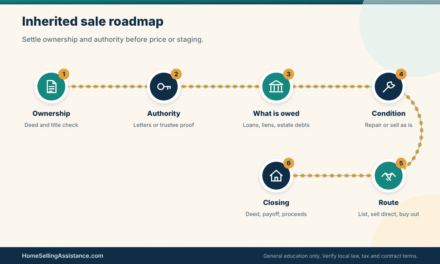
Whether you can sell inherited house before probate is finished comes down to one question that has nothing to do with the housing market: does the person who wants to sell hold legal authority to sign a deed today, and can they prove it to a buyer and a title company?
Many families who want to sell inherited house before probate assume probate is a waiting room. Someone dies, a court process starts, and nothing can happen to the house until a judge says so. Sometimes that is close to the truth. Sometimes it is not even partly true, because the house never needed probate at all, or because the person named in the will has already been given authority by the court within a few weeks. The honest answer is that it depends on how the property was titled, what documents exist and how your state handles estates.
This article shows you how to decide whether to sell inherited house before probate, and where you stand, before you spend money on cleanout crews, photographers or a listing. We will look at who owns and who signs, how federal and state rules divide the work, what a buyer and a title company will want to see, and how to build a short verification checklist. For the wider picture of the whole process, our cornerstone guide on selling an inherited house is a good companion, and the inherited homes and probate library goes deeper on individual topics.
A caution first. Probate rules are state law, and they differ in vocabulary, thresholds, timing and court involvement. Nothing here is legal advice for your estate. Where we use dollar figures or day counts, they are round, illustrative numbers that show how the reasoning works, not rules you can rely on.
Key takeaways
- Authority matters more than ownership talk. The right to sign a deed usually comes from a recorded document, a court appointment or a trust instrument, not from being a family member or even the named heir.
- Some homes never go through probate. Jointly held property, trust property and property with a transfer-on-death deed can follow a different path, and that can change what it takes to sell inherited house before probate would otherwise end.
- Listing and closing are different steps. Preparing the house and even accepting an offer can sometimes happen earlier than closing, but a title company will want proof of authority before it insures the buyer.
- Your state sets the rules. Court confirmation, notice periods, small-estate shortcuts and creditor claim windows vary, so confirm them with the probate court clerk, a probate attorney or a title company in the county.
- Build a file, not a hope. Certified death certificates, the will, deed copies, letters from the court and a payoff statement turn a vague plan to sell inherited house before probate into a sale a buyer can trust.
- Protect the property while you wait. Insurance, taxes, utilities and security keep running during probate, and gaps there can cost more than the delay itself.
Who has the power to sell inherited house before probate ends
If you hope to sell inherited house before probate, the first job is to separate three ideas that families tend to blur together: who inherits the house, who owns it right now, and who is allowed to sign the deed. In an ordinary sale these are the same person, so nobody thinks about the distinction. After a death they can be three different people, or the same person at three different moments. Everything else in this article builds on getting that sorting right.
Think of any plan to sell inherited house before probate as a chain. A document says who should receive the property. Another document, or a court order, says who may manage it in the meantime. A recorded deed says who the public record treats as the owner. A buyer looks at the end of that chain, and a title company looks at every link. If one link is missing, a plan to sell inherited house before probate does not necessarily die, but it usually waits.
Reading the deed, the will and the death certificate together
Start with the deed, because the deed tells you more than the will does about whether probate is needed. A deed recorded in the county land records shows how the decedent held title. If the home was held alone, it is typically a probate asset, which means someone will need court-recognized authority to deal with it. If it was held with another person with a right of survivorship, the surviving owner may already own the whole property, and the question becomes mostly one of paperwork.
Then read the will, if there is one. A will names who receives the house, and usually names the person who should manage the estate, often called the executor or personal representative. Naming is not the same as appointing. In many states the named person has no power over the house until a court issues a document confirming the role. Until then, that person is a candidate, not an officeholder.
The certified death certificate is the third piece. Title companies, banks, county recorders and courts all want certified copies, and they rarely accept photocopies. It is cheap to order several at once, and expensive in time to discover that you need a fourth copy when the other three are sitting in someone else’s file.
It helps to know the vocabulary before you meet a professional. Probate is the court-supervised process of confirming a will if there is one, identifying creditors and heirs, paying valid debts and then passing what remains to the people entitled to it. A probate asset is something that passes through that process. A non-probate asset passes by contract or title, such as a joint account, a beneficiary designation or a deed with survivorship language. The same family can hold both kinds.
That distinction is why a blanket yes or no on whether you can sell inherited house before probate is finished would be a bad answer. If the house is a non-probate asset, the real question may be which recorded document to file so the surviving owner or beneficiary can sell. If it is a probate asset, the real question is how soon someone can be appointed, and what the court will want to see before you can sell inherited house before probate with confidence.
Marital property rules can add a layer. In some states a surviving spouse has automatic rights in a home, such as a homestead right or an elective share, that exist alongside or even ahead of what a will says. Community property states treat property acquired during a marriage differently from common-law states. None of this means you cannot sell. It means a spouse, even one not named in the will, may have to sign or release an interest before a title company will insure.
Evidence to gather: deed, trust pages and beneficiary designations
Before anyone calls a listing agent, assemble a small evidence folder. You are looking for the most recent recorded deed, any trust agreement or certification of trust, any transfer-on-death or beneficiary deed that was recorded before death, the original will, and a list of any mortgage, home equity line or lien on the property. You can often pull the recorded deed yourself from the county recorder’s website or office, and a title company can run a fuller search.
Pay attention to dates and signatures, because they decide whether you can sell inherited house before probate. A transfer-on-death deed generally has to be recorded during the owner’s lifetime to work, and states differ on whether it can be used at all. A trust only controls property that was actually transferred into it, so a trust document sitting in a drawer does not prove the house is in the trust. The deed or a county record has to say so.
Make a note of every name that appears. If a deed lists “John Smith and Mary Smith, husband and wife,” the surviving spouse’s rights depend on how that phrase is treated in your state. If a deed lists a trustee, the successor trustee named in the trust agreement may be the one who signs. Write down what each document appears to say and flag anything you cannot interpret for an attorney.
A scenario: three siblings and a deed nobody has pulled
Picture three siblings who lost their mother. She had a will leaving the house equally to the three of them, and one sibling, Dana, is named executor. The siblings assume Dana can list the house this month because she is executor. Nobody has looked at the deed.
When Dana finally pulls the record, it shows the house was deeded years ago into a living trust, with Dana as successor trustee. That changes the picture considerably. The house may not be a probate asset at all, and Dana’s authority may come from the trust instrument rather than from a court. She still needs to show the trust terms and a death certificate to a title company, and the trust may give instructions about how to divide proceeds that differ from the will.
The lesson is not that one path is better. It is that the siblings were about to rely on a document that might not control the property. A short check of the land records prevented a listing agreement signed by the wrong person under the wrong authority. Your own next step is the same: pull the deed first, then decide which documents matter.
Federal rules versus state and local requirements
Families sometimes ask whether there is a national rule that says when an inherited house can be sold. There is not. Probate, titling, deed transfers and the authority of a personal representative are governed by state law, and the process runs through a county or state probate court. No federal agency decides whether you may sell inherited house before probate concludes.
Federal rules still matter around the edges. Federal tax law affects what you owe or report after a sale, federal lead-paint disclosure rules apply to older homes, and fair housing law governs how the home is marketed. Those rules apply whether probate is open, closed or never needed. They do not give anyone authority to sell, but they do shape what the seller must do once authority exists.
It also helps to split the legal landscape into layers so you know whom to ask. The federal layer covers tax reporting, lead-paint disclosure and fair housing. The state layer covers probate procedure, who counts as an heir, creditor claims, deed forms, disclosure statutes and licensing of agents. The county layer covers recording, property tax, local permits and the specific habits of your probate judges and title examiners. A question about whether you may sell inherited house before probate ends lives almost entirely in the second and third layers.
Local custom matters more than most families expect. In some counties, title companies routinely close a sale by a personal representative as soon as letters issue, which is how many families sell inherited house before probate is formally closed. In others, they wait for a creditor period to run, or for the court to confirm the price. Two attorneys in neighboring states can give you honest answers that sound opposite, because they are describing different systems. That is another reason to prefer a professional who works in the county where the house sits.
Where to confirm your state’s probate and small-estate rules
The most reliable sources are the probate court for the county where the decedent lived, the state court system’s self-help pages, and a licensed probate attorney in that state. Court clerks cannot give legal advice, but many can tell you which forms exist, what filing fees apply, whether the county offers a simplified process and how long an appointment usually takes. Ask them those procedural questions politely and specifically.
Look for the names your state uses for the key terms. Some states call the court-issued proof of authority “letters testamentary” when there is a will and “letters of administration” when there is not. Others use different labels. Some offer small-estate affidavits, summary administration or similar shortcuts for estates under a set value, and the thresholds differ widely. You will see wording like “voluntary administration,” “informal probate” and “formal probate.” Do not assume a term means the same thing across state lines.
Real estate is often treated differently from other assets under small-estate shortcuts. A procedure that lets a family collect a bank account without a full case may not let anyone transfer a deed. Ask the clerk or attorney directly whether the shortcut covers real property, and what a title company in your county typically accepts.
A scenario: the cabin in one state and the heirs in another
Suppose a father lived in a city in one state and owned a small cabin in another. His children all live in a third state. The will is simple, and the family has already opened an estate where he lived. They assume that one court appointment covers everything.
Usually it does not. Real property is generally controlled by the law of the place where it sits, and many states require a separate, sometimes shorter, court step to deal with land located there. The appointment from the home state may need to be recognized or supplemented in the cabin’s state before a title company will insure a sale. Procedures vary, and some states have streamlined versions for out-of-state personal representatives.
Your next step, if this sounds familiar, is to call a title company or attorney in the county where the property sits and ask what they need to see from an out-of-state estate. Ask early, because a second filing can add weeks, and the answer shapes whether it makes sense to list before the paperwork is complete.
Turning the legal question into a seller workflow
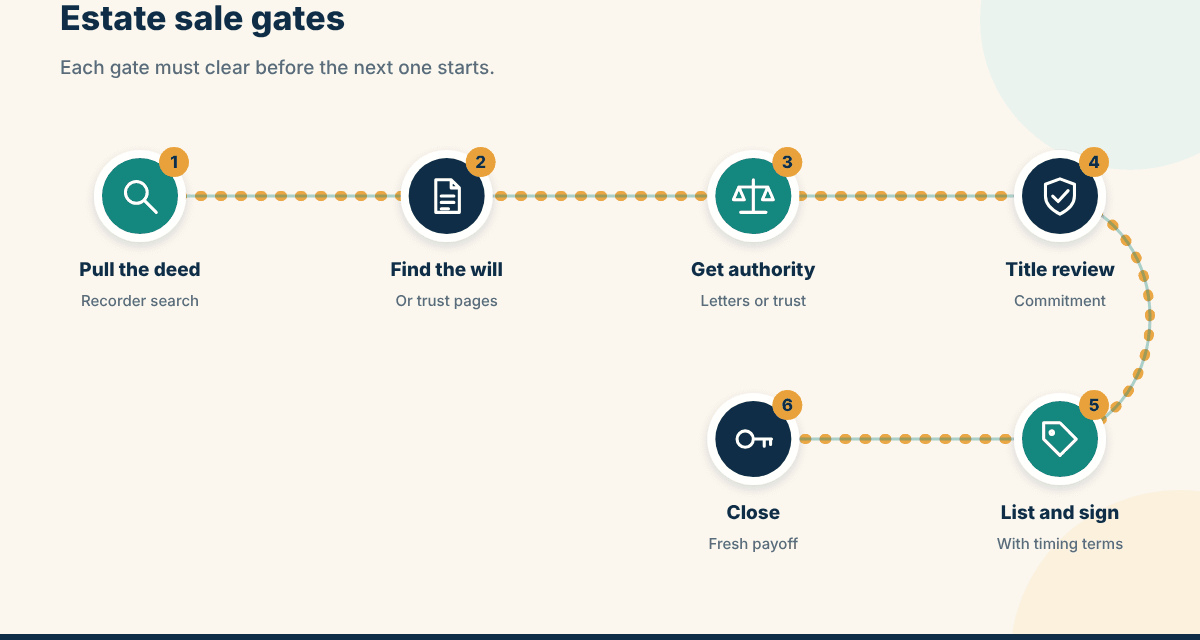
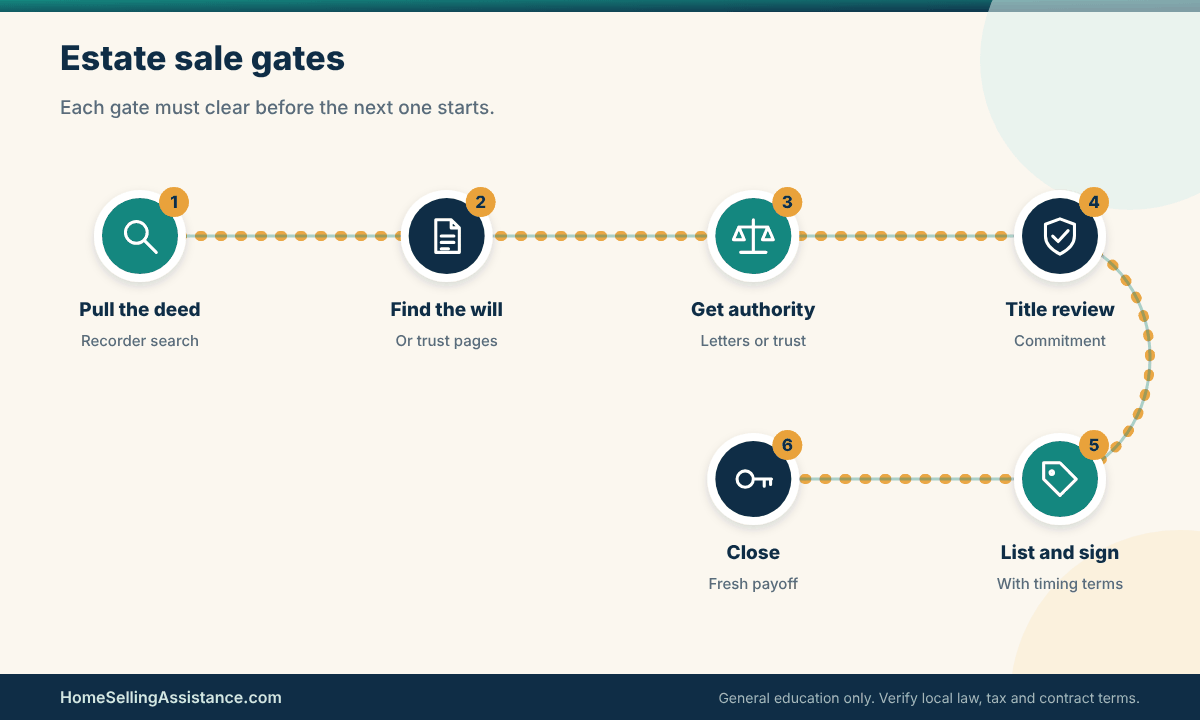
Once you know who holds authority, or what has to happen for someone to hold it, the legal question becomes a workflow with a sequence, owners and dates. This is where many families lose weeks, not because the law is hard but because nobody wrote down who was responsible for which document. Treat the plan to sell inherited house before probate as a project with a small number of gates, and decide at each gate whether you can proceed or must wait.
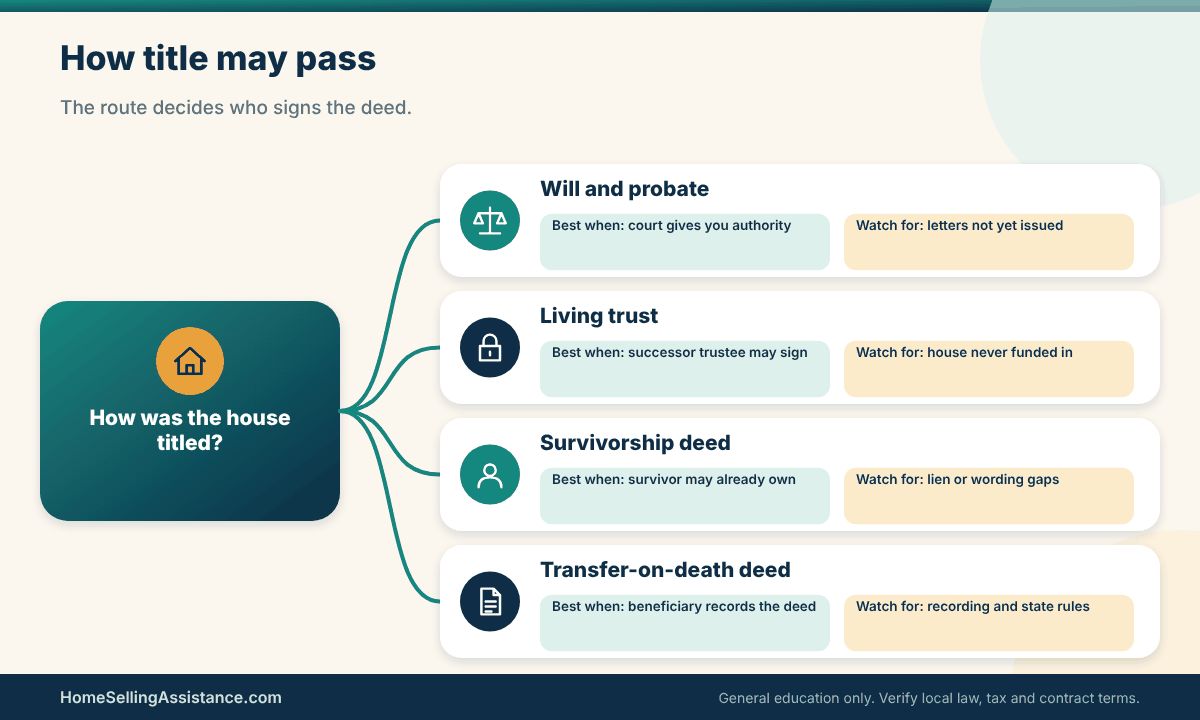
The visual below lays out the usual order of those gates when someone wants to sell inherited house before probate has formally closed. Notice that the listing sits in the middle, not at the start. Marketing a property can sometimes be done earlier than closing, but each step before the listing is about protecting the estate and confirming authority.
Disclosures, notices and approvals when the seller is an estate
When the seller is an estate or a trustee instead of an individual homeowner, the paperwork changes shape. A personal representative or trustee usually did not live in the house and may know little about its history. Many states still expect a seller disclosure form, though some give estates and fiduciaries an exemption or a modified form that says the seller has no personal knowledge. Others treat estate sales like any other sale. This varies, so ask the state real estate commission or an attorney which form applies.
Federal law adds one fixed requirement that does not depend on probate. If the home was built before 1978, federal rules require the seller to give buyers a lead-based paint disclosure and an EPA pamphlet, and to share any known information about lead hazards. The EPA real estate disclosure page explains the requirement. Estates are not automatically exempt, so do not assume the rule goes away because the seller is a fiduciary.
Some estate sales also need court or beneficiary approval, so ask early whether you can sell inherited house before probate without it. Certain states require the court to confirm a sale, which affects any plan to sell inherited house before probate, or give heirs notice and a chance to object, particularly when the estate is supervised or when the sale price is below a set share of appraised value. Others let a personal representative sell without any court approval if the will grants that power.
Whether your estate falls into the first group or the second is a question for the local court rules and an attorney.
The table below organizes the main issues into a matrix you can bring to a first conversation with a probate attorney or title officer. Use it as a question list, not as an answer sheet. The right-hand column tells you where to verify each point locally.
| Issue | Controlling document or authority | Seller obligation or choice | Typical deadline | Where to verify locally |
|---|---|---|---|---|
| Who may sign the deed | Court letters, trust instrument or recorded survivorship deed | Show authority to buyer and title company | Before closing; sometimes before contract | Probate clerk, title company |
| Court approval of sale | Will terms, state statute, local court rules | Seek confirmation or give notice if required | Varies by state and estate type | Probate attorney, court rules |
| Creditor claims period | State probate code and published notice | Decide whether to sell before or after the window | Set by state, often months | Probate court, attorney |
| Seller disclosure form | State disclosure statute, fiduciary exemptions | Complete, modify or note exemption | Often before or at contract | State real estate commission |
| Lead-paint notice, pre-1978 homes | Federal rule enforced by EPA and HUD | Give pamphlet and disclose known hazards | Before buyer is bound | EPA lead disclosure page |
| Mortgage or lien payoff | Recorded loan documents and payoff letter | Request payoff from servicer as estate representative | Fresh letter near closing | Servicer, title company |
Read the table from left to right for each row, and fill in the blanks with real answers from the county. If a row stays blank after your first round of calls, that gap is the thing to resolve before listing. A blank row is a risk, and a title company will usually find it for you if you do not find it first.
Documents the estate must produce for a buyer’s side
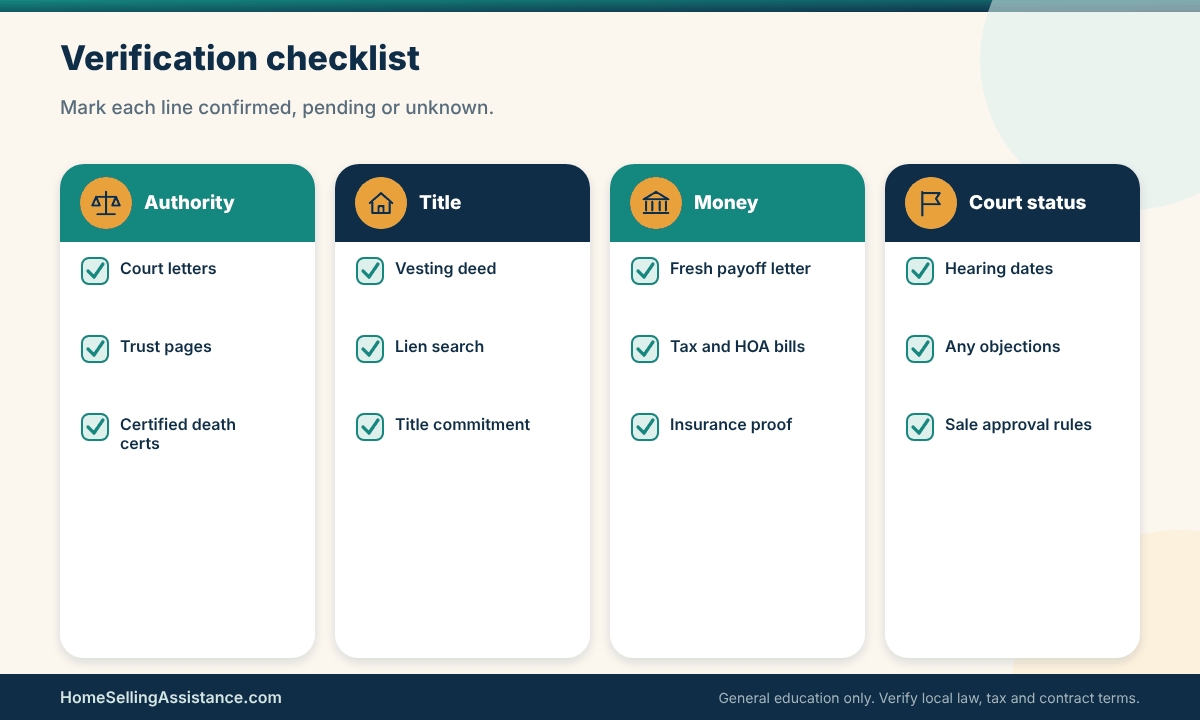
A buyer’s agent, lender and title company will each ask for proof that the seller can sell. Expect to produce certified letters or an equivalent court order if probate has opened, a certified death certificate, the will or trust pages that grant authority, and the recorded deed showing how title was held. Some title companies also ask for an estate tax clearance, a statement that no estate tax is due, or notice that creditors have been given the required time. Each company has its own checklist, so ask for it early.
Lenders add their own requirements when the buyer is financing, and a financed buyer is the hardest case if you sell inherited house before probate. An underwriter wants a clear chain of title and may ask for the same documents again in a different format. Cash buyers generally move through the same title review, but with fewer outside parties. Either way, the documents are cheaper to prepare once and share than to rebuild every time a different party asks.
Keep copies organized by purpose, since a sale to sell inherited house before probate involves many readers: authority, title history, property condition, and money. When a question arrives from a buyer at nine at night, you will be glad the answer is in one place. That small habit is worth more than any marketing trick during an estate sale.
A scenario: the buyer wants to close in 30 days
An offer arrives from a buyer who wants to close in thirty days. The family is delighted, because the house has been sitting empty and the carrying costs are mounting. The personal representative filed for appointment two weeks ago, and the court has not yet issued letters.
Several things could happen. If the court issues letters in a week or two, the thirty-day closing might work, provided the title company accepts them and no court confirmation step applies. If the court is slower, or the state requires a notice period before a sale, the closing date may have to move. A well-drafted contract can handle this with an extension clause or a contingency tied to the seller’s authority, but the buyer has to agree.
The practical approach, if you want to sell inherited house before probate, is honesty. Tell the buyer’s side early that the estate is waiting on authority, and ask whether they will accept a closing date tied to the court’s timing. Some buyers will, and some will walk. A seller who hides the delay risks a default dispute, and a seller who explains it clearly usually finds the buyers who can live with it.
Handoffs to title, court and attorney if you sell inherited house before probate
An inherited house sale involves more outside parties than an ordinary one, and the handoffs between them are where timing is won or lost. The court issues authority. The attorney translates what the court and statute require. The title company decides what it will insure. The lender, if there is one, underwrites. The buyer’s agent and the listing agent coordinate showings and negotiation. Each one assumes the others are doing their job.
If you want to sell inherited house before probate wraps up, the order of those handoffs matters even more. Early on, the attorney and the title company are your two most useful contacts, because they can tell you what the court and the insurer will accept. The agent can then work within those limits instead of discovering them in the middle of a contract.
The next table shifts from rules to situations. Estates differ, and the same legal question yields a different practical answer depending on the facts. Use it to find the row that looks most like your own, then read across to see the options, the risk, the documents to review and the point at which you should stop and call a professional.
| Situation | Seller options | Main risk | Document to review | Escalate to |
|---|---|---|---|---|
| Will names executor, no court case opened yet | File for appointment, then list or wait for letters | Signing without authority | Original will, deed | Probate attorney |
| House held in living trust | Successor trustee sells under trust terms | Property never funded into trust | Trust pages, recorded deed | Trust attorney, title officer |
| Joint owner with survivorship survives | Record death documents, then sell as owner | Missed lien or unclear deed wording | Vesting deed, death certificate | Title company |
| Several heirs, no will | Petition for administrator, then agree on sale | Disagreement among heirs | Heir list, court petition | Attorney, possible mediator |
| Buyer offers quick cash, estate unopened | Accept with authority contingency, or decline | Contract the estate cannot perform | Draft contract, title commitment | Attorney before signing |
| Mortgage in default after death | Contact servicer, consider a prompt sale | Foreclosure timeline running | Loan statements, servicer letters | Attorney, HUD housing counselor |
Use the table as a conversation starter, and expect your own estate to sit between rows. The pattern to notice is that every row ends with the same instruction in different words: confirm authority before you commit. That is the thread running through every safe path to sell inherited house before probate formally ends. Housing counselors approved by HUD can help with the mortgage rows, and you can find one at hud.gov/findacounselor.
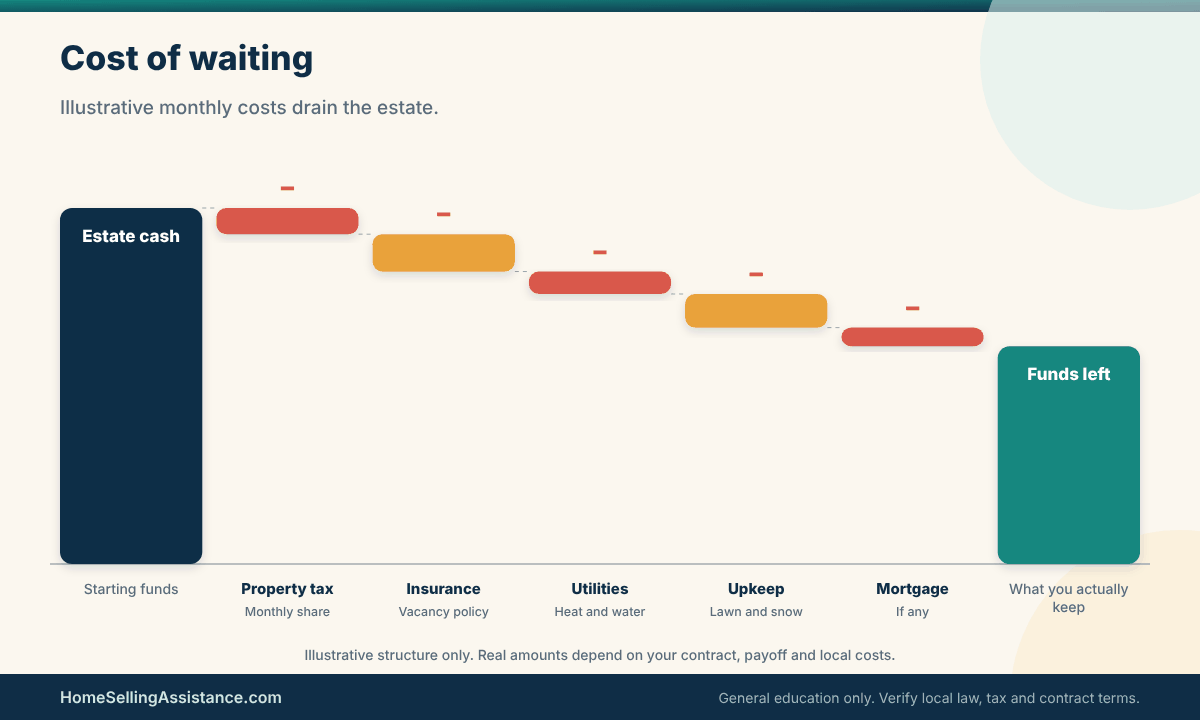
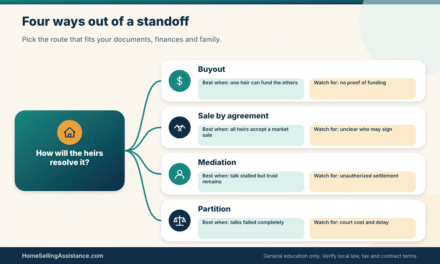
The decision tree above shows the same idea as a fork. If authority is already in hand, you move to pricing and disclosure. If it is pending, you decide whether to prepare while you wait. If it is unclear, you stop and get advice. Skipping the fork is how families end up with a signed contract and no way to deliver a deed.
Title company evidence requests to expect
Title companies protect the buyer and the lender against defects in ownership. When they see an estate, they start with a title search, then compare it against the documents the seller supplies. Expect questions about unreleased mortgages, judgment liens, unpaid property taxes, and anyone who might claim an interest, such as a surviving spouse or a child omitted from a will. You can read more about what a search covers in our guide to the title search in a home sale.
The title officer will also want to see that the person signing has authority and that the authority fits the transaction. Some letters limit a personal representative’s powers, and some wills grant broad powers to sell. A restricted appointment can block a plan to sell inherited house before probate until the court expands it. A title officer can read the letters and tell you quickly whether they are enough, and that conversation is free in most markets.
Ask what the company requires in writing, and ask whether it will issue a preliminary commitment before contract. A preliminary commitment lists the requirements to close, and it can turn a vague worry into a concrete to-do list. Treat it as a map, and share it with your attorney.
A scenario: the title company asks for letters you do not have yet
You have an offer, a signed contract and an opened estate file. The title officer calls and says the company cannot move forward without letters of authority. The court hearing is three weeks away, and the buyer’s lender is asking when title will clear.
You have a few options. You might ask the buyer for a short extension in writing, backed by the contract’s own extension terms. You might ask the attorney whether an emergency or expedited appointment is available in your court, since some courts hold quick hearings for estates with a pending sale. You might also check whether a different title company has a different view of the documents, though a shopping spree for a more lenient insurer is rarely wise.
What you should not do is sign a deed on a wing and a prayer. A deed signed without authority can be challenged later, and a challenge can cloud the buyer’s title and expose the estate to claims. If you are unsure, pause and ask. A few extra weeks of waiting costs less than a title dispute.
A verification checklist before you sell inherited house before probate
By now you have a picture of the moving parts. The last stretch is about turning that picture into checks you can actually perform, in order, with a named source for each. A checklist for anyone planning to sell inherited house before probate protects you from two opposite mistakes: moving too fast because the family is impatient, and waiting too long because nobody is sure what is required. It also gives you something to hand an attorney, so a paid hour covers judgment instead of data gathering.
The checklist graphic below groups the verification work into four buckets. You can use it as a printable starting point, and then add the items your own estate raises. Mark each line as confirmed, pending or unknown, and treat every unknown as a question for a professional.
Official sources and recorded documents worth pulling yourself
Official records beat family memory, especially if you plan to sell inherited house before probate. A relative may say that the mortgage was paid off years ago, that the house was put in a trust, or that a sibling was removed from the deed. Any of those might be true. Any might also be wrong in a way that only the public record can settle. The county recorder, the tax assessor, the probate court docket and the mortgage servicer are the primary sources, and most of them can be searched online or by phone.
Anyone trying to sell inherited house before probate should be careful with anything that arrives by email or phone and claims to represent the estate or the buyer. Fraud targeting estates is real, partly because the transaction involves a large asset and a grieving family. If wiring instructions change, or someone asks for money before a sale closes, stop and confirm by a phone number you found independently. The FTC at consumer.ftc.gov publishes plain-language warnings about these patterns.
Evidence to gather: recorder, tax and docket searches
To sell inherited house before probate safely, start with the county recorder. Search the property by address or parcel number and download the vesting deed, any recorded trust transfer, any transfer-on-death deed, mortgages, releases and liens. Note the book and page or instrument number for each. If the website is limited, the recorder’s office staff can usually tell you how to request copies, and a title company can pull the same records for a modest fee or as part of a search.
Next, check the tax assessor and collector. Confirm who is listed as the owner for tax purposes, what is owed, and whether any exemption, such as a senior or homestead exemption, ended at death. Some of those exemptions end automatically, and a bill can arrive later with a surprise. Unpaid taxes can become liens that must be cleared at closing.
Finally, search the probate court docket. Many courts have an online case search where you can see whether an estate has been opened, who petitioned, what hearing dates are set, and whether letters were issued. If you cannot find a case, call the clerk. Absence of a case may mean none is needed, or it may mean nobody has filed yet.
A scenario: the lien that nobody mentioned
A family prepares to sell their father’s house. They know there was a mortgage, and the servicer has been sending statements. What they do not know is that a contractor recorded a lien after an unpaid roof repair two years before the death.
The title search finds it. The lien is not a surprise to the contractor, who has been waiting for payment, but it is a surprise to the family. The buyer’s lender will not close with it on the record, so the estate has to pay it, negotiate a release or ask the court how to treat it as a creditor claim, depending on state law.
This is why the search comes first when you sell inherited house before probate. It costs little compared with listing, staging and signing a contract that then collapses. If your own search shows a lien, our guide to selling a house with a lien explains the general options, and your attorney can tell you how your state treats liens against an estate.
What must be current before signing
Documents go stale, and that matters whenever you sell inherited house before probate. A mortgage payoff statement is accurate for a particular day. Court letters can be limited, revoked or expire in some states. Title commitments reflect a snapshot of the record. Insurance policies on a vacant house may include restrictions that took effect after a certain number of days. The last review before signing should confirm that each key document is current, not merely present.
Build that review around dates, whether you sell inherited house before probate next month or next year. Write the date next to each item in your file, and ask yourself whether anything could have changed since. For estates, the typical changes are a new lien, a new claim, a new heir surfacing, a change in the court’s approval, or a lapse in coverage. Any of these can derail a closing if found late.
Carrying costs also change the math on waiting. While probate runs, the estate usually keeps paying property tax, insurance, utilities, lawn care and any mortgage or HOA dues. These payments can come out of estate funds if there are any, or out of a family member’s pocket with the hope of reimbursement. Keep receipts. A careful ledger of these costs helps with accounting later, and it helps heirs see that waiting for authority has a price as well as a purpose.
The figure below shows how those pieces stack up. Put real numbers into your own version, using bills and quotes in your file. For example, if illustrative monthly costs for tax, insurance, utilities and upkeep total a round two thousand dollars, then three months of delay means about six thousand dollars leaves the estate before any sale. That is an example, not a prediction, but it shows why the family may prefer a prompt sale once authority exists.
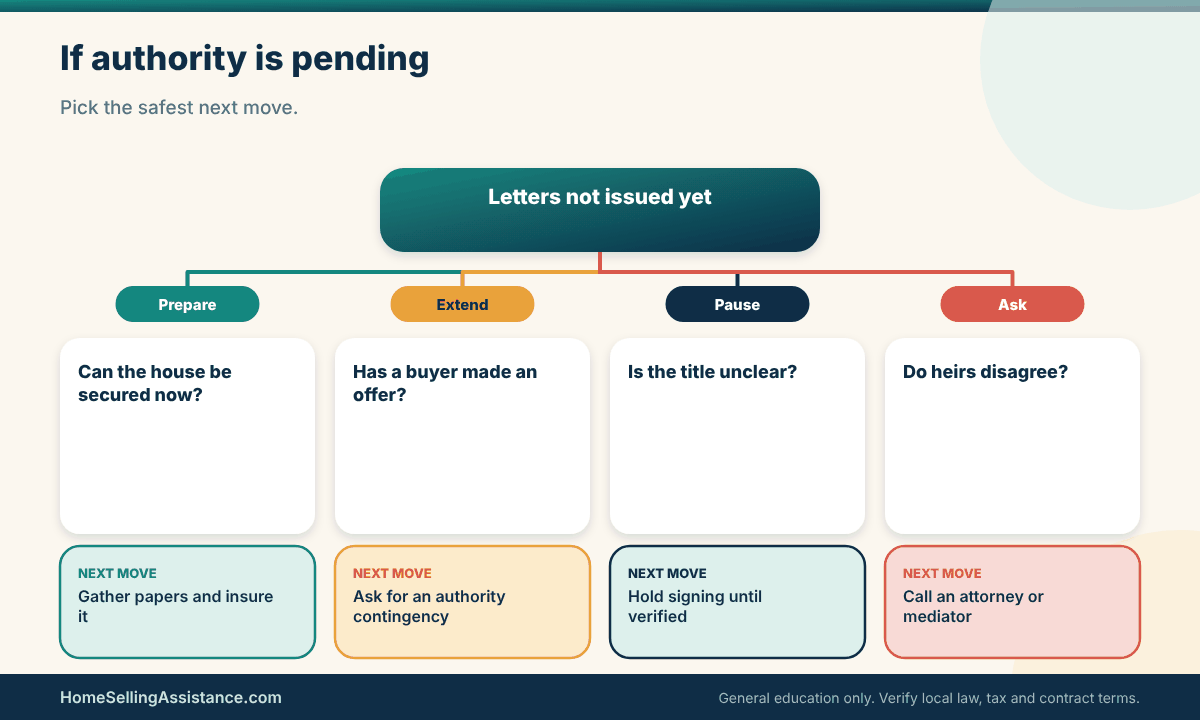
The cost of delay should not push anyone who wants to sell inherited house before probate into signing something they cannot deliver. The point of tracking it is to make a sober decision. If a sale will take place within the next few months either way, the cost of waiting is modest. If probate is likely to run a year or more, the carrying costs may justify asking whether the court and heirs would support an earlier sale with proper approval.
Evidence to gather: payoff, insurance and court status
Request an updated payoff letter from the mortgage servicer close to closing. Servicers calculate interest daily, and a payoff from several weeks earlier may be short. The estate representative usually has to prove authority to receive one, so send the letters and death certificate with the request. Our article on an inherited house with a mortgage covers servicer conversations in more detail.
Check the homeowner’s policy. Many policies treat a house as vacant after a period of no occupants and may limit coverage for some risks. Call the insurer, explain that the owner died and the house is in an estate, and ask what the policy requires. Some insurers offer vacant-property endorsements. Do not assume the old policy continues in full just because premiums are paid.
Finally, confirm the court status, the last gate before you sell inherited house before probate. Ask the attorney or clerk whether letters are still in force, whether any hearing is pending, and whether any objection has been filed. If a heir or creditor has challenged the will or the appointment, the situation may change quickly, and you will want to know before you sign.
Tax questions belong on the same list. The sale of an inherited house can raise basis, reporting and timing questions that are separate from probate. In general terms, the property’s tax basis for the heir is often tied to its value at the date of death, which can reduce the gain reported on a sale, but the details depend on how the property passes, how the estate is administered and the facts of the case.
The IRS covers the framework in Publication 559, and our articles on inherited house cost basis and inherited home sale taxes explain the questions to bring to a tax professional.
Last, before you sell inherited house before probate, confirm who will receive the proceeds and in what form. Estates generally deposit sale proceeds into an estate account, and distribution to heirs follows court rules or the will, sometimes after creditor periods and expenses are resolved. A sale can close before the estate is ready to distribute. Tell heirs early that closing day and payout day are usually different, so nobody plans a down payment around a check that cannot be written yet.
A scenario: the payoff that came up short
A personal representative gets a payoff letter in March, and the closing is scheduled for late April. The letter shows a balance and a daily interest figure. The representative assumes the number is good through closing.
Two things happen. The closing slips by two weeks because the buyer’s appraisal is delayed, and the servicer posts a late fee that predates the death but was not on the original letter. At the table, the title company’s updated figure is higher than the one the family used to plan their share of the proceeds. Nothing is wrong. The family simply relied on an old number.
The fix is a habit. Ask for an updated payoff within a week or so of closing, ask for a per diem figure, and ask the servicer to list any fees. Plan your own net with a cushion, and compare against the title company’s closing statement before you sign. Our guide to the seller closing statement shows what to look for.
Quick scenario
A family wants to sell inherited house before probate closes because the house is empty and costing money each month. Their attorney confirms the will names an executor, the court has issued letters, and state rules do not require confirmation of the sale. The title company reviews the letters, finds no liens beyond the mortgage and issues a commitment. The family lists, accepts an offer with a closing date that leaves room for a fresh payoff letter, and closes while the estate remains open. The sale worked because authority existed and was documented, not because probate was skipped.
That outcome is common among families who sell inherited house before probate with documents in hand, and it is also not guaranteed. A different family in a different state might need court confirmation, a waiting period for creditors or the agreement of every heir. The workable approach is to ask the three questions that decide most cases: who holds authority now, what the court and title company require, and what the contract says about delays.
If you can answer those three, you know whether you can sell inherited house before probate ends, or whether the better move is to prepare and wait.
Preparation is not wasted time, even if you cannot yet sell inherited house before probate. Even when authority is pending, the family can usually gather documents, order certified death certificates, secure and insure the property, obtain a payoff figure, schedule a cleanout once the attorney agrees on what may be removed, and interview agents or attorneys. Our guides on cleaning out an inherited house before a sale and on an executor selling a house cover that waiting period in practical terms. When letters arrive, you will be ready to move.
Frequently asked questions about sell inherited house before probate
Can I really sell inherited house before probate is finished?
Often yes, but the real requirement is authority, not a finished case. Many estates close a sale while probate is still open, as long as the person signing holds court letters or other recognized authority. Some homes avoid probate entirely, and some states add steps like court confirmation. Ask a probate attorney or title company in your county what they accept before you commit to a contract.
What if probate has not even been opened yet?
Then nobody may have power to sell the house, even if the will names an executor. You can usually prepare, gather documents and talk to professionals, but a title company will generally want proof of authority before closing. If you want to sell inherited house before probate formally begins, ask an attorney whether the property passes outside probate or whether opening a case is the faster path.
Can an heir sign a listing agreement or a contract?
It depends on who holds title and authority. An heir who has not been appointed or recorded as owner may not be able to bind the estate. A contract signed by someone without authority can create disputes, and a listing agent may refuse to proceed. Check with an attorney before anyone signs, and consider a contingency that ties the closing to the appointment of a representative.
Does a house in a living trust need probate?
Property that was properly transferred into a revocable trust generally passes under the trust, and the successor trustee may be able to sell without opening a probate case. The key words are properly transferred. A trust that never received the deed may not control the house. Confirm how title is recorded, and ask a title officer what trust documents they need to see.
Can a buyer accept a long closing while probate runs?
Some buyers can, especially cash buyers or investors, but a lender-financed buyer may have a rate lock and a deadline that limits flexibility. Put the estate’s timing in the contract through extension rights or a contingency, and explain it up front. A buyer who understands the delay is more likely to wait than a buyer who learns about it late.
Should we wait for the creditor claims period to end?
States set claim periods differently, and some require notice by publication or mail. Selling does not erase valid claims, but the estate may need to hold proceeds until claims are resolved. Whether it makes sense to sell inherited house before probate claim periods end is a question for the personal representative and the attorney, because the answer depends on estate debts and state procedure.
What happens if heirs disagree about selling?
Disagreement can slow or stop a sale, especially when the will is contested or there is no will. A court may need to resolve disputes, and some states allow a sale ordered by a judge in certain situations. Mediation can help families reach agreement before costs mount. Our guides on multiple heirs selling an inherited house and one heir who wants to sell go deeper.
Who pays expenses while the house waits?
Usually the estate pays from estate funds, if there are any, though a family member may advance costs and seek reimbursement. Keep receipts for taxes, insurance, utilities and repairs. If you plan to sell inherited house before probate ends partly to stop these costs, compare the ongoing bills with the timeline for authority, and talk to the attorney about what may be repaid from proceeds.
Do I owe tax on an inherited house I sell?
Possibly, but it depends on the sale price, the property’s tax basis, how the estate is handled and other facts. Basis for inherited property is often tied to value at the date of death, which can reduce reported gain. Do not rely on a general statement. Ask a tax professional and review IRS guidance such as Publication 551 on basis.
How do I protect myself from scams during an estate sale?
Be skeptical of unsolicited offers, pressure to sign quickly, requests for upfront fees and any change to wiring instructions. Verify identities by phone numbers you find yourself, and confirm funds with the title company. Estates draw scammers because sellers are grieving and busy. The FBI’s Internet Crime Complaint Center takes reports of wire fraud.
Before you decide
The safest way to sell inherited house before probate is complete is to treat authority as the first deliverable, not an afterthought. Pull the deed, read the documents, ask the court, the title company and an attorney what they will accept, and write down the answers. If you would like to see the full process from first call to closing day, our guide to an estate home sale closing picks up where this article stops. This article is general education, not legal, tax or financial advice, so confirm every state-specific point with a qualified professional in your county.