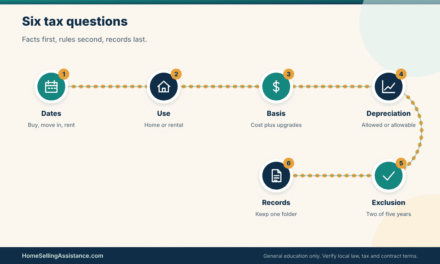
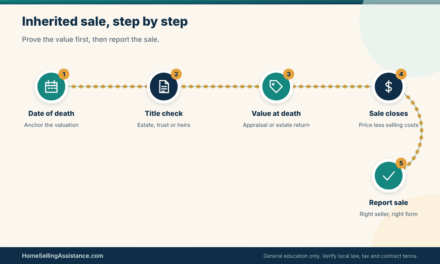
Working out how selling costs capital gain home figures fit together is one of the least glamorous parts of selling a house, and it is also one of the parts that can quietly change a tax bill. The sale price you celebrate on the contract is not the number the IRS cares about. What matters is the gain, and the gain depends on what you paid, what you put into the property, and which transaction costs the rules let you subtract.
Most sellers meet this topic late. They hear “capital gains” at a dinner party, glance at the closing statement the week of closing, and then try to reconstruct years of paperwork in an afternoon. That is a stressful way to learn that, under the selling costs capital gain home rules, a commission, a transfer tax or a title charge may or may not belong in the calculation, depending on the facts and the current IRS instructions.
This guide is built to slow that moment down. We will separate sale price, proceeds and gain, which people constantly mix up. We will look at which transaction costs generally reduce the amount you realize under selling costs capital gain home rules, which costs only feel deductible, and how the main-home exclusion changes the stakes. Then we will cover reporting forms, messy situations such as rentals, inherited homes and divorces, and the records that make a calculation defensible.

Read the sections in order the first time, because each one builds on the last. On a second pass, keep your own closing statement beside you and treat the selling costs capital gain home steps as a checklist. By the end you should be able to describe, in two sentences, how your amount realized, your basis and your gain relate, and which charges you are still unsure about.
One boundary before we start. This is general education about how the federal rules are commonly described in IRS publications. It is not a calculation of your tax, and it cannot account for your state, your filing status or your history with the property. Treat every number here as an illustration, and treat the IRS and a qualified tax professional as the final word for your own sale.
Key takeaways
- Gain is not proceeds. Net cash at closing and taxable gain answer different questions, and mixing them up is the most common error in selling costs capital gain home worksheets.
- Selling expenses generally reduce the amount realized. Commissions, legal fees and certain closing charges you paid as the seller are the usual candidates, but each item needs a document behind it.
- Preparation costs are a gray area. Ordinary cleaning, staging and repairs often do not count the way sellers hope, while true capital improvements belong in basis instead.
- The exclusion can make costs matter less or more. Eligible sellers may exclude up to $250,000 of gain, or $500,000 on a qualifying joint return, so costs matter most near those thresholds.
- Paper beats memory. A closing statement, receipts and a simple selling costs capital gain home worksheet are what let you, a preparer or the IRS follow the math.
- Escalate early when facts are unusual. Rentals, inherited property, divorce and partial-year ownership deserve a professional’s eyes before you file.
Start with the right question about selling costs capital gain home figures: gain, not price
Every honest conversation about the selling costs capital gain home topic begins with vocabulary. If the words are fuzzy, the math will be wrong no matter how careful the arithmetic is. So let us fix the words first, then look at how real closing paperwork maps onto them.
Three numbers that are easy to confuse
Sellers routinely talk about the price, the profit and the payout as if they were one number. They are three different numbers, and only one of them is the tax gain. Getting them separated on paper is the first real step in any selling costs capital gain home worksheet you will ever build.
Here is the short definition set. Amount realized is generally the selling price less eligible selling expenses. Adjusted basis is generally what you paid plus capital improvements and certain other adjustments, less certain reductions. Gain is the first figure minus the second. Every selling costs capital gain home worksheet, simple or elaborate, is these three definitions applied carefully, and the IRS publications explain the exceptions at each step.
Evidence to gather: the contract price, the payoff letter and the closing statement
The sale price comes from your purchase contract. The mortgage payoff comes from your lender’s payoff letter, which is a different figure from the balance printed on your last monthly statement because interest accrues daily. The settlement or closing statement ties both together and shows every charge assigned to you as the seller. Start by collecting those three documents for your selling costs capital gain home file.
Then walk down the seller side of the statement line by line and label each item in the margin. Is it the loan payoff? A commission? A tax or HOA proration? A credit you gave the buyer? A fee for a service you personally ordered? That labeling step feels fussy, but it is the bridge between a stack of closing numbers and a tax calculation. Our guide to the seller closing statement shows how each line is typically organized.
Pay attention to the difference between money that left your pocket and money that reduced your gain. A loan payoff is not a cost of selling. It repays a debt you owed, and it has no effect on gain at all. Principal you paid down over the years simply returns to the lender. Only the charges for the act of selling can enter the calculation, and even then each one has to be an eligible kind of expense.
If your sale is still ahead, you can build a draft before listing. Ask a title company or closing agent for an estimated seller statement, then run a rough selling costs capital gain home estimate with conservative numbers. Draft figures are not final, but they show early whether you are near an exclusion threshold, which changes how carefully you should track every receipt from the first day of listing.
A scenario, an exception, and your next step: the proceeds trap
Picture two sellers who each sell for an illustrative $600,000. One bought years ago with a small loan and walks away with a large check. The other bought recently with a big loan and walks away with very little. Their checks differ enormously, yet their tax gain depends on purchase price and improvements, not on how much was borrowed.
The exception is the seller who refinanced and pulled cash out. Borrowed money is not income and does not change basis, so a bigger loan never raises or lowers gain. It only changes the check. If you refinanced, keep the original purchase paperwork separate from the refinance paperwork so nobody confuses debt with cost.
Your next step is small and concrete. Write three headings on a sheet of paper: amount realized, adjusted basis and gain. Put the contract price under the first, leave the other two blank for now, and move on. Our overview of taxes when selling a home gives the wider map around this three-part frame for selling costs capital gain home questions.
What counts as a cost of selling
Once the vocabulary is straight, the practical question is which seller-side charges qualify as selling expenses. IRS Publication 523 is the primary source for selling costs capital gain home questions, and it describes selling expenses in general terms. Your job is to match your own documents against those descriptions rather than rely on a friend’s rule of thumb.
Evidence to gather: commissions, legal fees, title charges and transfer taxes
The categories that publications usually describe include broker or agent compensation paid by the seller, advertising, legal fees connected to the sale, and certain loan charges the seller paid on the buyer’s behalf. Transfer, stamp or recording-type taxes that fall on the seller can also appear, and these differ widely from one state or county to another.
Title and escrow charges are less uniform. Who pays for the owner’s title policy, escrow fees or settlement fees is a matter of state custom and contract, so you cannot assume your neighbor’s pattern applies to you. The reliable method is to read your own statement, confirm which party was charged, and then compare the item to the current IRS description of selling expenses before including it.
Compensation deserves one extra sentence. Since the broker-compensation changes that followed recent industry settlements, how a seller’s agent is paid, and whether the seller contributes to a buyer’s agent, is negotiable and must be spelled out in writing. What matters for tax is what you actually paid as the seller, which your contract and closing statement will show. Our seller closing costs guide explains the main categories.
A scenario, an exception, and your next step: the buyer-side charges you did not pay
Suppose your statement lists a lender fee, a buyer’s inspection and a buyer’s attorney. Those usually appear on the buyer’s side of the statement because the buyer owes them. They are not your selling expenses, even if they appear in the same stack of paper. Only the items charged to you belong in your column.
An exception arises when you agree to pay part of the buyer’s costs through a concession. A seller credit or contribution toward the buyer’s costs is handled differently from a fee you incurred for your own services, and the treatment can depend on what the credit pays for. Do not guess. Record the amount, the purpose stated in the contract, and bring the question to a preparer.
Your next step is to highlight, on a printed copy of the statement, every charge that sits in the seller column. Put a question mark beside anything you cannot explain, because an unexplained line is exactly the kind of item that is worth asking your closing agent about before the paperwork is archived.
Use current IRS rules to test every selling costs capital gain home input
With the vocabulary settled, the next job is to test each number against the rules as they stand today. Tax rules get amended, forms get renumbered and thresholds can be revisited, so a blog post, including this one, is a starting point. The current IRS publications and form instructions are the documents you verify against.
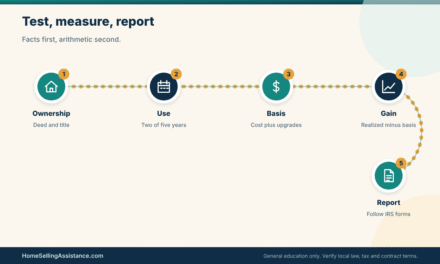
Think of the selling costs capital gain home process as a short chain. You start with the price, subtract eligible selling expenses to get the amount realized, subtract adjusted basis to get gain, and then see whether the main-home exclusion covers some or all of that gain. Each link has its own evidence and its own ways to go wrong.
How the exclusion changes what each cost is worth
A selling cost does not carry a fixed dollar value in every household. For a seller whose gain is comfortably inside the exclusion, an extra expense may change nothing on the return. For a seller whose gain lands just past the exclusion, the same expense can matter a lot. That is why the selling costs capital gain home question feels urgent for some people and trivial for others.
Sellers sometimes assume the exclusion makes records unnecessary. That is a risky assumption. Gain can be larger than expected after years of appreciation, the exclusion has eligibility conditions, and a sale reported without support invites questions. A well-kept selling costs capital gain home file costs little during the sale and can save a great deal of effort if questions appear later.
Evidence to gather: ownership, use and prior-exclusion records
The federal main-home exclusion generally lets an eligible seller exclude up to $250,000 of gain, or up to $500,000 on a joint return when the conditions are met. The familiar tests look at ownership and use: you generally must have owned the home and used it as your main home for at least two of the five years before the sale. Details and exceptions live in IRS Publication 523.
Gather proof for each test. Ownership is usually shown by the deed and closing paperwork from your purchase. Use is shown by addresses on tax returns, driver’s licenses, voter registration, utility bills and similar records. If you claimed the exclusion on another home recently, note the date, because a prior use of the exclusion within a short window can limit it. Our guide to the home sale capital gains exclusion goes through the tests in detail.
Eligibility is a yes-or-no gate that sits in front of the selling costs capital gain home math. If you do not clear the gate, the calculation of costs becomes much more important, because there is less excluded gain to absorb mistakes. If you clear it fully, accuracy still matters, since the exclusion has a ceiling and a gain can exceed it, especially after many years of appreciation.
A scenario, an exception, and your next step: a couple near the $500,000 line
Here is a worked example with deliberately round, illustrative numbers. A married couple selling their main home has a contract price of $900,000, seller-side selling expenses of $55,000, and an adjusted basis of $350,000. Subtract the expenses and you get an amount realized of $845,000. Subtract basis and the gain is $495,000.
If they qualify for the joint exclusion of $500,000, that gain is fully covered in this illustration. Now suppose they had ignored the selling expenses. Their gain would look like $550,000, which appears to exceed the exclusion by $50,000. The same house and the same sale give two very different pictures, depending on whether eligible costs were found, documented and counted.
The exception is obvious but worth saying: if one spouse alone qualifies, or the couple does not file jointly, the ceiling can differ, and the same $495,000 gain could leave a large taxable amount. Your next step is to run your own numbers three ways, using conservative, expected and generous cost assumptions, so you see how sensitive the result is before you decide how much to worry.

The picture above lays the chain out visually: price, selling costs, basis, exclusion and what is left. Use it as a mental model, then replace the sample figures with your own documented ones.
Costs that feel deductible but often are not
Sellers spend real money getting a house ready and moving out, and it is natural to assume that spending must count somewhere. Sometimes it does, sometimes it belongs somewhere else in the calculation, and sometimes it simply is not available for a personal residence. The categories blur, so it helps to sort selling costs capital gain home spending deliberately.
Evidence to gather: preparation, moving and carrying costs
Start with three buckets. Preparation costs include cleaning, staging, minor repairs and cosmetic work done to help the home sell. Moving costs include movers, truck rentals and storage. Carrying costs include the mortgage interest, utilities and insurance you paid while the home sat on the market. Each bucket needs its own receipts, and each has its own rules.
For a personal residence, moving expenses are generally not a way to reduce gain, and carrying costs are ordinary household expenses rather than selling expenses. Preparation costs are the real gray area, because whether they matter can depend on what the work was. Check the current treatment of such costs in IRS Publication 523 rather than trusting a rumor from a neighbor or an internet forum.
One habit makes selling costs capital gain home paperwork far easier. Keep two folders for any receipt that touches the sale: one marked “possible selling expense” and one marked “possible basis.” You do not have to decide the tax treatment while the sale is happening. You only have to avoid losing the paper, and sort it when you are calmer and have the instructions in front of you.
A scenario, an exception, and your next step: fresh paint versus a new roof
Imagine two projects in the same house. One is repainting the living room and patching a few nail holes before photos. The other is replacing the roof two years before listing. Both made the house easier to sell, yet they are not the same kind of spending. The roof is the kind of project that may qualify as a capital improvement and belong in adjusted basis. The paint is more likely maintenance.
The exception is that the line is not always obvious. A repair that is part of a larger renovation can be treated differently from the same repair standing alone, and professional judgment sometimes enters. Keep the contractor’s invoice, which usually describes the scope better than a bank statement does. Our guide to which home improvements increase tax basis covers the dividing line more closely.
Your next step is to sort every project receipt from the last several years into repair, improvement or unsure. Take the unsure pile to your preparer with the invoices attached. That small piece of homework often improves the result more than any amount of searching for obscure deductions.
The next table pulls the main selling costs capital gain home inputs together as a seller money matrix. Read across a row to see where the number comes from, how it usually affects cash or tax, what is uncertain about it, and which document proves it. All amounts and effects are general, not a statement about your return.
| Input | Assumption or source | Cash-flow or tax effect | Uncertainty | Verification document |
|---|---|---|---|---|
| Contract price | Signed purchase agreement | Starting point for amount realized | Low once signed; changes if amended | Executed contract and amendments |
| Seller-paid commission | Your listing agreement and contract terms | Cash cost at closing; generally a selling expense | Who paid what varies by deal | Closing statement, listing agreement |
| Legal and title charges | State custom and your contract | Cash cost; may count if charged to you as seller | Allocation differs by state and county | Itemized statement, invoices |
| Seller credit to buyer | Negotiated concession in the contract | Reduces check; tax treatment can depend on purpose | Moderate; confirm with a preparer | Contract addendum, statement |
| Staging and cosmetic prep | Your own receipts | Cash cost; often not a selling expense | High; depends on the nature of work | Invoices and scope descriptions |
| Mortgage payoff | Lender payoff letter | Reduces cash; no effect on gain | Low; daily interest changes the figure | Payoff letter, final statement |
To use the matrix, copy it into a spreadsheet and replace the examples with your own entries. If you cannot name a verification document for a row, treat that row as unproven. An unproven number is not necessarily wrong, but it is the first place a preparer will ask questions, and the first place an error can hide.
Exceptions, reporting and uncertainty in selling costs capital gain home math
Even a clean calculation can run into reporting questions, and some sellers sit in situations the simple chain does not cover. This section is about both. The goal is not to turn you into a tax preparer. It is to help you recognize when a standard selling costs capital gain home calculation is enough and when the facts have outgrown it.
Reporting the sale and handling unusual situations
Selling a home does not always mean a tax form, yet reporting selling costs capital gain home figures is sometimes required even when no tax is owed. Whether you must report depends on what you received, what you claim and whether any part of the gain exceeds the exclusion. Because reporting rules and form instructions are updated, read the current instructions for the tax year of your sale.
Evidence to gather: the reporting statement, forms and instructions
Closing agents sometimes send the seller and the IRS an information return that reports the gross proceeds of a real estate sale, commonly known as Form 1099-S. Whether you receive one can depend on the transaction and on certifications you provide at closing. If you do receive it, its gross proceeds figure is not your gain, and the selling costs capital gain home worksheet you built is what bridges the gap.
If part of your gain is taxable, or if you received a reporting statement and cannot exclude all of the gain, the sale is generally reported using the forms that handle capital gains, such as Form 8949 and Schedule D. The IRS instructions explain how selling expenses are folded into the amount you report. Read those instructions for your tax year, since line numbers and examples change.
Keep a copy of the closing statement with your return file. If a notice ever arrives asking how you got from a reporting statement’s gross proceeds to the figure on your return, the reconciliation worksheet and the supporting statement are your answer. A short note explaining each subtraction can save hours of reconstruction years later.
A scenario, an exception, and your next step: a gain that exceeds the exclusion
Take a single seller with a gain of $320,000 in an illustrative example and a $250,000 exclusion for which they qualify. The excluded portion is $250,000 and the remaining $70,000 would generally be treated as a capital gain. Whether it is long-term or short-term depends on the holding period, and gains on property held more than one year are generally long-term.
The exception is how carefully the costs were counted. If an eligible $20,000 of selling expenses had been left out, the illustrative reported gain would be $20,000 higher than it needed to be. That is the real reason to be careful about selling costs capital gain home figures: a missed cost can mean paying tax on money that was spent on the sale itself.
Your next step is to look up the current tax rate rules and any additional taxes that could apply to investment income, because those depend on income and filing status and change over time. The IRS website is the place to confirm current figures, or a preparer can run the numbers for your situation.

The checklist above shows the paperwork most sellers should have in hand before a preparer opens their return. If you cannot tick most of those boxes yet, there is still time. Start with the closing statement, then work backwards to the purchase file and the improvement receipts.
State rules add another layer. Some states follow the federal treatment of home sales closely, others differ, and a few have no broad income tax. Check your state revenue department or ask a preparer how your state treats selling costs capital gain home items, rather than assuming the federal approach carries over unchanged.
Quick scenario
An illustrative single seller has a contract price of $480,000, seller-paid selling expenses of $32,000 and an adjusted basis of $290,000. Amount realized is $448,000 and gain is $158,000. If the seller qualifies for the $250,000 exclusion, that gain falls inside it. The selling costs capital gain home work still earns its keep, because a modest change in basis or expenses could matter if the numbers were tighter.
Unusual situations: rentals, inheritances, divorces and short ownership
The simple chain assumes you owned and lived in the home as your main residence for the required time. Plenty of sellers do not fit that picture. Their selling costs capital gain home questions hide inside bigger tax topics, and the costs may matter less than the rule that applies to the situation itself.
The following table is a scenario guide. Each row names a common seller situation, the kind of assumption a preparer would examine, the general effect, the main risk and a question worth asking. It does not predict anyone’s tax, and the effects are described in words rather than percentages for good reason: they depend on facts, not on rules of thumb.
| Seller situation | Sale, loan or tax assumption | Estimated effect | Key risk | Professional question |
|---|---|---|---|---|
| Long-time owner-occupant | Meets ownership and use tests | Exclusion may cover much or all gain | Gain above the ceiling after long appreciation | Is my gain under the exclusion limit? |
| Sold before two years | Moved for work, health or unforeseen events | A partial exclusion may be possible | Reason must fit the rules and be documented | Does my reason qualify for a reduced exclusion? |
| Former rental or home office | Part of the property used for business | Depreciation may affect gain | Depreciation taken or allowable can be recaptured | How is depreciation treated in my sale? |
| Inherited home | Basis often tied to value at the owner’s death | Selling costs may reduce a small gain | Missing date-of-death valuation | What basis applies and who reports the sale? |
| Divorce sale or transfer | Decree or agreement sets who sells and who keeps cash | Each spouse’s gain and exclusion may differ | Wrong party claims the costs | Who bears and reports which costs? |
| Owner who carried improvements | Capital projects documented over years | Higher basis and a smaller gain | Lost receipts and unclear scope | Which projects count as improvements? |
Use the table as a prompt for your selling costs capital gain home review, not an answer. If your situation matches a row with a heavier risk, take that row’s question word for word to a CPA, enrolled agent or tax attorney. Specific, document-backed questions get faster and cheaper answers than a general request to look at the sale.
Evidence to gather: rental, inheritance and divorce records
Each unusual situation has its own proof. For a former rental, gather depreciation schedules from earlier returns and the dates the property was rented and lived in. For an inherited home, gather the date-of-death appraisal, the estate paperwork and the deed transfer. For a divorce, gather the decree, any property settlement agreement and the closing statement that shows who received what.
The primary sources differ by topic. Rental property is covered in IRS Publication 527, divorced and separated taxpayers in Publication 504, and the basics of basis in Publication 551. You do not need to read them cover to cover. Search for the heading that matches your facts and read that part carefully.
Our deeper guides apply the same logic to individual cases, including selling a former rental home, inherited home sale taxes and divorce and home sale taxes. If you land in one of those situations, read the matching guide before you finalize any worksheet.
A scenario, an exception, and your next step: the owner who moved after eighteen months
A seller takes a job in another state and sells after about eighteen months. The usual two-year test is not met, so a full exclusion is not automatic. Depending on the reason for the move and the facts, a reduced exclusion may be available. The amount generally relates to how much of the two-year period the seller satisfied, and the work-related, health-related or unforeseen-circumstance categories have specific criteria.
The exception is that not every move qualifies, and a reason that feels compelling is not the same as a reason that satisfies the rules. A preparer will want evidence such as an employer letter, relocation paperwork or medical documentation. Our article on a home sale before two years explains the reasoning in more depth.
Your next step is to write down the dates of purchase, move-in, move-out and sale, and then the reason for selling. Those four dates and one sentence are the raw material for any professional’s first answer. Without them, even an expert can only give you a general sketch, and the selling costs capital gain home figures remain unsettled.
The flow below is a simple decision path for gray-area spending. It does not give final answers, but it shows the questions a careful reader asks before putting any expense into the calculation. Start at the top with the receipt in your hand.

Escalate fact-specific selling costs capital gain home questions to a professional
There is a point where reading stops being useful and a conversation with a qualified person starts paying for itself. That point comes sooner when your facts are unusual, your gain is near a threshold, or your records have holes. Knowing how to escalate well is part of handling selling costs capital gain home questions responsibly.
The picture below weighs the two sides. It is not a rule. Some sellers with simple facts still prefer to have a preparer confirm everything, and some with complicated facts are comfortable with software and the IRS instructions. The scale simply shows which signals usually point which way.

Professional questions and the records to preserve
Professionals differ in what they are best at. A CPA or enrolled agent usually prepares returns and can run the numbers for your situation. A tax attorney is more useful when the issue is a legal structure, a dispute, an estate or a divorce decree. Your state’s rules for licensing and credentials vary, so confirm the credential of anyone you hire.
Ask how a professional charges and what they need from you before you agree. A narrow review of a selling costs capital gain home worksheet may be quicker and less costly than full return preparation, though that depends on the provider and your situation. Get the scope and fee in writing so nobody is surprised later.
Evidence to gather: a one-page fact sheet and a list of questions
Before the first meeting, prepare a one-page fact sheet. Include the purchase date and price, the dates you lived in the home, the sale date and contract price, the total of seller-paid charges from the closing statement, a list of major improvements with approximate costs, and any rental, business or inheritance history. A tidy sheet saves billable time and tends to produce sharper answers.
Then write your questions in the order of how much money they could move. A useful list might ask whether the selling costs capital gain home worksheet you drafted counts each charge correctly, whether any item is better treated as a basis item, whether the exclusion applies in full, and which forms will be needed. Ask also how the professional would document any judgment calls.
Be open about what you do not know. Sellers sometimes hide gaps, such as a missing receipt or a past period of renting, because they fear it looks careless. Experienced preparers see gaps constantly. They can only plan around a problem they know about, and an early honest answer usually leads to a better result than a late surprise.
A scenario, an exception, and your next step: a seller who waited until filing season
Consider a seller who closes in the autumn, shoves the paperwork in a drawer and visits a preparer the following spring. By then the title company has archived its file, the contractor’s invoices are hard to find and the seller cannot remember whether a particular charge was theirs. Reconstruction takes weeks and some figures stay uncertain.
The exception is the seller who does a short review immediately after closing, while memories and documents are fresh. A one-hour session in the weeks after closing can fix most of the problem. If your sale is still ahead, you can do better still: ask your closing agent which seller-side charges will appear, and request an early draft statement so you can review it.
Your next step is to decide when you will meet your preparer. If your sale has not closed, schedule a brief call before closing so structural questions, such as who is selling, how title is held and whether a concession is wise, get raised while the contract can still be adjusted. Our overview of home sale net proceeds pairs well with that planning.
Records to preserve for the long run
Create a simple index, too. One page lists each document, its date, where the original is stored and which part of the calculation it supports. That index turns a box of papers into an audit trail for your selling costs capital gain home figures, and it makes handing materials to a preparer a ten-minute task instead of an afternoon.
Good selling costs capital gain home records protect you in two ways. They make today’s calculation accurate, and they let you answer questions years from now. The IRS generally expects taxpayers to keep records that support the items on a return, and the time to keep them depends on the circumstances. The best approach is to confirm the current retention guidance and keep home records longer than ordinary receipts.
Evidence to gather: purchase, improvement and closing files
A complete home-tax file usually contains the purchase closing statement, the deed, receipts and invoices for capital improvements, permits and contractor agreements for major projects, records of any casualty losses or insurance reimbursements, and the sale closing statement. If you rented part of the property or used it for business, add depreciation records and the related returns. The home sale tax records guide has a fuller inventory.
Digital copies are worth the half hour they take. Scan the closing statements and save each file with a name that includes the property address and the date. Store one copy in a cloud folder you control and one on a drive you own. Store the paper originals of the deed and the statements somewhere fireproof if you can.
Keep the selling costs capital gain home file together for as long as you own the home, and then for the period the IRS guidance suggests after the return that reports the sale. The basis you establish today may be needed by a future owner or an heir. Records from your purchase are often the most valuable and the most likely to vanish, so protect them first.
A scenario, an exception, and your next step: the missing improvement receipts
Imagine a seller who finished a kitchen remodel and a deck a decade ago and now cannot find most of the paperwork. The work is real and visible, but proof is thin. In that case, the seller can try to reconstruct evidence from bank and card statements, the contractor’s records, permit files at the local building department, and photographs with dates.
The exception is that reconstruction is never assured of acceptance, and estimates without support can be challenged. Whatever you can document is stronger than what you remember. Do not invent figures. If an amount cannot be supported, it is better to leave it out than to claim something that might not survive a question.
Your next step is a thirty-minute sweep. Pull everything related to improvements into one folder, list each project with an approximate date and cost, and flag anything missing a document. Next, ask for copies from contractors, the building department or your bank. Then store the finished folder with your sale paperwork, and note on the cover sheet where each original lives. A calm review of the adjusted basis home sale rules will tell you what else belongs there.
If you want help finding a trustworthy financial or housing counselor in general, HUD-approved housing counseling offers a directory, although tax preparation itself is a different service. The IRS also publishes taxpayer resources and lists of ways to find qualified preparers at irs.gov. Browse our broader home sale taxes category and the closing costs and net proceeds category for related reading.
Frequently asked questions about selling costs capital gain home
Do selling costs reduce my capital gain on a home?
Generally, eligible selling expenses reduce the amount realized, which in turn reduces gain. The word eligible matters, because not every charge on a closing statement qualifies. Commissions and certain seller-paid fees are the usual examples, while loan payoffs and ordinary moving costs are not. Check IRS Publication 523 and your own statement before counting anything.
Is the mortgage payoff a cost of selling?
No. Paying off your loan returns borrowed money and does not change gain. It reduces the cash you receive at closing, but gain is measured from price, selling expenses and basis. This is the biggest source of confusion about selling costs capital gain home calculations, so keep the payoff line out of the expense column.
Do repairs I made before listing count as selling costs?
It depends on the nature of the work. Ordinary repairs and cosmetic prep are often treated as maintenance rather than selling expenses, while a true capital improvement may belong in basis. The line can be subtle, so keep invoices that describe the scope. A preparer can help classify borderline projects using the current IRS guidance.
What if my gain is under the exclusion limit?
If you qualify for the main-home exclusion and your gain is within the limit, you may owe no federal tax on that gain. You might still receive a reporting statement or have forms to consider, depending on the facts. Even when the tax effect is zero, a documented selling costs capital gain home worksheet protects you if questions come later.
Does a seller credit to the buyer reduce my gain?
A concession can reduce what you realize, but the treatment may depend on what the credit pays for. Because the details turn on the contract language and the type of cost, record the amount and the purpose, then ask a preparer. Do not assume every credit is treated the same way.
Can I deduct a loss if I sell my home for less than I paid?
For a personal residence, a loss on sale is generally not deductible. That is a stable federal principle, although special situations such as business use can change the analysis. If part of your home was a rental or office, the treatment may differ, and a professional can sort out which portion is which.
How long should I keep records of the sale?
Keep the closing statements, improvement receipts and the selling costs capital gain home worksheet for as long as you own the home and then for the period the IRS suggests after the return reporting the sale. Many people keep purchase and improvement records longer, since basis questions can surface years later, for example when an heir sells the same property.
Does the selling costs capital gain home calculation change if I inherit the property?
Often, yes. Inherited property commonly has a basis tied to its value at the owner’s death, which can shrink the gain and shift the role of selling costs. The rules have exceptions, so gather the date-of-death valuation and estate paperwork, then read the inherited-property guidance or consult a professional.
Where can I check the official rules?
Start with the IRS publications on selling your home and on basis, found at irs.gov, then read the instructions for the forms that apply to your tax year. Your state revenue agency covers state tax. A CPA, enrolled agent or tax attorney can apply the rules to your specific facts and your state.
When should I talk to a tax professional?
Consider it when your gain is near the exclusion limit, when you owned the home for less than two years, when part of it was a rental or office, or when the property was inherited or involved in a divorce. Records that are missing or unclear are another reason. A short, well-prepared selling costs capital gain home consultation is often cheaper than a repair after filing.
A calmer way to finish the sale
Sorting out selling costs capital gain home figures is mostly patience and paperwork: separate price, proceeds and gain, label every seller-side charge, keep the proof, and test each number against the current IRS rules. The aim is a worksheet you can explain to a preparer or to yourself in five years. This article is general education, not legal, tax or financial advice, and your facts, state and filing status may change the answer. Check the official sources and bring specific questions to a qualified professional before you file.