Understanding divorce home sale taxes is mostly a matter of separating three questions that tend to blur together when a marriage ends: who owns the house on paper, what the house cost you in tax terms, and who will actually report the gain, if there is one, when the property is sold. Each question has its own rules, its own documents and its own deadline, and getting them tangled is how people end up with a surprise tax bill or a lost exclusion.
Most couples approach the house, and the divorce home sale taxes attached to it, emotionally first and financially second, which is natural. One spouse wants to stay for the kids or the schools. The other wants a clean break and a check. Somebody floats a buyout, somebody else suggests listing in spring, and the lawyers start drafting language. Meanwhile almost nobody has asked what the home sale will look like on a tax return, or whether the way the deal is written changes that picture.
The good news about divorce home sale taxes is that federal tax law handles the handoff between spouses more gently than most people fear. Under a long-standing federal rule, a transfer of property between spouses, or between former spouses when it is connected to the divorce, is generally not treated as a taxable sale. The less comfortable news is that the gentleness comes with strings attached.
The receiving spouse usually inherits the old tax basis, not a fresh one, and the clock and eligibility tests for the home sale exclusion keep running in ways that depend on who lived in the house and when.
This guide explains the moving parts of divorce home sale taxes in plain language. We stay at the level of general education: how basis works, how the exclusion applies to single and joint sellers, how buyouts and sales to a third party differ, which records to gather, and which questions deserve a CPA, enrolled agent or tax attorney. It sits within our wider look at taxes when selling a home, and it points to deeper guides where a topic needs more room.
We have no stake in whether you sell, buy out or stay, and nothing here is advice about your particular return.
Key takeaways
- Gain is not the same as cash. Divorce home sale taxes depend on sale price minus adjusted basis and selling costs, not on the equity check each spouse receives.
- Transfers between spouses are generally not taxed at the time. The trade-off is that the receiving spouse usually keeps the old basis, so the deferred gain travels with the house.
- The main-home exclusion has tests. Ownership, use and timing all matter, and a divorce can change who satisfies them and when.
- Who sells, and when, shapes the outcome. A joint sale before the divorce is final, a sale after it, and a buyout followed by a later sale can produce very different reporting.
- Paperwork carries real weight. The deed, divorce decree or settlement agreement, closing statement and improvement records are the evidence a tax professional will ask for.
- Verify with current IRS sources. Rules change and facts differ, so confirm with IRS publications and a qualified professional before you sign anything.
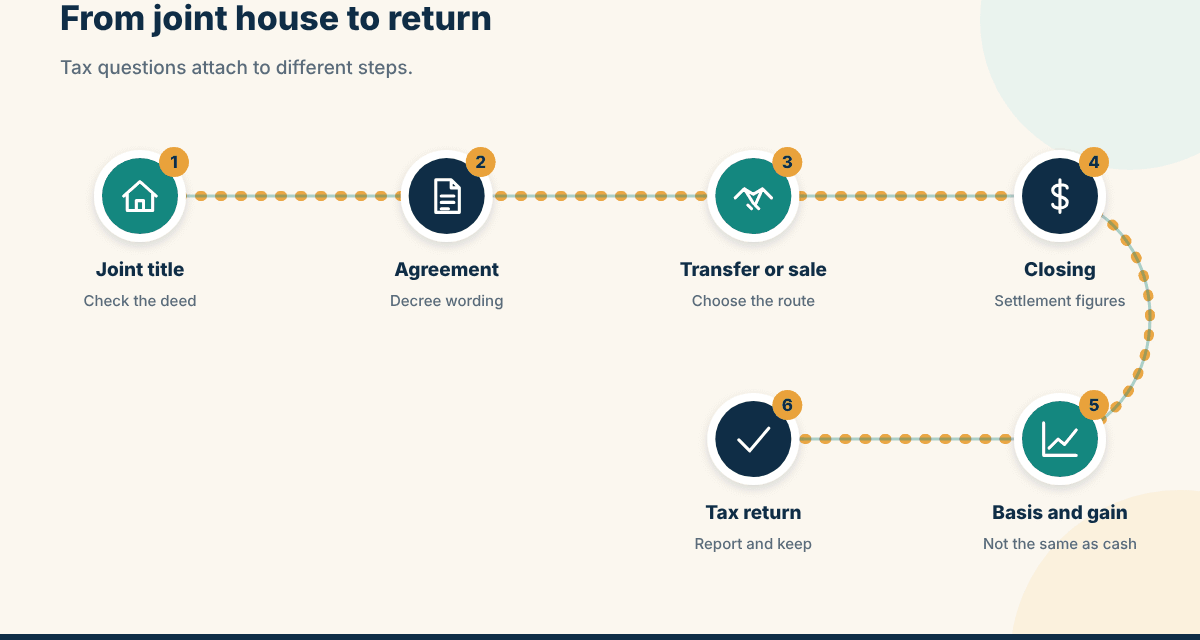
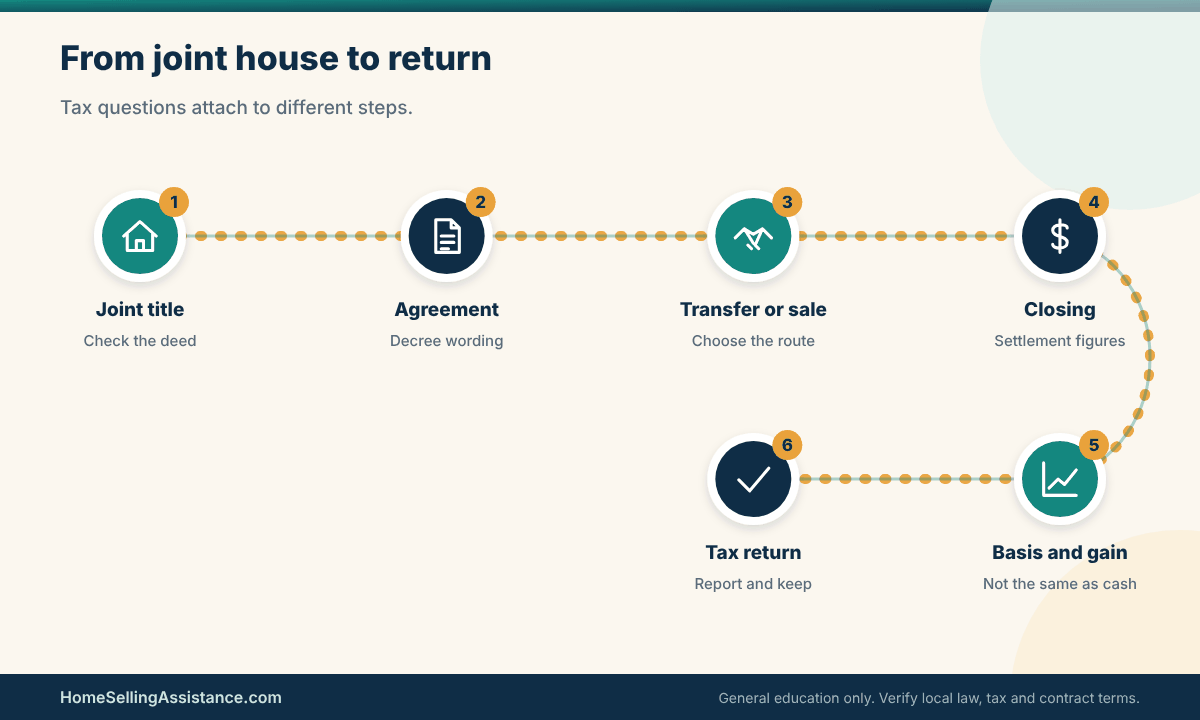
Before the details, here is the sequence most separating owners move through. The picture below shows how a shared house typically passes from joint ownership through an agreement, then either a transfer or a sale, and finally a return. Keep it in mind as you read, because the tax questions attach to different steps along the way.
Define the divorce home sale taxes question before you apply any rule
Tax rules are only useful once you know which rule is being asked about, and divorce home sale taxes involve several. In a divorce, “what about taxes on the house?” can mean at least four different things: whether moving the title from joint names to one name triggers tax, whether a sale to an outside buyer produces a taxable gain, whether either spouse qualifies for the exclusion, and how the proceeds will be reported once they are split. Writing down which of those you actually face is the first piece of useful work.
That matters because the answers do not travel from one question to the next. A transfer that is not taxed today may create a bigger gain on a later sale. An exclusion that is available for one spouse may be missing for the other. Treat each of your divorce home sale taxes questions as its own small file, with its own facts and its own sources.
Ownership, use, and basis facts for divorce home sale taxes
Three sets of facts drive nearly every conclusion about divorce home sale taxes: how the property is titled, how it has been used, and what it cost you in tax terms. Titling comes from the deed. It may show both spouses as joint tenants, as tenants in common, or in some other form, and the form can affect who legally has to sign and who owns what share. Some states also treat a home bought during a marriage as shared by default, which can matter even when only one name appears on the deed.
How your state treats that is a legal question for a family law attorney, not something a tax article can settle.
Use is the second set of facts. The main-home exclusion looks at where you actually lived, not where you say you lived. Utility bills, driver’s licenses, voter registration, tax returns and mail all tell the story. Basis is the third set: generally what you paid for the home plus the cost of certain improvements and some purchase costs, less certain items such as depreciation if part of the home was ever used for business or rent. Our guide to adjusted basis in a home sale walks through that math in detail.
Evidence to gather: deed, closing statement, and proof of who lived where
Start with the closing statement from the original purchase. It shows the price and many of the settlement charges that can feed into basis. Next, find the recorded deed, which you can usually obtain from the county recorder or clerk if you do not have a copy. Then collect anything that shows occupancy over the last five years: mortgage statements, utility bills, insurance declarations and tax filings with the home address.
If one spouse moved out before the divorce was final, a dated lease, a change-of-address confirmation or similar records will show when that happened. This matters later, because the use test is measured over a window of years, and the dates of a move can decide whether a spouse still meets it. Do not rely on memory for these dates. Memories of a painful year tend to drift, and a tax professional or the IRS will want documents.
Finally, gather the improvement records. Receipts, contractor invoices, permits and bank statements showing payments for additions, a new roof, a remodeled kitchen or similar projects all help support a higher basis. Our article on home improvements and cost basis explains which projects generally count and which are ordinary maintenance. In a divorce, one spouse often handled the paperwork. If that was your former partner, ask for copies early and politely, while communication is still workable.
A scenario, an exception, and your next step on titling and basis
Consider a simple, illustrative example with round numbers. Two spouses bought a house years ago for 300,000 dollars, put in a 40,000 dollar addition, and are now separating. They have not yet decided whether to sell. Their adjusted basis, ignoring other items, is roughly 340,000 dollars. If the house were sold for 600,000 dollars with 30,000 dollars in selling costs, the gain on paper would be about 230,000 dollars before any exclusion. Those numbers are invented for illustration only, but they show the structure: sale price, minus selling costs, minus adjusted basis.
Now add an exception. Suppose one spouse inherited a half interest from a parent partway through the marriage, or the house was owned by one spouse before the wedding. In that case the basis may not be a single clean number, and the facts around how the title changed become important. This is the kind of wrinkle where a general article stops being helpful and a professional starts.
Your next step in either case is the same when planning for divorce home sale taxes: build a one-page fact sheet with the purchase date, purchase price, improvement list, each owner’s name and move-in and move-out dates. That sheet turns a vague worry into a set of specific questions you can hand to a tax preparer.
The potential exclusion and the reporting issues that follow a sale
The best-known federal benefit for divorce home sale taxes for home sellers is the exclusion of gain on the sale of a main home. For a single filer it can shield up to 250,000 dollars of gain, and for a married couple filing jointly up to 500,000 dollars, if the eligibility tests are met. The tests, in broad terms, ask whether you owned the home and used it as your main home for at least two of the five years before the sale, and whether you have used the exclusion on another home sale within the prior two years.
Our guide to the home sale capital gains exclusion covers the basics, and this article focuses on what divorce changes.
Divorce changes a few things about how the exclusion works. The couple who might have shared a 500,000 dollar exclusion may now each be limited to 250,000 dollars on their own return. Special rules allow one former spouse to count the other’s ownership period, and to count time the other spouse was allowed to live in the home under a divorce or separation instrument. Those rules can be a relief, but they depend on precise facts and on how the paperwork is worded.
Evidence to check: the IRS tests, publication language, and sale paperwork
The authoritative source for the tests behind divorce home sale taxes is IRS Publication 523, Selling Your Home. It describes the ownership test, the use test, the lookback on prior exclusions, and the situations in which an unmarried or formerly married person can rely on the ownership or use of a spouse or former spouse. Read the current version rather than a summary from a few years ago, since thresholds, forms and examples can be updated.
Pair that reading with your own paperwork. The closing statement from the sale will show the sale price, payoff and fees. The settlement agent may issue a Form 1099-S reporting the gross proceeds to the IRS, depending on the transaction and on what you certify, so it is worth asking the title or escrow company in advance what they will report and in whose name or names. A mismatch between what is reported and what is on your return is easy to prevent and awkward to fix later.
If the divorce instrument says who may live in the house and for how long, keep a clean copy. A clause that lets one spouse remain in the home for a period, while the other still owns part of it, can bear directly on the use test for the spouse who moved out.
A scenario, an exception, and your next step on the exclusion
Here is another illustrative case. A couple divorces in the spring. One spouse moves out in the fall of the prior year, and the decree lets the other spouse stay in the house for another eighteen months before a sale, with both names remaining on the title. In general terms, the spouse who left may still be treated as using the home during the period the other spouse is allowed to live there under the divorce instrument.
That can protect the use test for the spouse who moved out. It does not guarantee any result, because the details of the instrument and the dates matter.
An exception to watch for is a recent exclusion claimed on another home. If either spouse used the exclusion on a different property within the last two years, a new claim may be limited. Another is a home that was partly a rental or home office, where depreciation can complicate things. Our piece on the partial exclusion when you own less than two years may help if the timing is tight.
Your next step with divorce home sale taxes is to list, for each spouse, the dates of ownership and use inside the five-year window, then ask a tax professional whether the exclusion, a reduced exclusion or none applies.
Check current IRS rules and your records before you trust any divorce home sale taxes estimate
Rough numbers are useful early, and dangerous late. A back-of-the-envelope estimate can help you decide whether a buyout is affordable or whether listing makes more sense, but it should never be the number you sign against. Before an agreement is final, the figures need to be rebuilt from documents and checked against the current year’s IRS guidance, because the rules around forms, thresholds and examples are updated from time to time.
Think of this section on divorce home sale taxes as the workshop. We cover the records and calculations that matter, show how the main pieces fit together in a money matrix, and then look at where certainty runs out.
Records and calculations that matter when spouses transfer or sell a home
Two calculations sit at the center of any divorce home sale taxes review. The first is the amount realized, which is generally the selling price less selling expenses such as agent compensation, title and escrow fees, transfer taxes and certain legal charges. The second is adjusted basis. Subtract basis from the amount realized and you get the gain or loss on the sale, which is a different number from the cash left at closing after the mortgage is paid. Our guide on selling costs and your capital gain separates the costs that reduce gain from the ones that do not.
Divorce adds a third idea: the transfer between spouses. Under the federal rule that treats such transfers as gifts for income tax purposes, the spouse who gives up a share generally recognizes no gain or loss, and the spouse who receives it generally steps into the giver’s basis rather than receiving a new one.
The rule applies to transfers between spouses and to transfers between former spouses when they are incident to the divorce, which in general means they occur within one year after the marriage ends or are related to its ending under the divorce instrument. The exact boundaries are worth confirming with a professional.
The table below pulls these threads into one matrix. Use it as a worksheet: each row is an input, with the assumption behind it, the effect it can have on cash or taxes, how uncertain it is, and the document that would verify it. The entries are examples of the kind of line you should expect, and the figures are placeholders to replace with your own.
| Input | Assumption or source | Cash-flow or tax effect | Uncertainty | Verification document |
|---|---|---|---|---|
| Sale price | Accepted contract price | Starts the gain calculation | Buyer may renegotiate or fail to close | Signed purchase contract |
| Selling costs | Agent, title, transfer charges | Reduces gain, not equity | Some items are not deductible against gain | Final settlement statement |
| Adjusted basis | Cost plus improvements | Larger basis lowers gain | Missing receipts weaken support | Purchase closing statement, invoices |
| Exclusion eligibility | Ownership and use tests met | Can shield part or all of gain | Depends on dates and prior claims | Deed, utility bills, tax returns |
| Spousal transfer | Incident to divorce | Generally no gain at transfer | Carryover basis shifts tax to later sale | Decree, quitclaim or deed |
| Mortgage payoff | Lender payoff letter | Reduces cash at closing only | Per diem interest changes the figure | Dated payoff statement |
| Proceeds split | Agreement or court order | Sets each spouse’s cash share | Reporting may not match the split | Settlement agreement, 1099-S |
To use the matrix well, fill in every row with a real document, not a hope. Where a cell says “assumption,” you have found the place where a professional’s review pays for itself. Notice that the last two rows concern cash division, while the earlier rows concern tax. Keeping those apart is the single most useful habit in divorce home sale taxes, and the guide to dividing home sale proceeds in a divorce looks at the cash side in more depth.
Source to use: current IRS publications, the closing statement, and a basis worksheet
Start your divorce home sale taxes research with the IRS publications that match your facts. Publication 523 covers selling your home, Publication 551 covers basis of assets, and Publication 504 covers divorced or separated individuals. You can read them on the IRS site for free, and they are written to be understood by non-specialists. Look especially for the sections on transfers between spouses, on home sales after a divorce, and on how to figure adjusted basis.
Next, build a simple basis worksheet for your divorce home sale taxes file. List the original price, the purchase costs that may be added, each improvement with its date and cost, and any reductions such as depreciation or casualty reimbursements. Then check that every line has a document behind it. If a line does not, mark it as an estimate and note how you might reconstruct it, for instance from bank statements or a contractor’s records.
The IRS guidance for divorced or separated people in Publication 504 is a good place to confirm how the spousal transfer rules are described. If the wording in a draft settlement does not seem to line up with what you read there, flag it for your attorney or tax professional rather than guessing.
A scenario, an exception, and your next step on records and calculations
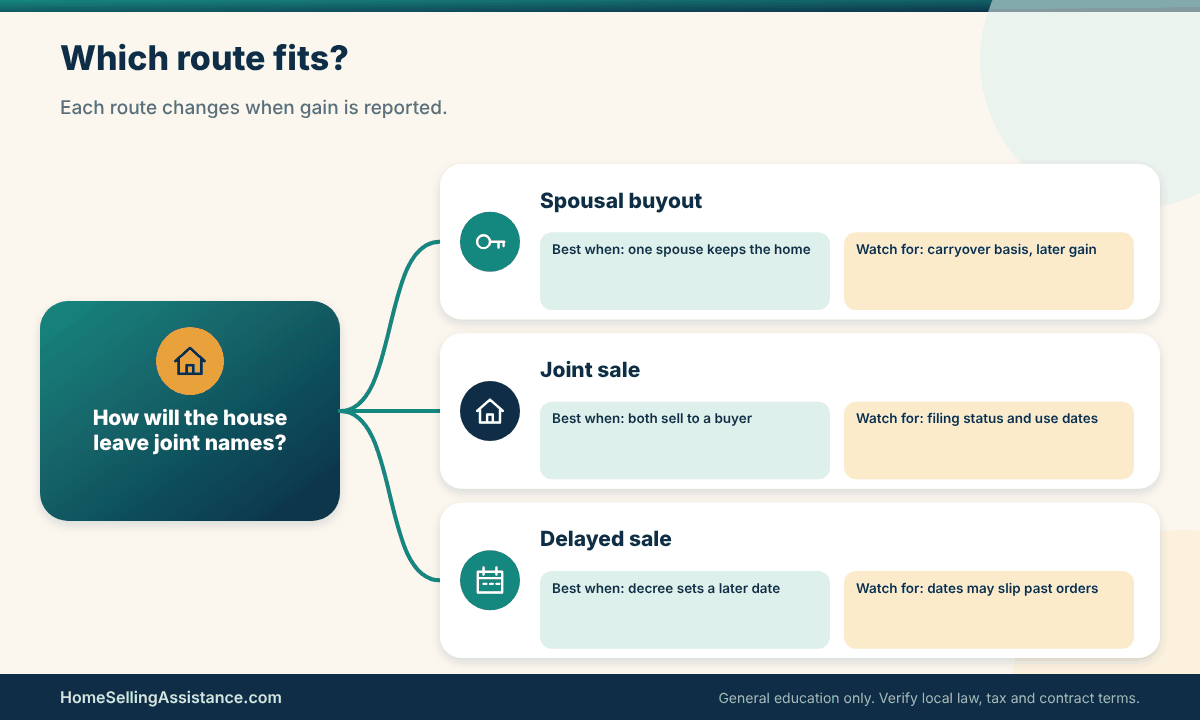
Imagine a pair of former spouses where one is buying out the other, a common setup in divorce home sale taxes questions. The house is worth 500,000 dollars in this illustration, the mortgage balance is 250,000 dollars, and the buying spouse refinances to pay the leaving spouse 125,000 dollars for a half share of the equity.
For tax purposes, the transfer incident to the divorce is generally not a sale, so the leaving spouse typically reports no gain on it, and the buying spouse takes over the combined basis. The buying spouse has therefore not escaped tax on the built-in gain. It has simply been postponed until a later sale.
The exception is where something other than a clean transfer is going on, for example a payment that looks more like a purchase from a person who is no longer a spouse, or a transfer made years after the divorce with no link to the decree. Those can be treated differently. The details are fact-heavy, which is exactly why you ask before you sign.
Your next step in sorting out divorce home sale taxes: calculate, with the basis worksheet, what the gain would be if the buying spouse sold at today’s value, and ask a tax professional how much of it the exclusion might cover. That one calculation can change how both sides view a buyout, and the broader comparison of a house buyout against selling during divorce shows how it fits into the larger decision.

Exceptions, uncertainty, and the limits of a general guide
Every general rule has a cluster of exceptions standing behind it, and being honest about them is part of the job. The exclusion has partial versions for people who moved for work, health or certain unforeseen circumstances. Basis can be adjusted downward by depreciation for any period a home office or rental portion was used. Some states have community property systems that change how ownership and basis are viewed. And federal and state tax treatment do not always match, so a state may tax a gain differently than the IRS does.
There is also plain uncertainty about the future. Nobody can say what the house will sell for next year, what the buyer’s financing will do, or how a court will word an order. A responsible plan acknowledges those unknowns and builds in margin instead of pretending to precision.
Evidence to review: what the decree, deed, and tax returns actually say
Most surprises in divorce home sale taxes come from documents that say something slightly different from what the parties remember agreeing. Read the decree or settlement agreement closely for who gets the house, who must sell, who pays the mortgage, who may claim any tax benefit, and what happens if the sale price comes in below expectation. Compare the deed with that language. If the decree awards the house to one spouse but the deed still shows both names, the paperwork needs to be reconciled before a sale or refinance.
Review earlier tax returns as well. They show whether the home was ever used for business, whether a past home sale used the exclusion, and what filing status each spouse used. If a previous return claimed a home office deduction, the depreciation may reduce basis, and a professional should look at it. If there is a past exclusion, the two-year lookback may apply.
Finally, look at any state-level documents. Some states charge transfer taxes on deeds, and some exempt transfers between spouses or incident to divorce while others do not. Your county recorder, state tax agency or a local title company can tell you what applies where you live.
A scenario, an exception, and your next step on uncertainty
Picture a couple facing divorce home sale taxes who plan to sell in a hot market, then watch it cool while the decree sets a deadline. An illustrative sale at 560,000 dollars instead of 600,000 dollars lowers the gain by 40,000 dollars, but it also lowers the cash each spouse takes home. If the agreement promised a fixed payment to one spouse regardless of price, the other spouse bears the shortfall. That is a cash and legal risk, though it can also change the tax picture.
An exception can show up when the sale slips past a deadline in the decree, or past the date on which a spouse’s right to live in the house ends. Dates in a divorce instrument can have tax consequences for the use test, so a delay is worth discussing with counsel instead of simply waiting it out.
Your next step is to write two or three what-if cases for your divorce home sale taxes plan, a high sale, a low sale and a delayed sale, and run each through the money matrix. If any of the three would break your plan, you have found the place to negotiate flexibility into the agreement. Asking how capital gains on a house sale work during divorce early gives you language to bring to that conversation.
Escalate fact-specific divorce home sale taxes decisions to the right professional
A general guide can teach you the vocabulary and the shape of the problem. It cannot read your decree, check your basis records or know what your state does. Somewhere in the divorce home sale taxes process, usually before the agreement is signed, the choices you face become fact-specific, and that is the moment to bring in someone licensed to advise on them. The aim of this section is to help you arrive prepared, so that the meeting is short, focused and worth the fee.
Different professionals answer different pieces of divorce home sale taxes. A family law attorney handles ownership, property division and the wording of the decree. A CPA, enrolled agent or tax attorney handles the return and the effect of the structure on taxes. A title company or closing attorney handles the deed, payoff and settlement statement. A mortgage lender handles whether a spouse can refinance or assume the loan. Knowing which door to knock on saves both time and money.
Professional questions to bring before you sign a divorce home sale agreement
The most valuable thing you can do is ask specific questions in the right order. Vague questions about divorce home sale taxes, such as “will I owe tax?”, tend to produce vague answers and a larger bill. Specific questions, such as “if I receive the house under this decree and sell it in two years, how would my gain be calculated and what would my basis be?”, give the professional something to work with and give you something to compare across advisors.
It also helps to tell each professional what the others have said. Attorneys and tax preparers often do not see each other’s work, and a clause that looks harmless to one can have a tax effect that only the other would notice. Sharing drafts early is cheaper than amending a signed agreement.
Evidence to bring: the decree draft, basis worksheet, and a dated fact sheet
Bring a short packet to your divorce home sale taxes meeting. It should contain the current draft of the settlement or decree, the deed, the original closing statement, your basis worksheet with improvements listed, the one-page fact sheet of ownership and move-out dates, and the last two or three years of tax returns. If a sale is already under contract, add the purchase agreement and any estimated settlement statement the title company has produced.
Add a short list of questions at the top. Good ones include: Does the proposed transfer qualify as incident to the divorce, and what happens if it slips past the usual timing? What will the receiving spouse’s basis and holding period be? Does either of us meet the ownership and use tests, and does the exclusion apply to a sale by one spouse or both? Who reports the sale and the Form 1099-S, if any? What would change if the sale happened before rather than after the decree is final?
If you are looking for general background before the meeting, the home sale taxes category collects our other guides on the topic, and the IRS publication on basis of assets is useful for the basis questions in particular.
A scenario, an exception, and your next step on professional questions
Take two people, each with a different view of the house and of divorce home sale taxes. One wants to keep it, the other wants to sell and use the money to buy somewhere new. In an illustrative setting, they agree that the spouse who stays will refinance and pay a lump sum. Before signing, the paying spouse asks a tax professional what the basis and eventual gain would look like.
The answer is that the built-in gain travels with the house, which affects how much the staying spouse should realistically agree to pay today, since a future sale will carry its own tax picture.
An exception is when there are children and a court order for the custodial parent to remain in the house for years. In such cases the sale may be far off, and the use rules over that long span become critical. Another exception is when one spouse is not a US citizen, since special rules can apply to transfers between spouses in that situation. If that describes you, tell your advisor at the very first meeting.
The next step is simply to book the consultation before the agreement is final, not after. A single hour with a qualified tax professional while the document can still be changed is generally more useful than several hours afterward spent trying to explain what was already signed.
To help you compare common divorce home sale taxes situations side by side, the table below sketches six scenarios. Each row names a seller situation, the assumption you would need to check about the sale, loan or tax treatment, a general idea of the estimated effect, the main risk and the question to take to a professional. The effects are described in general terms because the actual numbers depend entirely on your facts.
| Seller situation | Sale, loan or tax assumption | Estimated effect | Key risk | Professional question |
|---|---|---|---|---|
| Joint sale before the decree | Both on title, both live there | Joint filers may share the larger exclusion | Filing status may change by year-end | Which status applies for the sale year? |
| Joint sale after the decree | Each reports own share | Each may claim up to the single limit | One spouse may fail the use test | Does either spouse count the other’s use? |
| Buyout by one spouse | Transfer incident to divorce | No gain at transfer, carryover basis | Built-in gain postponed, not removed | What basis and holding period carry over? |
| Spouse stays for years | Decree sets a delayed sale | Use may continue to count for both | Dates may slip past the decree | How do the dates affect each spouse’s tests? |
| Former rental or home office | Depreciation was claimed | Basis lowered, part of gain may not be excluded | Unreported depreciation | How is the business portion handled? |
| Sale under financial pressure | Price below basis or payoff | Possible loss or no gain | Loss on a personal home is generally not deductible | What shortfall rules apply to my loan? |
Use the table as a conversation guide rather than a verdict. If your own situation does not fit any row neatly, that is a signal to describe it in more detail to your advisor instead of forcing it into the nearest label. Notice also how often the same question recurs: what basis, what dates and what filing status. Those three answers unlock most of the others.
Records to preserve after the sale, the transfer, and the final decree
The sale closing is not the end of the paper trail for divorce home sale taxes. A tax return reporting the sale, or claiming the exclusion, may be questioned later, and the burden of showing basis and eligibility generally rests with the taxpayer. In a divorce, the complication is that the documents were often created jointly, held by one person and now need to be accessed by two. The best time to split the file is while both parties are still cooperating.
Our guide to home sale tax records lists what to keep and for how long in general terms. Here we focus on what is special to a divorce: the instruments that transferred ownership, the evidence of who lived where, and the records that will support a later sale by the spouse who keeps the house.
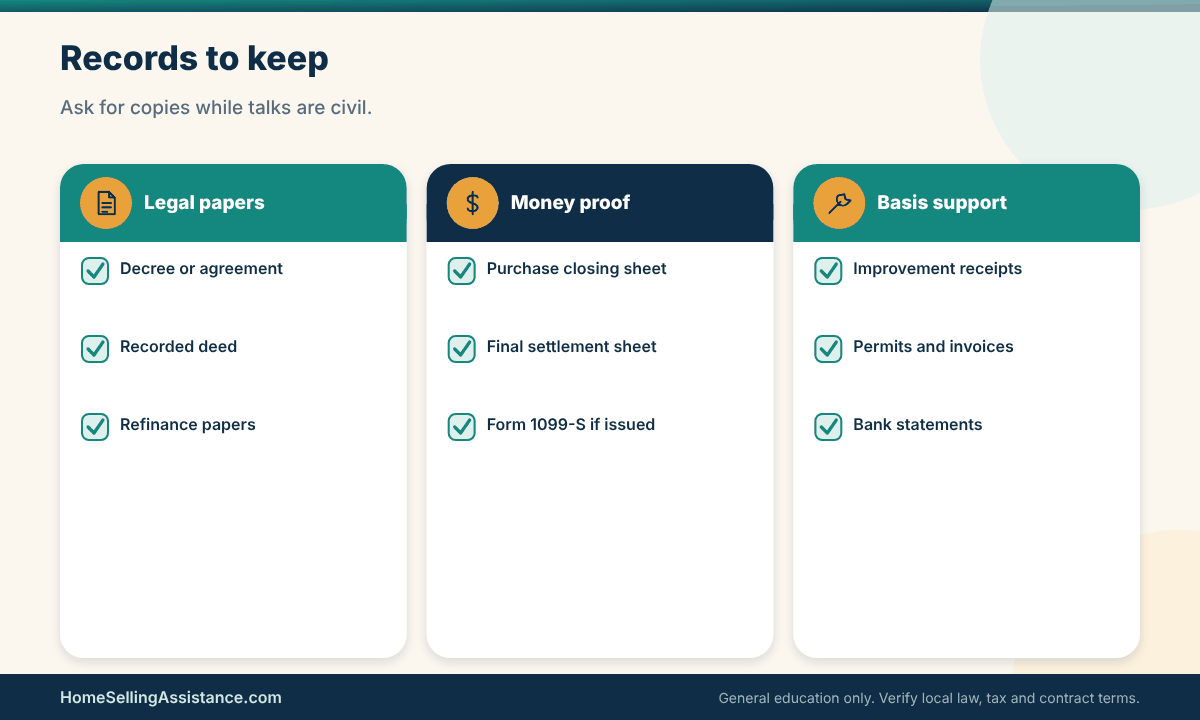
Evidence to keep: decree, deeds, closing statement, and basis support
For divorce home sale taxes, keep a certified or file-stamped copy of the divorce decree and any property settlement agreement, as these define the transfer and may be needed to show it was incident to the divorce. Keep the recorded deed that moves title, whether it is a quitclaim, a warranty deed or a deed required by the decree, along with any refinance documents that show how the loan was changed.
Keep the final settlement statement from any sale, plus the Form 1099-S if one was issued. Keep the basis worksheet and every receipt or bank record behind it. If you are the spouse who receives the home, make a copy of the original purchase file as well, because your basis starts from the old one and you may need to prove it years from now, possibly at a time when your former spouse has moved or become hard to reach.
Store copies in at least two places, one digital and one physical if you can. For a house you will own for a long time, a folder that survives a move and a change of email address is worth the small effort.
A scenario, an exception, and your next step on record keeping
Here is an illustrative situation in divorce home sale taxes. A spouse receives the house in the divorce, lives in it for eight years, then sells. When the tax preparer asks for the basis, the owner finds the decree but not the original closing statement from the purchase, which the former spouse kept. Reconstructing it takes weeks, involves a request to the county recorder and the old lender, and costs money. Had the owner asked for copies at the time of the divorce, the problem would have been a five minute task.
An exception is when the former spouse is unwilling or unable to provide records. In that case, lenders, title companies, the county recorder and prior-year tax returns can often supply parts of the picture, and a tax professional can advise on how to document basis when original papers are gone. It is slower and sometimes uncertain, so the prevention is worth far more than the cure.
The next step for your divorce home sale taxes file is to make a list today of the five documents you would most hate to lose, then ask for copies of each while the relationship is workable. For anyone who wants a wider view of how this fits into the process, the guide on calculating home sale net proceeds shows how the same documents feed the cash picture.

One last practical point about timing for divorce home sale taxes. Tax records and divorce records have different shelf lives, and it is easy to throw out a box of papers after the divorce is done without realizing the tax question has not started. If the house is still owned, keep everything until well after it is sold and the return reporting the sale has been filed, and then keep the sale records for as long as your tax professional recommends. When in doubt, scan it and keep it.
Quick scenario
Two spouses agree that one will keep the house and refinance. The leaving spouse receives a lump sum from the refinance and signs a deed under the decree. Generally, no gain is recognized at that transfer, and the keeping spouse carries the old basis forward. Years later the house sells for much more. The gain is measured against the old basis, and the exclusion that applies depends on that person’s own ownership and use. The earlier peace of mind about “no tax at the transfer” did not erase the later tax question. It only moved it.
Frequently asked questions about divorce home sale taxes
Is a transfer of the house to my spouse in a divorce taxable?
In general, a transfer of property between spouses, or between former spouses when it is incident to the divorce, is not treated as a taxable sale for federal income tax purposes. The person who gives up the interest usually recognizes no gain or loss. The person who receives it usually takes over the existing basis, which is the core of divorce home sale taxes. State transfer taxes and recording fees are separate matters, so check locally.
Do we both get the 250,000 dollar exclusion after a divorce?
Each person who qualifies may be able to exclude up to the single amount on their own share of a sale, if they meet the ownership and use tests. Whether both of you qualify depends on dates, on who lived in the house, and on whether either of you used the exclusion within the last two years. Treat this as a question to confirm with a tax professional, not as an assumption.
What if one of us moved out before the sale?
The use test looks at how long you lived in the home as your main home during the five years before the sale. A spouse who moved out may still meet it, either by living there long enough before moving, or in some cases by being treated as using the home while the other spouse lives there under a divorce or separation instrument. The dates and wording matter, so keep clear records of when each person moved.
Does the spouse who keeps the house pay tax later?
Possibly. Because the receiving spouse generally keeps the old basis, any built-in gain stays with the property and can show up when it is later sold. Some or all of it may be covered by the exclusion if the eligibility tests are met. That is why divorce home sale taxes are about the future sale as much as the present transfer, and why a buyout price should be thought through with that gain in mind.
Is the cash I receive from the sale the same as my taxable gain?
No. Your gain is generally the amount realized minus your adjusted basis, where the amount realized is the sale price less selling costs. The cash you receive is what is left after the mortgage payoff, fees and any agreed division between spouses. You can receive a large check and have little or no taxable gain, or the reverse, depending on basis and eligibility.
Who gets the Form 1099-S?
When a settlement agent reports a home sale, the form is generally issued to the seller or sellers named on the transaction, and the agent may rely on certifications you provide. For divorce home sale taxes, it is worth asking the title or escrow company in advance how it will report a sale with two sellers who are divorcing. Even if a form is not issued, a taxable gain still has to be reported on the return.
Can I deduct a loss if the house sells for less than I paid?
Generally, a loss on the sale of a personal residence is not deductible, even when the sale is forced by a divorce. That is one reason to understand basis, price and costs before agreeing to a sale date or a minimum price. A tax professional can confirm how this applies to your circumstances and whether any part of the property was used for business.
Does the date the divorce becomes final change the tax result?
It can. Filing status is generally determined as of the last day of the tax year, which can affect whether you claim the joint or single exclusion amount, and the timing of a transfer can affect whether it counts as incident to the divorce. If you have flexibility on dates, ask a professional to compare the options before you commit.
Where can I read the official rules myself?
The IRS publishes free guides on selling your home, basis, and divorced or separated taxpayers. Our IRS selling your home reference is a good place to begin, and Publications 504 and 551 add the divorce and basis detail. Always use the current version, and compare it with advice from a professional who has seen your documents.
When should I talk to a professional?
Ideally before you sign a settlement agreement, a deed or a listing agreement. Ask a family law attorney about ownership and the decree, and a CPA, enrolled agent or tax attorney about taxes. A short consultation at that point is usually far cheaper than trying to unwind an agreement that created an avoidable tax problem.
Before you sign or list
Divorce home sale taxes are manageable when you separate the questions: who owns what, what the home cost in tax terms, whether a transfer or a sale is involved, and who reports what. Gather your documents, write down your dates, and bring specific questions to a qualified professional while the agreement can still change. For the wider picture, return to our overview of home sale tax basics. This article is general education, not legal, tax or financial advice, and it cannot account for your facts, your state or the rules that apply to you.